Introduction
Laser-based air defense systems — once the stuff of science fiction — are rapidly becoming a reality on the modern battlefield. Advances in high-energy lasers now enable militaries to shoot down drones, rockets, and even missiles with beams of concentrated light. This new class of directed-energy weapons promises to “fundamentally alter the threat calculus” for air defense by intercepting targets at the speed of light and at a fraction of the cost of traditional interceptors. In recent years, real-world events like drone swarms and mass missile attacks have spurred accelerated development. The result is that as of the mid-2020s, the first operational laser defense systems are being deployed, and many more are in advanced testing. This article provides a comprehensive look at how these laser anti-missile and anti-drone systems work, their development from idea to deployment, the current state-of-the-art and near-future trends, who the leading nations and companies are, and why these developments matter for defense planners, political leaders, and industry executives worldwide.
Technical Overview: How Laser Air Defense Works
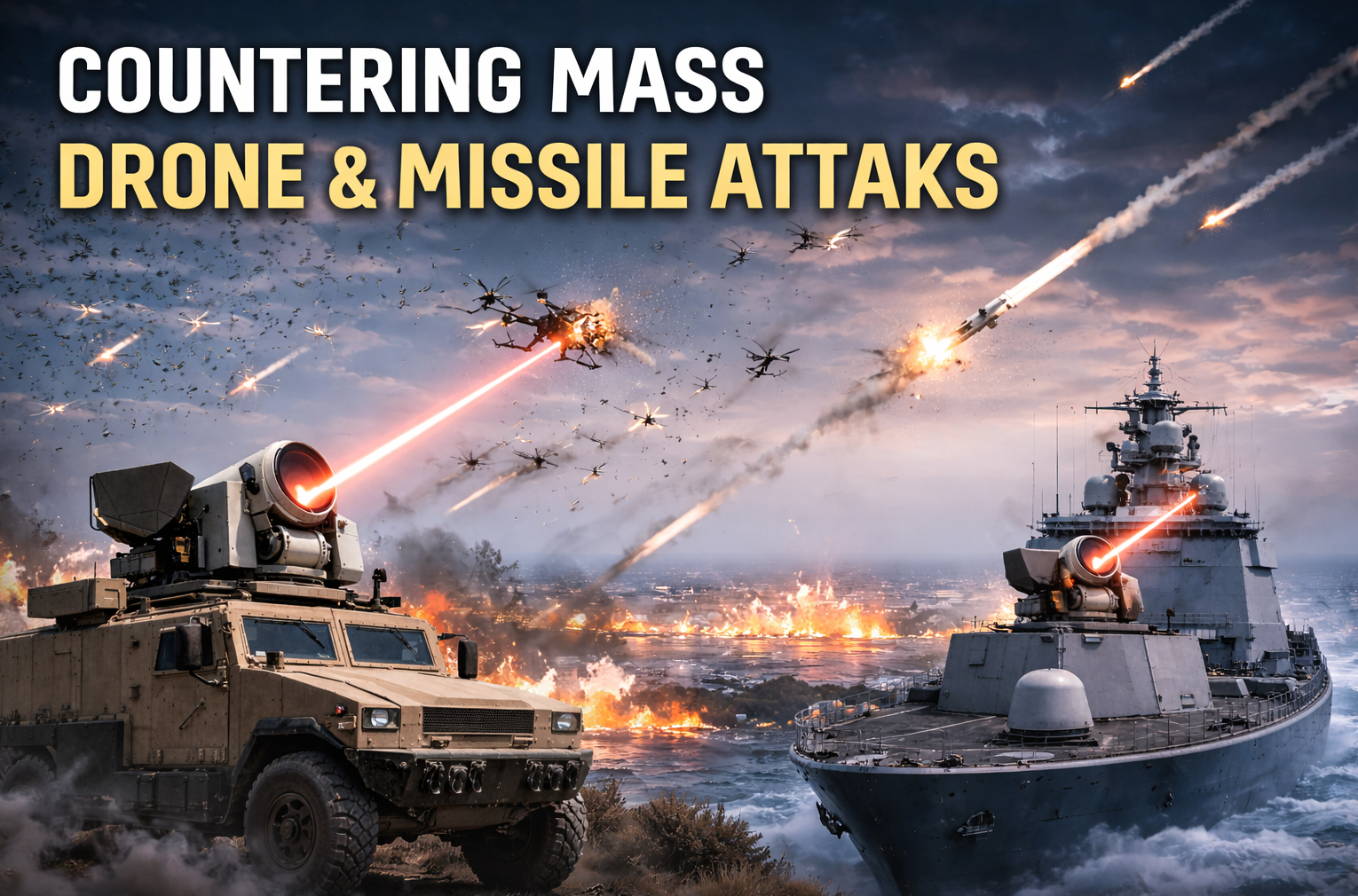
Laser air defense systems belong to the broader family of directed-energy weapons, using intense beams of light to destroy or disable incoming threats. Unlike missiles or gun projectiles, a laser beam travels in a straight line at light speed, allowing near-instant engagement of targets. High-Energy Laser (HEL) interceptors typically consist of a powerful laser generator, a beam director (often turret-mounted optics), aiming/tracking sensors (radar or electro-optical), and a power and cooling subsystem. When a hostile drone or munition is detected, the laser is focused on that target’s surface, delivering enough heat to fry electronics, ignite fuel, or weaken structural components until the target is destroyed or incapacitated. This process often requires the beam to dwell on one spot for a few seconds to achieve a “hard kill.” For example, Israel’s new Iron Beam system uses a fiber-optic laser reported to output around 100 kW of power focused on a spot the size of a coin, allowing it to destroy rockets or drones at ranges up to about 10 km. Similarly, China’s Silent Hunter mobile laser, with 30–100 kW power, can pierce a 5 mm steel plate at 1 km range and is capable of downing low-flying unmanned aerial vehicles (UAVs) up to roughly 4 km away.
Modern military lasers are generally solid-state (for instance, fiber lasers or slab lasers), drawing electrical power, in contrast to earlier chemical lasers that were bulkier and relied on exotic chemical fuels. Solid-state designs offer better efficiency and easier logistics, though they still demand significant electrical power and cooling. For perspective, a 50 kW-class laser weapon might require a dedicated generator or vehicle power source and cooling system to operate continuously. Many systems use spectral beam combining – effectively merging multiple laser beams into one – to achieve higher power levels. Multiple countries are now scaling lasers into the 100–300 kW range, which is the power believed necessary to engage faster and more hardened targets like cruise missiles or larger rockets. Importantly, laser interceptors are line-of-sight weapons: their effectiveness can be reduced by atmospheric factors like clouds, fog, rain, or dust which scatter and absorb the beam. They also struggle with very fast or robust targets that don’t remain illuminated long enough to burn through. Thus, lasers are typically viewed as a complement to, not a full replacement for, traditional missile defenses. In practice, a laser defense unit is integrated with detection radar and command systems to cue the beam onto targets and often paired with conventional interceptors – using the laser to handle many easy or short-range kills, while reserving missiles for heavier threats. The advantages of lasers are significant: each shot can be fired for only a few dollars’ worth of electricity (or even a few cents, in some cases) instead of expending a costly missile, and as long as power is available, a laser has a virtually unlimited “magazine” of shots. These attributes make high-energy lasers especially attractive for countering the growing threat of drones and mortar salvos, where an inexpensive or improvised attack could otherwise force a defender to waste high-value interceptors.
From Concept to Reality: A Brief History
The concept of using directed-energy beams for missile defense has been studied for decades, dating back to the Cold War’s ambitious “Star Wars” program (the U.S. Strategic Defense Initiative) in the 1980s. Early experiments proved lasers could destroy flying targets, but the technology then was not mature enough for practical deployment. One of the first major prototypes was the Tactical High Energy Laser (THEL), a joint U.S.-Israel project in the late 1990s and early 2000s. THEL was a ground-based deuterium-fluoride chemical laser intended to shoot down Katyusha rockets – and in tests around 2000, it did shoot down dozens of rockets and artillery shells. However, THEL’s enormous size (it filled several shipping containers), along with high costs and maintenance issues, led to its cancellation in 2005. Similarly, the U.S. Air Force pursued the Airborne Laser (ABL) program, mounting a megawatt-class chemical oxygen-iodine laser in a modified Boeing 747 to intercept ballistic missiles in their boost phase. The ABL (designated YAL-1) successfully destroyed two test ballistic missiles in 2010, a remarkable technical feat. Yet it too was deemed operationally impractical – the 747 would have had to fly dangerously near adversary territory for each shot – and the program was canceled by 2011. These early efforts demonstrated the physics was sound but underscored the challenges of building deployable systems.
Throughout the 2010s, focus shifted to more compact solid-state lasers as materials science improved power outputs. The U.S. Navy led the way in operationalizing a solid-state laser: in 2014, a 30 kW laser weapon (LaWS) was installed on the USS Ponce in the Persian Gulf, marking the first DoD-approved laser weapon on active duty. Sailors in that trial could use the laser to burn out sensors on drones or explode small boat engines at short range, although its power was limited. By the late 2010s, prototypes proliferated. The U.S. Army tested truck-mounted lasers like the HEL-MD (High Energy Laser Mobile Demonstrator) which shot down mortar rounds and small drones in trials. In parallel, European defense firms demonstrated smaller-scale lasers for intercepting UAVs, and China unveiled its first tactical lasers. Progress accelerated in the 2020s: solid-state laser power output grew from tens of kilowatts to the threshold of a hundred kilowatts and beyond. In 2022, for instance, Lockheed Martin announced it had delivered a laser surpassing 300 kW to the U.S. Department of Defense for research trials – a record-setting power level aimed at enabling defense against cruise missiles. That same year, the Israeli Ministry of Defense revealed footage of its experimental Iron Beam successfully shooting down rockets and drones in testing, a prelude to full deployment. By mid-decade, numerous nations had moved from concept to prototypes and were on the cusp of operational use. The long-envisioned promise of laser defenses – inexpensive, light-speed intercepts – has finally begun to materialize, after literally billions of dollars in R&D and decades of incremental breakthroughs in laser efficiency, beam control, and targeting software.
Current State and Near-Future Trends
As of 2025, laser air defense has transitioned from the lab to the field in several countries, and more widespread deployment is imminent. Israel has emerged as the first country to field an operational high-power laser interceptor, integrating the Iron Beam system into its multi-layered air defense network. In late 2025, the Israeli Air Force received its first Iron Beam units – 100 kW-class laser batteries capable of shooting down rockets, mortar shells, and UAVs – after the system “proved its effectiveness in an extensive series of tests” by destroying those threats in mid-air. Israeli officials hailed the event as the “beginning of the era of high-energy laser defense,” noting that Iron Beam will dramatically improve Israel’s interception capacity and cost-effectiveness against saturating rocket attacks. The plan is to deploy Iron Beam alongside the country’s Iron Dome missile batteries, using the laser to handle short-range or small threats so that expensive Tamir interceptors can be conserved for bigger missiles. Initial operational use is expected by 2026, making Israel a trailblazer in real-world laser defense deployment.
The United States, while not yet fielding lasers in regular units, has multiple programs maturing rapidly. The U.S. Army has tested a 50 kW laser weapon on Stryker armored vehicles (the DE M-SHORAD program) and, in 2023, began delivering four laser-armed Strykers to a combat Air Defense battalion for training and tactics development. In live-fire tests at Yuma Proving Ground, these 50 kW prototypes “knocked targets out of the sky” – successfully downing drones of various sizes (Group 1 through 3 UAS) with high accuracy. However, the Army found that higher power or further refinement may be needed to tackle tougher targets like rockets and artillery shells consistently. The Army’s roadmap includes scaling to 300 kW lasers under the upcoming IFPC-HEL program (Indirect Fire Protection Capability – High Energy Laser), intended to defend fixed sites against cruise missiles and larger threats. Lockheed Martin’s 300 kW laser (delivered in 2022) is earmarked for integration into this system for field trials, and a competing 300 kW design is being developed by a Boeing-General Atomics team. The U.S. Navy, meanwhile, has deployed or plans to deploy intermediate-power lasers on warships. A 60 kW HELIOS laser was delivered for installation on an Arleigh Burke-class destroyer, and the Navy previously tested a 150 kW laser on the USS Portland amphibious ship, successfully shooting down a target drone in 2021 (a notable increase from the 30 kW system on the USS Ponce in 2014). The Navy envisions laser defenses to counter drones, small boats, and eventually anti-ship missiles at close range. The U.S. Air Force is also exploring airborne lasers for self-defense; while plans to put lasers on fighter jets are still in development, the fact that solid-state lasers are becoming more compact opens the possibility of laser pods on aircraft in the late 2020s. Across all branches, the U.S. Department of Defense has been investing roughly $1 billion per year in directed-energy weapon development, encompassing dozens of projects. This concerted push suggests that initial operational deployments (beyond prototypes) are likely in the next few years. Indeed, Army officials stated that although these systems are expensive upfront, “the cost per shot from a laser is exponentially more affordable than a munition,” giving the military a strong incentive to field them as soon as they prove reliable.
Outside of the U.S. and Israel, several other nations are quickly advancing their own laser defense capabilities. China is a notable player: it has developed truck-mounted laser air defense units such as the Silent Hunter (also called LW-30), reportedly a 30–100 kW system used to destroy UAVs and even low-end missiles at short ranges. China has not only deployed such systems domestically (e.g. for base protection and major event security) but also begun exporting them. In fact, in late 2024 and 2025, evidence emerged that Russian forces in Ukraine obtained a Silent Hunter from China – a video showed a Russian unit using the Chinese laser to shoot down Ukrainian drones, with successful strikes at over 1 km distance. This implies that China’s laser weapon tech is already in operational use abroad (in the hands of multiple countries: the Silent Hunter has also been sold to Saudi Arabia and reportedly Iran). Russia, for its part, has claimed indigenous progress in lasers, though details are murky. In 2018, Russia unveiled a truck-carried laser system called “Peresvet,” allegedly for blinding enemy reconnaissance satellites. More concretely, Russian sources in 2025 said a new anti-drone laser system named Posokh was tested against UAV targets. There were also unconfirmed reports during the Ukraine war that Russia employed a different laser weapon (codenamed “Zadira”) to burn small drones, but scant evidence was provided. Regardless, Russia appears keen not to fall behind in directed-energy capabilities, even turning to Chinese hardware to field something quickly.
In Europe, Western allies are stepping up their laser air defense programs amid the drone and missile threats highlighted by recent conflicts. The United Kingdom’s DragonFire laser, a consortium-led project (with MBDA, Leonardo, and QinetiQ), achieved a major milestone in 2023–24 by successfully shooting down high-speed drones in trials over the Scottish coast. In one test, DragonFire struck UAVs traveling at 650 km/h (about 400 mph), demonstrating the ability to track and destroy fast-moving targets. Following these tests, the UK awarded a £316 million contract to integrate a directed-energy weapon on a Royal Navy Type 45 destroyer, aiming to deploy a laser weapon at sea by around 2027. The German military has similarly tested a prototype naval laser: in 2022–2023, a Rheinmetall-MBDA built laser (around 20 kW initially) was installed on the frigate Sachsen and conducted over 100 firing trials in the Baltic Sea. Those trials proved the system could track and engage drones and other fast targets even against a clear sky (a first for Europe, which showed the beam control is precise enough not to require a terrain backstop). Germany plans to scale this design up beyond 100 kW and projects that an operational shipborne laser defense system could be in service by 2028–2029, protecting warships against drones, swarms, and possibly supersonic missiles. Following the maritime demo, the laser was moved to a land test center for further trials against drones, as Germany considers land-based laser defenses as well. Other NATO countries are not far behind: Italy and France have explored laser technology in air defense (the European project “LTDI” and others), and Turkey has emerged as a surprising contributor. In 2025, Turkey’s defense firm Aselsan tested a home-grown mobile laser system called GÖKBERK as part of a future “Steel Dome” air defense shield. In trials, GÖKBERK autonomously detected, tracked, and destroyed first-person-view attack drones, combining a high-energy laser for the “hard kill” with electronic jamming for initial disruption. Turkish officials claim this system will soon be deployed to protect bases, airports, and critical infrastructure, and they are positioning it for export as well. Even Ukraine, pressed by constant drone and missile attacks, announced in 2024 that it had developed a domestic laser weapon named “Tryzub” and had begun using it against Russian drones at altitudes up to 2 km. While these claims haven’t been independently verified, they highlight how ubiquitous the interest in laser defense has become – even a nation at war is investing in this cutting-edge tech to gain any possible edge against aerial threats.
Looking ahead to the near future (the next 3–5 years), the trends in laser air defense are clear. First, we will see power levels continue to climb, enabling lasers to tackle a broader range of targets. Demonstrations of 300 kW-class lasers point toward capabilities against not just small drones and rockets, but eventually cruise missiles and larger munitions that require more energy to disable. Second, more platforms will mount lasers: expect more army units and naval vessels equipped with laser interceptors, and possibly the first airborne laser deployments on large aircraft. The U.S. and Israel are also cooperating on even more powerful systems – Rafael and Lockheed Martin have a joint effort to develop a future Iron Beam variant that could reach 300 kW and engage multiple targets simultaneously, aiming to expand the laser’s coverage and lethality. Another key trend is integration with existing air defense networks. Lasers will be linked with radar sensors and command systems so that they function as just another layer of a multi-layer defense (for instance, cueing a laser first, and if a target isn’t neutralized in a second or two, handing off to a missile interceptor). We also see a trend of international collaboration and export: nations that pioneer these weapons (US, Israel, Europe, China) are likely to sell or share them with allies, as threats from drones and missiles are global. On the flip side, adversaries are not standing still – there is concern that as lasers deploy, offensive tactics will adjust (e.g. using faster or more maneuverable missiles, hardened materials, or simply overwhelming laser defenses with sheer numbers or in bad weather). This cat-and-mouse dynamic will drive further innovation, such as techniques to mitigate atmospheric effects (adaptive optics to compensate for beam distortion) or pairing lasers with other directed-energy weapons like high-power microwave (HPM) systems, which can fry drone electronics over wide areas. In summary, 2025 marks an inflection point: after years of promise, laser defenses are entering operational service, and by the end of this decade they are expected to be a standard element of advanced militaries’ air defense toolkits.
Leaders of the Pack: Countries Adopting Laser Defense
Several countries stand out as leaders in the development and deployment of laser-based missile and drone defenses, each with different emphases:
United States: The U.S. has invested heavily across all services in directed-energy weapons and maintains a technological edge in high-power laser sources and targeting systems. It has demonstrated lasers on land vehicles, Navy ships, and is exploring airborne uses. While most U.S. systems are still pre-operational, the sheer breadth of programs (from 20 kW vehicle-mounted lasers to 300 kW strategic defense lasers) and the industrial base supporting them (Lockheed Martin, Northrop Grumman, Raytheon, Boeing, and others) make the U.S. a pace-setter. In terms of deployment, the U.S. Navy has prototypical lasers deployed at sea, and the Army will likely be the first to field a combat laser unit once it validates the DE M-SHORAD and IFPC-HEL systems around 2024–2025. The U.S. also collaborates with allies (for instance, co-developing aspects of Israel’s Iron Beam and sharing test data), underscoring its leadership role.
Israel: Israel can claim the title of the first nation to actually deploy a high-energy laser defense system in active service. Given the constant rocket and drone threats Israel faces, it prioritized laser defense early and, through Rafael and Elbit Systems, brought Iron Beam from concept to reality over roughly a decade. By integrating Iron Beam into its air defense network, Israel is now both a technology leader and a real-world case study of how lasers perform in combat conditions. The Israeli Ministry of Defense has indicated that serial production of Iron Beam is underway, with multiple systems to be rolled out to cover the nation. Israel’s success is closely watched by other countries, and there are already discussions about international cooperation to further develop the technology (e.g., the U.S. is interested in aspects of Iron Beam, and Israel’s laser know-how could be an export commodity down the line).
China: China is considered a major player in directed-energy weapons, though much of its work is shrouded in secrecy. It has unveiled and marketed systems like Silent Hunter (30 kW+) for UAV defense and has showcased portable or vehicle-mounted lasers at defense expos. Chinese laser units have been reportedly deployed for things like point defense of high-profile events (e.g., to protect against drone disruptions). Notably, China’s defense industry (such as Poly Technologies) has exported laser systems to other countries — a sign that it has confidence in their operational utility. The confirmed use of a Chinese laser by Russian forces in Ukraine suggests that China is already in the lead when it comes to proliferating this capability. Domestically, China likely has classified programs for higher-power lasers, possibly for anti-missile roles or for blinding intelligence assets. Strategically, China sees directed-energy weapons as part of its effort to compete with U.S. military technology, meaning we can expect continued advancement.
Russia: Russia publicizes certain laser developments (President Putin’s 2018 speech notably included the Peresvet laser), framing them as part of next-generation strategic weapons. However, the evidence of Russia’s actual capabilities is limited. The Peresvet system, by most accounts, is intended to dazzle or damage satellite sensors and has been deployed with Russian strategic rocket units as a counter-ISR measure. For anti-drone or anti-missile use, Russia has only recently hinted at systems like Zadira or Posokh. The war in Ukraine, where Russia faces a swarm of small UAV threats, has likely accelerated its interest in tactical lasers — ironically leading it to borrow Chinese technology in the interim. So while Russia wants to be seen as a leader, it may currently be a step behind the U.S. and China in operational laser weapons. Its strength in laser physics (a legacy of Soviet research) means it has the know-how, but economic and sanction pressures could impede large-scale development. All eyes will be on whether Russia can field a credible mobile laser air defense for frontline use in the next few years.
Europe (NATO states): In Europe, a few countries spearhead laser defenses. The U.K. and Germany are notable for investing in prototypes and demonstrations, as described. The U.K.’s DragonFire makes it a leader in European laser weapon tech, and the commitment to put lasers on Royal Navy warships will likely make the British Navy among the first, after the U.S., to have laser-armed ships at sea. Germany’s approach, teaming Rheinmetall and MBDA, has put a laser in realistic maritime trials and set a timeline for introduction by decade’s end. France, Italy, and others are partnering through joint projects or pursuing their own pieces (for example, France’s Thales and Germany’s Rheinmetall are both involved in laser turret development). The European Union as a whole has identified directed energy as a critical defense technology. While Europe’s programs are smaller in scale than the U.S. or China, European industry can contribute niche expertise (for instance, Germany’s excellence in optics and engineering is evident in the precise tracking of its ship laser test). By the late 2020s, we can expect at least a few European laser defense units deployed (land or sea), potentially protecting allied forces or high-value locations from drones and mortar fire.
Others: Beyond the big players, a number of other countries are pursuing laser defenses on a smaller scale. Turkey, as mentioned, has demonstrated indigenous capability with a focus on counter-drone applications. India has shown interest as well – the Indian Defense Research agency has tested a low-power laser against UAV targets and is reportedly working on a 100 kW system for air defense, though progress has been slow. Iran (frequently a target of drone strikes) has talked about developing laser air defenses, and given Iran’s procurement of foreign systems, it would not be surprising if it tries to acquire or copy Chinese or Russian laser technology. In summary, while the U.S., Israel, China, and leading NATO states are at the forefront, the appeal of laser defenses is global, and more nations are likely to join the club as the technology becomes more accessible.
Industry Leaders and Developers
The race to develop operational laser weapons has engaged some of the largest defense contractors and technology firms in the world. In the United States, Lockheed Martin has emerged as a key player, leveraging its experience in electro-optics and beam combination. Lockheed’s spectra beam-combined lasers have continually set power records – the company’s laser division scaled from 10 kW prototypes a decade ago to a 300 kW-class system delivered in 2022. Lockheed is the primary contractor for many U.S. high-energy laser programs (for example, it built the HELIOS naval laser and won the contract for the Army’s IFPC-HEL 300 kW demonstrators). Raytheon Technologies is another heavyweight, focusing on integrating lasers into air defense systems. Raytheon’s laser module won the U.S. Army contract for the 50 kW DE M-SHORAD Stryker vehicles after a competition, and Raytheon has developed laser variants of its popular Phalanx gun system and a directed-energy variant of its “C-RAM” defense for use against mortars and drones. Northrop Grumman, while it bowed out of one recent Army competition, has deep roots in laser weapon research – Northrop built the chemical laser for the old Airborne Laser 747 and has developed solid-state lasers like the FIRESTRIKE modules. Northrop continues to work on advanced laser concepts (including for aircraft self-defense). Boeing and General Atomics (GA) have teamed up on a 300 kW laser project for the Army, combining Boeing’s system integration experience with GA’s specialized knowledge in electromagnetic systems (GA is also known for building specialized capacitors and power systems that can help drive lasers). Outside these primes, numerous subcontractors and specialized tech firms contribute enabling technology: for instance, companies like nLIGHT (which was contracted to supply high-power fiber laser units for the Army’s lasers) and II-VI (now Coherent) provide advanced laser materials and optics. The U.S. defense industry also has newer entrants focusing on related tech like Epirus, a startup that delivered a high-power microwave counter-drone system (not a laser, but often discussed in tandem as directed-energy defense).
In Israel, Rafael Advanced Defense Systems is the chief contractor of Iron Beam and thus at the cutting edge of high-energy laser integration. Rafael worked closely with the Israeli Ministry of Defense’s research directorate MAFAT, and partnered with Elbit Systems and others to overcome the challenges of making Iron Beam combat-ready. Elbit, in fact, has its own laser programs (the company earlier developed a less powerful “Music” laser for aircraft defense and is involved in global marketing of laser defense solutions). The success of Iron Beam has put Rafael (traditionally a missile maker) into the spotlight as a top laser weapon producer. The company even signed an agreement with Lockheed Martin to cooperate on scaling Iron Beam for other markets, marrying Israeli operational experience with Lockheed’s platform reach.
Chinese industry features conglomerates like Poly Technologies (which developed Silent Hunter) and state-run aerospace groups like CASIC, which have showcased directed-energy air defense systems. While specific corporate details are less public, these firms are likely leading suppliers of laser systems to the Chinese military and for export. Russia’s development is largely within government institutes (like the Institute of Radio Engineering and Electronics for some laser physics work) and state firms such as Almaz-Antey, known for air defenses, which might take on laser-based air defense if funded. In Europe, MBDA (a pan-European missile company) has taken a lead, teaming up with national champions (like Rheinmetall in Germany and Leonardo in the U.K. for DragonFire). Rheinmetall, better known for firearms and kinetic cannons, has invested in laser weapon demonstrators for over a decade, developing a scalable 20 kW building block and combining multiple units to achieve 100 kW-class beams in tests. Its partnership with MBDA aims to bring that tech to operational use, making Rheinmetall a European leader in laser weapon hardware. Leonardo and QinetiQ in Britain provided key subsystems for DragonFire (Leonardo on targeting and QinetiQ on the laser source), showing how multiple companies collaborate on these complex systems. BAE Systems has also been involved in U.K. directed-energy projects and could bring integration expertise when it comes to mounting lasers on ships or vehicles.
Additionally, countries like Turkey have seen companies such as Aselsan step up; Aselsan not only developed GÖKBERK but is integrating a whole suite of sensors (radar, electro-optic) with the laser, effectively offering an all-in-one counter-drone solution. This indicates that even outside the traditional U.S./Europe defense giants, there are emerging industry players in the directed-energy domain. As the market for laser defenses grows, we may see more private-sector innovation and possibly tech crossover from the commercial laser industry (which is driving improvements in fiber lasers for industrial use that can spin off to military applications).
It’s worth noting that developing a laser weapon is as much a software challenge as hardware — companies have had to create sophisticated aiming algorithms to hit a moving 10-cm wide section of a flying drone a kilometer away, and ensure the beam stays locked until the target is disabled. Many of the leading contractors have leveraged artificial intelligence and high-speed optics to solve these problems. According to the U.K. Ministry of Defence, their DragonFire tests achieved hitting a tiny target “the size of a £1 coin at a kilometer away”, underscoring the precision that industry teams have realized.
With multiple firms now proving the technology, the competitive landscape is likely to heat up. Countries will seek out the best or most cost-effective systems, perhaps leading to export sales. U.S. companies are already marketing smaller laser systems for drone defense to allies, while Israel’s Rafael will undoubtedly offer Iron Beam abroad once it meets domestic needs. China is selling its systems, and even Turkey’s Aselsan is eyeing exports. This mix of established defense primes and new entrants all vying for a piece of the directed-energy market suggests robust growth in the sector.
Why This Matters: Strategic and Business Implications
For defense professionals and policymakers, the advent of laser missile/drone defenses represents a strategic inflection point. These weapons have the potential to upend the cost dynamics and effectiveness of air defense. Traditionally, air defense has been a game of expensive interceptors (missiles that can cost anywhere from tens of thousands to millions of dollars) versus inexpensive offensive threats (drones or rockets that might cost a few hundred to a few thousand dollars). This unfavorable cost exchange has often benefited attackers, especially non-state actors or countries that saturate defenses with cheap rockets or UAVs. Laser systems flip that equation on its head. As Israeli Defense Minister Israel Katz remarked at the Iron Beam handover, a high-power laser “changes the rules of the game” by altering the economic balance between inexpensive threats and costly missile interceptors. Indeed, each Iron Beam shot is estimated to cost only about $2,000 (or even just a few cents of electricity in pure direct cost) compared to the $100,000+ for a single Iron Dome missile. The UK’s DragonFire program similarly touts a mere £10 per shot cost, versus “hundreds of thousands of pounds” for a traditional missile – essentially pocket change versus a luxury car. For military planners, such numbers are game-changing: a defender equipped with lasers can conceivably afford to engage incoming drones or rockets continuously without worrying about the bill, whereas an attacker’s economics become harder if their cheap drones can be zapped out of the sky for almost nothing.
This is not to say lasers are a silver bullet for all threats – but they promise to greatly augment defensive capacity. Politically, this could enhance deterrence: for example, a country threatened by missile barrages might feel more secure knowing it has a virtually inexhaustible defense (as long as the power is on). We see this in Israel’s case; Iron Beam is expected to “dramatically improve…the cost-effectiveness equation between interception and threat” and provide confidence that Israel can handle sustained rocket fire without running out of interceptors. On the other hand, widespread adoption of laser defenses could spur adversaries to develop new tactics or technologies (such as higher-speed missiles, saturation by sheer numbers, or new countermeasures like reflective coatings or spinning projectiles to diffuse laser energy). This means defense leaders must continue a balancing act of offense and defense, and likely invest in multi-layered systems. It’s notable that every military deploying lasers so far treats them as an addition to existing defenses, not a replacement. Decision-makers will have to plan doctrine and training for how to fight with directed-energy weapons in the mix – e.g., how rules of engagement might change (a laser can technically fire warning shots or disabling shots without explosive impact), how to manage power logistics in the field, and how to harden one’s own systems against enemy lasers.
For business leaders in the defense industry, laser weapons represent a major growth area. The global directed-energy weapons market is already valued at around $6–8 billion in 2024 and is projected to triple to over $20 billion by 2030 as more countries start buying these systems. Companies at the forefront stand to win significant contracts. For example, the U.S. Army’s plan to procure laser batteries for short-range air defense and base protection could be a multi-billion dollar program alone. In the naval sphere, every advanced warship in the future might budget for a laser turret, which translates to a new procurement line for shipbuilders and contractors. Additionally, the technology has spin-offs: the same high-power laser techniques can be used in industrial machining or in space communication, meaning companies developing military lasers can leverage commercial tech and vice versa. Investors and industry watchers will note that some traditional missile defense companies are pivoting resources into directed energy – essentially the market is at a tipping point where those who innovate will capture new value, and those who don’t may see their missile sales eventually plateau as lasers take on roles once filled by missiles.
There are also international collaboration opportunities. For instance, the U.S. and Israel partnering on lasers could open co-production deals (much like the Arrow missile or Iron Dome had joint production). European firms might form consortia to ensure they are not reliant on U.S. imports for this strategic tech. From a policy perspective, leaders will need to consider export controls and norms: lasers that can blind satellites or cause indiscriminate damage could be controversial, and there are existing treaties about blinding laser weapons (aimed at protecting soldiers’ eyesight). While anti-drone lasers are not intended to target humans, the proliferation of directed-energy devices will inevitably raise new questions in arms control forums.
For military and political leaders, there is also a capability gap consideration. If only a few nations master high-energy lasers, they gain a defensive advantage that others lack. This could affect the balance of power in certain regions. For example, if Country A’s cities are guarded by laser defenses that make ballistic or cruise missile attacks ineffective, Country B’s deterrent missile force loses leverage, potentially shifting strategic calculations. We are not fully there yet – lasers right now excel at short-range and smaller targets, not ICBMs or hypersonic weapons – but one can envision the technology improving to handle greater threats over time. Hence, today’s investments by major powers are partly to future-proof their militaries for that scenario.
Finally, the importance of these developments extends beyond the military realm. The same innovations driving weapon lasers are closely tied to the broader high-tech economy: semiconductors (for laser diodes), advanced materials (for optics and beam directors), and energy storage. Political and business leaders interested in high-tech industrial growth will find that defense laser programs often spur advances in those fields. Governments may choose to fund directed-energy R&D not just for defense, but also to boost scientific know-how in lasers and photonics that can benefit the civilian sector (from medical devices to telecommunications).
In conclusion, the rise of laser anti-missile and anti-drone systems is highly significant for strategic and economic reasons. These systems promise a new era of affordable defense against prevalent threats, fundamentally shifting how nations can protect their skies. Leaders in defense policy must adapt to integrate these tools effectively and consider their implications on warfare and stability. Business leaders in the defense industry see a burgeoning market that rewards innovation and can reshape competitive standings in the arms sector. As laser defenses move from prototype to battlefield reality, those in positions of decision-making — be it in government or industry — will need to stay informed and agile, seizing the opportunities and managing the challenges that this once-futuristic technology now presents in very concrete terms.