The Radar That Never Transmits: How Civilian Signals (TV, FM radio…) Are Becoming Part of the Air-Defence Sensor Network
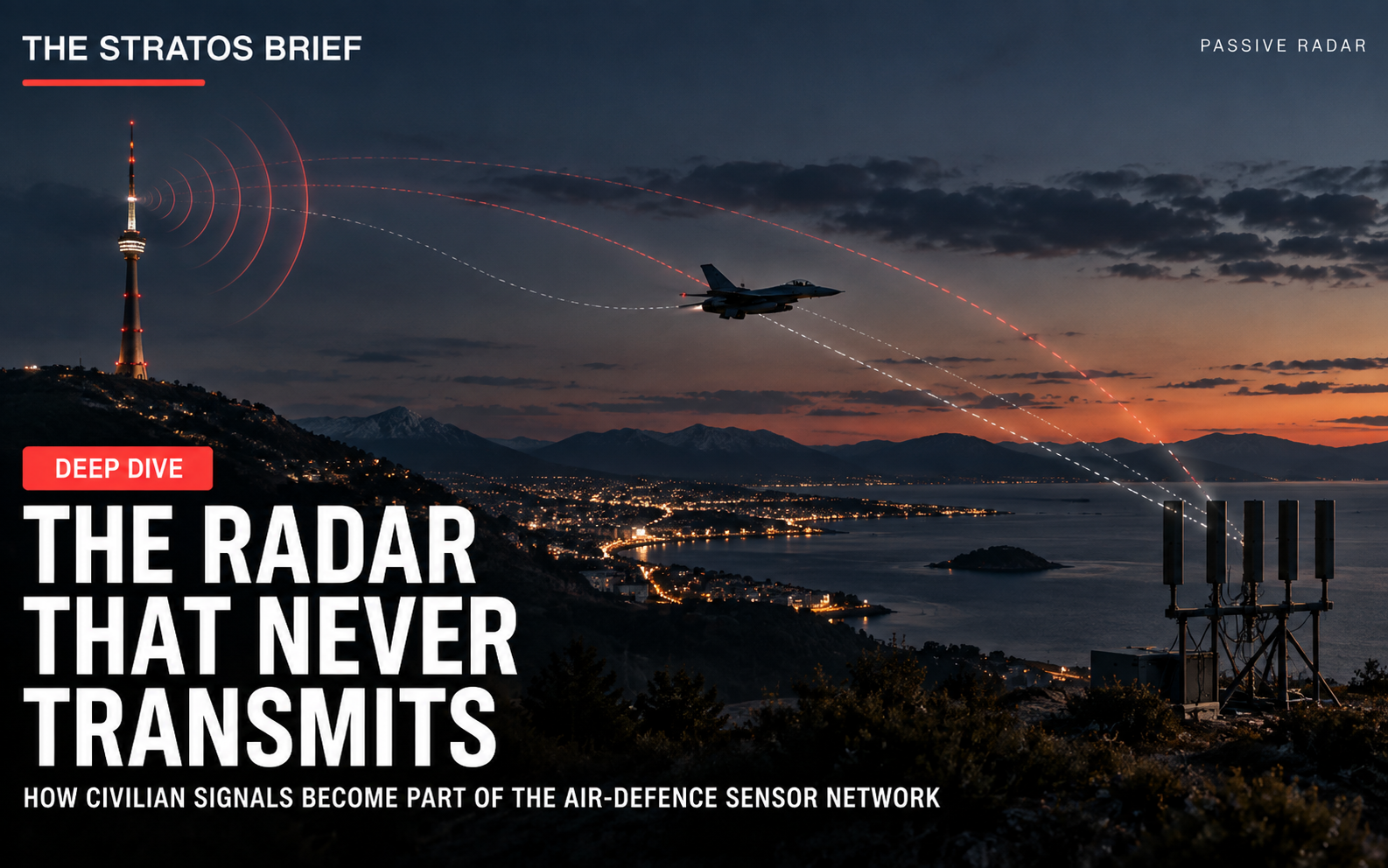
FM radio, digital television, cellular networks and satellite communications already fill the atmosphere with electromagnetic energy. Modern passive radars are learning to turn that background illumination into an air picture.
For most of radar's history, the relationship between sensor and target has been straightforward. A radar transmits electromagnetic energy, some of that energy strikes an aircraft, and a fraction of the reflected signal returns to the receiver. The time delay reveals distance, the direction of the antenna provides bearing, Doppler gives information about motion, and increasingly sophisticated processing turns these measurements into a track. Much of modern air warfare has consequently developed around disrupting that chain. Aircraft are shaped to scatter radar energy away from the transmitter, radar-absorbing materials reduce the strength of the return, jammers attempt to corrupt the receiver, and anti-radiation weapons threaten the radar by homing on the very emissions that allow it to see.
Passive coherent location changes one element of that arrangement in a fundamental way: the radar does not transmit.
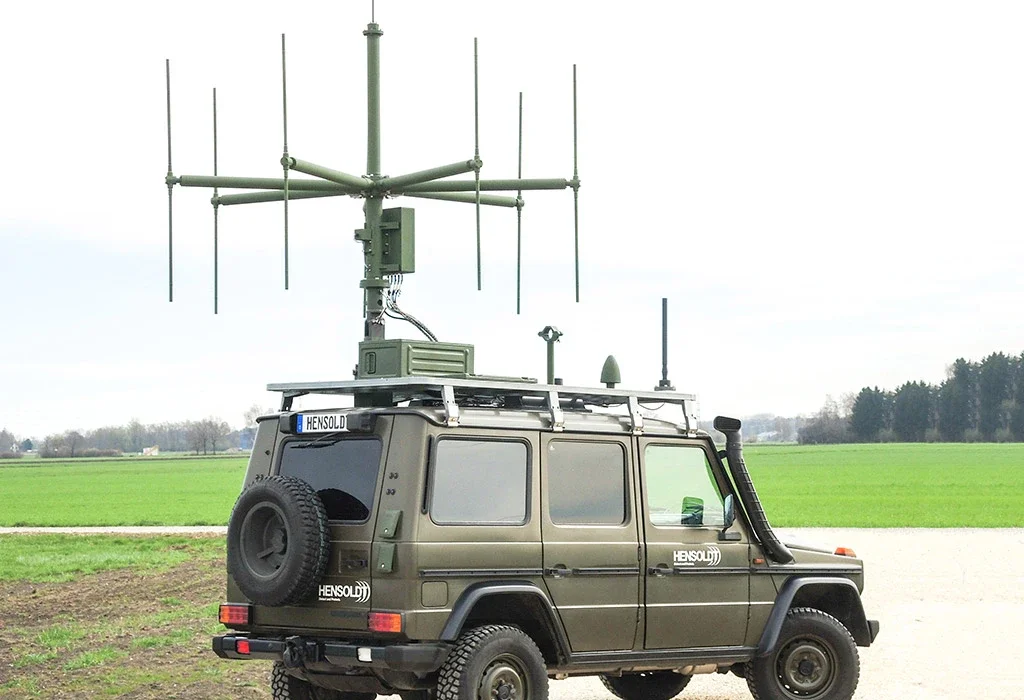
Instead, it uses electromagnetic energy that somebody else is already broadcasting. An FM radio tower, a DAB multiplex, a DVB-T television transmitter or a cellular base station continuously illuminates part of the surrounding airspace for an entirely civilian purpose. When an aircraft passes through that illumination, a minute fraction of the transmitted energy is scattered from its structure. A suitably positioned passive receiver can compare that reflected signal with the original transmission, measure the differences between the two and derive information about the target without generating a radar transmission of its own.
The concept is old. Passive detection was demonstrated during radar's earliest development and systems exploiting non-cooperative transmitters have appeared repeatedly since the Second World War. What has changed is the practicality of doing it well. Modern software-defined receivers can digitise broad sections of spectrum at comparatively low cost; contemporary processors and GPUs can perform enormous numbers of correlations in real time; adaptive algorithms can suppress direct-path interference and clutter; and multiple geographically separated sensors can combine their observations through data networks. A technique that spent decades largely in research laboratories and specialised demonstrations is therefore moving into deployable military systems.
The transition is becoming visible in procurement rather than merely in academic papers. Poland has ordered a national-scale family of combined PET/PCL sensors for its integrated air defence. Germany has connected a HENSOLDT Twinvis passive radar to Rheinmetall's Skymaster air-defence command architecture. Australia has funded military evaluation of Silentium Defence's MAVERICK family. Italy has demonstrated Leonardo's AULOS against both conventional aircraft and small drones. The United States has tested television-based passive sensing against non-emitting UAVs. Finland's Patria has developed a passive radar capable not only of air surveillance but of locating artillery projectiles, and on 14 September 2026 announced a contract to deliver several MUSCL passive-radar stations to an undisclosed European NATO member.
None of this means that conventional radar is becoming obsolete. Passive radar has important limitations and, despite years of claims about its ability to detect stealth aircraft, there is still no publicly verifiable case in which an aircraft has been destroyed in combat through a clearly documented PCL sensor-to-shooter chain. Its significance lies elsewhere. Passive coherent location is becoming one more layer in an increasingly distributed air-defence architecture, and it offers something that active radar can never provide in quite the same way: persistent surveillance without a dedicated radar transmitter announcing where the sensor is.
The transmitter already exists
The simplest way to understand passive coherent location is to imagine one FM radio transmitter, one aircraft and one passive receiver.
The receiver hears the radio station directly. That transmission provides a reference copy of the waveform. At almost the same moment, some of the same radio energy reaches the aircraft, is scattered by its structure and travels onward to the passive receiver. Because this second signal has taken the longer transmitter-aircraft-receiver route, it arrives later. Because the aircraft is moving, the reflected signal also contains a Doppler shift. The receiver searches for delayed and Doppler-shifted copies of the original waveform hidden inside the much more complicated electromagnetic environment.
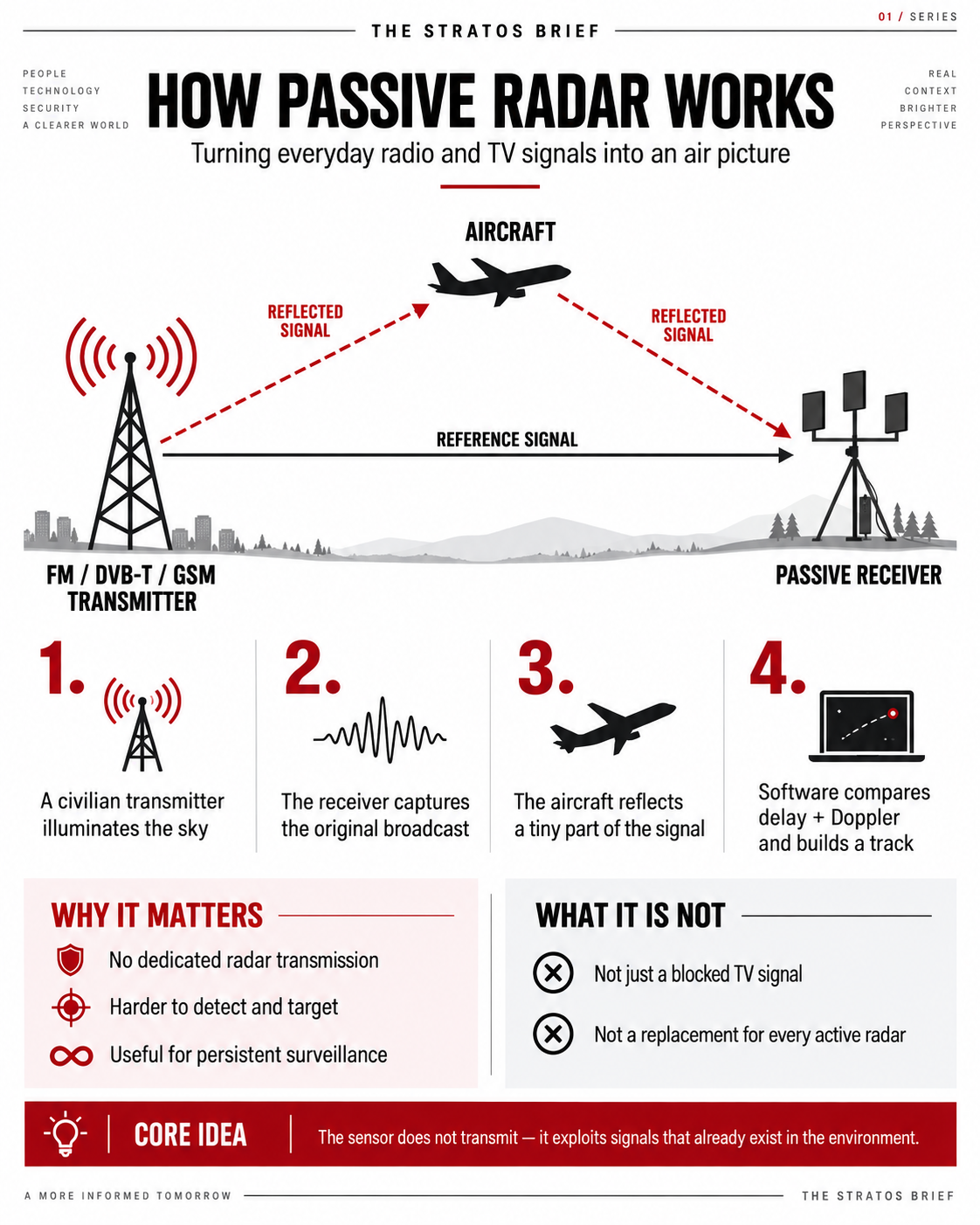
Passive coherent location does not require a dedicated radar transmitter. It compares an existing broadcast signal with the delayed and Doppler-shifted energy reflected by an aircraft to generate a target track. Infographic: The Stratos Brief
This is not simply a system watching for an aircraft to block a television signal. The distinction matters because popular descriptions of passive radar often present it as detecting a radio “shadow”. Forward-scatter radars can indeed exploit the disturbance produced when a target passes near the line between transmitter and receiver, and researchers have successfully demonstrated such techniques using satellite transmissions. Most modern air-surveillance PCL systems, however, work much more like a conventional radar receiver. They process target echoes, except the illuminating waveform has been borrowed from an unrelated transmitter rather than generated by the radar itself.
The signal-processing problem is considerably harder than that description makes it sound. The direct signal from the broadcast tower may be millions or billions of times stronger than the echo arriving from an aircraft. Buildings, terrain, vehicles, wind turbines and vegetation generate their own reflections. Multiple broadcasters may occupy neighbouring parts of the spectrum. A useful passive radar must first suppress the direct transmission and stationary clutter, then construct delay-Doppler maps, detect statistically significant returns and finally associate those detections over time into tracks. Leonardo's AULOS, for example, uses coherent multichannel receivers, digital beamforming, interference cancellation, range-Doppler processing and tracking algorithms to turn FM and DVB-T transmissions into a surveillance picture.
The geometry is also different from conventional radar. In a normal monostatic system, the transmitter and receiver are effectively in the same location, so target range is measured relative to one radar site. In a passive bistatic system, the transmitter and receiver may be tens or even more than one hundred kilometres apart. A single delay measurement therefore does not initially place the target at one simple range from the receiver. It constrains the target to an ellipsoidal surface defined by the total transmitter-target-receiver path length.
That apparent disadvantage becomes less important when the system can observe several illuminators simultaneously. A European passive radar may have multiple FM stations, several DVB-T transmitters and potentially other signals available from different directions. Each creates a different bistatic geometry. Combine those geometries with direction-of-arrival estimates, Doppler measurements and observations from additional passive receiver stations and the target position can be progressively refined. HENSOLDT's Twinvis and Patria's MUSCL are explicitly designed around this multistatic logic rather than the assumption that a single transmitter and receiver must produce the entire air picture.
The transmitter's civilian purpose is therefore almost incidental. To a television viewer, the DVB-T tower is distributing programmes. To a passive radar, it is an illumination source that somebody else has built, powered, licensed and maintained.
Why FM, television and mobile networks behave differently
The availability of a signal does not automatically make it an ideal radar illuminator. Different communications systems trade transmitter power, bandwidth, frequency, coverage geometry and waveform structure in ways that directly affect their usefulness for sensing.
FM broadcasting is particularly attractive for wide-area surveillance because transmitters can operate at substantial power and VHF propagation provides broad coverage. Its principal weakness is bandwidth. A conventional FM channel occupies only a few hundred kilohertz, which limits the system's ability to distinguish two targets whose bistatic ranges are close together. Using the familiar radar approximation in which delay resolution varies inversely with signal bandwidth, a 200 kHz waveform corresponds to a range-resolution scale of roughly 750 metres. Signal processing, multistatic geometry and tracking can improve target-location accuracy beyond such a crude single-measurement estimate, but the underlying bandwidth constraint remains.
Digital television changes that balance. An 8 MHz DVB-T channel has roughly forty times the bandwidth of a 200 kHz FM channel, reducing the corresponding delay-resolution scale to below twenty metres. Its transmitter may not provide the same useful geometry or long-range illumination as the strongest FM stations, but the wider waveform is far better suited to separating targets in range and identifying small objects close to one another. HENSOLDT's own published Twinvis material reflects this difference: it advertises FM-based detection of larger aircraft at distances up to approximately 250 kilometres with coarser accuracy, while DAB and DVB-T are associated with shorter ranges but substantially finer target localisation. These are manufacturer figures and should not be treated as universal performance guarantees, yet the trade-off itself follows directly from the physics of the signals.
This is one reason digital television has become so important in counter-UAS research. During experimental work at Italy's Pratica di Mare military airfield, a DVB-T version of Leonardo's AULOS passive radar used a television transmitter at Monte Cavo, approximately 22.5 kilometres away, while researchers simultaneously observed very small cooperative drones near the airfield and conventional civil aircraft at much greater distances. The published results demonstrated that the same illumination infrastructure could support short-range drone detection and longer-range air-traffic surveillance.
Cellular networks offer a different set of opportunities. LTE and 5G signals can provide considerably more bandwidth than conventional broadcasting, and base stations are extremely numerous in populated areas. Researchers at Wuhan University demonstrated UAV detection with LTE downlinks as early as 2017, while more recent experimental work has examined LTE450 and 5G New Radio waveforms specifically for passive sensing. The complication is that cellular networks were designed to illuminate users close to the ground, base-station antennas are often electrically downtilted, individual cells cover smaller areas than high-power broadcast transmitters and the transmitted waveform changes with network loading. These characteristics may make cellular signals particularly attractive for low-altitude or urban surveillance rather than as a straightforward replacement for a long-range FM-based sensor.
The important point is that a modern passive radar does not necessarily have to choose one source. Patria's MUSCL exploits both FM and DVB-T/T2 transmissions, while the Polish PET/PCL programme explicitly names FM, DVB-T and GSM among the illuminators used by its PCL subsystem. A future system able to combine broadcasting, cellular and perhaps satellite sources would gain not merely additional signal power but additional geometry. Every transmitter illuminates the target from a different direction, and in multistatic radar geometry is itself a source of information.
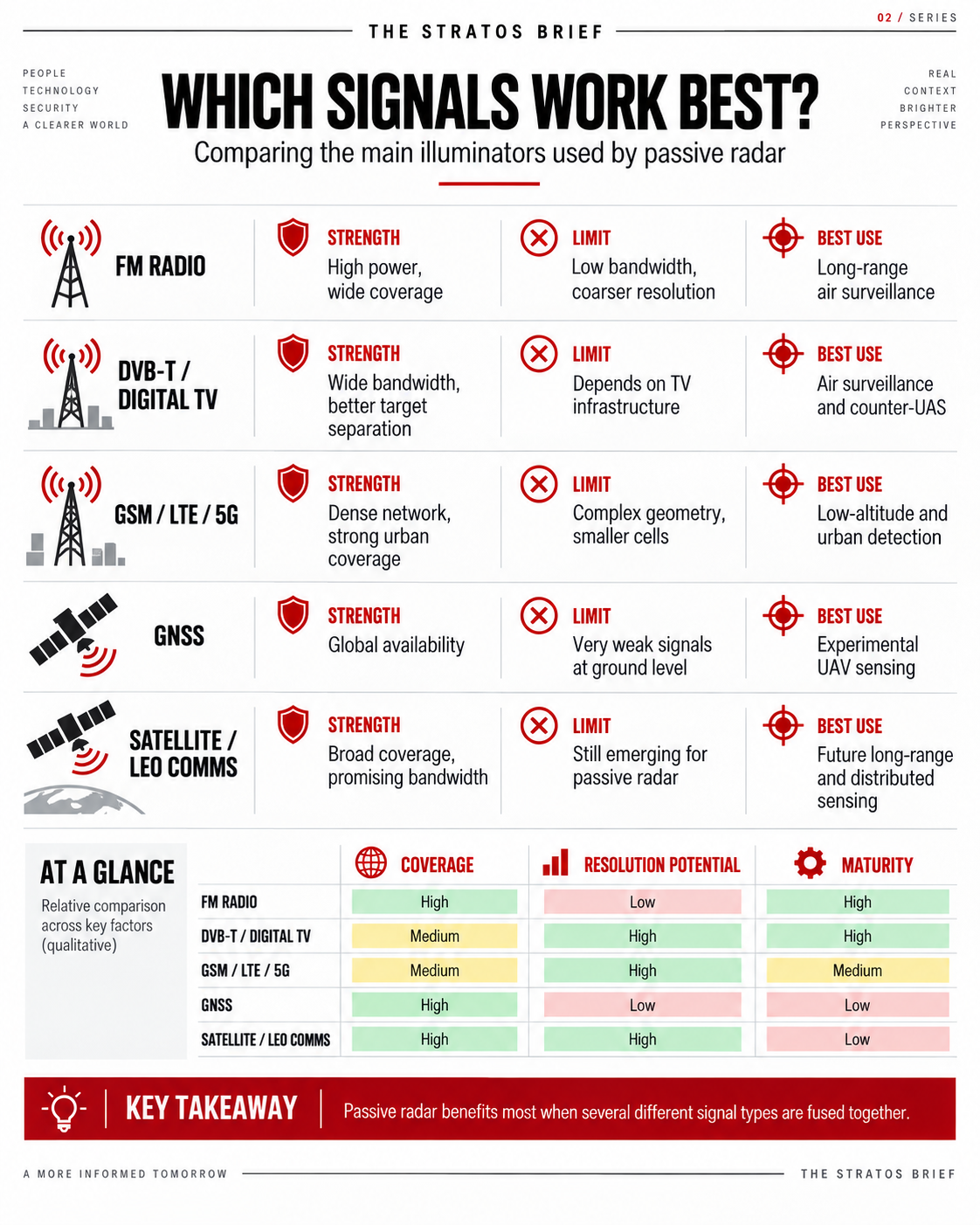
Different illuminators offer different trade-offs. FM provides wide-area coverage, digital television and cellular signals offer greater bandwidth and potential resolution, while satellite-based illumination could eventually extend passive sensing far beyond terrestrial broadcast networks. Infographic: The Stratos Brief
Not every “passive radar” works this way
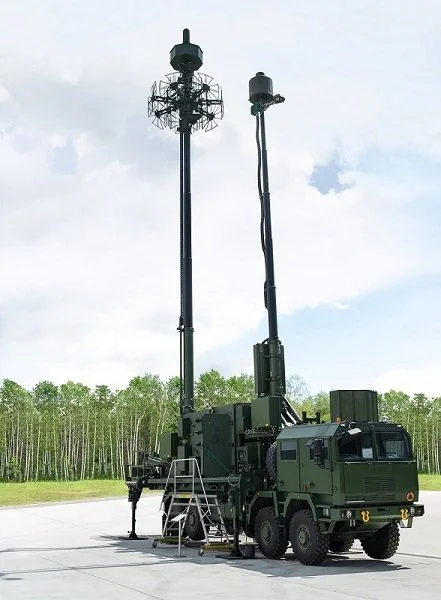
The phrase passive radar is frequently used for systems that operate on a fundamentally different principle, and that ambiguity has generated considerable confusion in discussions of stealth aircraft.
Central Europe provides a useful example. Czechoslovakia developed a celebrated line of passive surveillance systems beginning with KOPÁČ and continuing through RAMONA and TAMARA. Their modern descendant, ERA's VERA-NG, can detect and geolocate electromagnetic emissions from aircraft, ships or ground systems by comparing the time at which a signal reaches geographically separated receiving stations.
VERA-NG is passive because it does not illuminate the target. It listens. But the signal it uses normally originates from the target itself: an airborne radar, transponder, jammer, datalink or other emitter. ERA describes the system as a Passive ESM Tracker using time-difference-of-arrival processing.
Passive coherent location solves a different problem. If an aircraft switches off its radar, remains radio silent and emits no useful signal, a conventional emitter-location system has much less material to work with. PCL can still attempt to detect it because the illumination comes from a third party.
ERA itself makes the distinction particularly clearly. In 2013 it introduced the Silent Guard demonstrator for Multistatic Primary Surveillance Radar. The company describes Silent Guard as fundamentally different from VERA-NG because it uses signals reflected by the target and commercial broadcast transmitters as illuminators of opportunity. ERA subsequently demonstrated the PCL system during NATO's Unified Vision exercise in Norway.
The two approaches are complementary rather than mutually exclusive. A fighter using its radar may provide an excellent target for passive emitter tracking. The same aircraft flying in emission control may remove that source but remain physically illuminated by broadcast signals. Poland's new system deliberately combines both mechanisms in one architecture. Its PET subsystem listens for radar, communications, IFF and navigation emissions produced by airborne objects; its PCL subsystem processes FM, DVB-T and GSM signals scattered from those objects. A fusion module then attempts to produce a more stable and accurate track than either subsystem could provide independently.
This hybrid approach is arguably more important to future air defence than the search for a single passive sensor capable of replacing every active radar. Modern integrated air defence increasingly depends on combining sensors whose weaknesses are different.
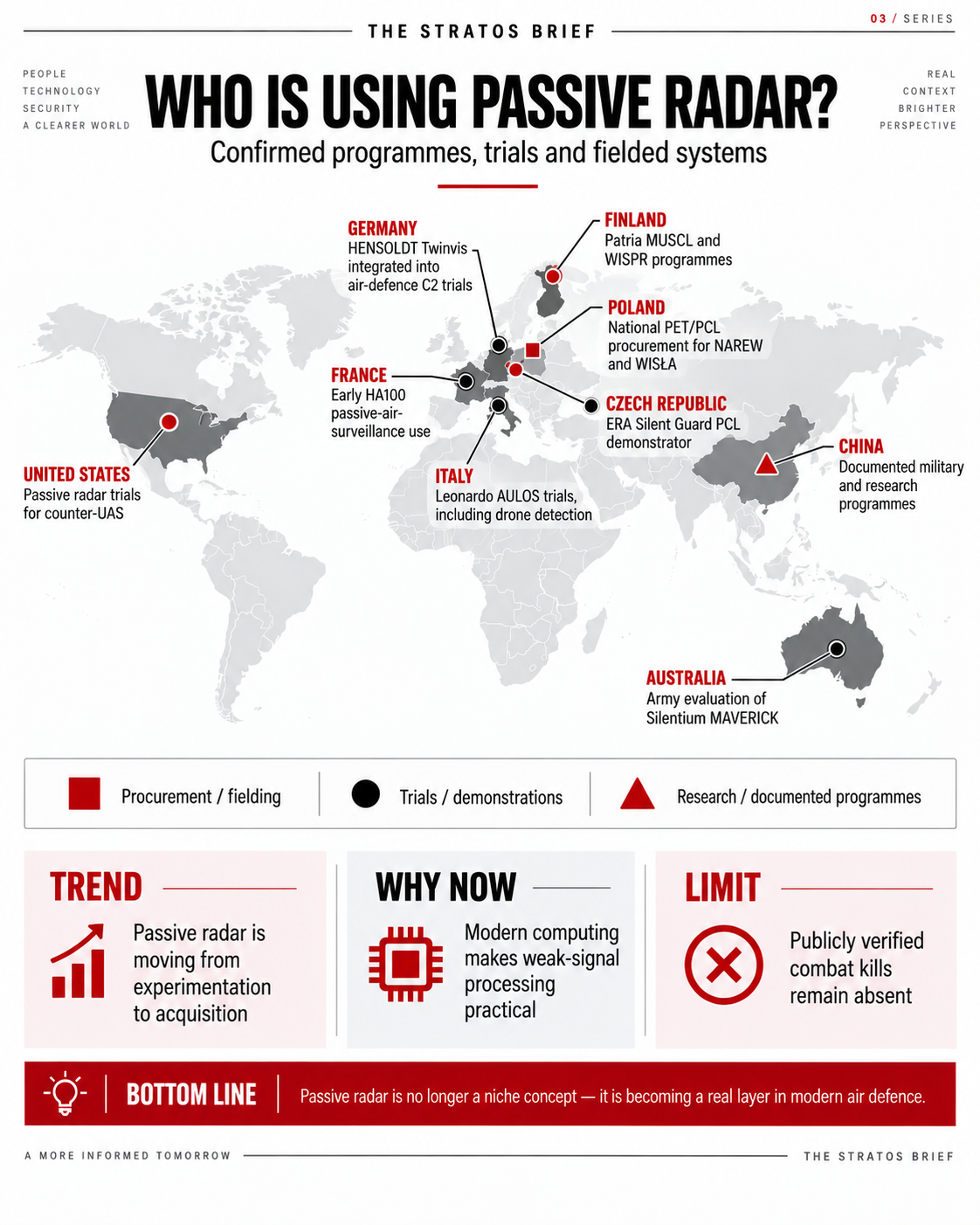
Passive radar is progressing at different speeds around the world, from experimental programmes and military trials to major procurement and integration into air-defence networks. Poland represents one of the most ambitious current acquisition programmes. Infographic: The Stratos Brief
Poland turns passive location into national air-defence infrastructure
The scale of Poland's programme is one of the strongest indications that passive radar has progressed beyond the status of an interesting demonstrator.
On 2 September 2025, during MSPO in Kielce, the Polish Armament Agency signed a contract with the PGZ-NAREW consortium for 28 PET/PCL passive-location radars, with an option for a further 18. The guaranteed portion is valued at approximately PLN 3.9 billion gross and the option at another PLN 1.9 billion, with deliveries planned between 2030 and 2038. If exercised in full, the programme will result in 46 systems.
More significant than the quantity is where Poland intends to put them. The Ministry of National Defence describes the radars as part of the country's integrated multilayer air- and missile-defence system and states that their characteristics allow them to support both the NAREW short-range and WISŁA medium-range architectures. They are therefore not being procured as isolated intelligence equipment or as experimental gap fillers. They are intended to contribute to the sensor layer behind weapon systems.
The Polish solution also demonstrates why the military value of passive radar cannot be measured only by asking whether the passive receiver itself could guide a missile. If PET detects an airborne radar, PCL independently observes a reflection from the same object and an active radar provides a high-precision track only when required, the engagement is the product of the network rather than any one sensor. An adversary must consequently deal with several detection mechanisms at once.
For a low-observable aircraft, this changes the problem from defeating one radar to managing an entire electromagnetic environment.
From demonstrations to an operational air-defence network
Germany provided a particularly useful demonstration of that networked logic during the Luftwaffe's Timber Express 2026 exercise at Manching.
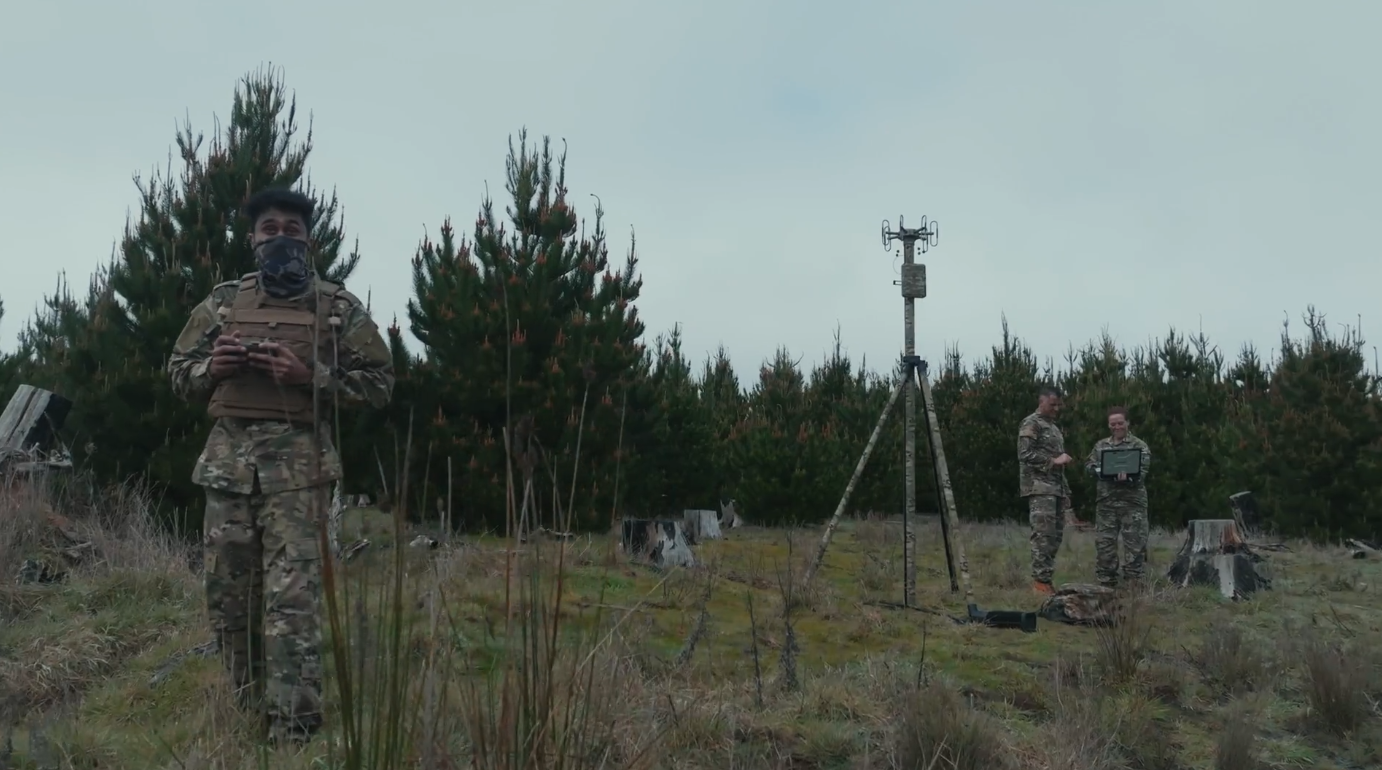
HENSOLDT's Twinvis passive radar generated an air picture that was fed into Rheinmetall's Skymaster command-and-weapon-engagement system, which in turn was controlling a Skynex air-defence battery in the scenario. Sensor information was fused within a NATO Link 16 environment to create a common operational picture. Rheinmetall reported that Twinvis successfully detected and tracked air targets during the exercise.
The event should not be overstated. Rheinmetall did not announce that Twinvis had independently produced the final fire-control solution for a live missile engagement. There is an important technical distance between contributing tracks to an air picture and supplying the angular accuracy, range precision, latency and update quality necessary to guide a particular interceptor.
Yet the exercise demonstrates something more relevant to the direction of air defence. A passive radar does not need to become the fire-control radar if it can keep the network informed while the fire-control radar remains silent. Once the passive system detects an approaching object and narrows the search volume, an active sensor can be activated briefly, an electro-optical system can be directed toward the track, fighters can be cued or another geographically separated radar can refine the solution.
This concept has become more valuable as the time between electromagnetic detection and physical attack has shortened. An active radar is not merely a sensor; in a contested environment it is also an emitter that electronic-support systems can detect, classify and potentially geolocate. Anti-radiation missiles were the traditional threat. Today an identified emitter may also become the target of long-range fires, loitering munitions, one-way attack drones or other networked weapons.
Passive radar does not make a sensor site physically invisible, and its own communications can still create signatures, but it removes the most obvious feature: the powerful radar transmission.
Finland pushes the concept from aircraft to artillery
Patria illustrates both the growing maturity and widening scope of the technology.
Its MUSCL system uses FM radio and DVB-T/T2 television signals and can operate either as an individual station or as a distributed network. Patria publicly advertises 360-degree surveillance extending to hundreds of kilometres, while stressing detection of low-altitude, small and low-observable targets. As with all manufacturer performance claims, exact ranges depend on target size, altitude, illuminator geometry, terrain and electromagnetic conditions. The more important point is that MUSCL is now moving into customer service rather than remaining only a development programme.
On 14 September 2026, Patria announced an agreement to deliver multiple MUSCL sensor stations, support equipment and training to an undisclosed European NATO member state. The number of stations and contract value were not disclosed, but Patria stated that the configuration is intended to cover a large area and allow rapid operational deployment.
The company has also extended the underlying PCL technology into an application that illustrates how far signal processing has progressed. Patria WISPR, unveiled at Eurosatory in June 2026, uses digital television transmitters to detect and track artillery shells, mortar bombs and rockets and estimate their point of origin. Patria envisages the system operating independently or as a cueing sensor for conventional active counter-battery radars, which could remain silent for longer and transmit only when additional precision is required.
A television transmitter was never designed to illuminate an artillery shell for a military sensor. The fact that its waveform can nevertheless be exploited for such a small and fast target demonstrates that the practical limit of passive radar is increasingly determined by receiver sensitivity, geometry and processing rather than by the original purpose of the transmission.
Australia, Italy and the United States fill in different parts of the picture
Other programmes show that the same principle is being explored for different operational requirements.
Australia awarded Silentium Defence a AUD 7.4 million contract in 2021 to provide its MAVERICK M-series passive radar to the Australian Army for capability development and evaluation. The system uses ambient transmissions including broadcast television and is designed as a portable surveillance sensor rather than a large fixed strategic radar. Silentium subsequently reported trials involving Australian services and participation in the US Special Operations Command's Trident Spectre technology exercise, although those activities should be distinguished from a declaration of full operational adoption.
Italy's Leonardo has pursued a more extensively documented experimental path with AULOS. The system supports FM and DVB-T processing, multistatic operation and 360-degree surveillance in its deployable configuration. Academic work conducted with Sapienza University has shown detection of conventional aircraft, maritime targets and very small drones under real field conditions.
The United States provides a particularly useful example of how such a sensor might enter a counter-UAS kill chain. CACI's SPaRK passive radar uses third-party transmissions including commercial television broadcasts to detect objects that may not emit radio signals of their own. During US Central Command's Desert Guardian experimentation, CACI says SPaRK detected and tracked drone targets and transferred tracks into a broader command architecture. According to the company, a Group 2 UAV was detected at approximately 17 kilometres and the passive track was handed to another sensor.
Again, that is not a combat shootdown. It is more informative than a simple range claim, however, because it demonstrates the function passive radar is increasingly being designed to perform: persistent low-signature search followed by hand-off to another component of the defensive system.
China has pursued passive detection for decades, but open-source certainty is lower
China also possesses a substantial research and industrial base in passive radar, although assessing operational deployment is more difficult.
The US Army's ODIN database identifies the Chinese JY-50 as a VHF passive two-dimensional air-defence radar that exploits distributed civilian emissions including mobile-phone, radio and television transmissions. ODIN lists a maximum range of 250 kilometres and describes the system as capable of detecting electromagnetically silent airborne targets.
Chinese universities have simultaneously conducted extensive research into digital television and cellular illumination. Wuhan University's experimental LTE passive radar, for example, successfully correlated passive detections of a DJI Phantom 4 with the UAV's recorded flight path, providing a useful demonstration that commercial cellular waveforms can support practical low-altitude target detection.
What cannot be established from public material with the same confidence is the operational performance of Chinese military PCL networks against modern combat aircraft. The presence of programmes and research is well supported; specific claims about the number of deployed systems, their real detection ranges against particular stealth designs or their integration into PLA engagement chains are considerably harder to verify.
That distinction is important throughout this field. Passive radar is technically real enough that exaggerated claims are unnecessary.
The stealth question is more complicated than “yes” or “no”
Few aspects of passive radar attract as much attention as its supposed ability to defeat stealth.
There is a legitimate physical reason for the interest. Low-observable aircraft are designed to reduce radar cross-section under particular combinations of frequency, aspect and transmitter-receiver geometry. Much of the shaping associated with modern stealth is especially effective against monostatic radars, where the transmitter and receiver occupy approximately the same location. Surfaces are arranged so that incident radar energy is preferentially scattered away from the direction from which it arrived.
A bistatic radar changes that geometry. The receiver is somewhere else. Energy that is successfully redirected away from the transmitter may under some conditions be scattered toward another location where a passive receiver happens to be listening. Distributed receivers and multiple transmitters create still more geometries from which the same target can be observed.
Frequency introduces a second complication. FM transmissions operate around 100 MHz and therefore have wavelengths measured in metres rather than the centimetre-scale wavelengths of many higher-frequency fire-control radars. The electromagnetic behaviour of an aircraft changes with the relationship between wavelength and the dimensions of its structures. A design optimised to achieve extremely low radar cross-section over important microwave bands and threat aspects does not necessarily achieve the same reduction at much lower frequencies.
This does not mean that a VHF passive radar obtains a precise, long-range weapon lock on every stealth aircraft. Lower frequencies bring disadvantages of their own, including physically larger antennas and poorer resolution for a given fractional bandwidth. The target echo still has to compete with clutter and interference, and the geometry may be unfavourable. Low observability also remains valuable even when it does not reduce radar cross-section to zero. If stealth reduces the range at which a sensor can establish and maintain a useful track, the aircraft has gained operational advantage.
The correct conclusion is therefore narrower but still significant. Passive multistatic sensing can create detection geometries and frequency combinations against which an aircraft's monostatic high-frequency radar cross-section is not a complete description of its observability.
The question that matters operationally is not simply whether the aircraft can be detected. It is whether the resulting observation can be converted into a sufficiently persistent and accurate track quickly enough for the rest of the air-defence network to act.
Detection, tracking, classification, fire-control-quality localisation and successful engagement are different stages of the process. Collapsing them into one word — “seen” — is responsible for much of the confusion surrounding stealth and passive radar.
What the famous F-35 demonstration did — and did not — prove
The best-known modern example is HENSOLDT's claim that Twinvis tracked two F-35s after the 2018 ILA Berlin air show.
The episode is useful because it demonstrates both the potential of passive radar and the danger of overinterpreting demonstrations. The aircraft were known to be present and their departure was expected. The test therefore did not replicate an unknown hostile F-35 attempting to penetrate defended airspace under wartime electronic conditions. Public reporting also indicated that ADS-B information was available for correlation.
Nevertheless, successful observation of F-35s in such circumstances matters at a basic technical level. It confirms the unsurprising but sometimes poorly understood point that stealth aircraft are not electromagnetically invisible. Their signatures depend on frequency, geometry, aspect, configuration and the sensitivity of the observing system.
What the episode did not demonstrate was an operational sensor-to-shooter engagement against an F-35.
That gap between detection and engagement remains central to any serious assessment of PCL.
The F-117 shootdown is not evidence of a television-radar kill
The same distinction is necessary when discussing perhaps the most frequently cited historical example.
On 27 March 1999, a Yugoslav air-defence unit shot down USAF F-117A 82-0806 during Operation Allied Force. The event remains the best-known combat loss of a stealth aircraft and is sometimes presented online as evidence that passive radar or civilian television signals defeated the Nighthawk.
The historical record does not support that interpretation.
The Yugoslav unit operated the Soviet-designed S-125 Neva air-defence system together with a P-18 VHF early-warning radar. Japan's National Institute for Defense Studies describes the unit as equipped with both the S-125M and P-18, while contemporary and later accounts describe an engagement in which early warning was followed by use of the S-125's active fire-control radar at relatively short range.
Stories have circulated for years about Czechoslovak TAMARA passive equipment contributing to the wider Yugoslav air picture. Even if an emitter-location system of that family had been involved somewhere in the operation, TAMARA was not an FM- or television-reflection PCL radar. As ERA's own history makes clear, TAMARA belongs to the TDOA passive-emitter lineage, while reflected-signal multistatic radar emerged later in its Silent Guard programme.
The F-117 shootdown therefore illustrates several important things about stealth: low observability does not provide immunity, lower-frequency surveillance can contribute to detection, tactical discipline matters, predictable routes create vulnerabilities and active fire-control radars can acquire stealth aircraft at sufficiently short range under favourable circumstances.
It does not provide a confirmed combat success for the technology examined here.
The missing milestone: a publicly verified combat kill
This leads to the most important evidentiary boundary in assessing passive coherent location.
As of 16 September 2026, there is substantial public evidence that PCL systems can detect real aircraft, drones and other targets; that militaries are evaluating or buying them; and that their tracks can be fused into wider command-and-control architectures. What remains absent from the open record is a clearly documented and independently verifiable case in which an airborne target was detected by a passive coherent-location radar using an external illuminator of opportunity and was then destroyed on the basis of that passive track.
The qualification is deliberate. It would be surprising if every operational use of such sensors were public. Passive systems are valuable partly because an adversary may not know which signals are being exploited or where receivers are deployed. Modern engagements are also highly networked, making it difficult to attribute a kill to one sensor when several contribute to the track.
A passive sensor could provide the first indication of a target, an ESM network could classify it, an active radar could refine the track for several seconds and an infrared seeker could perform terminal guidance. Calling that either a “passive radar kill” or an “active radar kill” would oversimplify the architecture.
The absence of a public combat success should therefore not be mistaken for evidence that the technology does not work. It does, however, set a useful limit on what can responsibly be claimed. Field demonstrations, procurement and network integration are established. A publicly proven PCL-to-weapon combat chain is not.
Why a silent radar is still not invulnerable
Passive radar's greatest advantage is easy to understand in an age of rapid electronic warfare: destroying a radar normally begins with finding it, and a transmitter makes itself relatively easy to find.
A PCL receiver removes that dedicated high-power emission. An electronic-support aircraft cannot simply detect the radar pulse, identify the waveform and draw a line toward its source. An anti-radiation missile has no radar transmitter on which to home. The passive station can also operate in populated areas without requiring its own radar-frequency allocation or generating the same electromagnetic-safety concerns as a high-power active transmitter.
But describing passive radar as “undetectable” goes too far.
Its electronics produce some unintended emissions, however small. It requires communications if its tracks are to enter a wider network. Antennas can be found by imagery or reconnaissance. Vehicles, generators and crews create physical signatures. A sophisticated adversary can attack the civilian transmitters on which the system depends, jam the relevant frequency bands or exploit knowledge of their locations to predict gaps in PCL coverage.
The dependence on third-party illumination is the fundamental trade-off. A conventional radar designer controls transmitter power, frequency, waveform, beam direction and timing. A passive-radar operator normally controls none of them.
A high-power television transmitter may be perfectly positioned for one surveillance sector and almost useless for another. Mountainous terrain can create shadowed regions. A country with a dense European broadcasting network provides a much richer electromagnetic environment than an isolated desert or sparsely populated Arctic region. Civil broadcasters may change frequencies, reduce power or shut down. Wartime destruction of communications infrastructure could remove illuminators just when they are most valuable.
Passive radar therefore converts one vulnerability into another. It avoids depending on a conspicuous dedicated transmitter, but accepts dependence on an electromagnetic environment that it does not fully control.
This is why the most resilient future architecture is likely to combine passive and active sensing rather than choosing between them.
Satellites could remove part of the geographical constraint
Terrestrial transmitters define the current generation of deployable PCL, but the most consequential research may be moving into orbit.
Navigation satellites have already been investigated as illuminators of opportunity. Their signals are weak by the time they reach the Earth's surface, which makes the target-echo problem exceptionally difficult, but experimental work has shown that GNSS transmissions can be used for passive sensing of small UAVs.
Satellite television offers more power and another geometry. Researchers have demonstrated UAV detection using DVB-S transmissions in forward-scatter configurations, showing that an illuminator does not have to be located on the ground.
Large low-Earth-orbit communications constellations are potentially much more interesting. Starlink and similar networks combine broad bandwidth, relatively strong downlinks, enormous geographical coverage and large numbers of transmitters moving rapidly across the sky. Instead of depending on several fixed broadcast towers around a passive receiver, a future system could potentially exploit a continuously changing set of illumination geometries from orbit.
The concept remains at a much earlier maturity level than FM- or DVB-T-based military PCL. A paper published on 15 September 2026 proposed a reference-free passive-radar architecture using Starlink downlinks and numerical simulations to examine detection feasibility. The authors explicitly identify experimental validation with live Starlink illumination as future work, which is an important limitation: this is not evidence that an operational Starlink-based air-defence radar exists today.
The direction is nevertheless notable. Starlink was designed to provide communications, not radar illumination. Yet its downlinks contain electromagnetic energy, have significant bandwidth and arrive from known or inferable orbital geometries. Those are precisely the ingredients passive sensing attempts to exploit.
If such techniques mature, they could reduce one of terrestrial PCL's major limitations. A television-based passive radar depends strongly on the local broadcast map. A space-illuminated system could in principle draw on transmitters over oceans, deserts and other regions with sparse terrestrial infrastructure, although satellite motion, synchronization, waveform access, link budget and rapidly changing bistatic geometry create substantial new processing challenges.
The possibility is larger than Starlink itself. Once communications constellations become sufficiently dense, commercial space infrastructure may inadvertently create a persistent layer of radio illumination that was never designed as a surveillance system but can nevertheless be used as one.
Passive radar is unlikely to replace active radar — and does not need to
The strongest case for passive coherent location does not require it to outperform an AESA radar at every task.
An active military radar has enormous advantages. Its designer controls the waveform. It can steer energy where required, increase dwell time, change frequency, adapt pulse structure, measure range directly and optimise the entire transmitter-receiver chain around the surveillance or fire-control mission. Nothing about PCL changes those facts.
What passive radar can do is alter when the active radar needs to transmit.
Imagine an air-defence sector protected by several layers. PCL receivers continuously exploit FM and television signals. An ESM network listens for hostile radar and communications emissions. Electro-optical sensors contribute bearing and identification when conditions permit. An active AESA remains largely silent. All of these sensors feed a common command system.
A target entering the sector may first generate only a coarse passive track. As additional illuminators or receivers observe it, confidence rises. ESM may associate an emitter with the track. The command system can then instruct the active radar to illuminate only a narrow volume rather than searching an entire sector. It may need to transmit for seconds instead of continuously.
The tactical gain is not that the active radar disappeared. It is that its exposure time became shorter.
Germany's 2026 Timber Express experiment points directly toward this architecture. Poland's PET/PCL procurement institutionalises the same principle on a much larger scale. Patria explicitly markets WISPR as a cueing sensor that can allow active counter-battery radars to remain silent until their precision is needed. CACI's CENTCOM experimentation demonstrates a similar hand-off concept against drones.
Passive radar therefore belongs to a broader change in air defence: the transition from individual sensors toward distributed kill webs in which detection, classification, tracking and engagement can be performed by different nodes.
The electromagnetic environment is becoming part of the sensor
The most important conclusion is not that television towers are secretly replacing military radars. They are not.
It is that the distinction between communications infrastructure and sensing infrastructure is becoming less rigid.
An FM transmitter can simultaneously deliver music to thousands of receivers and illuminate an aircraft for a military PCL sensor. DVB-T can provide television to a city while contributing enough bandwidth for passive detection of a small drone. LTE infrastructure built for mobile communications can generate waveforms from which target motion is extracted. A satellite network created to provide broadband may eventually supply useful illumination from orbit.
The transformation is being driven less by new physics than by the ability to recover increasingly small amounts of information from an already crowded spectrum.
That shift has particular military relevance because the electromagnetic battlefield is becoming more hostile to anything that transmits. Radar emissions can be detected, geolocated, classified and attacked. Communications are increasingly forced toward lower probability of intercept, shorter transmission windows and distributed networks. The survivability of a sensor is therefore becoming almost as important as its nominal detection range.
Passive radar offers one answer: let somebody else's transmitter illuminate the target.
It is not an answer without weaknesses. Coverage depends on geometry and infrastructure. Commercial waveforms were never designed for radar. Accuracy can be inferior to purpose-built active sensors. The illuminators may disappear in wartime. Claims regarding stealth detection often run ahead of what publicly available tests actually demonstrate, and there is still no openly verified combat engagement that establishes a complete PCL sensor-to-shooter kill chain.
Yet the direction of travel is increasingly difficult to dismiss. France demonstrated passive surveillance in national airspace protection more than fifteen years ago. Italy has experimentally detected drones with digital television. Australia has funded deployable military systems. China possesses documented programmes of its own. Poland is investing billions of złoty in combined PET/PCL networks. Germany has already inserted passive tracks into a weapon-system command architecture. Finland has sold a multistation passive air-surveillance network to another NATO country and has extended the same physical principle to counter-battery radar.
The technology is therefore moving beyond the old question of whether passive coherent location can detect aircraft. That question has largely been answered.
The more consequential questions are now operational. How dense must the receiver network be to maintain a reliable track against low-flying cruise missiles? How does PCL perform when an adversary deliberately attacks or manipulates civilian transmitters? How much useful information can be obtained from 5G and future communications networks? Can satellite constellations provide enough illumination to remove dependence on terrestrial broadcasting? And, most importantly for integrated air defence, how quickly can a passive detection be transformed into the precise, trusted and continuously updated track required by a weapon?
The answers will determine whether passive radar remains primarily a valuable complementary sensor or becomes a defining component of future air-defence networks.
Either way, the underlying change is already visible. For the traditional radar, the sky is dark until the transmitter illuminates it. For passive coherent location, much of the sky is illuminated already.
The radio station, television tower, mobile network and communications satellite were built for entirely different purposes.
Modern signal processing is beginning to make that distinction irrelevant.
Sources and methodology
This Deep Dive distinguishes passive coherent location from passive emitter tracking and treats manufacturer performance figures as declared specifications rather than independently verified operational performance. Procurement and military-integration claims were checked primarily against the Polish Ministry of National Defence, Rheinmetall, Patria, ERA and Australian programme announcements; technical performance and experimental evidence were cross-checked against published work involving Leonardo/Sapienza University, LTE and 5G passive-radar research, HENSOLDT documentation and the US Army ODIN database. The assessment of Starlink-based passive radar is deliberately described as emerging research because the 15 September 2026 study is based on modelling and simulation and identifies live experimental validation as future work.
Data cut-off: 16 September 2026.