Week in the World of Business Jets: Market Access Becomes the New Competitive Advantage

Bombardier’s Global 8000 in flight. The ultra-long-range business jet received UK CAA approval for operations at London City Airport in September 2026, strengthening its appeal for customers seeking both intercontinental range and access to airports closer to major business centres. Photo: Bombardier
Date published: 12 September 2026
Event window: 7–11 September 2026
Event location / region: Global business aviation market
Event type: Weekly business aviation brief / market access, fractional aviation, ultra-long-range aircraft, aftermarket and infrastructure
Business aviation spent much of the post-pandemic cycle focused on aircraft: who could build them, how quickly they could deliver them and how much range, speed or cabin space the next generation could offer.
This week suggested that the competitive battleground is becoming broader.
For Bombardier, access suddenly became political, after U.S. President Donald Trump threatened to shut the Canadian manufacturer out of its largest market. For the Global 8000, access meant something much more literal: approval to operate into London City Airport. Flexjet, meanwhile, opened a $34 million private terminal at Farnborough as it seeks to control more of the customer journey itself.
At the same time, scarcity in the pre-owned ultra-long-range market is making access to desirable aircraft increasingly difficult, while the latest flight-activity data shows that demand is becoming more concentrated around fractional operations rather than expanding evenly across the industry.
Taken together, these developments tell a surprisingly consistent story. Owning an attractive aircraft is no longer enough. The companies gaining leverage are those that can secure access — to markets, airports, infrastructure, customers, aircraft inventory and increasingly the passenger’s digital environment.
Bombardier discovers that market access can become a political risk
The most disruptive business aviation development of the week came from outside the industry itself.
On 7 September, U.S. President Donald Trump said Bombardier should no longer be allowed to sell aircraft in the United States unless the Canadian manufacturer builds them there. The threat came amid a broader deterioration in U.S.-Canada trade relations and quickly created uncertainty around one of the most important relationships in global business aviation.
The difficulty is that Bombardier is already deeply embedded in the American aerospace economy.
The company responded by highlighting an American presence spanning more than 20 states, relationships with around 2,800 U.S. companies across 47 states and annual spending of more than $2.5 billion with American suppliers. Major U.S.-produced systems fitted to Bombardier aircraft include engines, avionics and other high-value components.
That footprint also makes a simple “Canadian manufacturer versus American industry” narrative difficult to sustain. Bombardier employs thousands of people in the U.S., including a major concentration in Kansas, where Republican senators moved quickly to defend the company and the jobs associated with it.
For business aviation, the importance extends far beyond Bombardier.
The United States is the world’s largest business aircraft market. If access to that market becomes linked more explicitly to domestic manufacturing or wider trade disputes, political risk becomes another variable in aircraft purchasing decisions.
A corporate aircraft buyer normally compares range, cabin, residual value, maintenance support and operating economics. In a more protectionist environment, country of manufacture and exposure to trade policy could also begin to influence purchasing decisions, financing assumptions and residual-value forecasts.
For now, Trump’s statement is a political threat rather than a completed regulatory action. But that distinction does not make it irrelevant. Business aviation is a long-cycle industry: aircraft are ordered years ahead and expected to remain valuable for decades. Even uncertainty can influence behaviour.
Global 8000 turns London City approval into a competitive weapon
Only days after Bombardier faced questions over access to the U.S. market, the company gained a strategically important form of access in Europe.
On 10 September, the Bombardier Global 8000 received approval from the UK Civil Aviation Authority for operations into London City Airport. The airport’s short runway and steep-approach requirements make certification there particularly demanding for large business aircraft.
This is more significant than another airport appearing on an aircraft’s capability list.
The purpose of ultra-long-range business aviation is ultimately to save time. An aircraft may be capable of flying passengers from Singapore, Los Angeles or Buenos Aires to London nonstop, but part of that advantage disappears if passengers then face a long ground transfer from an airport outside the city.
London City changes that equation.
Bombardier estimates that using LCY can save passengers roughly 60 to 90 minutes of ground travel compared with alternatives such as Farnborough or Luton. For executives whose aircraft already costs tens of millions of dollars specifically to reduce travel friction, that is a commercially meaningful capability.
It also illustrates how competition at the top of the business jet market is evolving.
Range remains important, but ultra-long-range aircraft are already capable of connecting most major global economic centres. Once range becomes sufficient, competitive advantage moves elsewhere: airport performance, runway capability, connectivity, cabin productivity, dispatch reliability and access to airports closer to where passengers actually want to be.
The Global 8000’s London City approval therefore strengthens its proposition not simply as a long-range aircraft, but as a machine capable of converting that range into genuinely door-to-door time savings.
Flexjet is no longer selling only flight hours — it is building an ecosystem






Another of the week’s most revealing developments came just outside London.
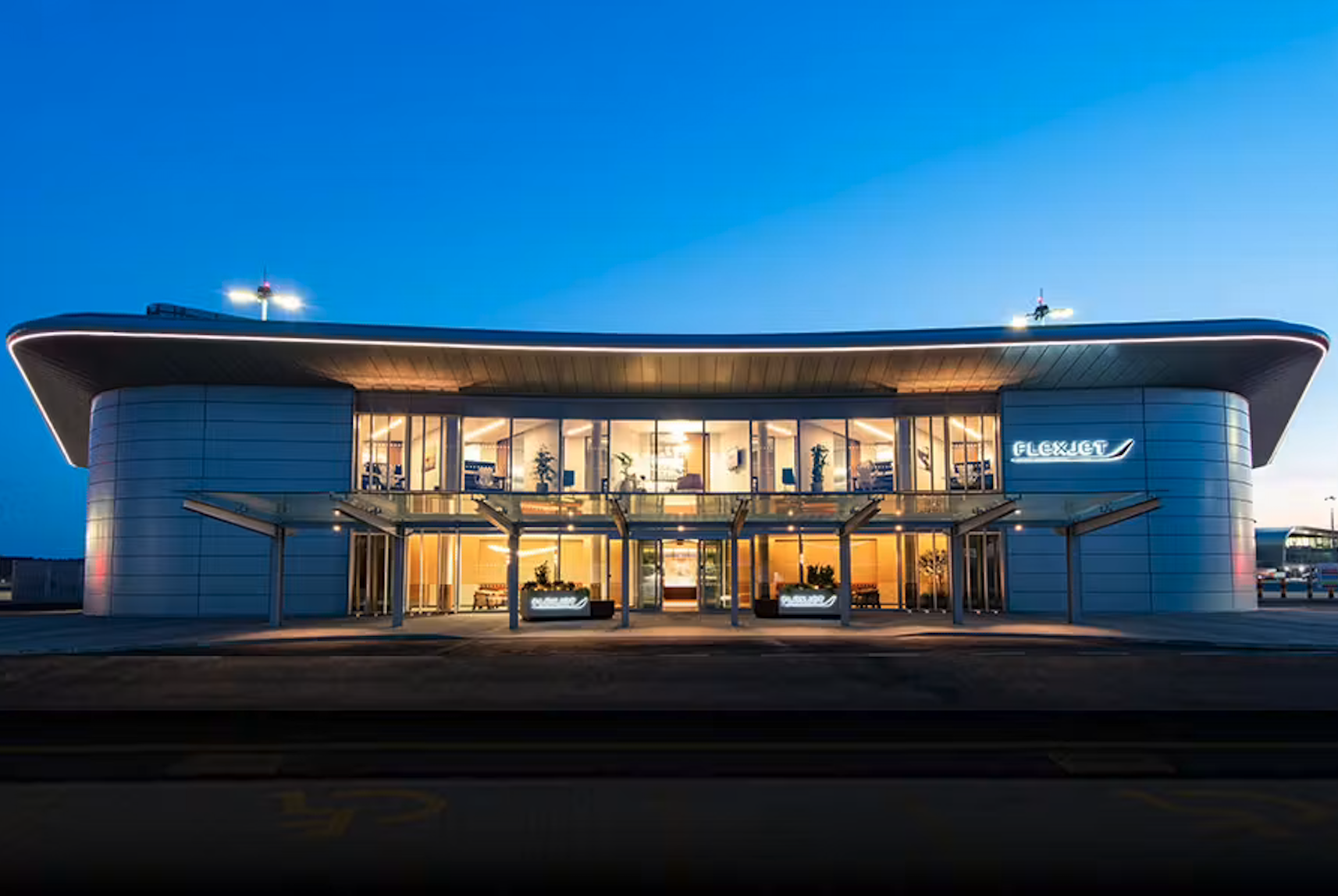
On 10 September, Flexjet officially opened its first dedicated private terminal in Europe at Farnborough Airport. The company says the 2,098-square-metre facility cost $34 million and joins a network of ten Flexjet private terminals either open or under development.
The scale of the investment matters.
Flexjet already operates a global fleet of more than 350 aircraft and helicopters. At Farnborough, however, it is going beyond aircraft ownership and operations to control more of the infrastructure surrounding the customer.
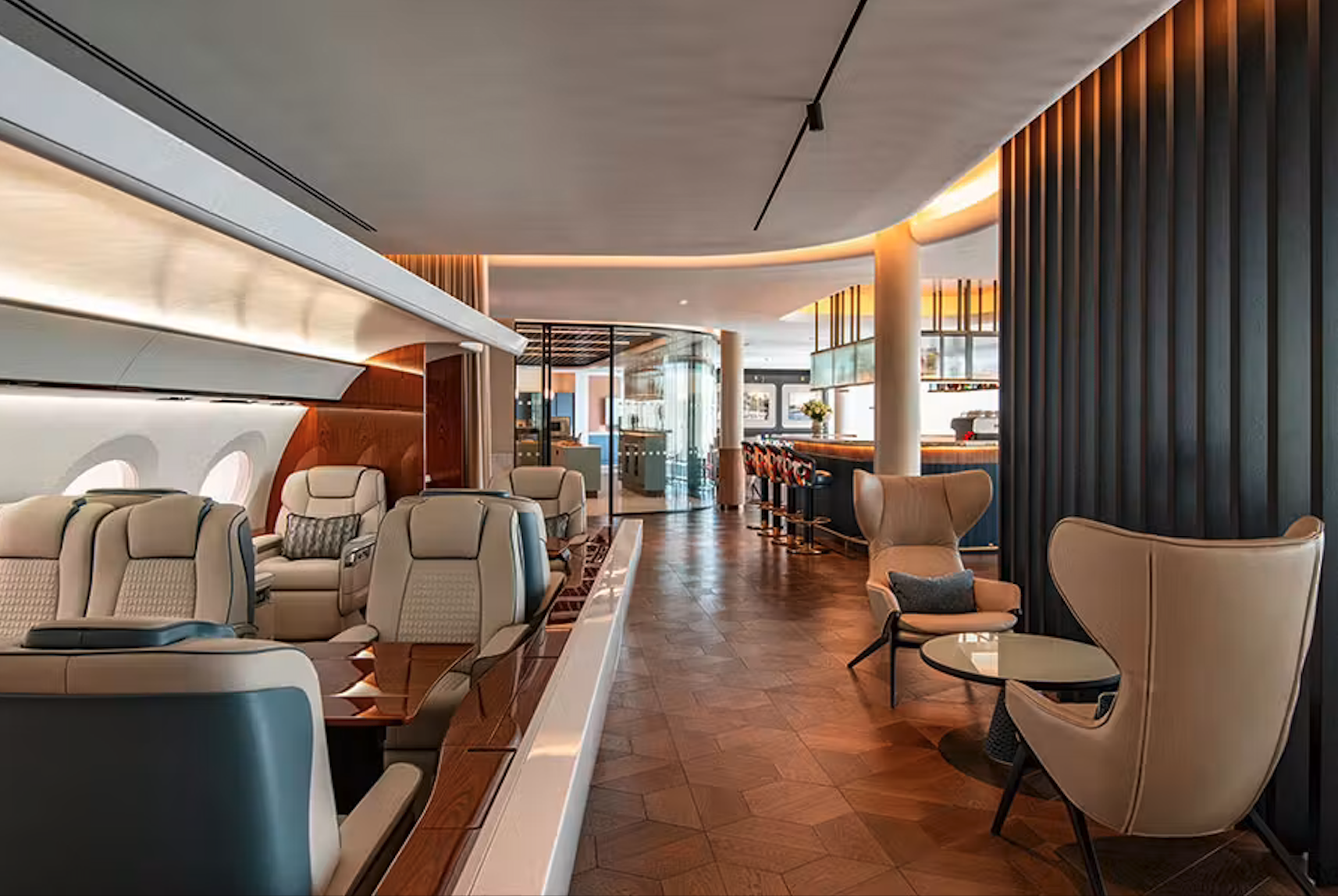
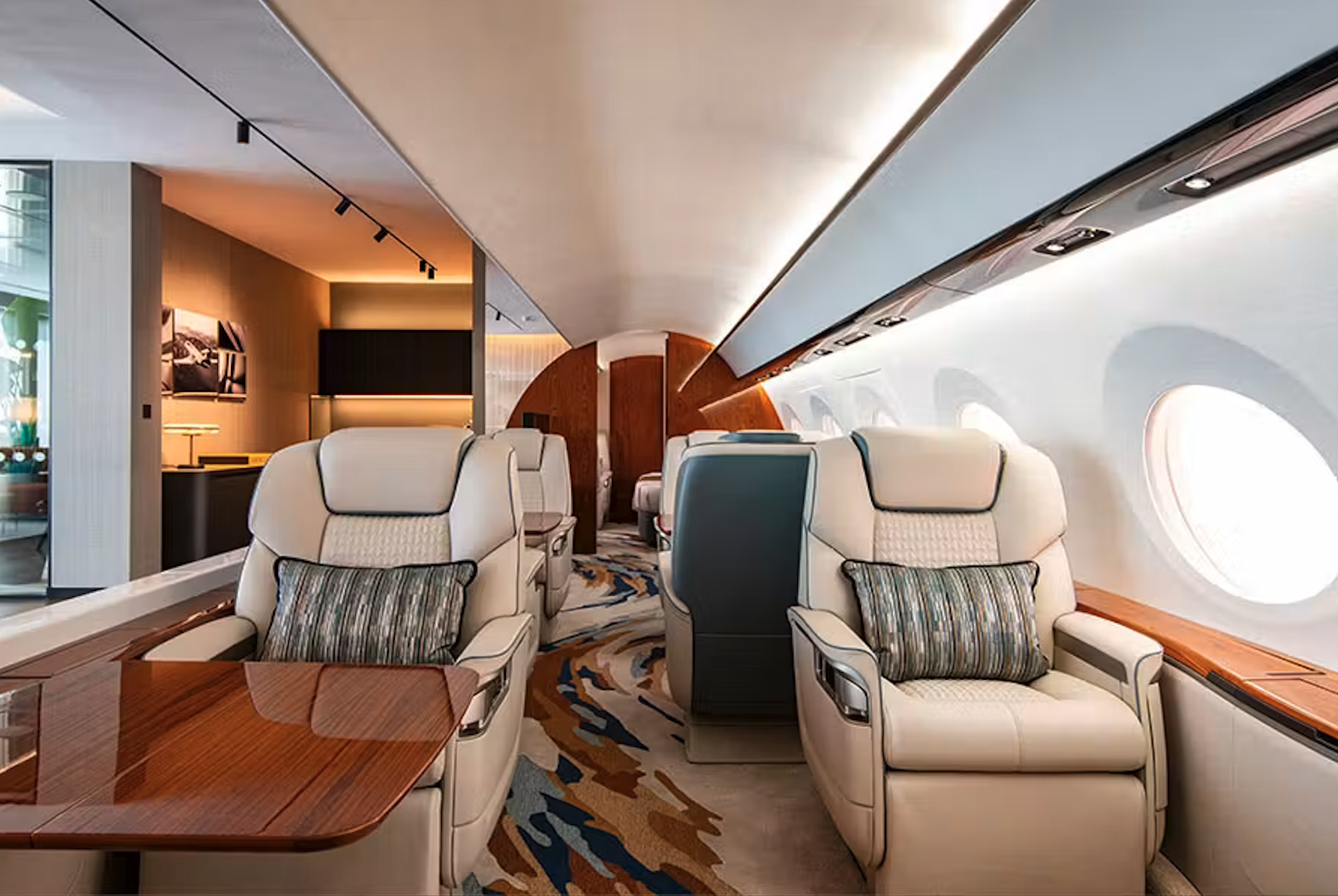
The new facility includes private lounges, dedicated security and immigration, meeting areas, a European tactical control centre and a full-size recreation of a Gulfstream G700 cabin. Flexjet has also opened a separate 3,530-square-metre MRO hangar at Farnborough to support its own fleet.
This is vertical integration applied to luxury aviation.
Instead of competing only through aircraft availability and hourly pricing, large fractional operators increasingly have the scale to build their own terminals, maintenance networks, training systems, helicopters, customer programmes and brand partnerships.
That matters because aircraft themselves are difficult to differentiate indefinitely.
A Gulfstream G700 operated by one company is still fundamentally the same aircraft as a G700 operated by another. But the environment around it can be very different. Private terminal access, dedicated crews, ground handling, helicopter transfers, maintenance resilience and service consistency can transform the customer experience without changing the aircraft.
Flexjet is effectively building barriers around its customers through infrastructure.
For competitors, this raises the capital required to compete at the premium end of fractional aviation. Matching another operator’s fleet may be possible. Replicating a global ecosystem of terminals, MRO capacity, customer facilities and supporting infrastructure is considerably harder.
Ultra-long-range aircraft are becoming harder to buy, not easier
The secondary market offered another indication that demand at the top end has not disappeared.
Jet Match’s latest market data shows increasingly unusual behaviour among sellers of ultra-long-range aircraft. Published asking prices have effectively disappeared from many listings for models including the Gulfstream G600, G650/G650ER and Bombardier Global 6000 and Global 7500, with sellers increasingly inviting buyers simply to “make offer.”
That would normally sound like a sign of a weak market.
Here, it appears to mean almost the opposite.
Jet Match counted 84 ultra-long-range resale transactions during the second quarter, compared with only 114 aircraft listed for sale. AIN reported that available inventory had fallen by nearly one-third year-on-year while transaction activity reached a quarterly record.
The absence of published prices therefore needs to be interpreted carefully.
When supply is tight, sellers have less incentive to establish a visible ceiling. An owner of a desirable G650 or Global 7500 can test the market, negotiate privately and potentially extract more value from buyers competing for limited inventory.
It also makes traditional market statistics less useful. If the most expensive aircraft are increasingly advertised without prices, headline average asking prices can appear to fall even though comparable aircraft are not necessarily getting cheaper.
For buyers, this creates a more opaque market in which access to information, off-market aircraft and knowledgeable brokers becomes increasingly valuable.
And it reinforces the wider theme of the week: scarcity is shifting bargaining power toward whoever controls access.
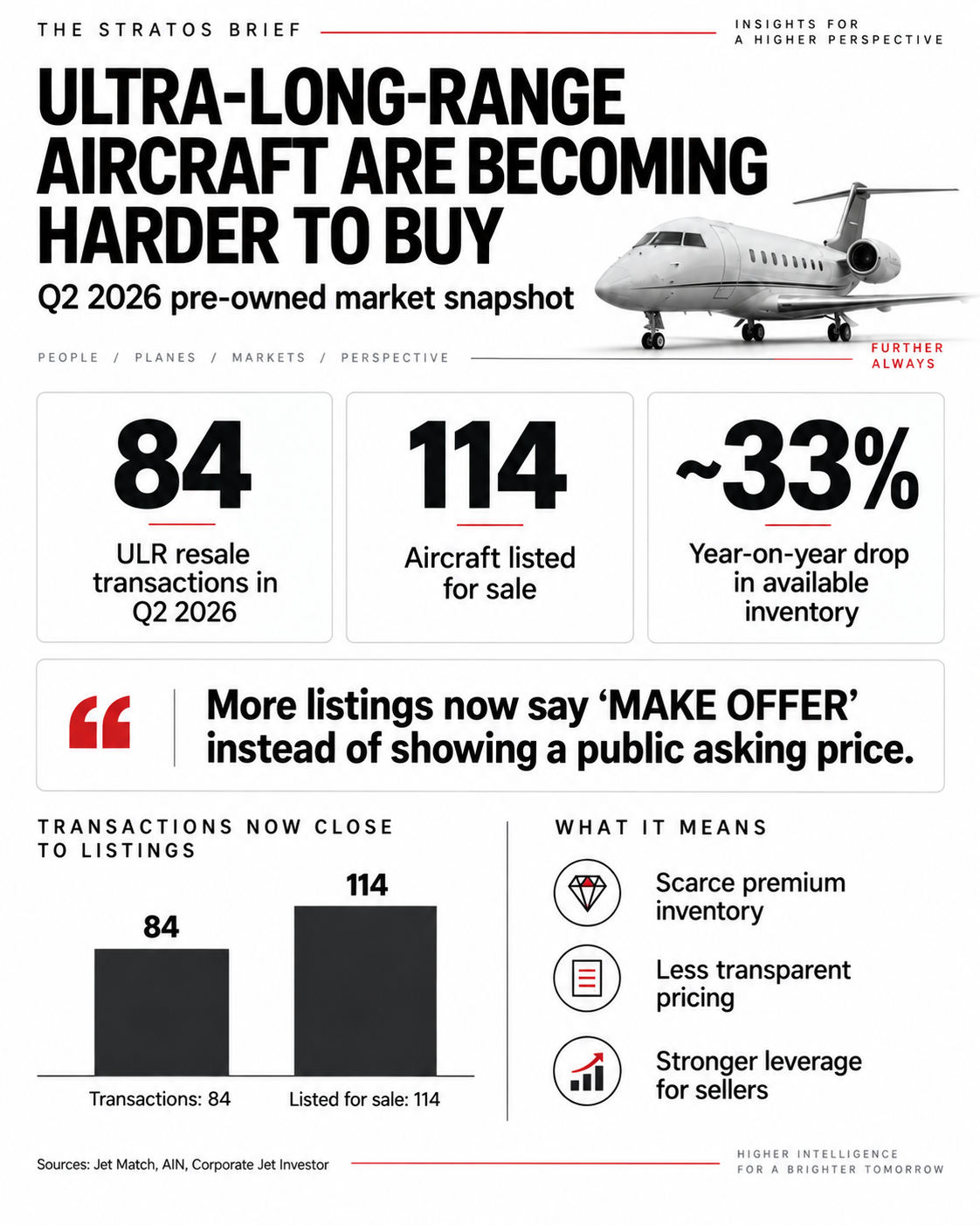
Q2 2026 snapshot of the ultra-long-range pre-owned business jet market. With 84 resale transactions against 114 aircraft listed for sale and available inventory down by roughly one-third year-on-year, premium aircraft are becoming harder to buy and pricing is becoming less transparent. Graphic: The Stratos Brief
Flight activity shows that demand is healthy — but increasingly concentrated
The latest operational data adds an important qualification.
Business aviation is not experiencing uniform growth.
According to ARGUS TRAQPak data reported this week, North American business aircraft activity increased only 0.3% year-on-year in August 2026, substantially below the 3.5% increase that had been forecast. Small-cabin jets and turboprops performed relatively well, while midsize activity declined 1.9% and large-cabin flying fell 6.2%.
The differences between operating models are even more revealing.
Fractional activity increased 7.9% year-on-year, including a 14.9% increase in large-cabin fractional flying. Part 135 charter activity was essentially flat at +0.1%, while Part 91 flying fell 2.9%. Within Part 91, midsize and large-cabin activity both fell by more than 13%.
That divergence matters.
It suggests that customers are not abandoning business aviation, but demand is migrating toward operating models that provide access without requiring traditional whole-aircraft ownership.
Fractional operators offer availability, fleet flexibility, reduced ownership administration and predictable service. For many users, particularly those who fly frequently but cannot justify having a dedicated aircraft sitting idle, that proposition is becoming increasingly attractive.
This also helps explain why companies such as Flexjet are willing to invest heavily in infrastructure. If fractional aviation continues taking a larger share of flight activity, controlling the complete service environment becomes economically more valuable.
ARGUS expects North American activity to slip around 0.1% year-on-year in September, which would represent the first negative monthly comparison of 2026. That would not indicate a collapse, but it would reinforce the picture of a mature market where growth is increasingly selective rather than universal.
Even older aircraft are being pulled into the premium connectivity race
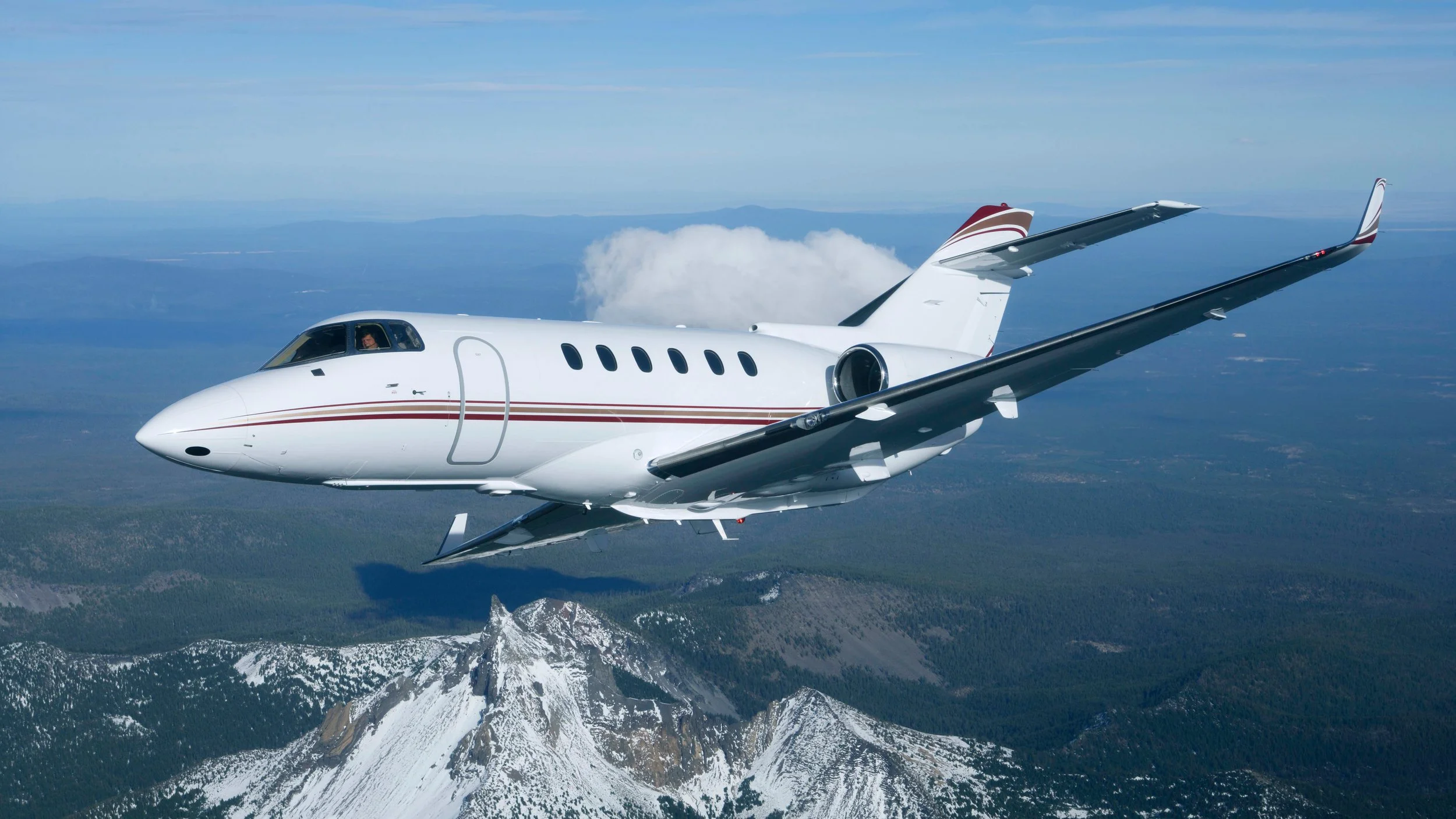
Hawker 900XP in flight. Textron Aviation announced in September 2026 that Starlink high-speed connectivity is now available for Hawker 700, 800 and 900-series aircraft through its customer support network. Photo: Textron Aviation
The week also provided a smaller but telling example of how value is shifting toward the passenger experience.
Textron Aviation announced that Starlink connectivity is now available for Hawker 700, 800 and 900-series aircraft after the FAA issued AeroMech a Supplemental Type Certificate for the installation. Textron says the system can support download speeds of up to 1 Gbps, upload speeds of up to 100 Mbps and latency as low as 20 milliseconds.
The interesting part is not Starlink itself. High-speed satellite connectivity is rapidly becoming expected in premium aviation.
The important part is the aircraft receiving it.
Many Hawker 800-series aircraft are decades old. Yet rather than becoming technologically irrelevant, these airframes can receive cabin upgrades that substantially narrow the passenger-experience gap with much newer aircraft.
This strengthens another increasingly important segment of the business aviation economy: aftermarket modernisation.
A well-maintained older jet with modern avionics, a refurbished cabin and high-speed connectivity can remain commercially useful long after its original technology generation has passed.
For OEMs and maintenance providers, supporting those aircraft can generate revenue for years after production ends. For owners, upgrades can extend useful life and protect residual value. And for charter operators, modern connectivity can determine whether an otherwise capable aircraft remains acceptable to premium customers.
The week’s signal: business aviation is becoming an access economy
Taken together, the week’s developments reveal a market that is healthy but changing in where it creates value.
Bombardier’s confrontation with Washington shows that access to national markets can no longer be taken entirely for granted.
The Global 8000’s London City approval shows that the value of extreme range increases when an aircraft can also reach difficult airports close to the passenger’s destination.
Flexjet’s Farnborough investment demonstrates that large operators increasingly want to control not just the aircraft, but the entire journey around it.
The ultra-long-range resale market shows that access to scarce aircraft and accurate market information can itself command a premium.
And the latest flight data suggests that more customers are choosing fractional access over traditional whole-aircraft operation.
None of this means aircraft performance has stopped mattering. Quite the opposite. The newest business jets are extraordinarily capable machines.
But capability is becoming only the starting point.
The next competitive layer is about who can put the right aircraft in the right place, maintain it reliably, connect it digitally, operate it through the airports customers actually want to use and deliver the complete experience with as little friction as possible.
That may be the most important signal from this week.
Business aviation is gradually shifting from an aircraft market into an access economy.
And the companies that control that access may capture a growing share of the industry’s value.
List of sources
Reuters — U.S. President Donald Trump’s comments on Bombardier and U.S.-Canada trade tensions.
Corporate Jet Investor — Bombardier’s response and details of its U.S. industrial footprint.
Bombardier / Aviation International News — Global 8000 approval for London City Airport operations.
Flexjet — Opening of the company’s Farnborough private terminal and European infrastructure expansion.
Jet Match / Aviation International News / Corporate Jet Investor — Q2 2026 ultra-long-range pre-owned aircraft market data.
ARGUS TRAQPak / Aviation International News — August 2026 North American business aviation flight activity.
Textron Aviation — FAA approval and introduction of Starlink connectivity for Hawker 700, 800 and 900-series aircraft.