How wars are born, grow and die
We usually describe war as an instrument. Governments decide to use military force when diplomacy, deterrence or coercion fail, armed forces receive political objectives, and violence is employed to achieve them. This is essentially the logic behind Clausewitz’s famous description of war as the continuation of politics by other means. It remains one of the foundations of strategic thought, but it describes war most cleanly at the moment before it begins. What happens afterwards is considerably less orderly.
Once people start dying, factories begin changing production, governments stake their survival on particular outcomes and societies reorganise themselves around the conflict, war acquires momentum. The objectives that justified its beginning can change. New objectives can appear. Actions taken by one side create reactions by the other, which produce further reactions in return. Weapons for which nobody had planned become essential, while capabilities considered decisive before the conflict may prove surprisingly ineffective. Economic relationships are broken, new industries emerge, political careers become dependent on victory and casualties already suffered begin influencing decisions about casualties yet to come.
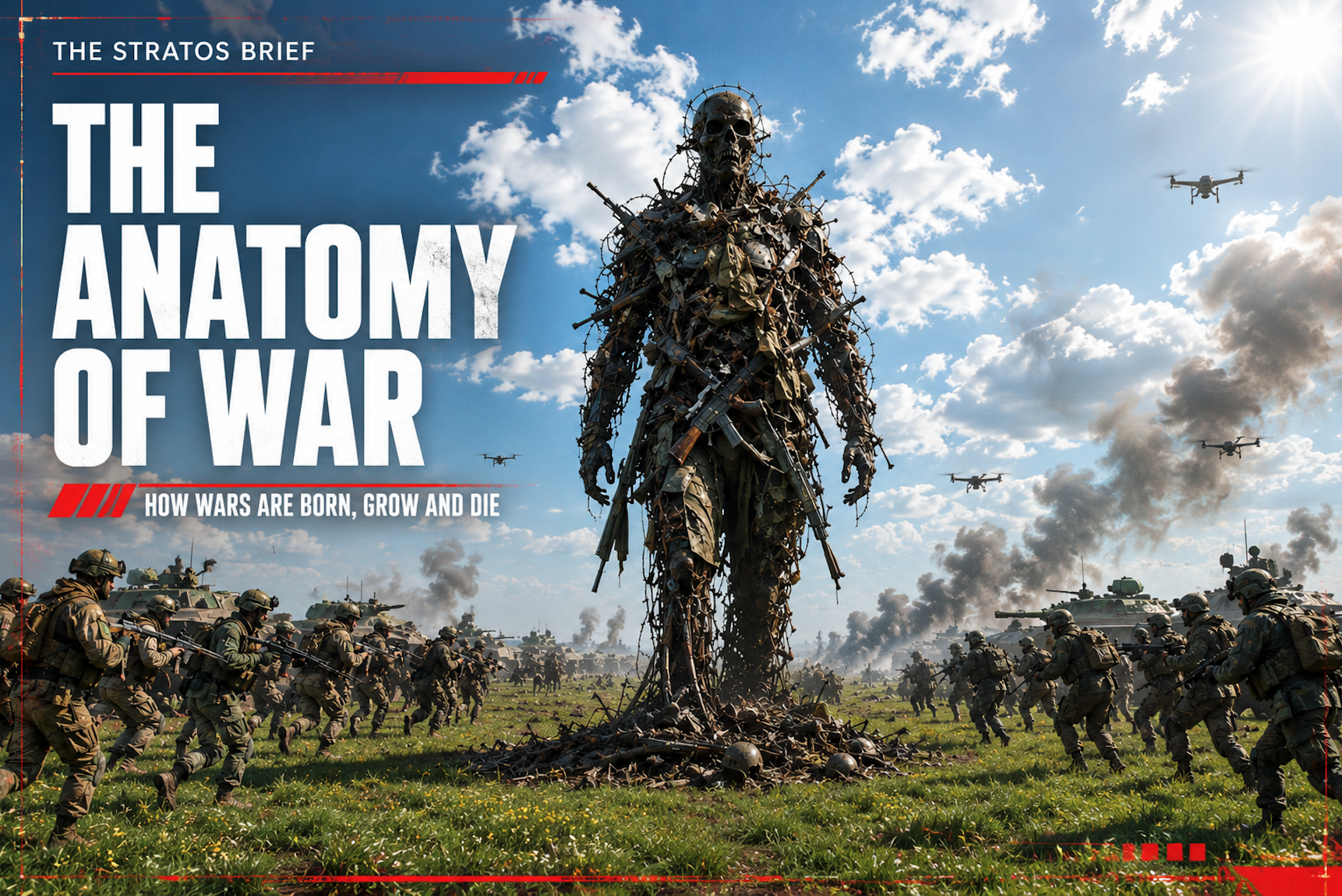
War has no consciousness, of course. It wants nothing. Yet the system created by war can behave disturbingly like an organism. It consumes resources, responds to threats, adapts to its environment and develops mechanisms that help it survive. This is the central paradox of war: people create it for a purpose, but once created, they may discover that controlling its development is much harder than deciding to begin it.
Understanding this transformation is useful because wars separated by centuries, technologies and political systems still share certain anatomical features. Their weapons change dramatically. Some of their underlying mechanisms change surprisingly little.
Before the first shot

Wars begin as calculations long before they become battles.
Perhaps the first question should be the most obvious one: if war is so destructive, why does it happen at all?
This is more difficult to answer than it seems. If two governments know that a war will destroy €100 billion of wealth, kill thousands of people and eventually produce a negotiated settlement, it would appear rational for them to negotiate that settlement before paying the price of discovering it on the battlefield. Political scientist James Fearon formulated this problem particularly clearly: because war is costly, there should normally exist at least some negotiated outcomes that both sides prefer to fighting. Yet wars happen anyway.
One explanation is that states rarely enter wars knowing what those wars will actually cost or how they will end. They operate with incomplete information about the opponent’s capabilities, intentions and tolerance for pain. Worse still, governments have incentives to conceal exactly those things. A state attempting deterrence wants its opponent to believe that it is stronger and more determined than it may really be; consequently, threats and declarations of resolve cannot always be taken at face value. Two governments can therefore examine the same balance of power and both sincerely believe that the other will eventually back down. Fearon’s influential bargaining framework identifies such private information and incentives to misrepresent it, together with problems of credible commitment, among the central rational explanations for why costly wars can occur.
This helps explain why some wars that look irrational in retrospect did not necessarily look irrational to the people who started them. The relevant calculation is not simply whether war is desirable. It is whether war appears preferable to the expected alternative.
That distinction is crucial.
A government that believes its strategic position will deteriorate sharply over the next decade may prefer a dangerous confrontation today to a much worse one tomorrow. A state that expects an opponent to become overwhelmingly stronger may distrust an agreement that leaves that opponent free to exploit its strength later. Another may believe that accepting a territorial or political concession would threaten the survival of the regime itself. In all these cases, the fundamental calculation is moving in the same direction: the perceived cost of not fighting is approaching, and eventually exceeding, the perceived cost of fighting.
This gives us a more useful way to think about the approach to war. Instead of asking only, “Does this country want a war?”, we should also ask, “What does this country increasingly believe will happen if it does not fight?”
The second question may tell us much more.
How a society approaches war
There is no universal checklist that can reliably predict an attack. Armies exercise in peacetime, governments stockpile strategic materials for prudent reasons, politicians use aggressive rhetoric for domestic audiences and states routinely threaten actions they have no intention of taking. The useful signal is therefore rarely one dramatic event. It is the convergence of several different forms of preparation.
Military mobilisation is the most visible, but political preparation may begin much earlier. Leaders start explaining why the status quo is becoming intolerable. The opponent gradually changes in public discourse from competitor to threat, from threat to enemy, and sometimes from enemy to existential danger. Compromise becomes harder to defend domestically because concessions that previously looked pragmatic begin to look like weakness.
Economic behaviour can change at the same time. Governments increase strategic reserves, secure alternative suppliers, protect critical infrastructure, expand military production or prepare financial mechanisms for disruption. Diplomacy also changes character. Negotiating positions become more rigid, communication channels narrow and previously technical disputes acquire symbolic significance. None of these developments individually means that war is coming, but their convergence tells us that a government is acquiring the ability to absorb the consequences of one.
The most revealing variable may therefore be neither rhetoric nor troop numbers but the willingness to accept cost.
If political leadership demonstrates that it is prepared to tolerate sanctions, disrupted trade, fiscal pressure, mobilisation and casualties in pursuit of an objective, an important barrier to war has already weakened. Capability tells us whether a state can fight. Acceptance of cost tells us something about whether it might.
There is, however, an analytical trap here. Governments are very good at searching for these symptoms in their opponents and much less comfortable recognising them in themselves.
The psychological progression towards war is often reciprocal. We begin describing the other side's behaviour as inherently aggressive while interpreting our own mobilisation as defensive. Their alliances are encirclement; ours are deterrence. Their military exercises are preparations for attack; ours demonstrate readiness. Their refusal to compromise proves hostile intent; our refusal demonstrates resolve.
This does not mean that responsibility for every conflict is symmetrical. Aggressors exist, and sometimes the evidence of intent is overwhelming. The point is analytical rather than moral: a state trying to understand whether a crisis is moving towards war must examine not only what is happening across the border but what is happening inside its own decision-making system.
One particularly important warning appears when political discourse begins converging on the proposition that there is no alternative. Sometimes there genuinely is no acceptable alternative to fighting. But once leaders, institutions and populations accept that premise, new information tends to be interpreted through it. Measures that previously appeared prohibitively dangerous become reasonable because they are compared not with peace but with an increasingly catastrophic vision of inaction.
At that stage, war may still be preventable, but the political room in which prevention can occur is becoming smaller.
Is there a point of no return?
History offers many crises in which armies mobilised and ultimately stood down, ultimatums were softened or diplomatic compromises arrived extraordinarily late. There is therefore no universal mechanical point after which war becomes inevitable.
There is, however, something resembling a political point of no return.
Imagine two governments negotiating at the beginning of a crisis. Both can compromise at relatively low domestic cost. Months later, troops have been deployed, money spent, allies given commitments and populations told repeatedly that the issue is vital to national security. A concession that was politically possible at the beginning may now threaten the credibility or even survival of the government making it. If people have already died, the constraint becomes stronger still.
This is where one of the most dangerous features of war appears: past expenditure begins influencing decisions about future expenditure.
Economically, resources already lost are sunk costs. They cannot be recovered by spending more. Strategically, the correct question should therefore be whether another month or another year of fighting will improve the outcome sufficiently to justify its additional cost. Human societies, however, do not process casualties like accountants process depreciated machinery. The argument that those already killed must not have “died for nothing” can create intense pressure to continue fighting even when the original strategic calculation has changed.
War has now acquired one of the characteristics that makes the organism metaphor useful. What it consumed yesterday can help justify what it consumes tomorrow.

Once the shooting starts, assumptions meet an enemy with plans of his own.
The war that was planned begins to disappear
The opening phase of a conflict is often the moment at which pre-war expectations encounter an adversary who has his own expectations.
Campaign plans are built on assumptions: how quickly forces can advance, how effectively air defence will work, whether allies will intervene, whether populations will resist, how much ammunition will be consumed, how reliable communications will remain and how the opponent will react. Some assumptions prove correct. Others survive only days.
The conflict then begins producing information at extraordinary speed.
A successful tactic is observed and copied. Once copied, it generates a countermeasure. The countermeasure creates demand for another adaptation. Equipment is modified, doctrine changes, units reorganise and procurement authorities discover that requirements written years earlier may no longer correspond to what soldiers need next month.
Ukraine provides an unusually visible contemporary example. The proliferation of unmanned systems has been accompanied by continuous adaptation in electronic warfare, communications, navigation, targeting and counter-drone technology. CSIS describes an ongoing adaptation spiral in which battlefield experience rapidly generates new techniques and technologies; separate CSIS research has documented how Ukraine built a more decentralised, commercially oriented procurement ecosystem for drones and software-intensive capabilities when traditional acquisition structures could not respond quickly enough.
This teaches a broader lesson that extends well beyond Ukraine: military power is not static.
The order of battle on the first morning of a war tells us what each side brought into the conflict. It does not tell us what those forces will become.
A military that begins with superior equipment but learns slowly may see its advantage erode. A weaker opponent that connects frontline experience rapidly to engineers, factories, training establishments and commanders can close gaps that appeared enormous before the fighting began. The relevant competition therefore becomes not merely tank against tank or missile against missile, but adaptation cycle against adaptation cycle.
War is learning.
And every lesson learned by one side becomes a problem the other must solve.
The metabolism of war
Adaptation explains how war changes. Economics explains how long it can continue.

Wars are fought by militaries, but sustained by entire industrial systems.
Modern military discussions naturally concentrate on platforms: aircraft, missiles, ships, tanks, drones and air-defence systems. Prolonged war eventually shifts attention from the performance of individual platforms to rates: rounds per day, interceptors per month, engines per year, repair turnaround times, available technicians, replacement crews and the number of systems that industry can deliver after existing stockpiles have been depleted.
That is the metabolism of war.
A military may enter a conflict with an impressive inventory and still be poorly configured for a long war if its weapons are difficult to replace, its supply chains depend on vulnerable foreign inputs or its industrial base cannot increase production. Conversely, a less sophisticated system may acquire enormous strategic value if it can be manufactured cheaply, modified rapidly and produced in quantities that correspond to wartime consumption.
This is one reason the defence-industrial lessons of Ukraine have attracted so much attention. Recent analysis emphasises not only drones but the need to connect production to a persistent battlefield innovation loop and to maintain the ability to surge industrial output in a protracted conflict. NATO has reached a similar conclusion at the institutional level: increasing defence budgets is insufficient if industry cannot convert those budgets into the required capabilities and production capacity.
The distinction sounds obvious, but it has major strategic consequences.
Money is not ammunition. A contract is not a missile. GDP is not a brigade.
Economic resources become military power only after passing through factories, skilled labour, raw materials, energy, transport networks, maintenance organisations and training systems. Each of those is a potential bottleneck.
This also explains why the economic balance between belligerents cannot be understood simply by comparing their nominal GDP. What matters in a prolonged war is how much economic capacity can actually be converted into sustainable combat power, how rapidly that conversion can occur, how vulnerable the process is to disruption and how much reduction in civilian consumption a political system can tolerate.
The economy is not behind the war. In a prolonged conflict, the economy gradually becomes part of the battlefield.
Then something even stranger happens: the war changes its purpose
Governments usually enter wars with declared objectives. Secure this territory. Remove this threat. Restore this border. Punish this attack. Protect this population. Force this concession.
But wars create new political facts.
Territory changes hands. Cities are destroyed. Soldiers are killed. Populations are displaced. Alliances form. Economies become dependent on wartime production. Political leaders build their legitimacy around promises of victory. Atrocities can create demands for punishment that did not exist before the fighting. Each side learns things about the other that change its perception of what future coexistence would require.
Consequently, the objectives that sustain a war after several years may no longer be identical to those that caused it.
This is perhaps the strongest sense in which war appears to develop a life of its own. It does not literally create objectives; people do. But the environment created by the fighting changes their incentives until new objectives emerge from the consequences of pursuing the old ones.
A conflict started over one disputed issue can therefore become a conflict about security guarantees, regime survival, reparations, territorial buffers, justice, prestige or the political future of entire populations. Ending it now requires solving problems that did not exist when it began.
The war has created part of the political landscape necessary for its own continuation.

As war continues, it creates consequences that become reasons for its own continuation.
How, then, does a war die?
The intuitive answer is that wars end when one side wins. History is less tidy.
Some wars end in decisive military defeat, but many conclude without either belligerent achieving everything it originally sought. Governments negotiate because their expectations have changed. External support disappears. Political leadership changes. Economic costs become intolerable. Military prospects deteriorate. Objectives are quietly reduced. Or both sides simply acquire enough information to recognise that the outcome they are still trying to obtain is unlikely to justify what obtaining it would cost.
This brings us back to the bargaining problem with which war began.
Before the conflict, the two sides may have possessed incompatible beliefs about their relative strength or resolve. Fighting brutally generates information. An army expected to collapse does not. An ally expected to remain neutral intervenes. A sanctions regime proves weaker or stronger than anticipated. An offensive fails. An industrial base performs differently from forecasts. Over time, the range of imaginable outcomes changes.
This does not make war an efficient way of discovering information. It is an appallingly expensive one. But it helps explain why negotiations that were impossible in year one can become possible in year three without either side suddenly becoming benevolent.
The calculation has changed.
One useful indicator that a war may be approaching such a stage is therefore not simply exhaustion but convergence of expectations. Public language can begin changing before formal negotiating positions do. Absolute objectives acquire qualifications. Victory becomes defined more flexibly. Previously unthinkable compromises become subjects of discussion. Governments begin preparing their populations not only for continued sacrifice but for what an acceptable settlement might look like.
The central strategic question is slowly changing from “How do we obtain everything we want?” to “What can we still obtain at an acceptable price?”
That is often how wars begin to grow old.
Why hurting the enemy is not the same as making him stop
If continuing war is a calculation, then forcing an opponent to stop should theoretically be straightforward: make continuation sufficiently expensive.
In practice, coercion contains another paradox. An opponent does not compare the cost of continuing only with the cost of peace. It compares it with the expected consequences of stopping.
Suppose military pressure convinces a government that victory is impossible, but that government also believes defeat will lead to its destruction, occupation or removal. The expected cost of surrender may still exceed the expected cost of continuing an apparently hopeless war. The same logic can operate at the level of states: if today's peace agreement cannot credibly prevent an opponent from exploiting a stronger position tomorrow, concessions that appear rational to outsiders may look suicidal to those expected to make them.
This is the commitment problem again, now appearing at the end of war rather than its beginning.
Successful coercion therefore often requires two messages that appear contradictory but are strategically complementary: continuing the war will make your position worse, and ending it will leave you with an outcome you can survive.
This is why an off-ramp is not necessarily a gift to an adversary. Under some conditions it is part of the mechanism that makes coercion work.
Remove every imaginable off-ramp and the enemy may conclude that there is no meaningful distinction between losing tomorrow and continuing today. At that point, additional punishment can strengthen rather than weaken the incentive to fight.

A war can end only when continuing it becomes less attractive than an available alternative.
Can escalation create peace?
This question sits near the uncomfortable centre of strategic thought because the answer is neither always yes nor always no.
Escalation can alter an opponent's expectations. A new capability, widening of permitted targets, additional mobilisation or demonstration of previously withheld resolve may convince the other side that the trajectory of the war has changed and that delaying settlement will only produce a worse outcome. In that sense, escalation can contribute to war termination.
But the same mechanism contains obvious danger. The side escalating knows what message it intends to send; the recipient observes only the action.
What one government regards as a carefully calibrated increase in pressure may be interpreted by another as preparation for a much larger attack. The opponent responds to that perceived threat. The first side interprets the response as confirmation of hostile intent and escalates again.
Both can therefore climb an escalation ladder while believing that the other is forcing them upwards.
This is why “escalate to de-escalate” is a dangerously incomplete formula when removed from context. Escalation is not a button that produces negotiation. It is an attempt to manipulate another actor's expectations under conditions of imperfect information, precisely the environment that helped make war possible in the first place.
It can shorten a war.
It can also enlarge it.
Knowing which effect is more likely requires understanding not merely one's own red lines and objectives but the opponent's perception of them.
What the anatomy of war tells us
Looking at war as an organism ultimately changes the questions we ask about it.
For political leaders, the important period begins long before mobilisation. Deterrence depends not only on possessing military power but on communicating both capability and intention accurately enough that an opponent does not build strategy around a false expectation. Equally important is recognising when one's own political system is progressively narrowing its choices until military action begins to appear inevitable. The most successful crisis management may therefore be the kind that preserves credible alternatives even while preparing seriously for war.
For military planners, the lesson is that readiness cannot be measured only by the force available on day one. A military should ask how it will look on day 100 and day 1,000: how rapidly it learns, how it replaces losses, whether its logistics remain functional under attack, how quickly doctrine can change and whether industry can modify equipment at the speed with which the enemy develops countermeasures. The Ukrainian experience has made this adaptation problem unusually visible, particularly in autonomous systems, electronic warfare and contested logistics.
For defence companies, war exposes the difference between manufacturing products and sustaining a military ecosystem. Production volume matters, but so do repairability, component availability, alternative suppliers, software updates, surge capacity and the ability to incorporate operational feedback while equipment is already being produced. A perfect system that arrives after the operational problem has changed may be less useful than an imperfect one that evolves with the battlefield.
For businesses outside defence, the lesson is that war rarely remains geographically confined to the place where soldiers fight. Energy, shipping, insurance, commodities, credit, sanctions, labour markets and supply chains transmit conflict into economies thousands of kilometres away. Global military expenditure reached $2.887 trillion in 2025, according to SIPRI, after an extraordinary 9.7 per cent real increase in 2024 and a further 2.9 per cent rise in 2025. War and preparation for war are therefore not peripheral economic phenomena; they increasingly shape capital allocation and industrial policy on a global scale.
And there is one final analytical lesson.
Political leaders begin wars, military leaders conduct them, industries sustain them, soldiers fight them and civilians absorb a significant part of their consequences. These groups do not experience the cost of war in the same way. That asymmetry matters not merely morally but strategically, because each group therefore has different incentives regarding escalation, endurance and termination. A government may regard another six months of fighting as tolerable in a way that a depleted infantry battalion does not; a factory may experience the same six months as unprecedented demand; a displaced family experiences them as six months without a home.
A state that wants to understand its own ability to continue a war must therefore understand all of these layers, not merely the battlefield.
That is ultimately what makes the organism metaphor useful.
War is not actually a monster standing between two armies. It has no independent mind and no secret objective. But once created, it connects political survival, military necessity, industrial production, technological adaptation, public emotion, economic interests, fear, revenge and accumulated sacrifice into a system that no single participant completely controls.
At the beginning, the question is whether political leaders can use war to change reality.
Later, the question can become how much war has changed the political reality in which those leaders themselves must operate.
And that may be the most important factual lesson contained in its anatomy: wars do not merely consume resources in pursuit of political objectives. They continuously alter the resources, the actors, the incentives and eventually even the objectives themselves.
That is why starting a war and controlling a war are two fundamentally different problems.
And why understanding how wars end should begin long before the first one is allowed to start.