The Problem Leonidas Is Trying to Solve

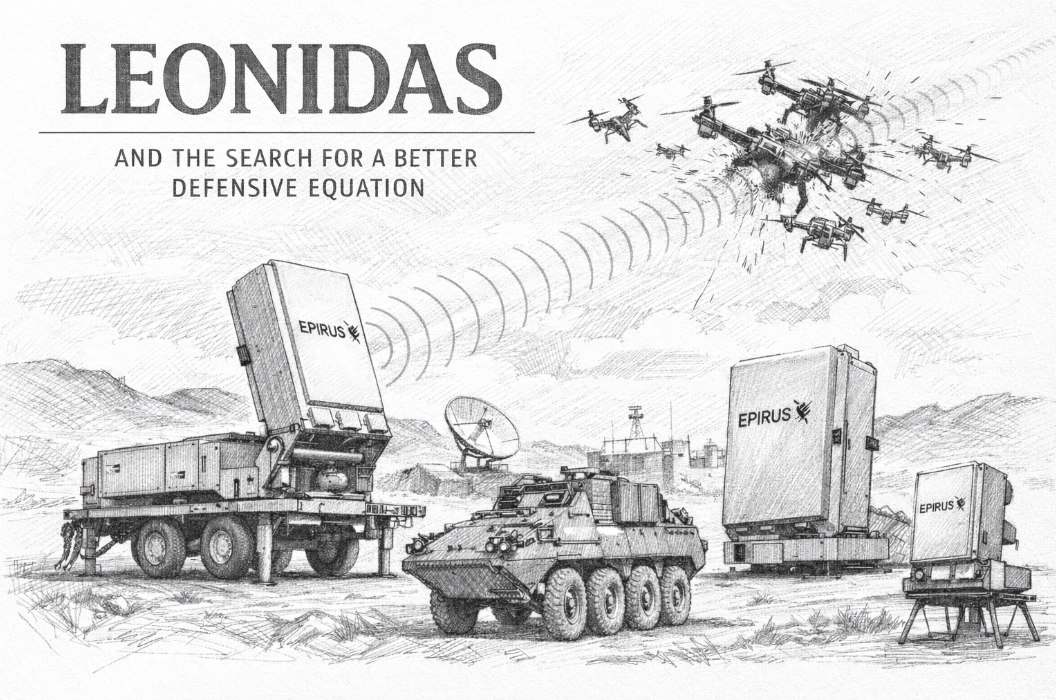
The case for Leonidas is not that it is futuristic. The case is that it may address a problem conventional air defence handles poorly: the mismatch between cheap, proliferating drones and expensive, finite defensive interceptors.

That problem is no longer hypothetical. The United States (U.S.) Army’s Indirect Fire Protection Capability – High-Power Microwave (IFPC-HPM) effort is explicitly aimed at protecting fixed and semi-fixed sites against small uncrewed aircraft systems (UAS), including groups and swarms approaching from different directions and altitudes. In Army language, the system is intended to provide 360-degree protection for those assets. In May 2025, the Army described IFPC-HPM as the first material-released directed-energy weapon system specifically designed to counter groups and swarms of drones.

Leonidas is Epirus’s answer to that requirement. Public company material describes it as a family of solid-state, software-defined, long-pulse high-power microwave (HPM) systems built around Gallium Nitride (GaN) semiconductors and modular line-replaceable amplifier modules. Epirus also says the system is designed for open-architecture integration with Forward Area Air Defense Command and Control (FAAD C2), and that software-driven waveform optimisation is central to how the platform improves range and firing efficiency over time.

From Technical Principle to Military Relevance

That matters because the central question is not whether Leonidas can disable electronics. High-power microwave effects against electronics are not new. The more important question is whether Epirus and the Army are beginning to turn that principle into something operationally useful: mobile enough, safe enough, scalable enough, and sufficiently integrated into the kill chain to alter how militaries defend infrastructure and forward positions against dense small-UAS attacks. The public record now suggests that this is a serious effort, but not yet a settled answer.

The program timeline is substantial enough to take seriously. On 23 January 2023, Epirus announced a $66.1 million U.S. Army contract through the Rapid Capabilities and Critical Technologies Office (RCCTO) for IFPC-HPM prototypes. The company delivered its first system in November 2023 and said it completed delivery of all four systems by March 2024, with new equipment training and engineering developmental testing completed by May 2024. The Army later said the 1st Multi-Domain Task Force (MDTF) first fielded the HPM systems in February 2024 and had since tested them across a range of environments.

That is the first reason Leonidas deserves attention. It is no longer best understood as a laboratory demonstration or venture-funded concept. It has moved into a more serious phase of Army experimentation, limited fielding and iterative development. In July 2025, Epirus announced a further $43.55 million Army contract for two IFPC-HPM Generation II systems, with the company saying the next increment is expected to more than double range and improve power, lethality and usability over the first generation. Those are company claims rather than independently published Army performance figures, but they indicate continued Army investment rather than disengagement.

Why the Real Significance Is Economic

The second reason Leonidas matters is economic rather than technical. Against small drones and swarms, the core defect of much existing air defence is not a lack of destructive power. It is a poor cost exchange and shallow magazine depth. A one-shot interceptor against a cheap quadcopter is often an economically irrational answer even when it works. Epirus states this point bluntly in its own material, arguing that the United States has spent more than $2 million per unit to defeat drones costing hundreds or thousands of dollars. That exact phrasing is advocacy, not neutral analysis. The broader logic, however, is difficult to dispute: a defender that must answer cheap mass with expensive precision is operating on unfavourable terms from the outset.

Leonidas is attractive because it proposes a different defensive equation. A high-power microwave effector is potentially one-to-many rather than one-to-one. It is designed to affect electronics across a beam or protected sector rather than requiring a separate shot for each incoming drone. If such a system can operate reliably at tactically relevant ranges and under real field conditions, it could reduce pressure on missile inventories, improve magazine depth for base defence, and make layered air defence cheaper at the low end of the threat spectrum. That is the real significance of Leonidas. It is not a “force field.” It is a bid to change the economics of defeating mass.

What the Demonstrations Do — and Do Not — Prove

The evidence base for that proposition is strongest in the counter-swarm lane. In September 2025, Epirus said a Leonidas system defeated 61 of 61 drones flown during a Camp Atterbury live-fire event, culminating in a 49-drone swarm kill with one pulse of electromagnetic interference. The scenario sequence described in the company’s release closely matches the widely circulated Sam Eckholm video about Leonidas. That is useful because it suggests the demonstration was real and structured. It is also important to note that Epirus Chief Executive Officer (CEO) Andy Lowery said publicly that the company had “teamed up” with Eckholm to tell the story, which means the video should be read as company-assisted access content, not independent operational evaluation.

That distinction matters. Leonidas may be credible, but the burden of proof is still different for a tightly managed live-fire demonstration than for sustained operational use. Publicly available Army and Epirus material does not disclose the most important hard numbers for serious military comparison: output power, frequency details, true maximum effective range, performance in adverse weather, sustained duty cycle, effects against hardened electronics, or the degree to which the system remains effective once an adversary begins adapting deliberately. The public story is therefore strong on concept validation and program momentum, but still thin on the specific parameters that determine combat utility.

Where the Program Stands in Army Terms

The Army’s own acquisition posture reinforces that caution. In June 2025, the Government Accountability Office (GAO) reported that all variants of IFPC had encountered performance or integration issues delaying transition into production. For IFPC-HPM specifically, GAO said the planned transition to a program office had been delayed; the Army chose to extend prototype testing to gather more data, including integration with the Integrated Battle Command System (IBCS) and user assessments; and senior Army leadership would decide whether to continue investing in or divest from the effort. GAO also noted that IFPC-HPM’s capability development document was approved in April 2025. That is a meaningful milestone, but it is not the same as a mature, de-risked production decision.

This is the right way to read Leonidas today. It is neither a speculative curiosity nor a finished answer. It is an advanced prototype family with credible Army backing, demonstrated utility against the mission that matters most to it, and enough remaining uncertainty to make overclaiming unwise.

Expansion Beyond the Core Army Use Case

The platform’s expansion beyond the core Army base-defence role is also worth watching, though here the evidence becomes more company-led. In April 2025, Epirus announced delivery of Expeditionary Directed Energy Counter-Swarm (ExDECS) to Naval Surface Warfare Center Dahlgren to support the U.S. Marine Corps. The same month, the company introduced Leonidas H₂O for maritime interdiction and uncrewed aerial vehicle (UAV) protection, saying it had demonstrated effects against outboard boat motors during a U.S. Navy exercise. In January 2026, Epirus also claimed Leonidas had successfully defeated a fibre-optic-controlled drone by attacking onboard electronics rather than the control link. If that proves repeatable, it would be a significant development because fibre-optic guidance bypasses the classical jamming problem. At present, however, these remain company-reported results rather than independently published government test conclusions.

The Force-Design Question

For policy and procurement audiences, the deeper issue is what Leonidas implies about force design. If one accepts that low-cost autonomous and semi-autonomous air threats will continue to proliferate, then the defender requires more than better sensors and faster cueing. The defender also needs an effector mix that can absorb mass without bankrupting itself or exhausting itself after a few salvos. That does not eliminate the role of missiles, guns or lasers. It changes how they should be prioritised within a layered architecture. Microwave systems, if they mature, are most compelling where density, simultaneity and cost pressure matter more than exquisite single-target engagement.

That has consequences beyond tactics. A credible one-to-many counter-swarm effector would influence procurement, force protection doctrine, site design and industrial planning. Fixed installations, expeditionary airfields, logistics hubs and ships would all be judged differently if they could defend against dense small-UAS attacks without relying solely on finite stores of expensive interceptors. The economic question would shift from the cost of each defensive shot to the cost of fielding and sustaining enough systems to cover the right assets, with the right sensors, power management and command integration. In that sense, Leonidas is as much a war-economics story as a weapons story.

The Industrial Test Still Ahead

There is also an industrial angle. In March 2025, Epirus announced a $250 million Series D round, saying the capital would help scale Leonidas production. That does not prove the company can manufacture at wartime pace. It does indicate that production capacity is now part of the business thesis, not an afterthought. For any technology seeking relevance in this part of the market, that matters. A counter-swarm system that works but cannot be produced, integrated, updated and sustained quickly enough is strategically less important than a slightly less elegant one that can.

A Narrow but Serious Conclusion

The strongest near-term conclusion is therefore a narrow one. Leonidas appears to be one of the more serious attempts in the public domain to move high-power microwave counter-UAS from promising concept to fielded capability. Its value lies in the possibility that it improves the defensive cost equation against small-UAS mass and swarm attacks. The available evidence supports taking that possibility seriously. It does not yet justify treating the system as a universal solution, a mature program of record, or proof that the wider counter-drone problem has been solved.

If Leonidas continues to perform as advertised and survives the harder tests of integration, user assessment and procurement transition, its significance will extend beyond directed energy. It will stand as evidence that one part of modern air defence is being forced to relearn an old lesson under new technological conditions: in warfare, the most consequential systems are often the ones that do not simply destroy targets, but alter the terms on which destruction becomes affordable.