The United States remains the central military supplier inside the Western alliance system. What has changed is not that reality, but its practical terms. Recent reporting indicates that Washington has warned some European governments to expect delays in previously contracted weapons deliveries because the war involving Iran is putting additional strain on U.S. stocks of weapons and ammunition. Reuters reported that Estonia and Lithuania were among the countries notified, and that the affected deliveries included both offensive and defensive munitions sold through the Foreign Military Sales process.

That matters because it exposes a distinction European defence planning has often preferred to blur: access is not the same as timely access. In peacetime, it is easy to treat alliance membership, defence-industrial ties and formal procurement channels as proof that critical systems will be available when needed. In a period of overlapping crises, that assumption weakens. The same Reuters reporting says European officials are increasingly concerned that repeated delays could damage preparedness and are beginning to look more seriously at European-made alternatives.

This is not, first of all, a story about alliance breakdown. Estonia’s defence minister said this week that he remained confident the United States would defend its allies in the event of a Russian attack, even while acknowledging that Europe is not yet capable of defending itself independently and that European states need to spend more on defence. That is an important signal. The political core of the alliance may still hold, while the industrial and inventory side becomes more strained and less predictable.

Seen from that angle, the real issue is not American intent. It is American capacity under simultaneous demand. Reuters has separately reported that U.S. support for Ukraine’s air defence has already come under pressure this year, with Ukrainian F-16s facing a missile shortage for more than three weeks after partner supplies dried up, and that the Iran conflict could divert American air-defence missiles away from Ukraine at a moment when Russia continues large-scale aerial attacks.

That is the harder lesson for Europe. A defence relationship can remain politically intact and still become operationally less reliable under stress. If several theatres draw on the same U.S. production base, the bottleneck is no longer diplomatic commitment but industrial throughput, stockpile depth and sequencing. Europe has spent years debating strategic autonomy in abstract political terms. The more immediate problem may be narrower and more concrete: if the United States is simultaneously arming itself, supporting active operations in the Middle East, sustaining Ukraine and servicing allied orders, then not every allied customer will receive what it wants on its preferred timeline.

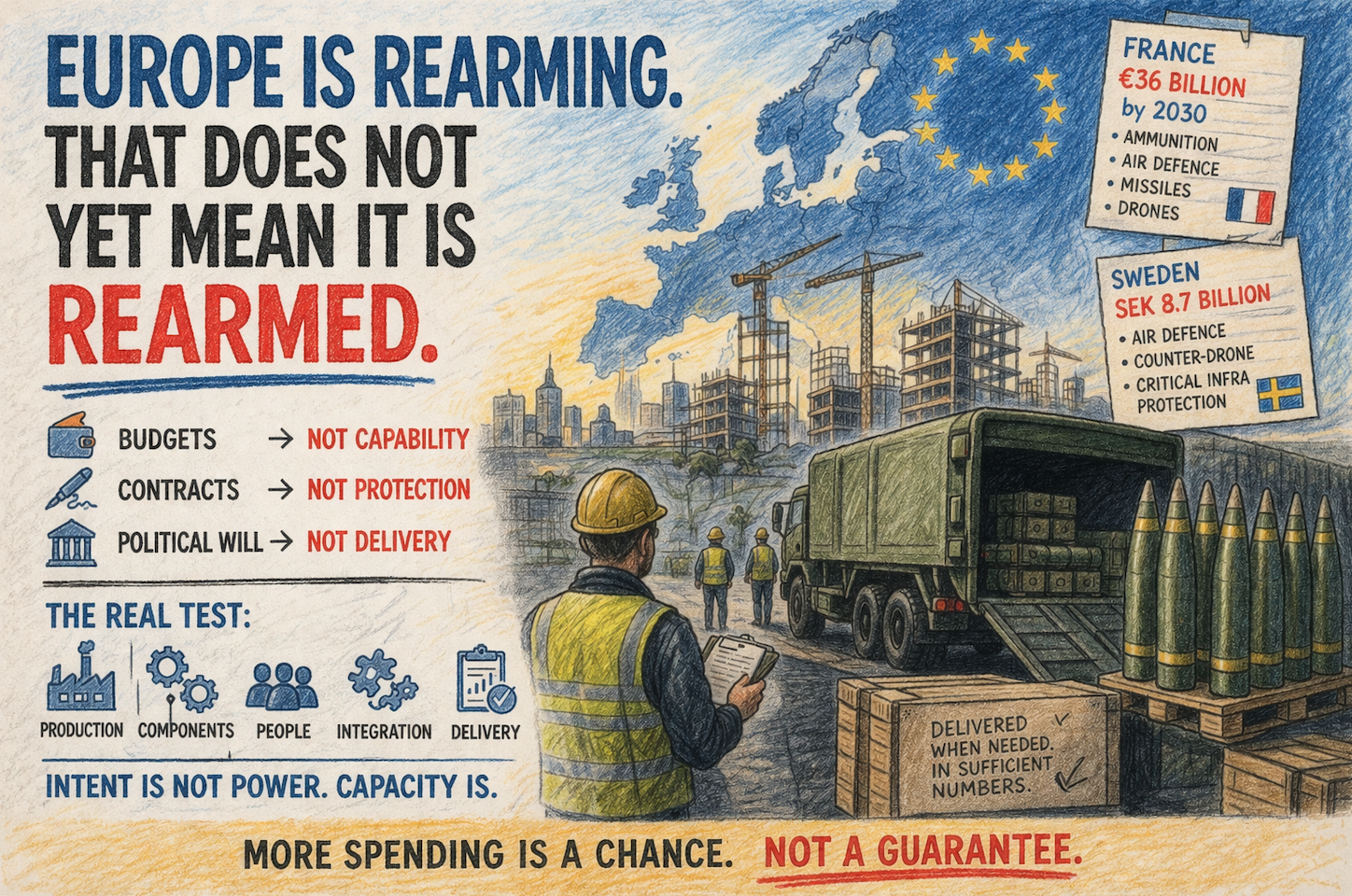
This does not make European substitution easy. Europe is trying to accelerate rearmament, but recent reporting points to structural limits there as well. France has announced a €36 billion rearmament increase by 2030, including spending on munitions, air defence, missiles and drones. At the same time, Reuters has reported supply bottlenecks in Europe’s mini jet engine sector that are constraining production of Ukrainian long-range strike drones, with analysts explicitly linking those constraints to Europe’s broader reliance on U.S. capabilities.

That combination is what makes the current moment strategically important. Europe is not dealing with a simple binary choice between American dependence and European self-sufficiency. It is facing a more uncomfortable reality: the American backstop is still indispensable, but less frictionless than many planners would prefer, while Europe’s own industrial base is improving but still constrained in critical segments. In that environment, delivery timing becomes part of deterrence. A capability that exists on paper but arrives late is still a weakness.

There is also a broader implication for procurement strategy. If delays become recurrent rather than exceptional, European governments will have stronger incentives to diversify suppliers, expand domestic and continental production, and prioritise systems where replenishment and production cadence matter as much as performance. That does not mean decoupling from the United States. It means taking inventory risk seriously as a strategic variable. Reuters’ reporting suggests some European officials are already moving in that direction by reassessing European-made alternatives.

The central point, then, is narrower than much of the rhetoric around sovereignty and burden-sharing. Europe’s problem is not that the United States has ceased to be the arsenal of the West. The problem is that even the arsenal has limits, queues and competing priorities. For European defence planners, that is not an ideological statement. It is a planning assumption that now deserves to be updated.

Sources
Reuters, “US to delay weapons deliveries to some European countries due to Iran war, sources say” (16 April 2026).
Reuters, “NATO will not collapse and US will defend its allies, Estonian minister says” (17 April 2026).
Reuters, “Exclusive: Ukraine's F-16 jets were starved of US-made missiles for weeks” (5 March 2026).
Reuters, “Iran conflict may divert US weapons from Ukraine” (4 March 2026).
Reuters, “US sending Marines and amphibious assault ship to Middle East, officials say” (March 2026 sitemap entry).
Reuters, “France plans 36 billion euro boost to rearmament, nuclear deterrent expansion” (8 April 2026).
Reuters, “Ukraine's attack drone fleet faces a mini jet engine supply crunch” (6 April 2026).
Reuters, “Russia launches drones, missiles overnight and through the day” (15 April 2026).