Date published: 5 June 2026
Event date: Structural analysis
Event location / region: Global defence and aerospace markets
Event type: Strategic procurement, defence consulting, market entry, stakeholder engagement, public affairs
Why major defence opportunities are often shaped long before the tender is published
By the time a major defence tender appears on a public procurement portal, the most important part of the competition may already have taken place.
The requirement has been discussed. The capability gap has been framed. Budget logic has been tested. Internal supporters and sceptics have formed their views. Political sensitivities have emerged. Industry expectations have been shaped. Media narratives may already exist.
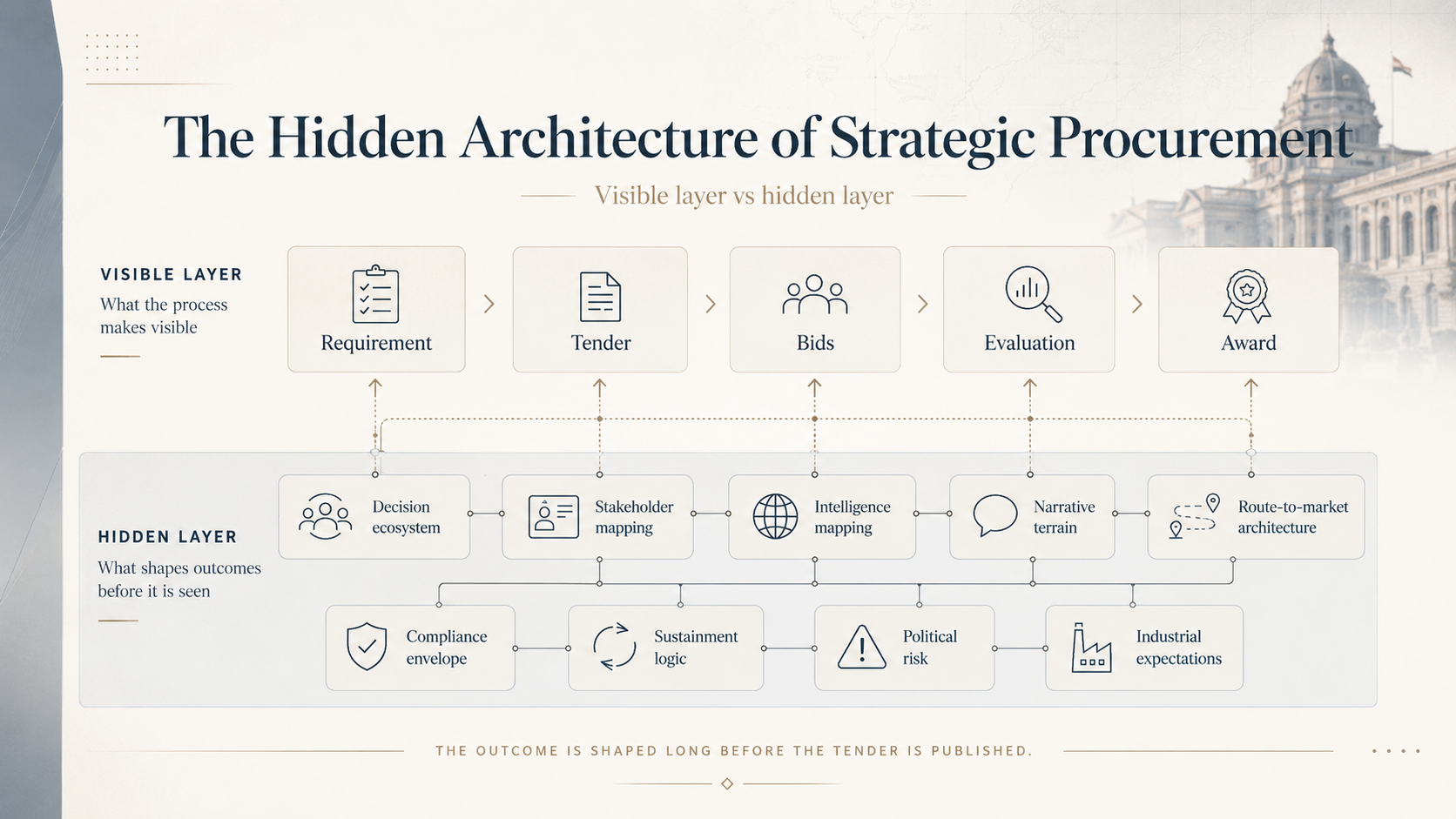
For outside observers, defence procurement often appears to follow a clear sequence: a capability need is identified, a tender is launched, companies submit bids, offers are evaluated and a winner is selected.
That sequence is real. It matters. It is governed by law, procedure and documentation.
But it is only the visible layer.
Behind it sits a more complex architecture of stakeholders, operational priorities, institutional incentives, alliance commitments, industrial expectations, political risk, public narratives and long-term sustainment concerns.
This hidden architecture is where many strategic defence opportunities are truly shaped.
It is also where serious defence consulting operates.
Not as a shortcut around the system. Not as improper influence. Not as a substitute for a strong product. And not merely as “knowing the right people”.
At its best, defence consulting is the discipline of understanding how strategic procurement decisions are actually formed, challenged, communicated and sustained.
A contact can open a door. It cannot create a requirement, repair a weak offer, neutralise poor timing or replace credibility.
The decision ecosystem
The first mistake many companies make in defence is assuming that the customer is obvious.
In reality, the “customer” in a strategic defence opportunity is rarely one person or even one institution. It is a decision ecosystem.
The end user may be the armed force.
The budget holder may be the ministry.
The specification may be shaped by a technical authority.
The political mandate may come from government.
The scrutiny may come from parliament.
The industrial expectation may come from domestic industry.
The legal framework may be controlled by procurement authorities.
The operational urgency may be influenced by allies, exercises, incidents or battlefield lessons.
The public acceptability may be shaped by media narratives.
This is why Stakeholder Mapping is not a cosmetic exercise. It is one of the core tools of strategic market entry.
A serious stakeholder map is not a list of names. It is a living intelligence product. It identifies who owns the problem, who controls the resources, who understands the technology, who fears the political consequences, who can block the process, who needs reassurance, who will operate the system, who will maintain it and who may be blamed if the programme fails.
A useful stakeholder map asks harder questions.
Who has formal authority?
Who has informal influence?
Who is technically credible?
Who is institutionally cautious?
Who has been disappointed by previous procurements?
Who is worried about lifecycle cost?
Who sees the capability as urgent?
Who sees it as a distraction?
Who benefits from delay?
Who needs the decision to be publicly defensible?
These questions often matter before the first formal bid is written.
A company that understands only the tender document understands the surface. A company that understands the decision ecosystem understands the terrain.
Intelligence Mapping: reading weak signals
Defence opportunities rarely begin with a tender.
They often begin with a speech, a doctrine update, a budget line, a parliamentary question, an operational lesson, a capability gap, a failed procurement, an accident, a NATO commitment or a quiet change in institutional language.
This is where Intelligence Mapping becomes valuable.
In this context, intelligence does not mean espionage. It means structured analysis of legally and ethically available information: public budgets, strategic documents, military exercises, procurement histories, conference remarks, media coverage, industrial partnerships, personnel changes and regional security developments.
The challenge is not only collecting information. The challenge is interpretation.
A single budget line may indicate real funding, political signalling or bureaucratic inertia. A public statement may reflect genuine intent or diplomatic language. A capability gap may be urgent, but unfunded. A user requirement may exist, but lack political support. A tender may be public, but the real competitive terrain may have been shaped long before publication.
The first signal rarely looks like a procurement.
Sometimes it looks like one sentence in a defence strategy.
The narrative around the capability
Every strategic procurement has a narrative.
Sometimes that narrative is controlled by the customer. Sometimes by industry. Sometimes by critics. Sometimes by media. Sometimes by previous procurement failures. Sometimes by geopolitics.
The narrative determines whether a capability is seen as urgent, excessive, overdue, risky, foreign-dependent, politically sensitive, industrially attractive or operationally essential.
This is where public affairs becomes part of the defence consulting lifecycle.
In defence, public relations is not simply about visibility. Visibility without discipline can damage a project. A company can be too loud too early, too quiet when the debate is being shaped, too technical for political audiences or too political for military audiences.
The real task is not promotion. It is Narrative Terrain Mapping.
Before a company enters a defence market, it needs to understand the information environment around the capability.
Has the country had a failed procurement in this area before?
Is there public sensitivity about cost?
Is domestic industry expected to participate?
Is foreign dependence politically controversial?
Are there concerns about corruption, sovereignty, interoperability, sustainment or export restrictions?
Which media understand the topic?
Which commentators influence the debate?
Which arguments are already present before the company says anything?
A defence capability may be technically strong and still fail if the narrative around it is weak.
At the early opportunity stage, communication is often about making the problem visible. Not the product. The problem.
At the requirement-shaping stage, public affairs helps explain the capability gap. Why is this capability needed? What operational risk does it reduce? What are allies doing? What happens if the gap remains unresolved? What is the lifecycle logic? What industrial participation is realistic?
At the pre-tender stage, communication becomes more sensitive. The aim is Strategic Awareness Building, not pressure. Relevant audiences should understand the category of solution, the operational rationale and the trade-offs, without creating the impression of a campaign around a procurement process.
During the tender phase, communication discipline becomes critical. Public statements must not contradict formal submissions. Local partners must not overpromise. Executives must not create legal or reputational risk. In some cases, the best media strategy during a live procurement is disciplined silence.
After contract award, the narrative changes again. Even a legitimate decision can become vulnerable if it is poorly explained. The public, parliament and media may ask why this system was selected, what it costs, what it replaces, how it will be supported and what domestic industry receives.
Delivery and sustainment bring another phase. Programmes are not judged only on the day of contract signature. They are judged when deliveries slip, systems perform, upgrades are needed, incidents occur or the capability appears in operational use.
Every defence programme has two battlespaces: the operational one it is meant to serve, and the information environment in which it must survive.
From product to capability
One of the most important roles of a defence consultant is translation.
Industry often thinks in terms of products. Armed forces think in terms of capability. Governments think in terms of policy, budget and accountability. Media think in terms of relevance, controversy and public interest. Parliament thinks in terms of oversight. Domestic industry thinks in terms of participation.
A consultant’s role is often to help translate between these worlds.
A helicopter is not just a helicopter. It may be a training solution, a medevac asset, a special operations enabler, a logistics platform, a sovereignty instrument or a political symbol.
A simulator is not just a simulator. It may be a way to increase readiness, reduce training cost, standardise operator assessment, preserve scarce flight hours or accelerate adaptation to emerging battlefield lessons.
A protection system is not just a box installed on an aircraft. It may be a risk-reduction measure, a mission assurance tool, a survivability upgrade, a diplomatic necessity for VVIP transport or a prerequisite for operating in contested environments.
This is why Capability Gap Framing matters.
The objective is not to make a product sound attractive. The objective is to explain the operational problem clearly enough that the proposed solution can be understood in its proper context.
Poor framing turns a capability into a purchase.
Good framing turns a purchase into an answer to a national defence problem.
Route-to-Market Architecture
A strong product does not automatically create a strong market position.
In defence, the route to market can be as important as the technology itself.
Should the company approach the customer directly?
Should it work through a local partner?
Should it join a larger prime contractor?
Should the opportunity be pursued through a government-to-government channel?
Is domestic maintenance expected?
Will technology transfer be politically necessary?
Is export approval realistic?
Can the company support the system for twenty years?
Does the country want a product, a capability, an industrial package or a strategic relationship?
This is Route-to-Market Architecture.
It defines how a company enters a market in a way that is compliant, credible and sustainable.
Many companies underestimate this step. They treat market entry as a sales problem. In defence, it is often a political, industrial, operational, legal and reputational problem at the same time.
A company may have the right product but the wrong local partner.
The right price but the wrong sustainment model.
The right technology but the wrong export-control assumptions.
The right message but the wrong timing.
The right customer interest but no budget pathway.
The right operational logic but no political defence.
A serious consultant does not simply ask: “Who should we meet?”
The better question is: “What path would make this opportunity credible, compliant and defensible?”
The analytical matrix behind serious market entry
A simplified way to understand defence consulting is to view every opportunity through four overlapping maps.
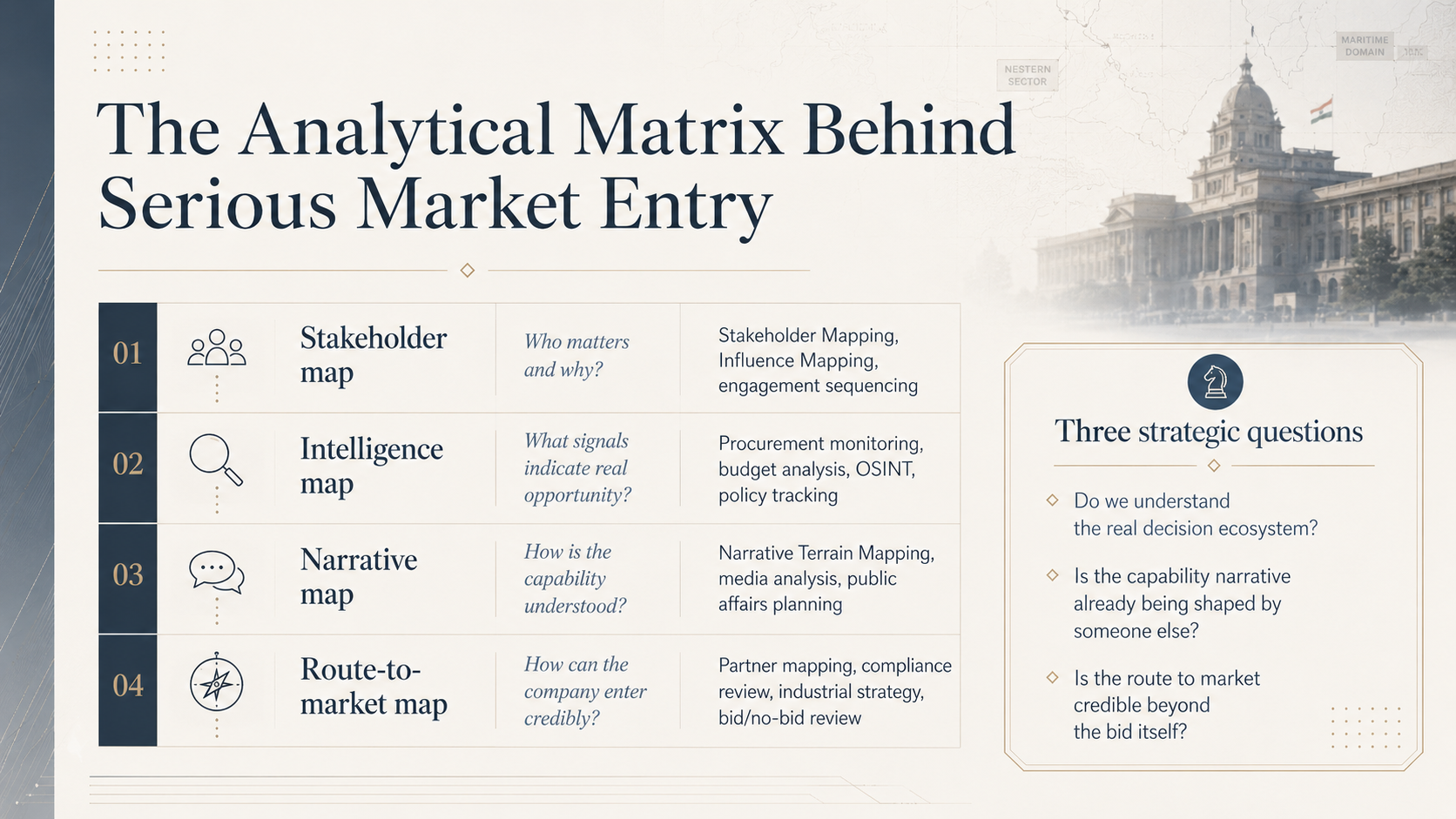
The value is not in producing the maps separately.
The value is in connecting them.
A budget signal may explain timing. A stakeholder concern may explain resistance. A media narrative may explain political hesitation. A local industrial expectation may shape the route to market. A capability gap may be real but unfunded. A tender may be public but strategically unattractive. A market may appear closed but become viable if the engagement sequence changes.
This is the difference between information and intelligence.
Information tells a company what is visible.
Intelligence explains what it means.
A composite scenario: when the tender is already too late
Consider a composite scenario familiar across defence markets.
A foreign technology company identifies a future opportunity in a NATO country. The armed forces have a real capability gap. Public documents mention the issue. Several officers understand the need. The company has a competitive product and assumes the opportunity is promising.
It waits for the tender.
When the tender is finally published, the company discovers that the specification favours a different architecture. Domestic industry expectations are already aligned around another supplier. The ministry is politically cautious because of a previous controversial procurement. The media narrative frames the capability as expensive and non-urgent. The end user likes parts of the company’s solution, but the sustainment model is unclear. Export approval is possible, but slow. The company submits a bid anyway.
Technically, the bid is respectable.
Strategically, the opportunity was lost much earlier.
A better approach would have started before the tender. The company would have mapped the stakeholder environment, understood previous procurement sensitivities, identified the real capability gap, tested the sustainment assumptions, assessed local industrial expectations, monitored the public narrative and decided whether to shape, partner, wait or walk away.
The lesson is not that tenders are irrelevant. They are highly relevant.
The lesson is that in strategic defence procurement, the tender is often the formal phase of a much longer competition for credibility.
Bid/No-Bid discipline
The most underrated consulting contribution may be the ability to say no.
Defence companies often chase opportunities because the headline looks attractive. The requirement appears large. The country is modernising. The budget seems available. The tender looks open.
But a serious Bid/No-Bid Review asks harder questions.
Is the requirement real?
Is the funding real?
Is the timeline realistic?
Is the customer accessible?
Is the specification neutral?
Is there an incumbent advantage?
Is the company compliant?
Can export approval be obtained?
Can the company deliver on time?
Can it support the system locally?
Does the industrial cooperation requirement make sense?
Is the expected margin worth the effort?
Would losing damage the company’s position for future opportunities?
A disciplined no can be more valuable than an enthusiastic yes.
In defence, bidding is expensive. Failed bids consume management attention, technical resources, partner credibility and political capital. A consultant who can help a company avoid a strategically bad pursuit may create value that is never visible from the outside.
Discipline before access
The most dangerous myth about defence consulting is that access is everything.
Access matters. Relationships matter. Trust matters. But access without discipline can destroy credibility faster than no access at all.
Best practice in serious defence consulting begins with restraint.
Do not approach stakeholders before understanding the institutional context.
Do not create visibility before understanding the narrative terrain.
Do not promise local industrial cooperation before testing feasibility.
Do not claim political support without evidence.
Do not treat informal interest as procurement intent.
Do not confuse a positive meeting with a funded requirement.
Do not bid because the opportunity is attractive on paper.
Do not speak publicly during a sensitive phase unless the message is necessary, accurate and compliant.
A good consultant sometimes accelerates a project. Just as often, a good consultant slows it down.
That is not weakness. It is risk control.
In defence, wrong speed is dangerous. Moving too slowly can make a company irrelevant. Moving too quickly can make it look reckless, politically insensitive or non-compliant.
The art is timing.
The compliance envelope
All of this must operate inside a strict compliance envelope.
Defence consulting touches export controls, sanctions, anti-corruption rules, procurement law, lobbying regulations, national security sensitivities, classified-information boundaries and reputational risk.
The distinction between strategic access and improper influence is fundamental.
Strategic access helps a company understand the environment, communicate professionally, respect institutions and make better decisions.
Improper influence attempts to distort the process, bypass rules or create hidden pressure.
The best consultants understand not only what can be done, but what should not be done.
They know when communication must be formal.
They know when legal review is needed.
They know when a claim requires evidence.
They know when a meeting creates risk.
They know when a partner requires due diligence.
They know when silence protects the client better than visibility.
In this sector, reputation is not a soft asset.
It is operational capital.

Why this matters for governments too
Good defence consulting does not only benefit industry.
When done properly, it can also improve the quality of dialogue between the public sector and the market. It can help companies understand real user needs before submitting unrealistic offers. It can reduce noise. It can clarify technical options. It can support better market engagement. It can help foreign companies understand local legal, industrial and political expectations.
Governments do not need more aggressive sales campaigns.
They need better-informed industry engagement.
They need suppliers who understand the problem, respect the process and communicate in a language that is useful to the state. They need companies that do not arrive with generic presentations, but with a serious understanding of national priorities, operational constraints and lifecycle responsibilities.
A good consultant can help create that discipline.
Three questions every decision-maker should ask
For industry leaders, defence investors, ministers, senior officials and military planners, the practical value of this discipline can be reduced to three strategic questions.
First: do we understand the real decision ecosystem, or only the formal procurement structure?
If the answer is only the formal structure, the map is incomplete.
Second: is the capability narrative already being shaped by someone else?
If yes, silence may not be neutrality. It may be strategic absence.
Third: is the route to market credible beyond the bid itself?
A winning offer is not enough if the support model, industrial logic, export pathway, political defence or public explanation collapses later.
These questions matter because defence procurement is not only a competition of products. It is a competition of credibility, timing, alignment and trust.
The real secret behind defence consulting
The real secret is that there is no single secret.
There are maps.
A map of stakeholders.
A map of influence.
A map of weak signals.
A map of procurement pathways.
A map of narratives.
A map of risks.
A map of what is formally written and what is institutionally understood.
Serious defence consultants do not win opportunities by noise. They help clients see the system before the system becomes visible to everyone else.
They help distinguish real opportunity from market illusion. They translate technology into capability. They protect credibility. They manage information discipline. They identify when to engage, when to wait and when to walk away.
That is why defence consulting, when done properly, is not about operating behind the curtain.
It is about understanding what the curtain hides.