China’s Type 076 Sichuan Trials: Are we watching another naval aviation superpower take shape?
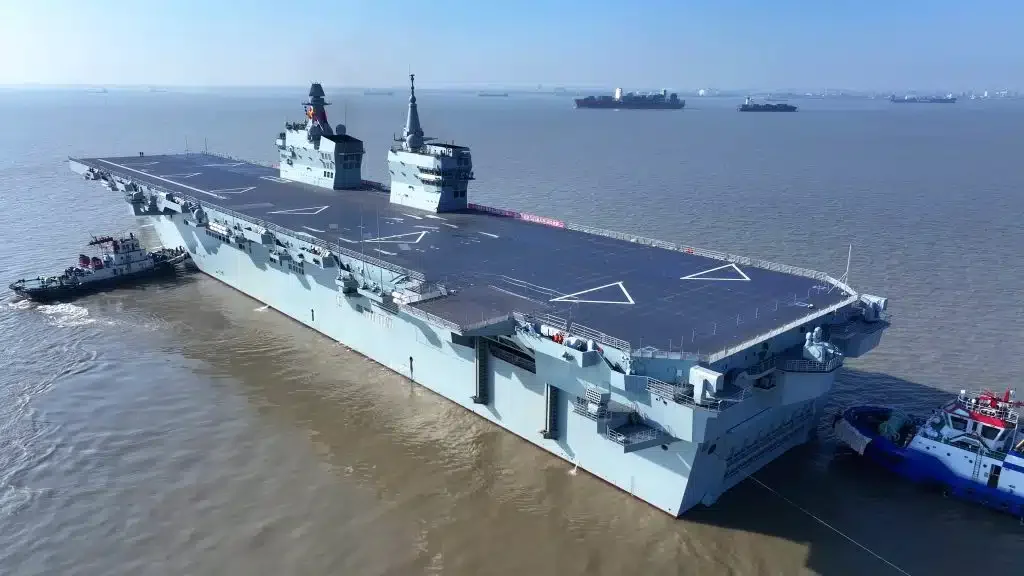
Sichuan transiting through the Yangtze River Delta after departing Changxing Island. The vessel appears to have received its helicopter landing spot markings only shortly before this image was taken. Image provenance: Chinese state media.
The Sichuan’s South China Sea trials are not just another ship milestone. They are a visible step in China’s move from naval mass to aviation-enabled maritime power.
Release date: 27 April 2026
By: The Stratos Brief
Region: China / South China Sea / Western Pacific / Indo-Pacific
Event date: The Type 076 Sichuan’s South China Sea trial deployment was publicly reported on 22 April 2026. The PLA Navy said the ship had “recently departed” Shanghai; China Daily reported that the PLA Navy statement was issued on Tuesday night, 21 April 2026. The exact departure date was not publicly specified.
It is rare to watch a naval power emerge in real time. Most major naval transitions are understood in hindsight, after decades of shipbuilding, training, doctrine and conflict have already revealed what mattered. China’s naval aviation build-up is different. It is happening in public view, ship by ship, aircraft by aircraft, trial by trial.
The latest marker is the Type 076 amphibious assault ship Sichuan. According to the People’s Liberation Army Navy, the ship has left Shanghai for the South China Sea to conduct scientific research trials and training exercises. Chinese official media describe the deployment as routine, part of the vessel’s planned development process, and not aimed at any specific target.
That official wording is important. Beijing wants the movement to look normal. But the wider context makes it anything but ordinary. The Sichuan is not a conventional amphibious assault ship. It is a large-deck amphibious aviation platform fitted with electromagnetic catapult and arresting technology, a feature more commonly associated with advanced aircraft carriers. Global Times describes the Type 076 as a ship of over 40,000 tonnes full-load displacement, with a dual-island superstructure, full-length flight deck, and the ability to carry fixed-wing aircraft, helicopters and amphibious equipment.
That makes the Type 076 trials strategically significant. They are not only about validating one new hull. They are about testing whether China can integrate carrier-style aviation technology into a broader naval force structure.
A ship between categories
The Type 076 sits in an unusual space. It is not a full aircraft carrier. It is not simply a helicopter carrier either. It appears to be a hybrid platform: part amphibious assault ship, part drone carrier, part light-carrier-style aviation node.
The Associated Press described the Sichuan as combining some attributes of an aircraft carrier and an amphibious assault ship, with the ability to launch aircraft and landing craft carrying troops. AP also noted that the ship broadly compares with US America-class and Wasp-class amphibious assault ships, but differs in one crucial respect: the Chinese vessel has an electromagnetic catapult system, while the US amphibious assault ships do not.
This is the key point. The Type 076 does not need to become a full fighter carrier to matter. Its importance may lie in giving China another aviation deck from which it can launch drones, helicopters, and potentially fixed-wing aircraft in support of amphibious operations, reconnaissance, targeting, electronic warfare and distributed maritime operations.
That would make the Sichuan more than a landing platform. It could become a floating aviation multiplier.
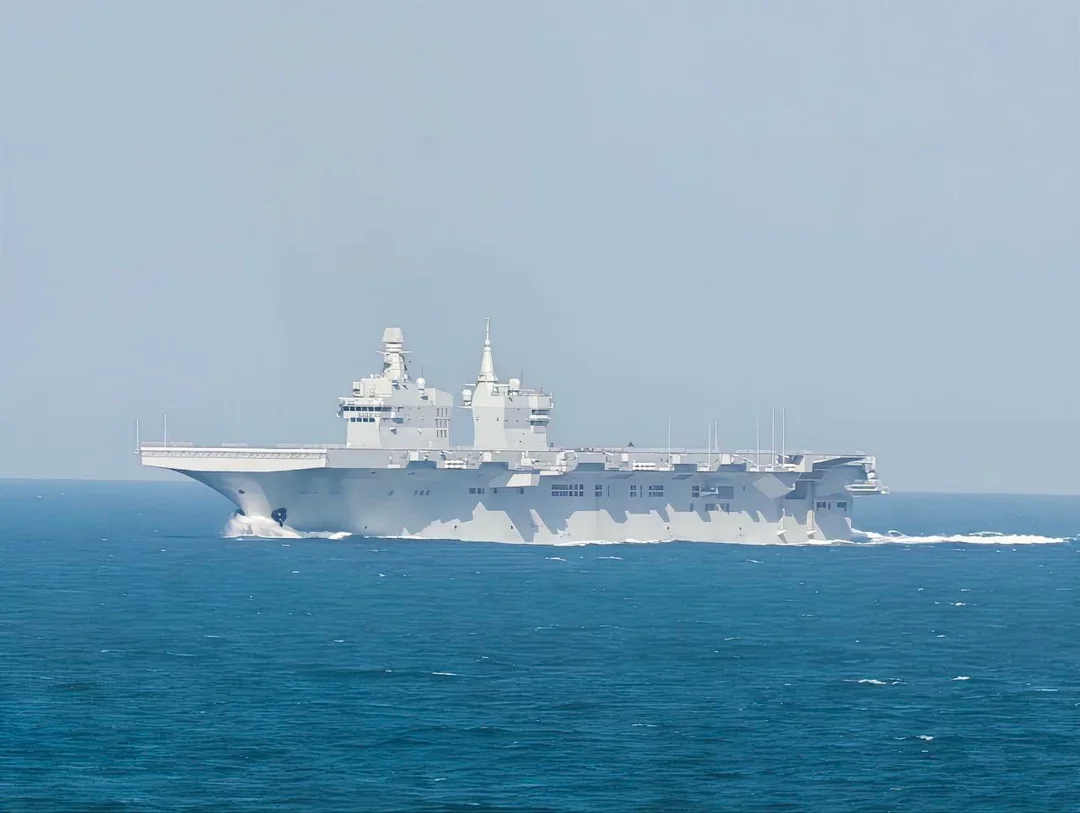
Type 076 at sea. Image provenance: Chinese state media.
The drone-carrier question
The most important unresolved question is the ship’s air wing. Chinese sources say the Type 076 can carry fixed-wing aircraft, helicopters and amphibious equipment. Some Chinese commentary has suggested that its systems could make it a platform for large shipborne drones, not just helicopters or landing support assets. China Daily, citing military observer Wu Peixin, said the South China Sea trial would test propulsion, power supply, electromagnetic catapult and ship-aircraft coordination systems, including compatibility with large shipborne drones.
Western reporting is more cautious. AP notes that it is still unclear whether the Sichuan will ultimately launch crewed fixed-wing fighters or whether its fixed-wing role will be limited mainly to drones.
That distinction matters, but it should not be overstated. Even if the Type 076 becomes primarily a drone carrier, that would still be a major development. A large amphibious ship able to operate unmanned aircraft could extend surveillance, targeting and strike options well beyond the reach of helicopters alone. It could support landing operations without exposing a full carrier strike group. It could also add aviation mass to a Chinese naval task force in the South China Sea, the Taiwan Strait or the wider Western Pacific.
In that sense, the Type 076 may be less about copying a US-style amphibious ship and more about testing a Chinese solution to distributed naval aviation.
The Fujian connection
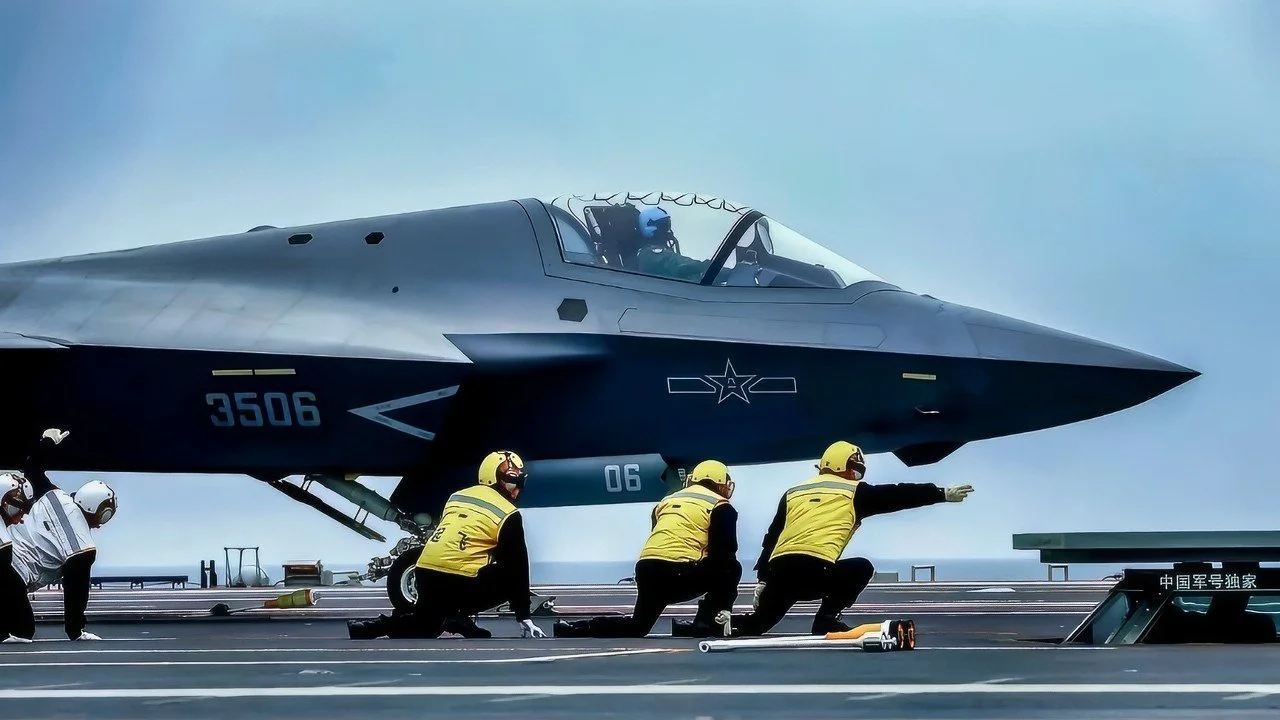
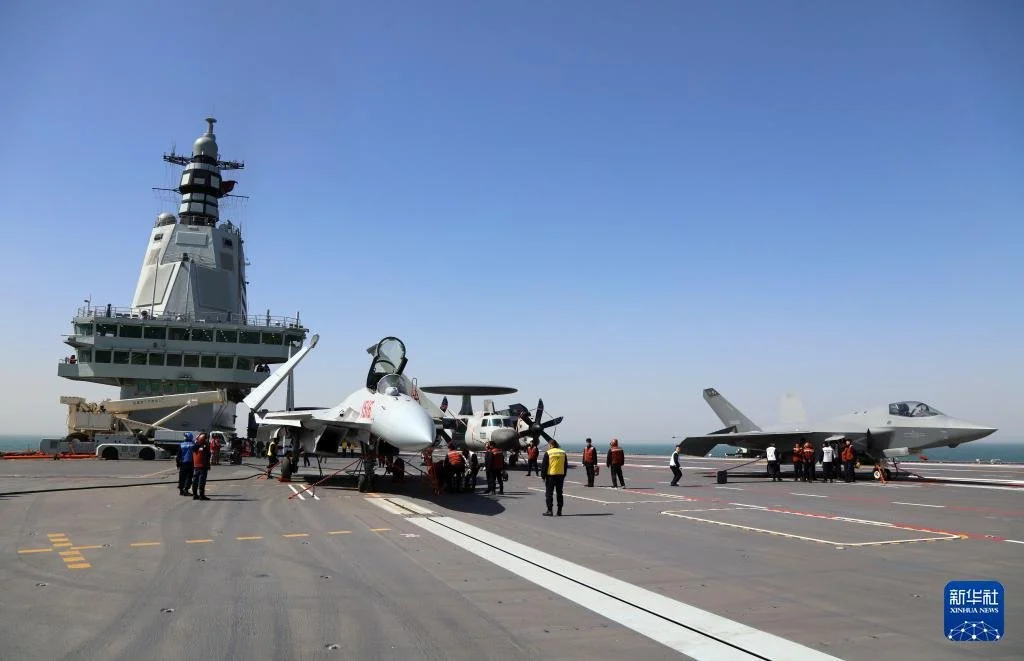
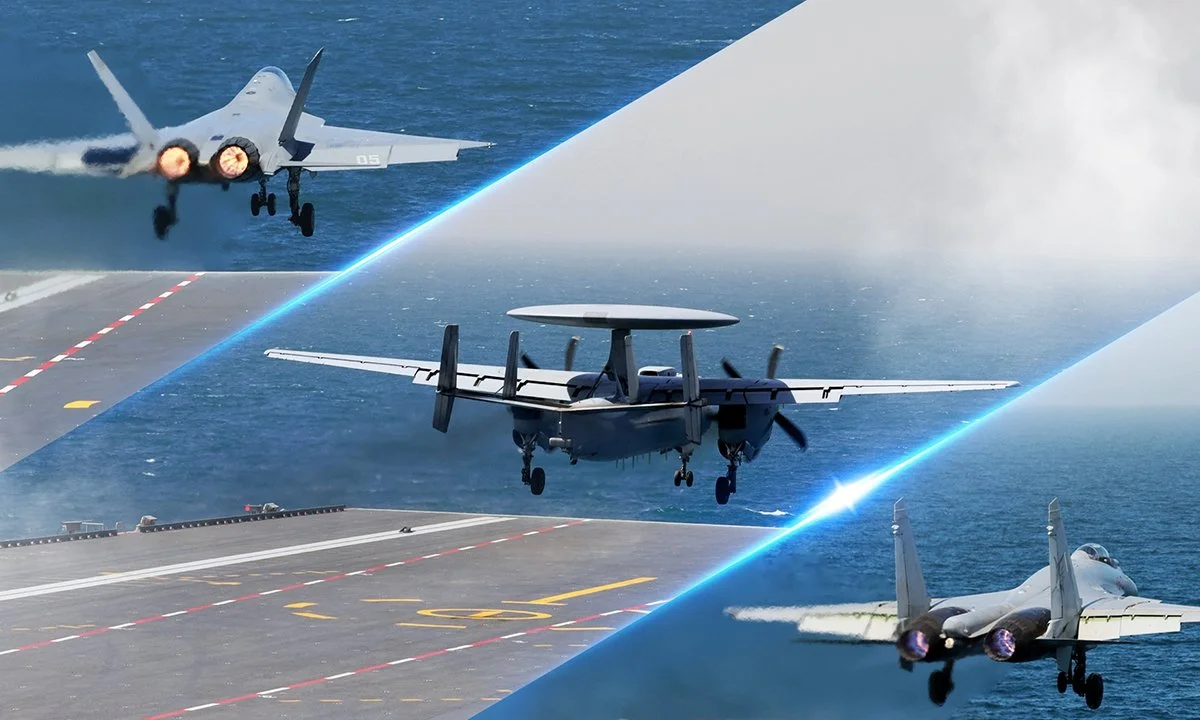
The Type 076 should be read together with China’s third aircraft carrier, the Fujian. The Fujian is China’s first catapult-equipped carrier and the most visible symbol of the next phase of Chinese naval aviation. Xinhua reported in September 2025 that the J-15T, J-35 and KJ-600 had successfully completed electromagnetic catapult-assisted take-off and arrested landing training aboard the ship.
That was a major threshold. China’s first two carriers, Liaoning and Shandong, rely on ski-jump ramps. That limits launch weight and makes it harder to operate heavier aircraft with more fuel, weapons or specialised equipment. Catapult launch changes the equation. It allows a carrier to operate a more capable air wing, including heavier fighters and fixed-wing airborne early-warning aircraft.
The KJ-600 may be especially important. It gives China a path towards the kind of fixed-wing airborne early-warning and command-and-control capability that mature carrier groups need. Fighters provide reach and strike power. But airborne early warning provides the ability to see farther, coordinate aircraft, manage air defence and operate a carrier group with less dependence on land-based sensors. Without that layer, a carrier is far more limited. With it, the carrier begins to look like the centre of an integrated naval air system.
This is where China’s naval aviation story becomes larger than one ship. The Type 076 and Fujian are different platforms, but they point in the same direction: more decks, more aircraft, more unmanned systems, more airborne command-and-control, and more options for operating farther from China’s coast.
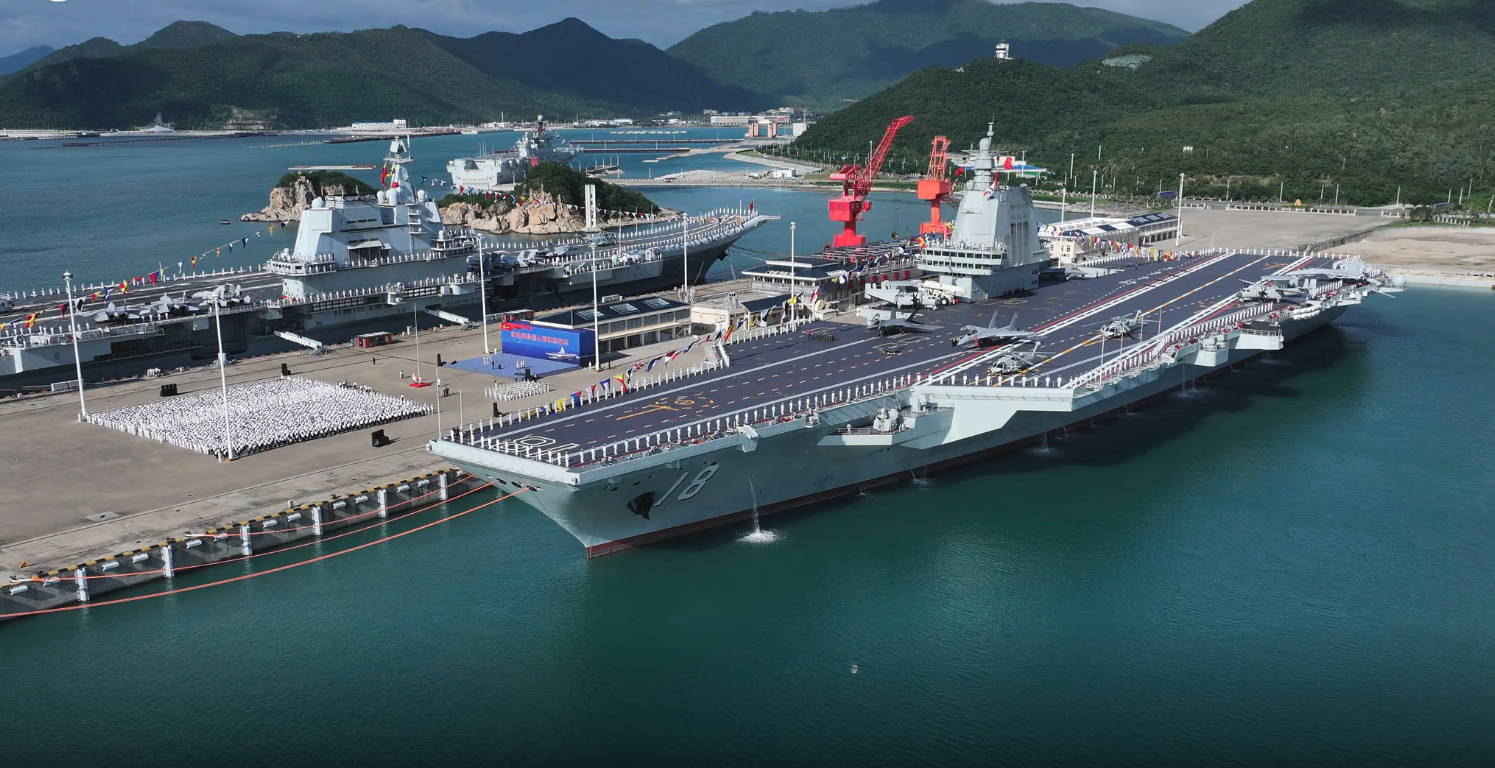
China’s aircraft carriers Fujian and Shandong moored at Sanya Naval Base on Hainan Island. The newer Fujian is seen in the foreground, with Shandong in the background, highlighting the growing scale and maturity of China’s carrier aviation fleet. Image provenance: Xinhua.
From shipbuilding scale to operational complexity
For years, much of the discussion around the Chinese navy focused on ship numbers. That was understandable. China’s naval expansion has been extraordinary. CSIS has described China as possessing the world’s largest maritime fighting force under its counting method, while also noting that about 70 percent of Chinese warships were launched after 2010.
But the Type 076 and Fujian show that the next stage is not just about numbers. It is about complexity.
A navy can build many ships and still remain mainly regional. A naval aviation power needs much more. It needs flight decks, aircraft, airborne command-and-control, escorts, logistics, trained deck crews, pilots, maintainers, doctrine, safety culture and repeated operational experience. It needs to learn how to generate sorties at sea, sustain aviation operations in difficult weather, integrate aircraft with destroyers and submarines, and protect the force across long distances.
China is now visibly working through those layers.
Reuters reported that analysts will be watching how quickly the Fujian becomes combat-ready, including its ability to integrate with support ships, submarines and wider naval operations. Reuters also noted that, despite major progress, China is still working with new platforms from top to bottom.
That is the right balance. China is advancing quickly, but it is still learning. The gap between launching aircraft in trials and operating a mature carrier air wing under combat conditions is large. The United States has decades of experience in this field. China does not.
But experience accumulates through use. And China is using its carriers more.
The First Island Chain is no longer the outer edge
China’s naval aviation is also moving farther from home waters. CSIS reported that in 2025, Liaoning and Shandong were spotted outside the First Island Chain for a combined 58 days, up from 32 days in 2024. CSIS also reported an estimated 1,680 fighter and helicopter sorties from the two carriers in the Western Pacific in 2025, compared with 1,240 in 2024.
That matters because it shows a transition from possession to practice. A carrier force is not built simply by commissioning carriers. It is built through repeated cycles of deployment, flight operations, maintenance, escort integration and command experience.
In 2025, according to CSIS, China also conducted its first simultaneous dual-carrier operation outside the First Island Chain. That is not yet proof of US-style global carrier mastery. But it is clear evidence that China is pushing its carrier force into more demanding operational patterns.
This is exactly why the current moment is so interesting. China is not only revealing new ships. It is learning how to use them. The operational geography is expanding from the near seas towards the wider Western Pacific.
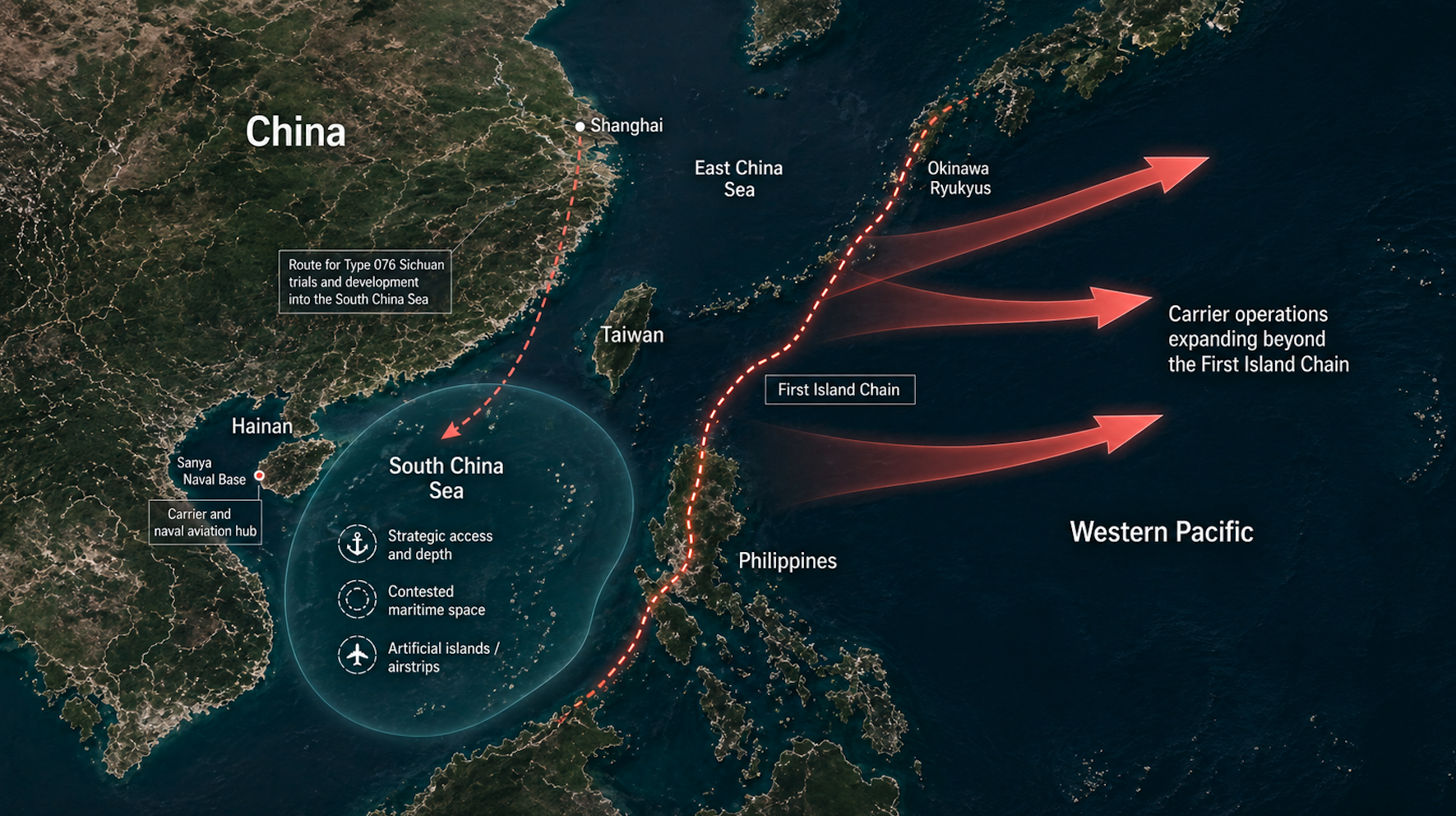
Strategic view of East Asia and the Western Pacific, showing the South China Sea, Taiwan, the First Island Chain, and the wider area where Chinese carrier operations have been expanding. The graphic illustrates how the Type 076 Sichuan trials fit into China’s broader move from near-seas operations towards more regular naval aviation activity beyond the First Island Chain. Image: The Stratos Brief analytical graphic.
Why the South China Sea matters
The Sichuan’s South China Sea trials are therefore not just a convenient test route. They take place in one of the central maritime theatres of Chinese strategy.
The South China Sea gives China depth, access and political leverage. It connects China’s southern coastline to Southeast Asia, Taiwan, the wider Pacific and the Indian Ocean approaches. It is also a contested space where China has built artificial islands, airstrips and military infrastructure. Reuters reported in April 2026 that China had called for further development of more than 11,000 islands it claims, as part of a long-term campaign to strengthen maritime power, secure resources and reinforce territorial claims.
In that setting, a ship like the Type 076 has several potential roles. It could support amphibious operations. It could help sustain a visible naval presence. It could operate drones for surveillance and targeting. It could complement carrier groups or operate below the political threshold of deploying a full carrier. And in a crisis, it could add another layer of aviation capacity to a Chinese maritime force.
That makes the ship relevant not only to a Taiwan scenario, but also to wider South China Sea competition and Western Pacific power projection.
China is not yet the US Navy
The analysis should remain careful. China is not yet the US Navy. It does not have the same number of large nuclear-powered aircraft carriers. It does not have the same global base network. It does not have the same decades of carrier combat experience. Its newest carrier, Fujian, is conventionally powered, unlike US nuclear carriers. Reuters noted that this limits endurance compared with US nuclear-powered carriers, while AP notes that Fujian is smaller than US Nimitz and Ford-class carriers and is estimated to carry fewer aircraft.
There are also questions around training, sortie generation, damage control, maintenance, command culture and combat integration. These cannot be solved by shipbuilding alone.
But the more important point is that China has a visible path. It has the industrial base to build ships. It now has three aircraft carriers in service. It has moved from ski-jump carriers to electromagnetic catapults. It is testing carrier-compatible fighters and early-warning aircraft. It is deploying carriers beyond the First Island Chain. And with the Type 076, it is applying advanced aviation-launch technology to a new class of amphibious ship.
That is not parity with the United States. But it is a serious, sustained and observable movement towards great-power naval aviation.
The real meaning of Type 076
The Type 076 trials should therefore be understood as part of a wider pattern.
The Fujian brings catapult carrier aviation. The J-35 introduces a stealth fighter into China’s carrier aviation future. The J-15T gives China a catapult-compatible heavy fighter. The KJ-600 adds airborne early warning and command-and-control. The Type 075 created a modern amphibious assault fleet. The Type 076 now points towards drone-enabled amphibious aviation.
Taken together, these are not isolated programmes. They are pieces of an ecosystem.
That ecosystem is still incomplete. It still has weaknesses. It still needs time at sea. But it is becoming more coherent. China is moving from building platforms to building a naval aviation architecture.
Conclusion: a superpower transition in public view
The Sichuan’s South China Sea trials are important because they offer a glimpse of China’s next naval phase. The country has already built the world’s largest navy by hull numbers under several Western assessments. The more consequential question now is whether it can turn that fleet into a force able to project air power at sea.
That is what the Type 076, the Fujian, the J-35 and the KJ-600 are really about.
China is not simply adding ships. It is building the aviation layer that allows a navy to operate farther from home, protect larger task groups, contest airspace over the sea and support military options beyond the shoreline. This is a difficult transition. It requires technology, training and time. But it is now visible.
For defence observers, that is what makes this moment remarkable. Naval superpowers are not created overnight. They are built through repeated decisions, industrial capacity, doctrine, training cycles and the slow accumulation of operational confidence.
With the Type 076 now moving into more demanding trials, China’s naval aviation transformation is no longer theoretical. It is unfolding at sea.
Sources
Chinese / Chinese state-linked sources
Xinhua — “China’s first Type 076 amphibious assault ship heads to South China Sea for regular training”
Used for the official PLA Navy wording on the Sichuan’s South China Sea trial deployment, including the description of the mission as routine and not aimed at any specific target.Global Times — “China’s first Type 076 amphibious assault ship Sichuan heads to S.China Sea for trials and training”
Used for the Chinese expert framing of the Type 076 trials, the ship’s basic features, and its role in the broader development schedule.China Daily — “Amphibious assault ship CNS Sichuan embarks on open-sea trial”
Used for details on the PLA Navy statement issued on Tuesday night, the systems expected to be tested, and the discussion of large shipborne drone compatibility.Xinhua — “Three types of aircraft complete electromagnetic catapult-assisted takeoffs, landings on China’s carrier Fujian”
Used for the reported J-15T, J-35 and KJ-600 catapult-assisted take-off and arrested landing training aboard the Fujian.
Western / international sources
Associated Press — “Fresh off commissioning new aircraft carrier, China starts sea trials of amphibious assault ship”
Used for Western reporting on the Type 076 Sichuan, including its hybrid aircraft-carrier/amphibious-assault-ship characteristics and the uncertainty around whether it will operate crewed fixed-wing fighters or mainly drones.Associated Press — “What to know about China’s newest aircraft carrier, the Fujian”
Used for comparison between Fujian and US carriers, including displacement and estimated aircraft capacity.Reuters — “China’s third aircraft carrier, the Fujian, enters service”
Used for the Fujian’s commissioning context, its electromagnetic catapults, the reported testing of J-35, KJ-600 and J-15 variants, and caveats around combat readiness and conventional propulsion.Reuters — “China teases new aircraft carrier in video, vows to build up islands”
Used for wider context on China’s maritime-power messaging, potential fourth carrier signalling, and South China Sea island development.CSIS — “China’s Carriers Increasingly Venture Beyond the First Island Chain”
Used for data on Liaoning and Shandong operating beyond the First Island Chain in 2025, including reported sortie figures and simultaneous dual-carrier activity.CSIS China Power — “Tracking China’s Increased Military Activities in the Indo-Pacific in 2025”
Used for corroborating figures on Chinese carrier activity beyond the First Island Chain and the increase in fighter and helicopter sorties.CSIS — “Unpacking China’s Naval Buildup”
Used for the broader assessment of China’s naval growth, including the age of the fleet and the scale of Chinese warship construction since 2010.
Russian / Russian-language source
VPK— Russian-language defence coverage on Type 076 Sichuan
Used as Russian-language defence-media context for the interpretation of Type 076 as a large amphibious aviation platform with electromagnetic catapult and arresting equipment, mainly expected to support large UAV operations.