IRAN - US/Israel: The Pause Before the Next Phase?
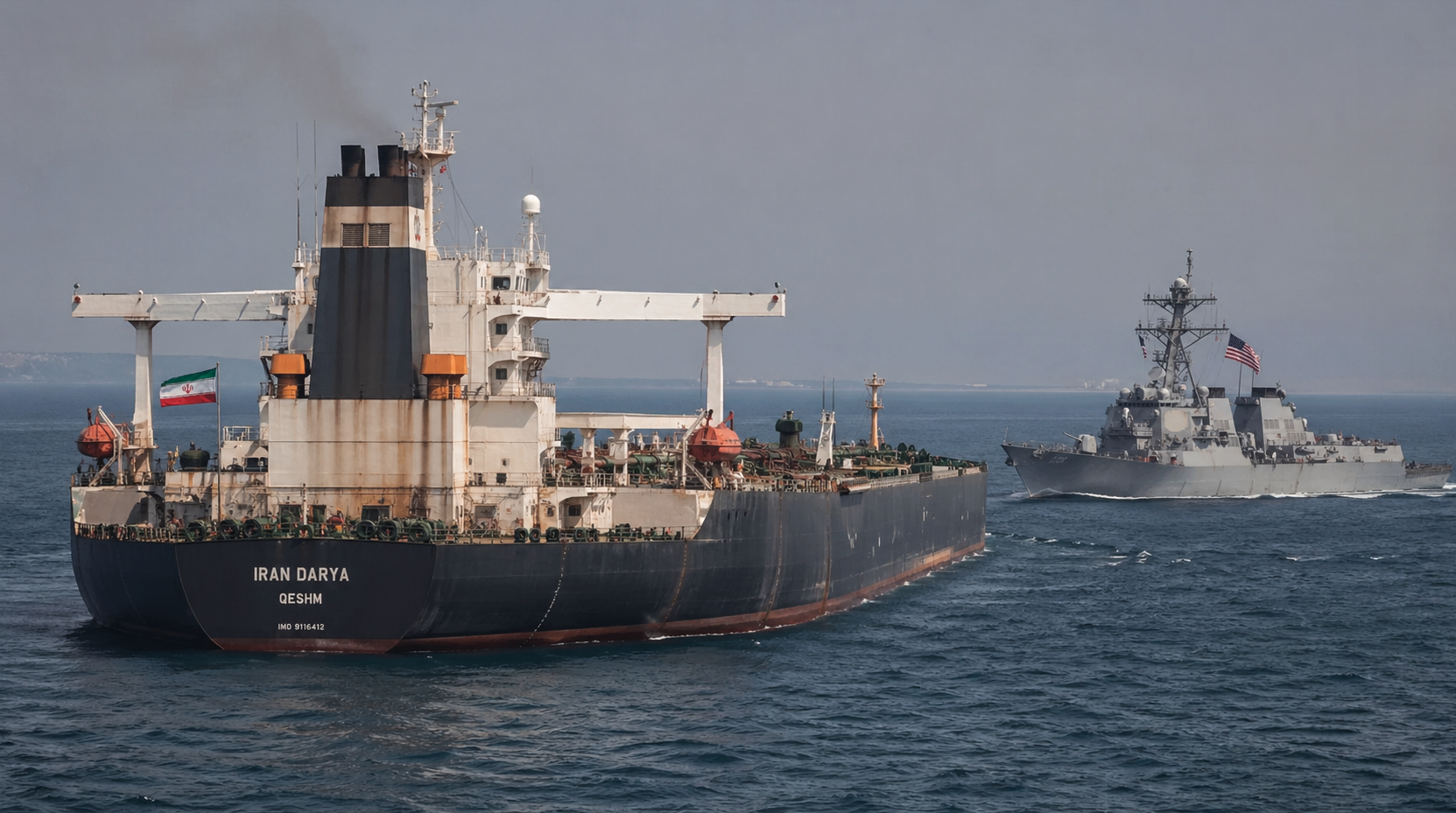
How the US/Israel–Iran conflict could move from ceasefire to settlement, stalemate or renewed war.
Release date: 27 April 2026
By: The Stratos Brief
Region: Middle East / Persian Gulf / Strait of Hormuz
The current pause in the US–Israel–Iran conflict should not be mistaken for peace.
What exists today is closer to a military pause under diplomatic pressure. Direct fighting has slowed, but the strategic contest continues across several connected fronts: the Strait of Hormuz, Iran’s nuclear and missile programme, US maritime enforcement, Israeli operations linked to Hezbollah in Lebanon, sanctions, energy markets, and the diplomatic role of Russia, China, Pakistan and Gulf states.
The core question is not only whether diplomacy can end the conflict. It is whether the current pause is being used to build a settlement, freeze the confrontation, or prepare for another phase of active operations.
What is confirmed
Several developments are clear.
Iran has reportedly presented a proposal to the United States through Pakistani mediators to reopen the Strait of Hormuz and end the war, while postponing negotiations on Iran’s nuclear programme to a later stage. Reuters reported this on 27 April, citing Axios, a US official and two sources familiar with the matter. AP reported the same broad outline, adding that Iran’s offer would require the United States to lift its blockade and end the war first.
The Strait of Hormuz remains central. AP describes the strait as a route through which roughly a fifth of globally traded oil and gas passes in peacetime. The same report said Brent crude was trading around USD 108 per barrel on 27 April, nearly 50% higher than when the war began.
The United States has imposed a blockade on vessels entering or departing Iranian ports and coastal areas. CENTCOM stated that the measure began on 13 April and would apply to vessels of all nations entering or departing Iranian ports, while ships transiting the Strait of Hormuz to and from non-Iranian ports would not be impeded.
Iran rejects that framing. IRNA reported that Iran’s Foreign Ministry spokesperson described the US blockade as unlawful, criminal, a breach of the ceasefire, and a violation of the UN Charter. IRNA also reported that Iran’s Parliament Speaker Mohammad Bagher Ghalibaf said reopening the Strait of Hormuz would not be possible while the ceasefire was being violated by the naval blockade.
That is the central dispute: Washington presents the blockade as a pressure tool against Iranian ports, while Tehran presents it as an act of war and a violation of the ceasefire.
Key dates
28 February 2026 — The conflict begins. AP and other outlets report that the current US–Israel–Iran war began on 28 February 2026. The conflict quickly expanded from strikes and retaliation into a wider maritime, economic and diplomatic crisis.
7–8 April 2026 — A temporary ceasefire takes effect. Chinese Foreign Ministry spokesperson Mao Ning said on 7 April that China supported a ceasefire and political settlement, while stating Beijing’s view that the root cause of the conflict was the US-Israeli launch of military attacks against Iran. This is China’s official position, not a neutral finding of fact.
13 April 2026 — US blockade of Iranian ports begins. CENTCOM announced that US forces would implement a blockade of maritime traffic entering and exiting Iranian ports from 13 April.
14 April 2026 — China criticises the US blockade. China’s Foreign Ministry called the US blockade “dangerous and irresponsible”, saying it would aggravate confrontation and undermine the fragile ceasefire. Reuters also reported China’s criticism of the blockade in its coverage of shipping through Hormuz.
19 April 2026 — Iran says the blockade breaches the ceasefire. IRNA reported that Iran viewed the US blockade as a breach of the Pakistani-mediated ceasefire and as an unlawful act under international law.
20 April 2026 — Russia offers facilitation between Iran and Gulf states. TASS reported that Russia said it was ready to facilitate mutually acceptable agreements between Iran and Arab states of the Persian Gulf. The same report said Iran had confirmed readiness to ensure passage of Russian ships and cargo through Hormuz.
23 April 2026 — Russia says restricted shipping affects Russia too. TASS reported Russian Deputy Foreign Minister Alexander Pankin saying that restricted shipping through Hormuz and the US naval blockade of Iran affected Russia, despite Russia being an oil exporter.
23 April 2026 — Iran says reopening Hormuz is impossible under blockade. IRNA reported Ghalibaf’s position that reopening the Strait of Hormuz was not possible while the ceasefire was being violated by the naval blockade.
24–27 April 2026 — The maritime and diplomatic standoff continues. Israeli media, including The Times of Israel and The Jerusalem Post, reported Iran’s proposal to reopen Hormuz while delaying nuclear talks, and also covered continuing Israel-Hezbollah tensions in Lebanon.
26 April 2026 — Israel says Hezbollah is undermining the Lebanon ceasefire. The Times of Israel reported Prime Minister Benjamin Netanyahu saying Hezbollah’s actions were “dismantling” the ceasefire, and that Israel reserved freedom of action to respond to attacks and pre-empt threats. This reflects Israel’s stated position.
27 April 2026 — Iran’s proposal becomes the main diplomatic development. Reuters, AP and Israeli media reported that Iran had put forward a proposal through Pakistani mediation to reopen Hormuz and end the war while leaving nuclear negotiations for a later stage.
How the main sides frame the conflict
The United States frames the blockade as a coercive maritime measure directed at Iranian ports, not at general transit through the Strait of Hormuz. CENTCOM says vessels transiting the Strait to and from non-Iranian ports will not be impeded.
Iran frames the same blockade as an unlawful act, a ceasefire breach and collective punishment. IRNA and Press TV report Iranian officials describing the blockade and vessel seizures as “piracy”, “aggression” and violations of Iran’s sovereignty. These terms should be understood as Iran’s official language, not adopted as neutral wording.
Israel frames the wider conflict around Iran’s nuclear programme, missile capabilities and regional armed partners. In an interview published by Israel’s Foreign Ministry site, an Israeli ambassador described Israel’s objectives as dismantling Iran’s nuclear infrastructure, degrading ballistic missile capabilities and preventing Iran from threatening Israel through regional networks.
Russia frames the crisis as a destabilising consequence of Western military action and as a threat to global energy and food markets. TASS reported Russian officials warning that disruption in Hormuz could affect oil, fertiliser and food production costs.
China frames the conflict as one that should be resolved through ceasefire and political settlement. China’s Foreign Ministry said the use of force would not bring peace and argued that UN Security Council action should de-escalate the situation rather than endorse military moves. Beijing also criticised the US blockade as dangerous and irresponsible.
These positions are not interchangeable facts. They are the stated narratives and strategic arguments of the parties and major outside actors.
The maritime domain is now central
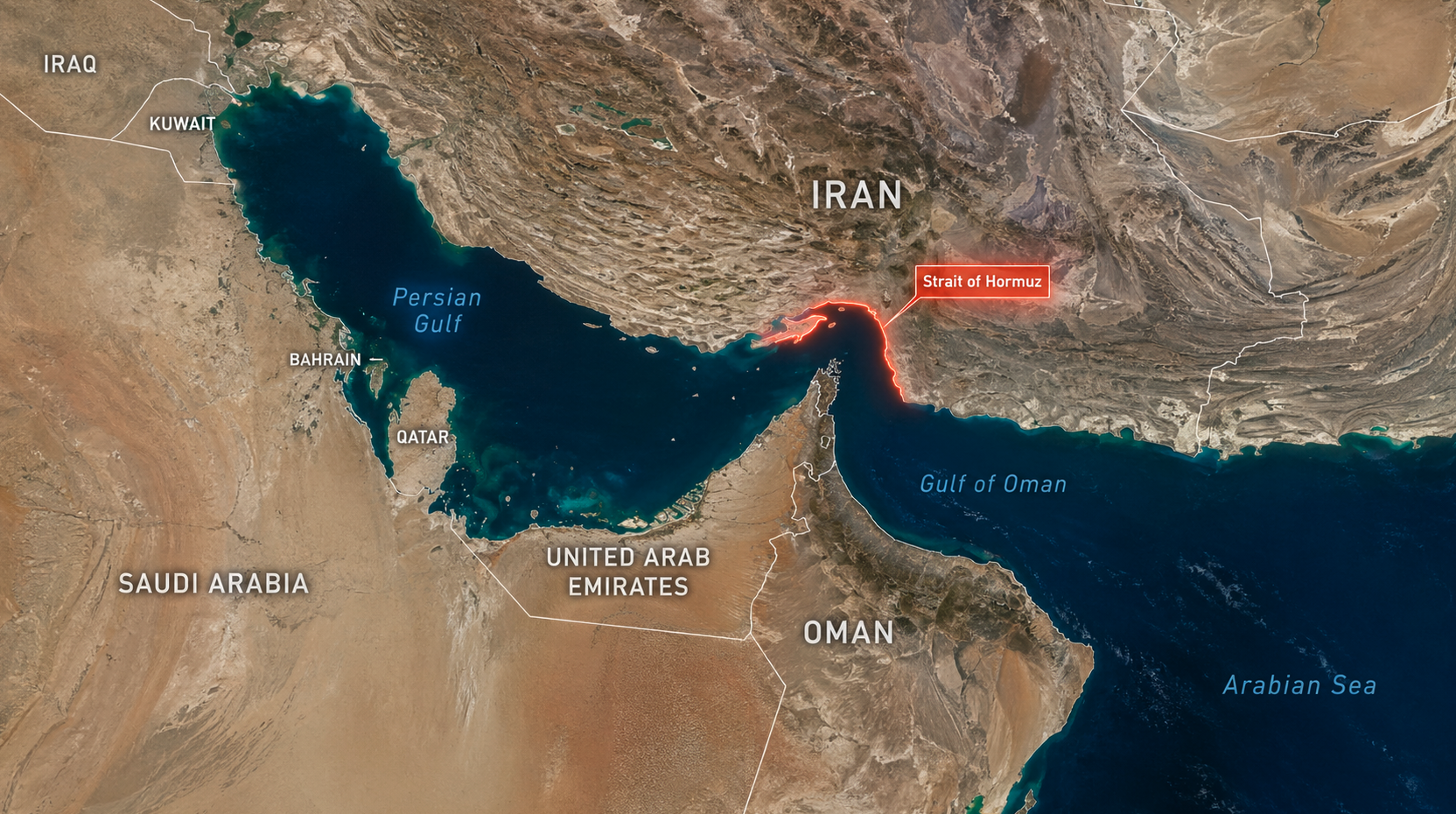
The Strait of Hormuz has become the main point where military, economic and diplomatic pressure meet.
For Iran, the strait is leverage. Restrictions on shipping increase pressure on the United States, Gulf exporters, global energy markets and insurers. For the United States, the blockade of Iranian ports is a way to constrain Iranian oil revenue without necessarily stopping all traffic through the strait. For Gulf states and import-dependent economies, the same confrontation creates exposure to higher energy, shipping and insurance costs.
This means the next phase of the conflict may not begin with a large air campaign. It could begin with a maritime incident.
A tanker diverted.
A vessel seized.
A ship boarded.
A radar track misread.
A warning shot that causes casualties.
A mine or drone incident in a congested sea lane.
In a narrow chokepoint, escalation does not require a large strategic decision by every capital. It can begin with one event that leaders cannot ignore.
The military posture remains ambiguous
US military deployments and maritime enforcement can be read in two ways.
One reading is deterrence. A strong posture gives Washington leverage in negotiations and signals that Iran should not expect to use Hormuz without cost.
Another reading is preparation. The same posture also allows a rapid move from negotiations to renewed military operations if talks fail.
That ambiguity is central to the current phase. Deterrence and preparation often look similar from the outside. The difference is political intent, which may not become visible until after a decision has already been made.
Iran’s behaviour can also be read in two ways. Tehran may be using Hormuz to force diplomatic relief, or it may be using the pause to rebuild military options, reinforce air defence, protect nuclear assets and secure external support. Both interpretations are possible. Neither should be stated as proven without stronger evidence.
Russia and China matter, but differently
Russia and China are not direct combatants in the same way as the United States, Israel and Iran. Their relevance lies in diplomacy, economics, intelligence, technology and strategic signalling.
Russia has positioned itself as a potential facilitator between Iran and Gulf states, while also warning that disruption in Hormuz affects Russia and global markets.
China has called for ceasefire and negotiations, criticised the US blockade, and rejected reports that it is preparing military support for Iran. China’s Foreign Ministry said Beijing acts prudently on military exports and controls them under Chinese law and international obligations.
For the United States and Israel, any confirmed external support that helps Iran restore air defence, missile capacity or intelligence awareness would matter. For Iran, diplomacy with Moscow and Beijing helps offset isolation and creates additional pressure on Washington.
This does not mean Russia or China are driving the conflict. It means the conflict now sits inside a wider strategic competition.
Scenario one: successful negotiations and a more durable settlement
The best outcome would be a negotiated settlement that reopens Hormuz, reduces or lifts the US blockade, creates a credible nuclear framework, limits further missile escalation and gives all parties enough political cover to step back.
This is possible, but difficult.
Iran would likely need to accept nuclear-related limits or inspections that Washington and Israel can treat as meaningful. The United States would need to reduce pressure without appearing to reward maritime coercion. Israel would need to accept a diplomatic result that may not remove all Iranian capabilities. Iran would need to accept limits without appearing to surrender under military pressure.
This scenario would reduce immediate risks to shipping and energy markets. It would also give Gulf states breathing space. But it would require more than a ceasefire. It would require a package that covers maritime access, sanctions, nuclear issues, missiles, regional security and guarantees against renewed attacks.
At present, the biggest obstacle is sequencing. Iran appears to want relief and maritime de-escalation first. The United States and Israel appear to want strategic concessions first.
Scenario two: failed talks and a frozen conflict
This is the most plausible near-term scenario.
In this outcome, major direct strikes do not resume immediately, but the conflict does not end. Instead, it becomes a prolonged confrontation built around maritime pressure, sanctions, intelligence activity, proxy theatres and periodic incidents.
Hormuz remains restricted or only partially reopened. The United States maintains pressure on Iranian ports. Iran keeps using maritime access as leverage. Israel continues to act against perceived threats linked to Hezbollah. Russia and China continue diplomatic positioning. Gulf states seek to protect their exports without becoming more deeply involved.
This would not be peace. It would be an armed stalemate.
For TSB readers, this scenario is important because a frozen conflict in the Gulf would not be passive. It would affect oil markets, tanker routing, insurance, sanctions enforcement, air defence demand, naval deployments and regional security planning.
The battlefield would be partly military, partly economic and partly diplomatic.
Scenario three: failed talks and renewed active operations
The third scenario is a return to active combat operations.
This could happen by deliberate decision or by uncontrolled escalation.
A deliberate return to strikes could occur if Washington or Jerusalem concludes that Iran is using talks to rebuild capacity, protect nuclear assets or prepare retaliation. An uncontrolled escalation could begin with a maritime incident, a strike on US forces, a major Hezbollah-Israel escalation, a missile or drone attack on Gulf infrastructure, or confirmed external military support that changes threat perceptions.
The current posture makes this scenario credible, even if it is not inevitable.
The United States has maintained military pressure and maritime enforcement. Iran maintains leverage through Hormuz and insists that the blockade must end. Israel continues to see Hezbollah and Iran-linked capabilities as direct security threats. Russia and China oppose further escalation but are also using the crisis to criticise US policy and strengthen their diplomatic relevance.
The risk is not that every side necessarily wants a wider war. The risk is that every side has incentives to wait, signal, pressure and prepare.
The Lebanon variable
Lebanon remains a separate escalation channel.
Israel argues that Hezbollah is undermining the ceasefire and says it reserves freedom of action to respond to immediate and emerging threats. Hezbollah and Iranian-aligned sources present Israeli actions as violations and escalation. The result is that a US-Iran diplomatic track could continue while the Israel-Hezbollah track deteriorates.
This matters because the next breakdown may not begin in Tehran, Washington or Tel Aviv. It may begin along the Israel-Lebanon front and then pull the wider conflict back into motion.
What to watch next
The first indicator is Hormuz. A verifiable reopening of safe shipping routes would point towards de-escalation. Continued restrictions, seizures or toll disputes would point towards stalemate or renewed escalation.
The second is the US blockade. If Washington relaxes enforcement, diplomacy may be gaining traction. If enforcement expands or becomes more aggressive, the maritime conflict is deepening.
The third is sequencing in negotiations. If Iran agrees to bring nuclear issues into the first phase, a settlement becomes more plausible. If Tehran insists that maritime and sanctions relief must come first, talks may remain stuck.
The fourth is Israeli activity in Lebanon. A serious escalation with Hezbollah could undermine the wider pause even if US-Iran contacts continue.
The fifth is external support. Confirmed Russian intelligence assistance, Chinese military transfers, or expanded sanctions on China-linked oil networks would indicate that the conflict is widening beyond the immediate theatre.
The sixth is US force posture. A reduction in visible regional posture would suggest confidence in diplomacy. Sustained or expanded deployments would suggest that Washington wants to keep military options ready.
Conclusion: diplomacy inside the conflict
Diplomacy is not taking place after the conflict. It is taking place inside the conflict.
The shooting has slowed, but pressure continues. The United States is using maritime enforcement and sanctions. Iran is using Hormuz and regional diplomacy. Israel is keeping military options open. Russia and China are positioning themselves diplomatically and strategically. Gulf states are trying to protect their economies without being pulled deeper into confrontation.
A durable settlement remains possible, but it would require more than reopening Hormuz. It would require a credible bargain over nuclear limits, sanctions, missile capability, maritime access, regional security and guarantees against renewed attacks.
A frozen conflict is more likely in the near term. It would be unstable, costly and global in its consequences.
Renewed active combat remains the highest-risk scenario. The military and political ingredients are already present. The trigger has not yet arrived, or at least has not yet become visible.
For now, the ceasefire is not the end of the war.
It is the space in which the next phase is being shaped.
Sources
Western and international reporting
Reuters — Iran gave US a proposal for reopening the Strait of Hormuz and ending the war, Axios reports.
Associated Press — Iran offers to reopen Strait of Hormuz if US lifts its blockade and the war ends.
Reuters — Strait of Hormuz traffic and first day of US blockade.
The Guardian — No headway in Middle East peace efforts as US and Iran refuse to yield.
US official sources
US Central Command — U.S. to Blockade Ships Entering or Exiting Iranian Ports.
US Treasury — Economic Fury Targets Global Network Fueling Iran’s Oil Trade and Shadow Fleet.
Israeli and Israel-linked sources
The Times of Israel — Iran said to offer US deal to reopen Hormuz, end war and put off nuclear talks.
The Times of Israel — Netanyahu says Hezbollah is dismantling ceasefire with Lebanon.
The Jerusalem Post — Live updates on Israel, Iran and Hezbollah front.
Israel Ministry of Foreign Affairs / Israeli Embassy source — Interview outlining Israel’s stated objectives regarding Iran’s nuclear and missile capabilities.
Iranian sources
IRNA — US blockade of Iranian ports described by Iranian Foreign Ministry as war crime and breach of ceasefire.
IRNA — Iran says reopening Strait of Hormuz is impossible under continued ceasefire violation.
Press TV — Iran presents “workable framework” through Pakistani mediators; Iranian officials warn against continued blockade.
Press TV — Iran urges UN action over seized Iranian commercial vessel and describes seizure as piracy.
Russian sources
TASS — Russian Security Council says blockade of Hormuz could affect food production and fertiliser costs.
TASS — Russian Deputy Foreign Minister says restricted shipping in Hormuz and US blockade affect Russia.
TASS — Russia says it is ready to facilitate agreements between Iran and Gulf countries.
TASS — Iran gives US new proposal to reopen Strait of Hormuz, citing media reporting.
Chinese sources
Chinese Ministry of Foreign Affairs — China calls for ceasefire, political settlement and return to dialogue.
Chinese Ministry of Foreign Affairs — China criticises US blockade as dangerous and irresponsible and calls for de-escalation. Reuters quoting
Chinese Foreign Ministry — China says US blockade of Iranian ports is dangerous and irresponsible.
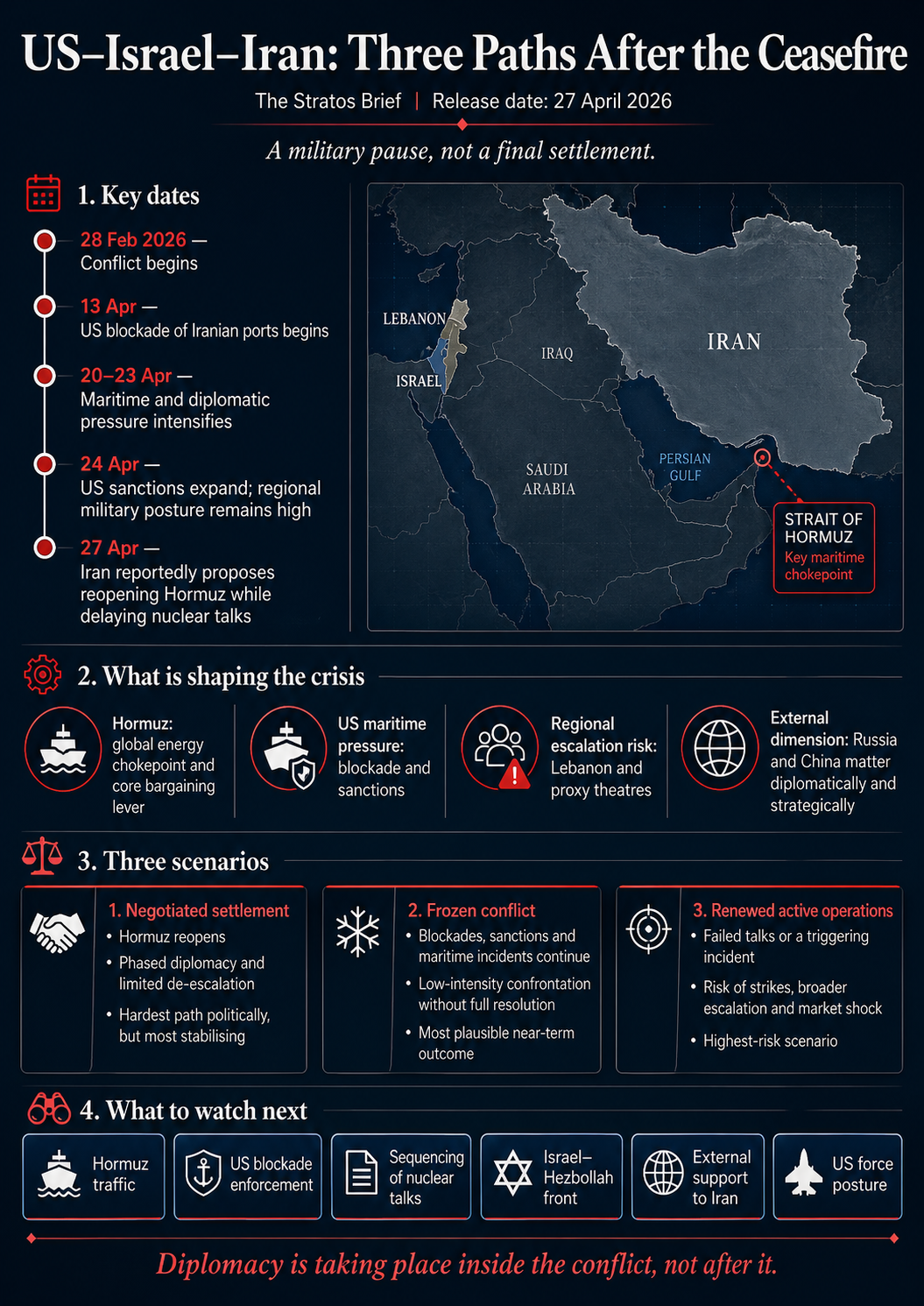
The Stratos Brief infographics