MQ-25A Stingray First Flight: The US Navy’s Tanker Drone Moves from Concept to Carrier Air Wing Integration
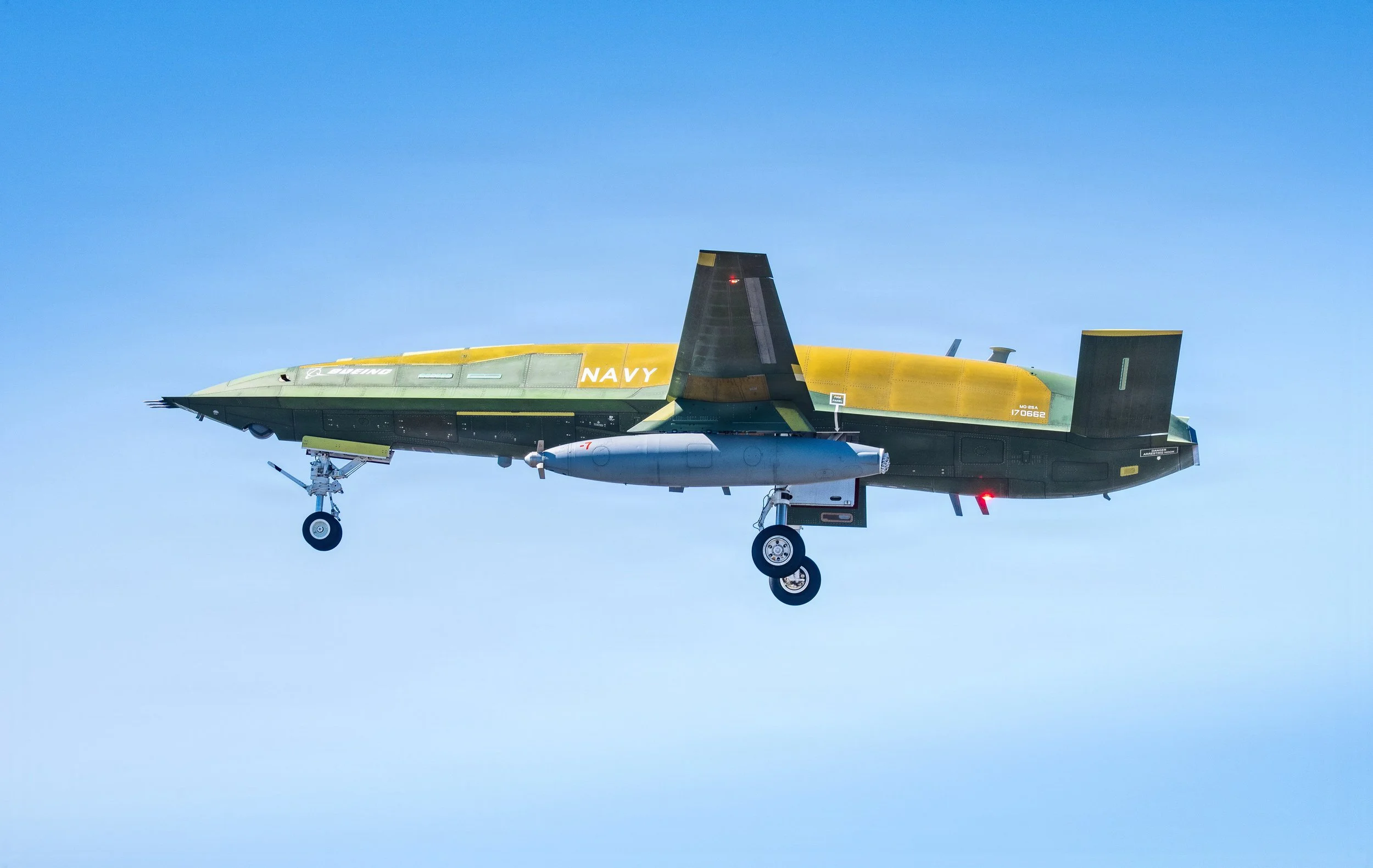
The Navy’s MQ-25A Stingray takes its first flight April 25 at Boeing’s facility at MidAmerica Airport in Mascoutah, Ill. The MQ-25 is the Navy’s first operational carrier-based unmanned aircraft. (Photo courtesy of Boeing)
Date published: 29 April 2026
Event date: 25 April 2026
Event location / region: Mascoutah, Illinois, United States / US naval aviation industrial base
Event: First test flight of the operational MQ-25A Stingray unmanned carrier-based refuelling aircraft
The First Flight of an Operational MQ-25A
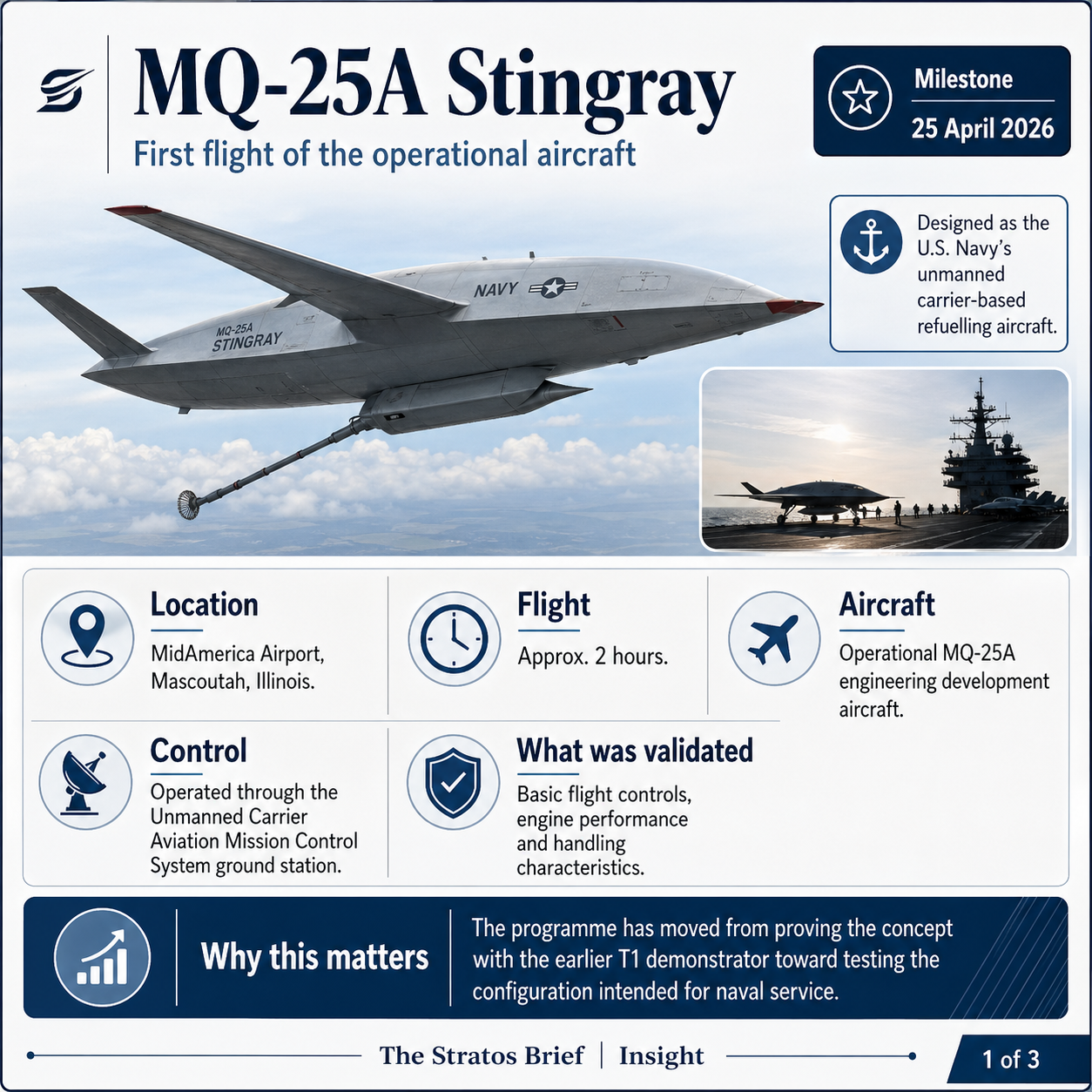
The US Navy’s MQ-25A Stingray completed its first test flight on 25 April 2026 from Boeing’s facility at MidAmerica Airport in Mascoutah, Illinois. The flight lasted approximately two hours and was controlled by US Navy and Boeing air vehicle pilots through the Unmanned Carrier Aviation Mission Control System ground control station. According to the Navy, the aircraft validated basic flight controls, engine performance and handling characteristics during the sortie.
This was not the first time the MQ-25 concept had flown. Boeing’s earlier T1 test asset first flew in 2019 and later demonstrated unmanned aerial refuelling with carrier aircraft including the F/A-18, E-2D and F-35C. What makes the April 2026 event important is that it involved an operational MQ-25A engineering development aircraft rather than the earlier company-owned prototype. In practical terms, the programme has moved from proving the concept to testing the configuration intended for naval service.
Why the Stingray Matters for the US Navy
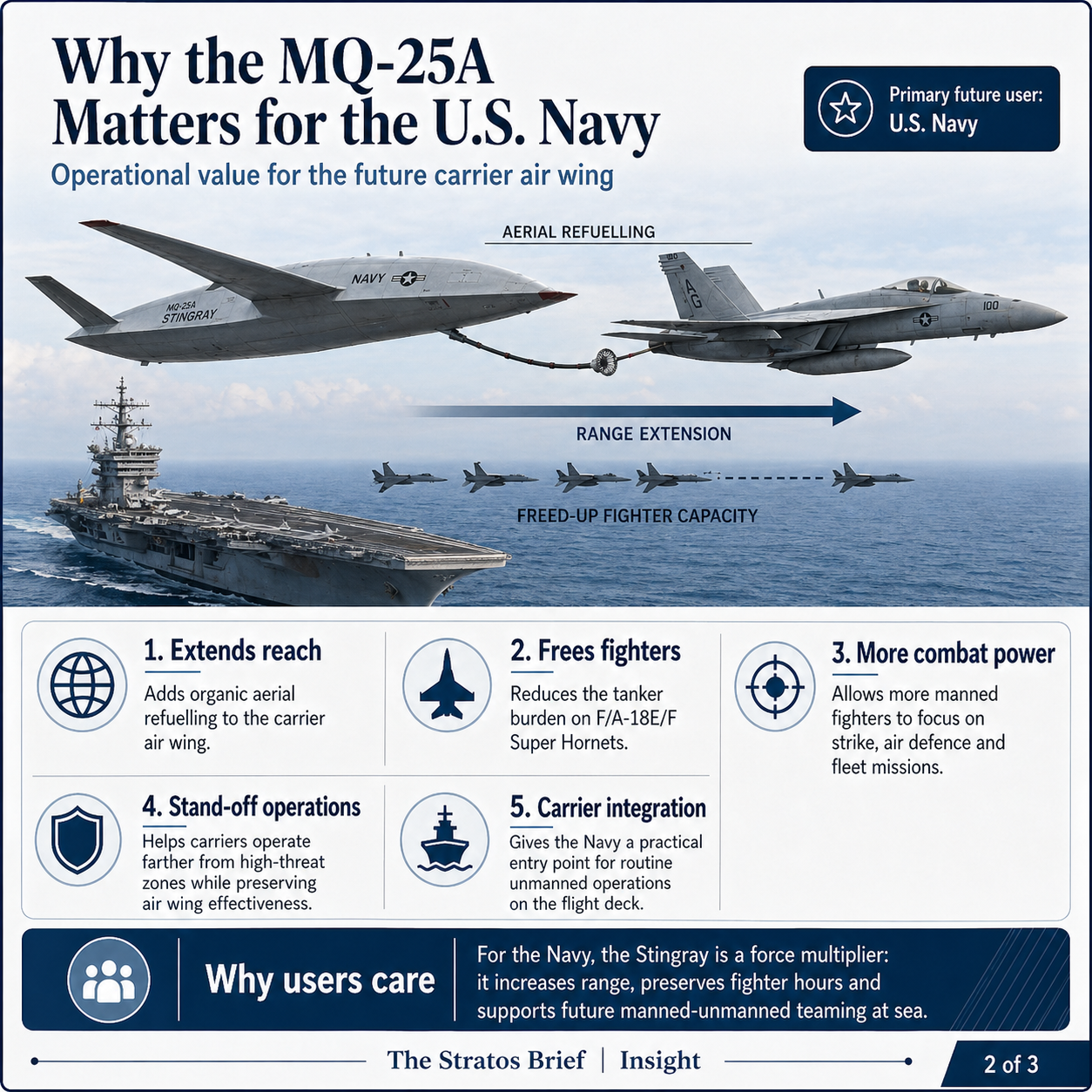
The MQ-25A is designed to become the US Navy’s first operational carrier-based unmanned aircraft. Its primary mission is aerial refuelling, but its importance is broader than simply adding another tanker to the carrier air wing. By taking over part of the refuelling mission now performed by F/A-18E/F Super Hornets, the Stingray should allow more manned fighters to focus on strike, air defence and other combat missions. This is a force-multiplication effect: the Navy is not only adding endurance, it is also releasing scarce crewed aircraft from a support role.
For future users, first of all the US Navy, the operational logic is clear. Carrier aviation is increasingly constrained by distance. Modern anti-ship missiles, long-range sensors and contested maritime zones push aircraft carriers farther from potential operating areas. A carrier air wing that can refuel organically from an unmanned aircraft gains more reach without requiring a land base, a friendly tanker orbit or a larger number of crewed aircraft. That matters especially in the Indo-Pacific, where geography, basing access and survivability all shape operational planning.
A Practical Path into Unmanned Carrier Aviation
The MQ-25A also provides a lower-risk entry point for unmanned carrier aviation. Rather than beginning with a high-end autonomous strike aircraft, the Navy is introducing an unmanned system through a critical but comparatively bounded support mission: refuelling. This is a pragmatic path. It allows the Navy to learn how to control, maintain, move, launch and recover unmanned aircraft in the uniquely demanding environment of a carrier deck before expanding toward more complex manned-unmanned teaming concepts. NAVAIR describes MQ-25 as a foundation for future carrier-based unmanned systems and states that the Navy plans for all Nimitz- and Ford-class carriers eventually to be MQ-25 capable.
The milestone should not be read as immediate operational arrival. USNI News, citing Navy budget documents, reported that initial operational capability has moved to 2029, with IOC defined as three MQ-25As, trained personnel and equipment ready to deploy on an MQ-25-capable aircraft carrier. This underlines the gap between first flight and fleet service: the difficult work now shifts to flight-envelope expansion, mission-system verification, carrier qualification, production maturity, deck integration and training.
What This Means for Aerospace and Defence
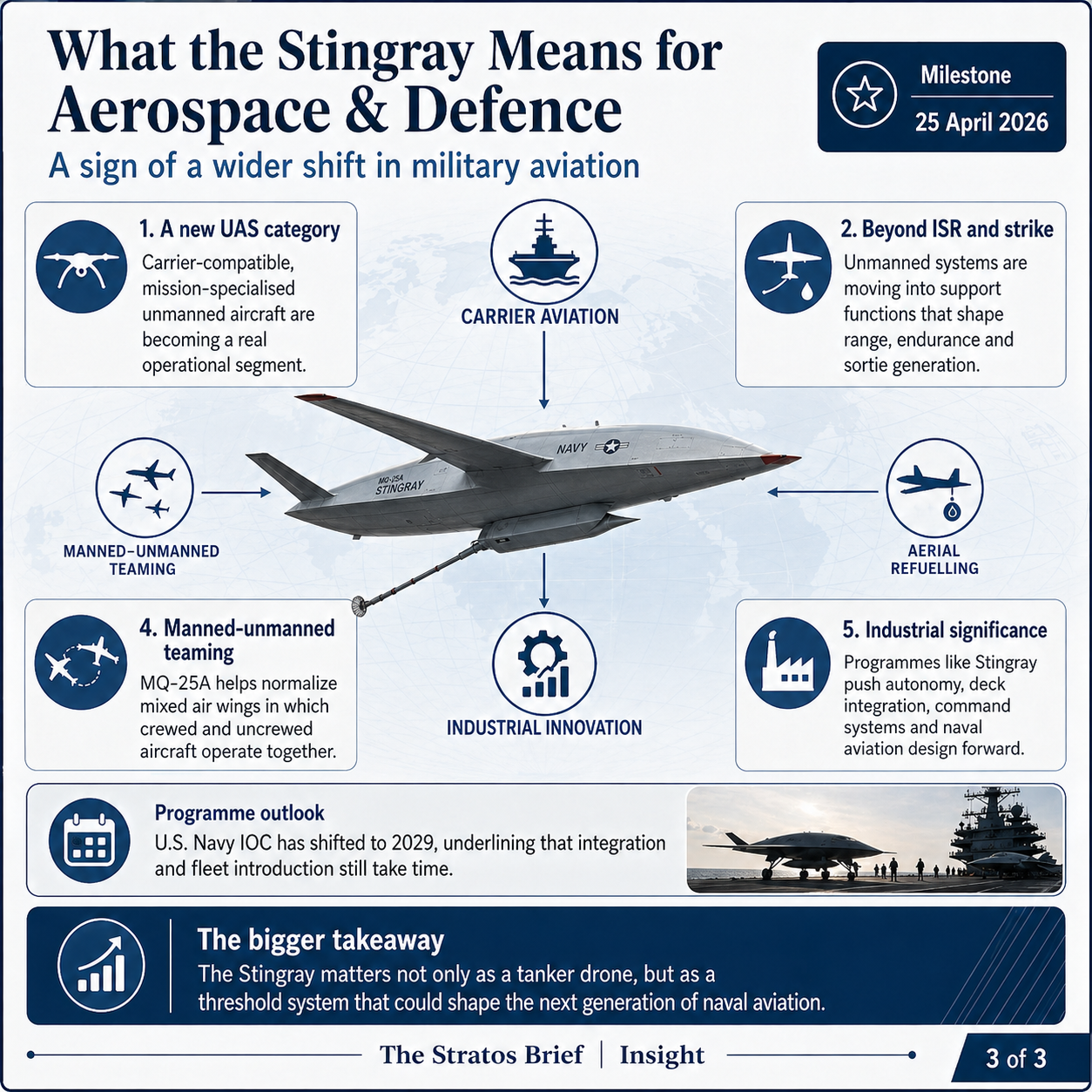
Strategically, the Stingray signals a wider shift in aerospace and defence. Unmanned systems are no longer limited to intelligence, surveillance, reconnaissance or one-way strike roles. They are moving into the core logistics and enabling functions that allow high-end combat aircraft to operate at scale. Aerial refuelling is one of the most strategically important of those functions because it directly determines range, persistence and sortie generation.
For the global aerospace market, this creates a new category: carrier-compatible, mission-specialised unmanned aircraft that are not necessarily replacements for manned fighters, but extensions of the combat aviation ecosystem. The first practical value is not autonomy for its own sake. It is autonomy where it removes burden from crewed assets, expands operational reach and builds confidence in more advanced unmanned carrier operations.
The MQ-25A Stingray therefore matters less as a single aircraft and more as a threshold. If successful, it will give the US Navy a new refuelling tool, but it will also normalise unmanned aircraft as working members of the carrier air wing. That is the deeper strategic implication: the future carrier air wing is unlikely to be purely manned or purely unmanned. It will be a mixed system, where crewed fighters, unmanned support aircraft and eventually more capable autonomous platforms operate as one force.
Sources: US Navy; NAVAIR; Boeing; USNI News.