Romania’s H225M Decision: 12 New Helicopters, a SAFE-Funded Capability Step, and an Industrial Test Case
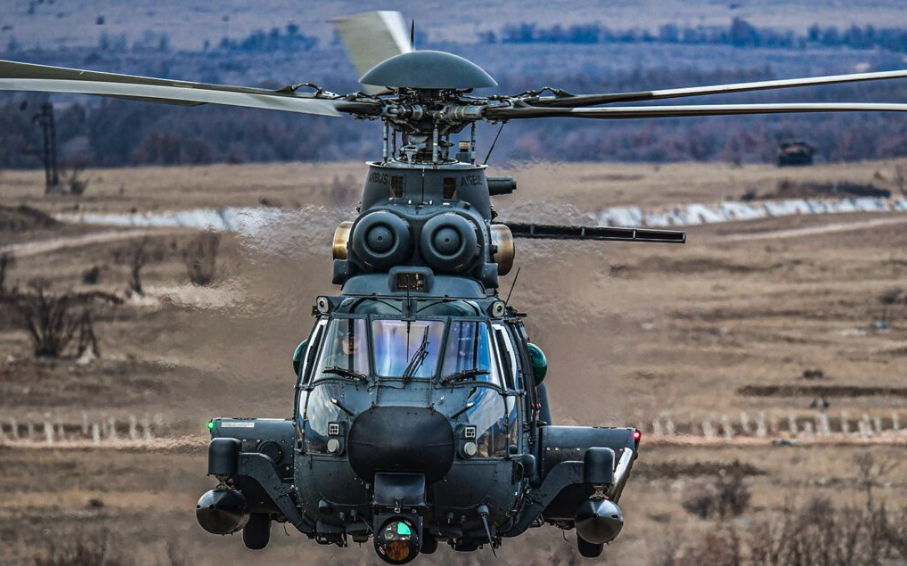
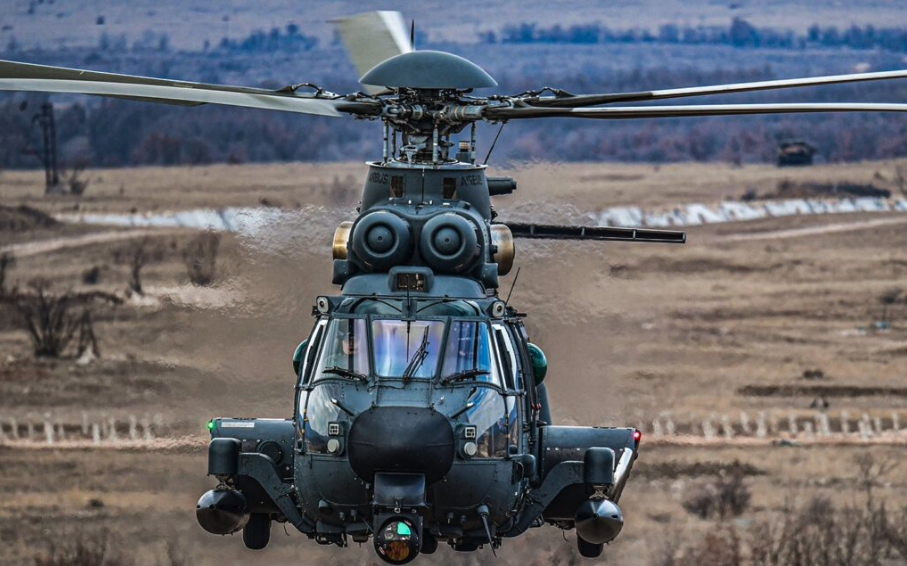
The Hungarian Airbus H225M helicopter during the exercise. Photo: Honvédelem.hu
Date published: 5 May 2026
Event date: 28 April 2026
Event location / region: Bucharest, Romania / NATO eastern flank / European defence industrial base
Romania is moving forward with the procurement of 12 new Airbus H225M Caracal multi-mission helicopters. The purchase is part of Romania’s wider defence-modernisation package financed through the European Union’s SAFE — Security Action for Europe instrument. According to the Romanian Ministry of National Defence, the project is valued at €852 million excluding VAT, covers helicopters in an attack configuration, and includes initial integrated logistic support and personnel training.
The acquisition matters for three reasons. First, it gives Romania a first tranche of modern helicopters to begin replacing its ageing IAR-330 Puma fleet. Second, it tests whether EU-backed defence financing can quickly generate usable capability on NATO’s eastern flank. Third, it will show how far Romania can convert a relatively small first order into meaningful domestic industrial participation around Brașov, Airbus Helicopters Romania and IAR S.A. Brașov.
The Romanian Ministry of National Defence — Ministerul Apărării Naționale, MApN lists the programme as SAFE_RO_1_C_006 – “Elicoptere multi-misiune”(Multi-mission helicopters). The official entry states that Romania plans to acquire 12 H225M helicopters produced by Airbus Helicopters through a joint procurement with France, conducted via the French Direction générale de l’armement, DGA(Directorate General of Armaments).
The project sits inside Programul SAFE (the SAFE Programme). In practical terms, it is an EU loan instrument designed to help member states rapidly increase defence investment through common procurement. The Council of the EU describes SAFE as an instrument providing loans of up to €150 billion for defence investments, funded through EU borrowing and focused on strengthening Europe’s defence technological and industrial base.
A first tranche, not a full helicopter replacement programme
The announced purchase covers 12 helicopters. That makes it an important first step in Romania’s helicopter modernisation, but not yet a full replacement of the country’s legacy fleet.
Romania’s official SAFE list points in the same direction. It describes the project as “Elicoptere multi-misiune H225M – minim 12” (H225M multi-mission helicopters – minimum 12). This suggests that 12 helicopters are the approved baseline, while the final size of Romania’s future H225M fleet may still depend on later funding and procurement decisions.
This distinction matters because Romania’s helicopter requirement is much larger than the first batch. Romanian defence reporting has framed the issue directly: why only 12 H225M helicopters if the need is significantly greater? Defence Romania reported that the 12-aircraft number reflected the distribution of available SAFE financing across multiple defence priorities, rather than the full scale of the Romanian Armed Forces’ long-term helicopter requirement.
The capability logic is clear. Romania still relies heavily on the IAR-330 Puma family, including locally built and upgraded versions derived from older Puma/Cougar lineage aircraft. The H225M is not a like-for-like light replacement. It is a larger, more capable heavy multi-role helicopter designed for missions such as tactical transport, special operations, combat search and rescue, medical evacuation and armed support.
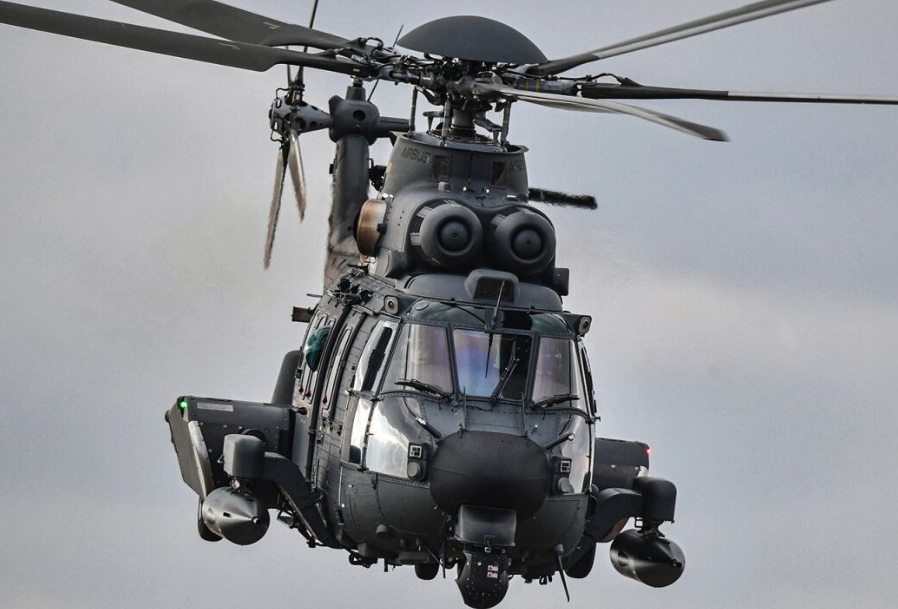
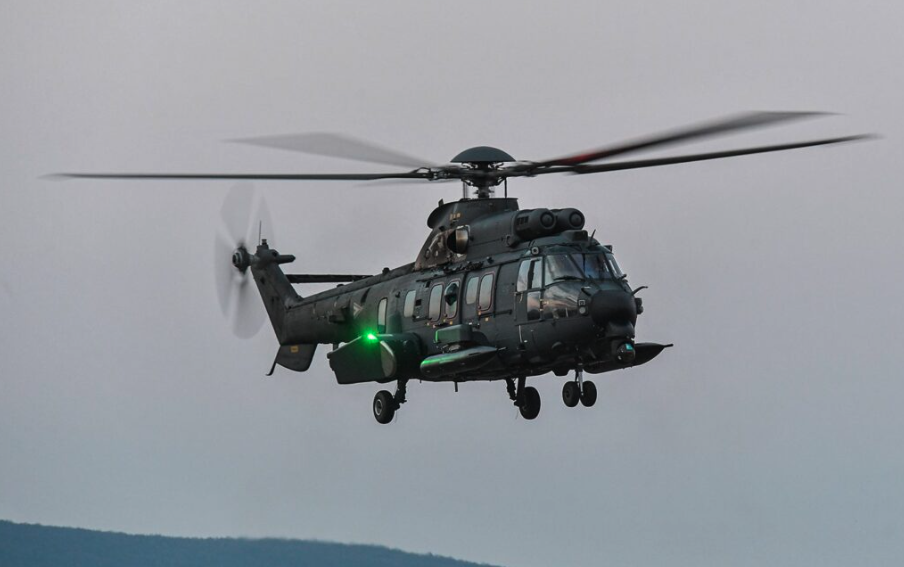
Airbus describes the H225M as a combat-proven multi-role helicopter for special operations, combat search and rescue, tactical transport and medical evacuation. Airbus also lists the platform’s key figures as 28 troops, 4,750 kg sling load and 920 km maximum range.
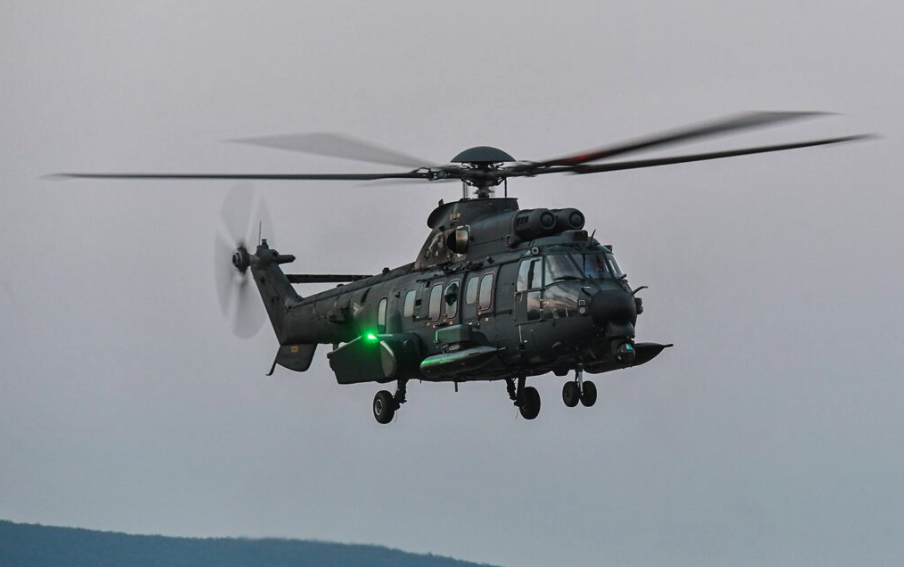
The Airbus H225M. Photo: Honvédelem.hu
The positive case: capability renewal and eastern-flank urgency
The strongest argument in favour of the H225M procurement is operational. Romania is a NATO eastern-flank state bordering Ukraine and facing a deteriorated regional security environment. Reuters reported that Romanian lawmakers approved €8.33 billion in EU-funded defence contracts under SAFE and noted Romania’s 650-km land border with Ukraine, repeated Russian drone breaches of Romanian airspace, and Black Sea security exposure.
For Romania’s armed forces, the H225M offers a modern heavy multi-role helicopter able to combine lift, range, survivability, troop transport, rescue and armed mission profiles. MApN’s description is important here because it does not refer only to generic transport helicopters. It says the estimated value is for 12 H225M helicopters equipped in attack configuration.
That makes the procurement more significant than a standard utility-helicopter buy. It suggests Romania is seeking a more flexible armed helicopter capability that can support land forces, special operations and potentially higher-end contingency missions where legacy Puma-type aircraft are increasingly exposed by age, survivability and interoperability limitations.
The SAFE advantage: speed, financing and European procurement
SAFE changes the financial and political context of the deal. It gives Romania access to long-term EU-backed financing rather than requiring the entire procurement burden to fall immediately on the national budget.
The Council of the EU says SAFE financing is intended to support rapid and significant increases in defence investment through common procurement. It also states that SAFE is funded through the EU’s borrowing capacity and that disbursements take the form of competitively priced, long-maturity loans repaid by beneficiary EU member states.
From a European policy perspective, the H225M procurement fits the SAFE logic. It involves a European platform, a French procurement channel and potential Romanian industrial participation. It also aligns with the EU’s broader attempt to turn defence spending into common European procurement rather than purely national, fragmented acquisition.
This is politically useful for Bucharest. It lets Romania present the purchase not only as a military requirement, but also as part of a broader European defence-industrial response to the war-driven security environment.
The industrial case: Brașov, Airbus and IAR
The industrial angle is central to the political value of the programme.
Airbus already has a significant Romanian footprint. Airbus says it has strengthened its presence in Romania over the past 50 years through business relationships with IAR, Aerostar, Comoti, Sonaca, Aeroteh, Turbomecanica, Aerofina, INCAS, UAC and others. Airbus also states that previous industrial cooperation agreements with IAR for local manufacturing and customization of H215M and H145M helicopters were revised in 2025 to include the H225M.
IAR S.A. Brașov — historically Industria Aeronautică Română(Romanian Aeronautical Industry) — is Romania’s legacy aerospace company in the Brașov/Ghimbav area. IAR’s own public information describes the company as one of the pillars of Romania’s aviation industry, founded in 1925 as the country’s first aircraft factory. It states that IAR produced more than 360 Puma and Alouette III helicopters under Aérospatiale licence and is today specialised in maintenance, repair, overhaul, modernisation and support for Puma and Alouette III helicopters.
This gives the H225M project an industrial-policy dimension beyond aircraft delivery. In public messaging, the programme has been linked to possible Romanian participation in maintenance, customization, component work, training and supply-chain development. For Romania, this matters because helicopter procurement is politically easier to justify if it sustains domestic aerospace competence rather than simply importing finished aircraft.
However, this is also where the largest uncertainty lies. Public Romanian reporting indicates that the first 12 aircraft alone will not be sufficient to move full production or licensing into Romania. Defence Romania quoted Defence Minister Radu Miruță saying that with only 12 helicopters ordered, the licence cannot be moved exclusively to Romania, although discussions may cover some components being produced domestically.
The critical case: price, quantity and localisation risk
The main criticism of the procurement is not that Romania does not need modern helicopters. It is that the first batch may be too small, too expensive and industrially less transformative than the political narrative suggests.
The headline value is high: €852 million for 12 aircraft, or roughly €71 million per helicopter before adjusting for package content. That figure should not be treated as a simple flyaway unit price, because MApN says it includes attack configuration, initial logistic support, personnel training, indexation potential and SAFE cooperation requirements.
Still, Romanian media have questioned the value-for-money aspect. HotNews highlighted that the acquisition represents around €71 million per aircraft on a simple calculation and described it as the second-largest Romanian military acquisition through SAFE after the infantry fighting vehicle programme. HotNews also noted that each helicopter contract has its own specifications, which means headline comparisons with other H225M purchases can be misleading without knowing the exact configuration and support package.
The second criticism is quantity. If Romania needs to replace a much larger legacy helicopter fleet, 12 H225Ms will provide only limited operational mass. A small fleet can deliver high-end capability, but it also creates challenges in availability, training, maintenance, spare aircraft, deployment rotation and long-term cost efficiency.
The third criticism is localisation. Romanian media have reported that the 12 helicopters will not initially be built in Romania, while the official and industrial narrative still points to Romanian participation in components, maintenance and support. HotNews reported that the large financial envelope may provide space for negotiation on Romanian component production and a potential local maintenance, repair, overhaul and modernisation centre, but those details remain to be negotiated.
This creates a political risk. If the procurement is sold domestically as both a capability programme and an industrial revival, public scrutiny will focus not only on the helicopters delivered, but also on the number of jobs, the share of Romanian work, the role of IAR Brașov and the durability of Airbus’ local commitments.
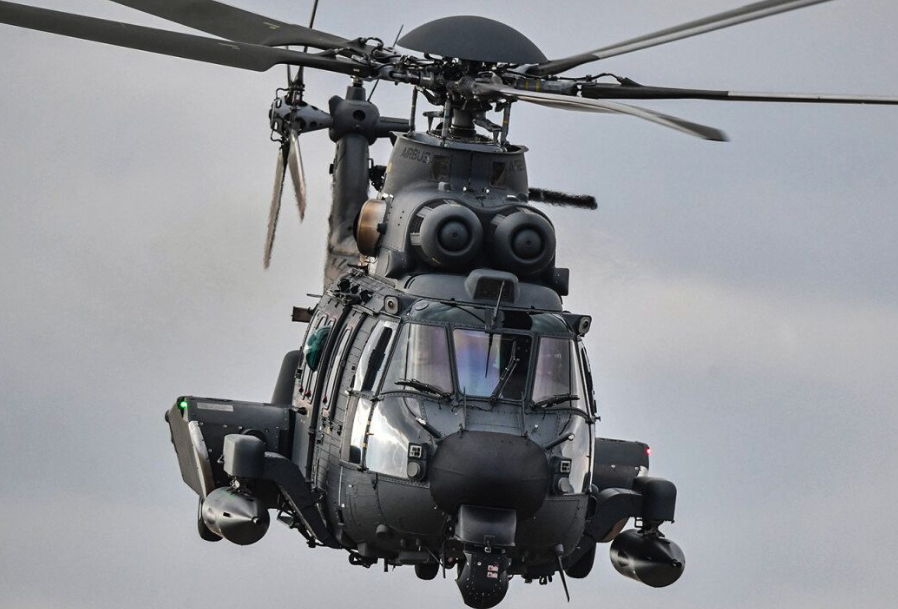
The Airbus H225M. Photo: Honvédelem.hu
The procedural risk: approval is not the same as final delivery
The procurement has advanced, but public sources should be read carefully. Romania’s Parliament gave prior approval for the SAFE projects, and MApN says it can initiate award procedures. However, the Romanian official SAFE framework still refers to further procedural steps around acquisition strategies, supplier selection, cooperation conditions and contracting.
The relevant Romanian institutional framework includes Consiliul Suprem de Apărare a Țării, CSAT(Supreme Council of National Defence), Romania’s top national security decision-making body, and OUG 62/2025 — Ordonanță de urgență a Guvernului(Government Emergency Ordinance), the legal basis referenced by MApN for SAFE-related procurement procedures.
That means the public record supports a conclusion that Romania has politically and procedurally cleared the H225M project for procurement under SAFE. It does not necessarily prove that a final aircraft supply contract has already been signed and fully disclosed.
This distinction is important for defence-industry stakeholders. The programme is real and officially listed. But final contract structure, delivery schedule, exact configuration, weapons package, industrial workshare and long-term fleet plan remain areas to watch.
The 42-aircraft question
The strategic question is whether the first 12 aircraft become the foundation for a larger H225M fleet.
Public reporting has repeatedly mentioned that Romania’s wider requirement is much larger than the first tranche. Defence Romania noted that previous Romanian plans for attack and multi-role helicopters for the land forces involved much higher numbers, and that the current number reflects allocation of money across competing priorities rather than the full operational need.
If Romania eventually expands the H225M fleet, the procurement could become a genuine national rotorcraft programme. It could support deeper Romanian participation in maintenance, training, customization, component production and regional support. If the programme remains limited to 12 aircraft, it will still modernise part of the force, but its industrial and operational impact will be more limited.
This is why the H225M decision should be read as a first tranche, not as the final answer to Romania’s helicopter-modernisation problem.
The Stratos Brief assessment
Romania’s H225M procurement is a credible and strategically understandable decision. The platform is modern, European, NATO-compatible and operationally more capable than the legacy Puma family it begins to replace. The joint-procurement structure with France and the use of SAFE financing also align with the EU’s current push for faster and more European defence acquisition.
At the same time, the programme has real weaknesses. Twelve helicopters are not enough to recapitalise Romania’s helicopter force. The headline price is high and will require consistent public explanation. The industrial benefits appear potentially meaningful, but not yet fully defined in publicly visible contractual terms. Full industrial cooperation seems linked to a larger fleet size than the currently approved first batch.
The most balanced reading is therefore this: Romania is not yet buying a complete helicopter-modernisation solution. It is buying a first operational and industrial entry point. The success of the programme will depend on whether Bucharest can convert the first 12 H225Ms into a coherent long-term fleet, a sustainable support model and a credible Romanian industrial role.
Why this matters for decision makers
For military decision makers, the procurement signals a shift toward a heavier, armed, multi-mission helicopter capability. The key question is how 12 aircraft will be used: as a niche high-end fleet, a special-operations and combat-support asset, or the first phase of a larger Puma replacement strategy.
For business and industrial stakeholders, the programme identifies potential opportunities in MRO, training, mission-system integration, logistics, spare parts, component manufacturing, support equipment and workforce development. The larger commercial opportunity depends on whether Romania expands beyond the initial 12-aircraft tranche and locks in a more substantial domestic workshare.
For political decision makers, the H225M case is a visible test of SAFE. It shows that EU loans can accelerate defence procurement, but also that financing speed does not remove the need for transparency, industrial realism and clear communication about cost, debt and local economic return.
For external observers, Romania’s H225M decision is a useful indicator of where European defence procurement is heading. It combines eastern-flank urgency, EU-backed financing, French industrial leadership and Romanian localisation expectations. If it succeeds, it could become a model for SAFE-supported capability renewal. If it stalls or under-delivers industrially, it will become another example of the gap between European defence ambition and executable national programmes.
Sources considered
Romanian Ministry of National Defence / Ministerul Apărării Naționale, MApN (Ministry of National Defence) SAFE programme page; Council of the European Union SAFE explainer; Reuters reporting on Romanian parliamentary approval; Airbus H225M official product information; Airbus Romania official industrial profile; IAR S.A. Brașov official company information; Defence Romania; HotNews; and other Romanian public reporting on the H225M, IAR Brașov and SAFE procurement context. Photos: honvedelem.hu