A New NATO? What the Makkah Pact Is Really Building.
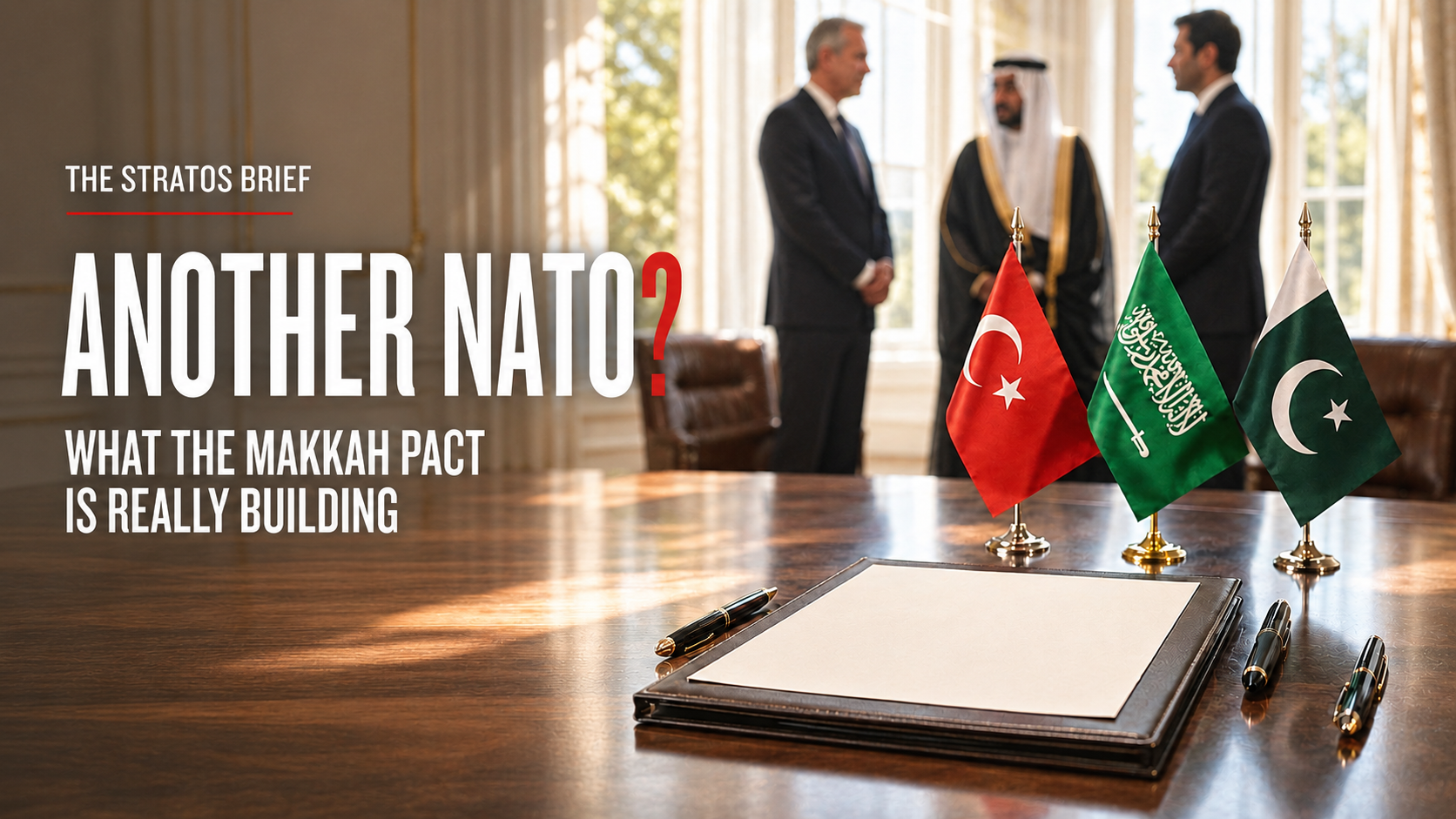
Saudi Arabia, Türkiye and Pakistan have declared that an armed attack on one will be treated as an attack on all. The strategic test is whether they can convert that political commitment into common planning, interoperable forces and an enduring defence-industrial system.
Quick Read
Collective defence — adopted
Treaty text — unpublished
Institutions — taking shape
Military command — unresolved
Nuclear guarantee — unconfirmed
Defence industry — prioritised
Expansion — legally possible
On 7 August 2026, Saudi Crown Prince Mohammed bin Salman, Turkish President Recep Tayyip Erdoğan and Pakistani Prime Minister Muhammad Shehbaz Sharif signed the Makkah Joint Defence Agreement at Al-Safa Palace, declaring that an armed attack on one state would be regarded as an attack on all three. The formulation joined the largest Arab military spender to NATO’s second-largest army and the only nuclear-armed Muslim-majority state, placing their established bilateral relationships inside a new trilateral framework.
That combination explains the “Muslim NATO” label, but NATO’s deterrent value rests on machinery accumulated behind Article 5: political consultation, integrated commands, defence planning, reinforcement, standards, intelligence, logistics and exercises. The Makkah Pact has the collective-defence commitment and a blueprint for ministerial coordination, a Saudi-based secretariat, exercises and industrial cooperation. It does not yet have most of the systems required to execute the promise reliably.
Its more consequential proposition is to institutionalise a practical division of labour: Saudi Arabia finances and hosts, Türkiye designs and integrates, and Pakistan supplies manpower, lower-cost production and operational depth. Common planning and funded programmes could turn that triangle into a durable security network linking the Eastern Mediterranean, Gulf and Arabian Sea; without them, the pact will retain diplomatic weight but offer little clarity about how its militaries would respond under pressure.
What was signed — and what remains hidden
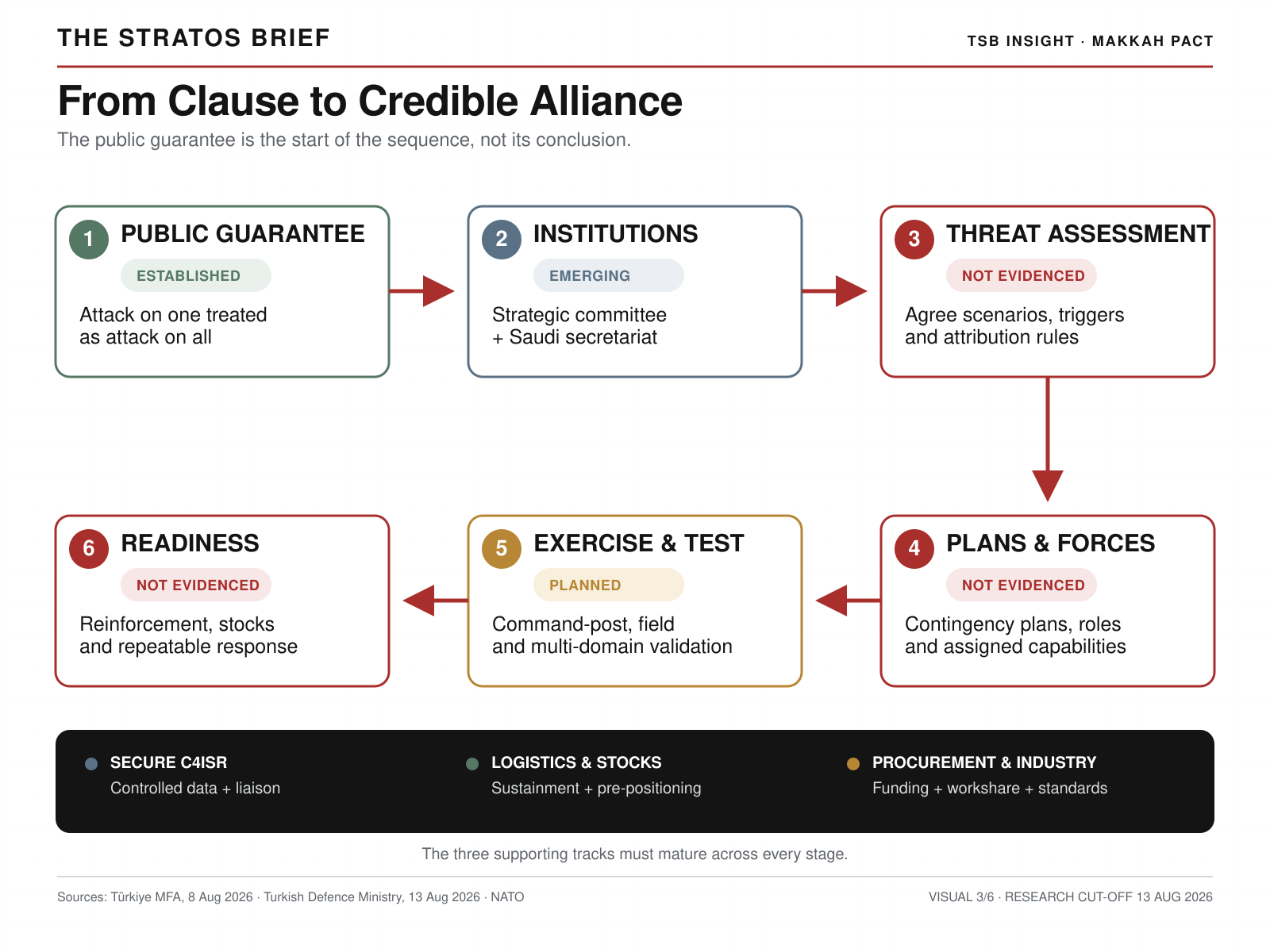
A public mutual-defence clause starts the process. Credibility depends on institutions, shared threat assessment, plans and forces, testing, and repeatable readiness
The authoritative English-language announcements from Pakistan’s Ministry of Foreign Affairs and the Saudi Press Agency use Makkah Joint Defence Agreement. “Mecca” is the familiar international rendering, while Turkish officials use Mekke Savunma Anlaşması and sometimes “Makkah Alliance.” No founding government has established “MJDA” as an official acronym.
The public joint statement contains two substantive commitments. It says the agreement is intended to strengthen collective deterrence against aggression and stipulates that “any armed attack against any one of the three States shall be regarded as an attack against them all”; it also promises to enhance defence cooperation in all its aspects. Pakistan’s Deputy Prime Minister and Foreign Minister Ishaq Dar subsequently described the pact as purely defensive and anchored it in Article 51 of the UN Charter, which recognises individual and collective self-defence after an armed attack. The three governments have repeatedly said the agreement is not directed against any particular country and does not cancel their existing bilateral or multilateral commitments.
The complete treaty had not been published by 13 August. The public record therefore does not settle entry into force, geographic coverage, proxy, cyber or space triggers, withdrawal, costs, voting or the precise duty to assist. These gaps are operationally important: a missile strike, proxy-claimed drone attack and cyber operation present different attribution and escalation problems, and no public text shows how the pact distinguishes them.
Hakan Fidan supplied the most detailed official interpretation on 8 August. Asked whether the collective-defence provision was the same as NATO Article 5, the Turkish foreign minister answered, “Technically, the same,” before describing a process in which an attacked member requests help and identifies what it needs. Assistance could involve intelligence, logistics, ammunition or, in a more severe case, military units; the partners would then decide through their institutions how to respond. His official Turkish-language transcript is more nuanced than headlines suggesting that all three states automatically enter a war the moment one is struck. It portrays a political guarantee whose military expression remains contingent on the request, the threat and national decisions.
The NATO comparison, category by category
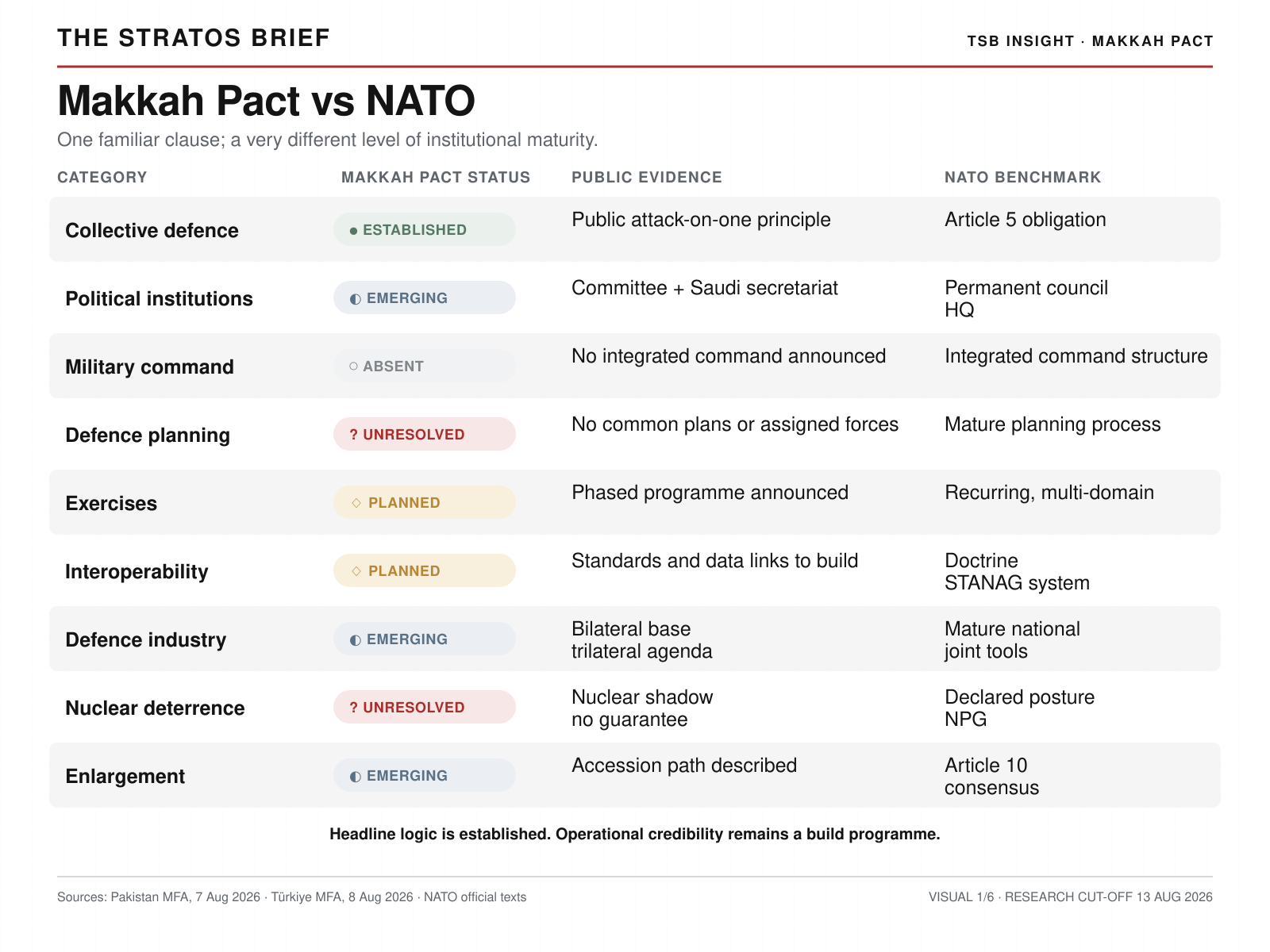
The Makkah Pact has adopted collective-defence logic, but the institutions that make NATO operational remain mostly emerging, planned, absent or unresolved.
The Article 5 analogy is not entirely misplaced. The North Atlantic Treaty requires each ally to take “such action as it deems necessary,” which may or may not involve armed force. Neither framework, as publicly described, is a mechanical tripwire that removes political judgement; both warn an attacker that a crisis may widen beyond its original target.
Across every other category, maturity is uneven. Collective defence is established at the political level, although its legal detail and operational triggers remain unresolved. Permanent political institutions are emerging: Fidan described a strategic political-military committee bringing together foreign ministers, defence ministers and chiefs of general staff, with periodic meetings and a secretariat headquartered in Saudi Arabia. A military command is absent or, at best, unresolved; no supreme commander, permanent joint headquarters, subordinate component commands or assigned forces have been announced. The secretariat may coordinate policy, but it should not be mistaken for an integrated command until its authority and staffing are known.
Defence planning is unresolved. NATO translates political guidance into capability targets and executable plans. The Makkah partners have announced neither a common threat assessment nor contingency plans, force-generation procedures, readiness targets or a reinforcement concept. Fidan said the three had not codified a common enemy, supporting the pact’s defensive presentation while leaving planners to agree on the threats, theatres and missions that deserve resources.
Exercises are planned. Türkiye’s Defence Ministry said cooperation would progress from command-post and field activities to land, sea, air, air-defence and unmanned-system exercises. No calendar, named series or force contributions have appeared. Repeated command-post work, rather than ceremonial drills, will show whether communications, authorities and rules of engagement can function together.
Interoperability and standardisation are planned, not achieved. NATO has common doctrine, technical standards, intelligence processes and logistics organisations developed over decades. The Makkah members begin with different equipment ecosystems and security rules, making mission-specific liaison networks, shared operational pictures, deconfliction, identification protocols and controlled data gateways more realistic than unrestricted platform-to-platform connectivity.
Defence-industrial cooperation is emerging from a stronger base than the military institution itself. Saudi Arabia already buys and seeks to localise Turkish systems; Türkiye and Pakistan already cooperate on naval platforms; all three have incentives to share development costs and expand export markets. Yet no trilateral funding vehicle, intellectual-property regime, workshare formula or approved programme portfolio has been disclosed. Nuclear deterrence remains unresolved, because Pakistan’s arsenal creates strategic ambiguity without a published extended-deterrence guarantee. Enlargement is legally envisaged in outline, according to Fidan, but public eligibility criteria, accession milestones and security obligations have not been issued.
This comparison produces a more exact conclusion than the phrase “NATO-style.” The Makkah Pact is NATO-like in its headline logic, alliance-like in its planned political structure, and pre-alliance in much of its operational machinery. NATO’s relevance is greatest as a development benchmark: it shows the institutions that must sit between a promise and a credible response. It is least useful when treated as a forecast that the three founders will reproduce the transatlantic alliance’s integrated model, nuclear arrangements or geographic mission.
From the Saudi–Pakistan pact to a wider architecture
The Makkah agreement emerged from an older network rather than from six days of crisis diplomacy. On 17 September 2025, Mohammed bin Salman and Shehbaz Sharif signed a bilateral Strategic Mutual Defense Agreement in Riyadh. Its public statement also said that aggression against either state would be considered aggression against both, formalising a relationship in which Pakistani personnel have trained and served in the kingdom for decades. The full bilateral text was never published, and the public documents do not establish whether the Makkah Pact legally expands that treaty or creates a parallel framework. Dar has said the new agreement does not replace existing commitments, making a layered relationship more likely than a clean substitution.
The development timeline contains an apparent discrepancy that is revealing rather than disqualifying. Reuters reportedthat the trilateral agreement followed nearly a year of negotiations. Fidan said he had worked through the broader idea with partners and other regional states for two years and eight months. Formal drafting can readily occupy a shorter period within a longer conceptual process, particularly when bilateral defence ties, the informal R4 consultations among Egypt, Pakistan, Saudi Arabia and Türkiye, and regional crises were already converging. What cannot be reconstructed from the public record is the sequence of draft texts, concessions and legal reviews.
The founders are also building on, and implicitly responding to, the mixed record of earlier regional institutions. The GCC’s Joint Defence Agreement already contains an attack-on-one commitment, and Peninsula Shield provides a standing Gulf framework with a unified military command. Yet intra-GCC political divisions, uneven forces and reliance on external enablers have constrained autonomous action. The Islamic Military Counter Terrorism Coalition has a broad membership and a Riyadh headquarters but a counterterrorism mission rather than a mutual-defence guarantee. The proposed Middle East Strategic Alliance, popularly called an “Arab NATO,” never acquired binding collective defence; even the US Department of Defense stressed in 2019 that it was not Article 5. The Makkah Pact’s distinction lies less in inventing solidarity than in connecting Saudi Arabia to two populous military states outside the GCC and making industrial integration a founding objective.
Three different forms of power
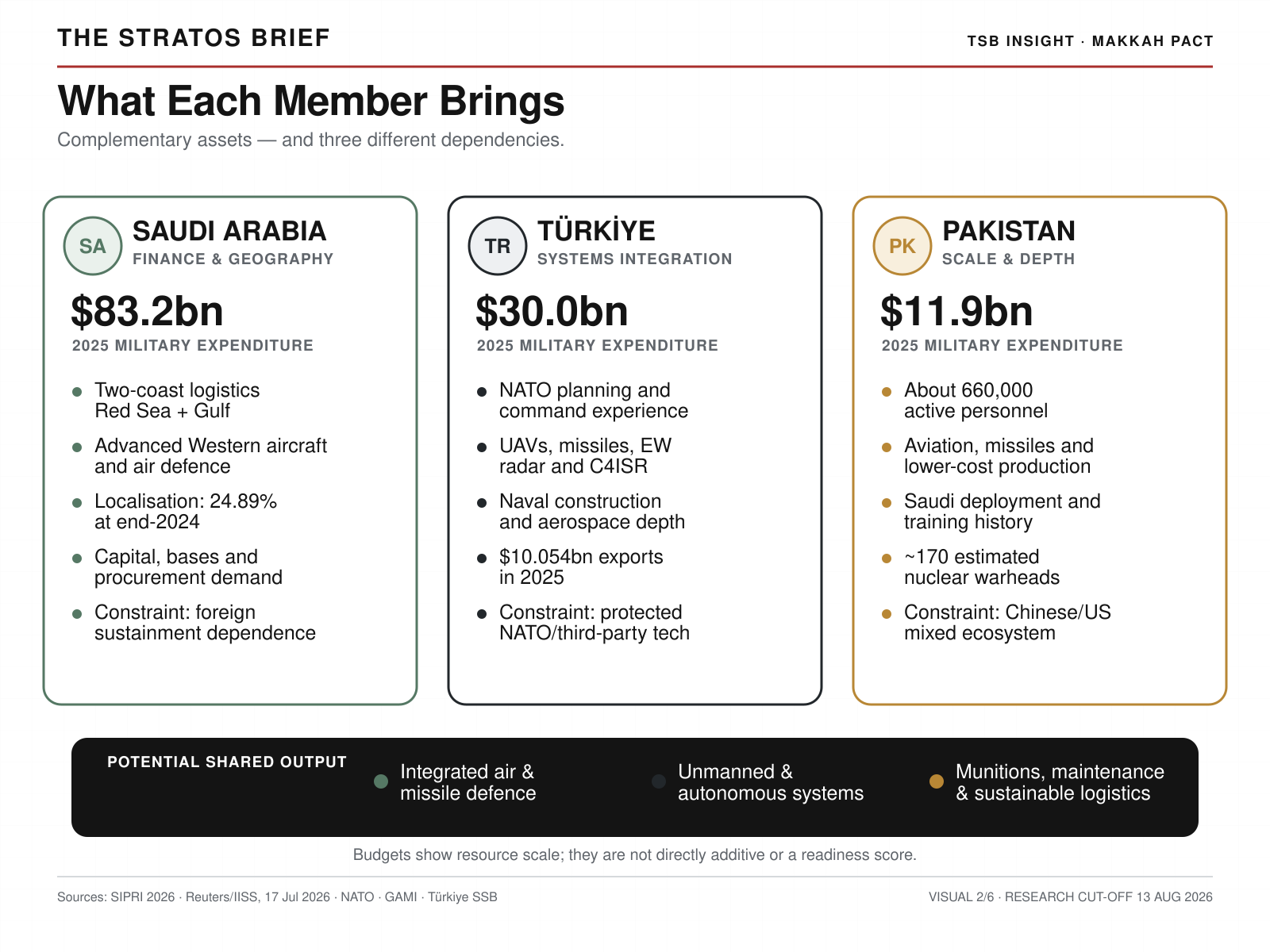
Saudi financial and geographic weight, Turkish systems integration and Pakistani scale create complementarity—but each member also brings a different external dependence
Saudi Arabiabrings the alliance its financial centre of gravity and the geography most immediately exposed to Gulf and Red Sea threats. SIPRI estimates that the kingdom spent $83.2 billion on the military in 2025, the largest total in the Middle East, representing 6.5 per cent of GDP. Its armed forces, estimated in open sources at roughly a quarter-million active personnel depending on definitions, field high-end F-15 and Eurofighter combat aircraft, aerial refuelling, Patriot air defence and naval forces on both the Gulf and Red Sea. Saudi territory contains energy infrastructure and bases near the approaches to the Strait of Hormuz, while its western coast faces the Red Sea and the missile-and-drone threat from Yemen. Those assets make the kingdom a natural host, funder and logistics hub.
SIPRI calculates that the United States supplied 74 per cent of Saudi major-arms imports in 2020–24. Advanced aircraft and air-defence systems require continued access to foreign munitions, software, maintenance and technical data; a potential $9 billion US sale of PAC-3 MSE interceptors in January 2026 underlined that dependency. Riyadh is combining diversification with localisation: GAMI reported 24.89 per cent localised military expenditure by end-2024 against a Vision 2030 goal above 50 per cent. Turkish and Pakistani partnerships could help convert more purchasing power into domestic production.
Türkiye contributes the closest thing the grouping has to a systems integrator. NATO calls the Turkish force its second-largest army, and Ankara combines alliance planning and multinational-command experience with operations in Syria, Iraq and Libya. Its industry spans UAVs, missiles, radar, electronic warfare, command systems, armoured vehicles and naval construction; aerospace programmes including KAAN, Hürjet and Kızılelma remain developmental but show the direction of travel. Türkiye reported $10.054 billion in defence and aerospace exports in 2025 and can increasingly package sensors, weapons, communications and platforms.
Air defence, unmanned warfare and maritime systems are particularly relevant. Türkiye is building the “Steel Dome” sensor-and-effector family, while its shipyards and UAV producers already serve export customers. Ankara can translate NATO-derived organisational habits into the pact, but it cannot freely transfer NATO information or third-party technology. Its value will lie in interfaces and doctrine as well as hardware.
Pakistan supplies scale and a Saudi relationship that has moved beyond exercises. A Reuters capability profile based on IISS data lists approximately 660,000 active personnel, more than 420 combat aircraft, eight submarines and 12 frigates. The air force mixes US-origin F-16s with Chinese-designed J-10Cs and jointly produced JF-17s, while the wider inventory includes Chinese air defence, sensors and missiles. Experience in deterrence against India, counterinsurgency and large-force management is relevant to readiness and mobilisation, though it is not automatically transferable to Gulf warfighting.
Reuters reported in May, citing five sources, that Pakistan had sent about 8,000 troops, roughly 16 mostly JF-17 fighters, drone units and an HQ-9 air-defence system to Saudi Arabia; neither government confirmed the complete package. Pakistan also has a long deployment and training history in the kingdom, while its four-corvette MILGEM programme with Türkiye includes construction and technology transfer in Pakistan. Its firms can offer aircraft, armoured vehicles, ammunition, missiles and naval systems at costs attractive to Saudi localisation, subject to programme-specific quality, scale and export permissions.
Measured by SIPRI’s consistent methodology, the three states spent about $125.1 billion combined in 2025: $83.2 billion for Saudi Arabia, $30.0 billion for Türkiye and $11.9 billion for Pakistan. Simple addition exaggerates usable collective power because currencies, personnel costs, imported sustainment and national missions differ. Even so, the total shows that the pact does not lack resources in the aggregate. Its problem is converting three national force structures into complementary mission packages without assuming that political signatures create common command, common stocks or common readiness.
A nuclear shadow is not a nuclear umbrella
Pakistan’s estimated arsenal of approximately 170 nuclear warheads changes the pact’s strategic context, but it does not establish extended deterrence. A formal nuclear guarantee normally entails more than membership in the same alliance: political consultation, doctrine identifying the protected territory, command-and-control arrangements, credible delivery options, exercises, signalling and an understanding of who decides to escalate. NATO supplements the US and British strategic forces assigned to alliance defence with a Nuclear Planning Group and a declared deterrence policy. No equivalent mechanism, nuclear planning body, basing arrangement or public Pakistani doctrine exists for Saudi Arabia or Türkiye.
The ambiguity originates in contradictory messaging after the 2025 Saudi–Pakistan agreement. Defence Minister Khawaja Asif initially said that Pakistan’s capabilities would “absolutely” be available under the pact, wording widely read to include nuclear forces; he later told Reuters that nuclear weapons were “not on the radar.” A senior Saudi official told the news agency that the agreement encompassed “all military means” without specifying nuclear weapons. No comparable declaration accompanied the 2026 trilateral pact. The evidence therefore supports two simultaneous conclusions: an attacker cannot entirely ignore Pakistan’s nuclear status, but neither Riyadh nor Ankara possesses a publicly demonstrated Pakistani nuclear guarantee.
Calling this a nuclear umbrella would convert ambiguity into a commitment that Islamabad has not formally made and may not wish to make. Pakistan’s nuclear posture has historically been designed around India, and extending it credibly to the Middle East would introduce distinct adversaries, flight paths, escalation thresholds and command risks. Strategic ambiguity may nevertheless produce a modest deterrent effect by widening the range of outcomes an attacker must consider. That is the pact’s nuclear shadow: politically relevant uncertainty without the doctrine and machinery of extended nuclear deterrence.
The industrial opportunity and the security wall
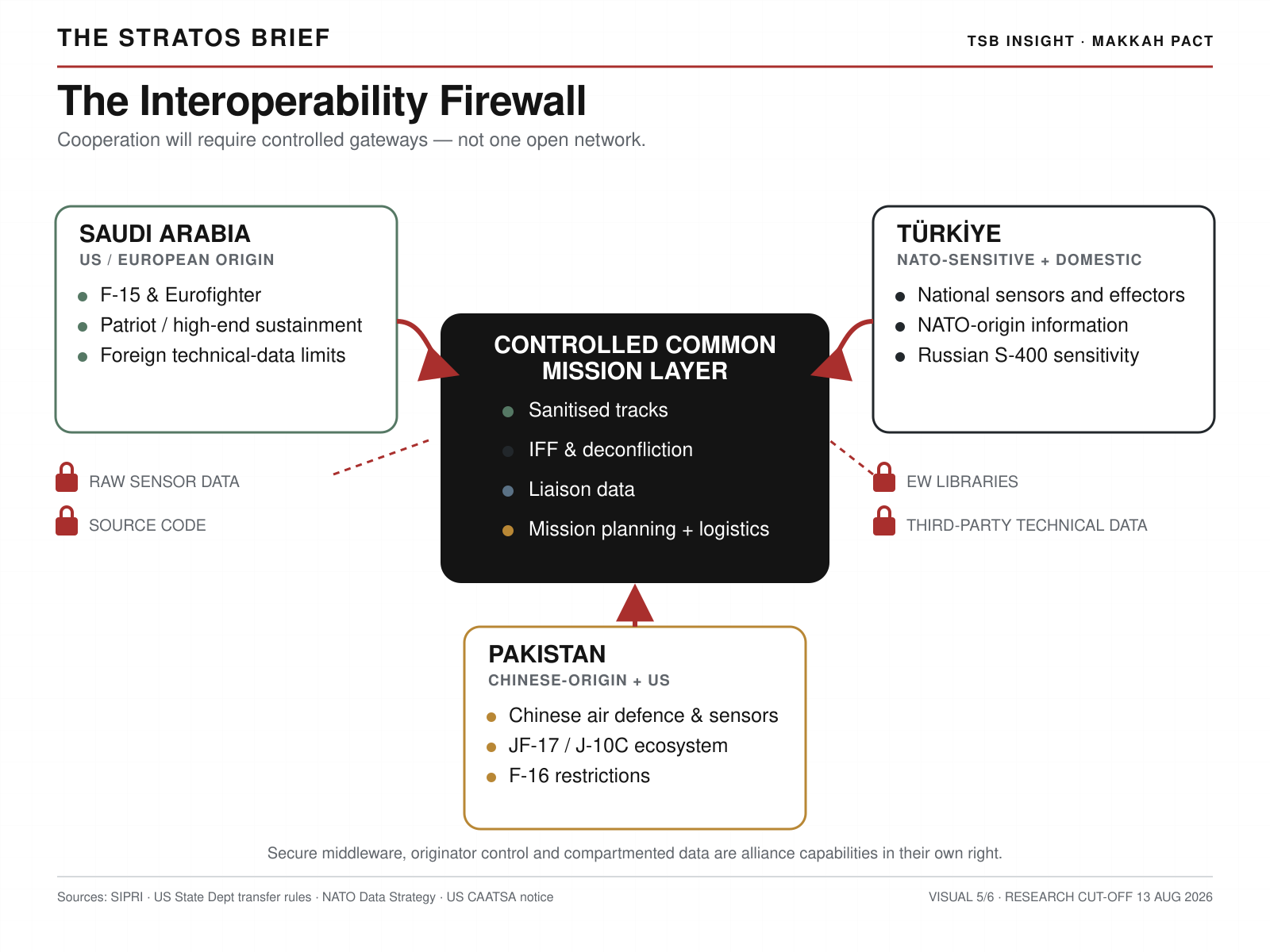
Cooperation across US-, European-, NATO-, Turkish-, Chinese- and Pakistani-origin systems will require controlled gateways, originator permissions and compartmented data—not one open network.
The defence-industrial agenda may become more consequential than the mutual-defence clause in peacetime. Türkiye’s 13 August briefing identified joint development, production, technology cooperation, maintenance and sustainable logistics, with particular attention to unmanned and autonomous systems, electronic warfare and AI-enabled capabilities. Those priorities match real needs exposed by missile-and-drone warfare: layered sensors, affordable interceptors, distributed command networks, resilient communications and the capacity to replace munitions faster than they are consumed. They also align with each government’s economic policy — Saudi localisation, Turkish exports and Pakistani production.
A workable model would combine Saudi demand and capital with Turkish design authority and systems integration, then use Saudi and Pakistani facilities for production, maintenance and regional support. The components already exist in bilateral form: Baykar’s Akıncı agreement with Saudi Arabia includes localisation, while the four-ship MILGEM project divides construction and technology between Türkiye and Pakistan. A trilateral portfolio could begin with less sensitive ammunition, UAV components, ground systems, maintenance software, simulators and naval subsystems before attempting integrated air defence or advanced aerospace work.
The limiting factor is not engineering alone. Saudi forces rely heavily on US and European platforms; Türkiye combines NATO-sensitive systems and domestic technology with the Russian S-400; Pakistan operates an extensive Chinese-origin architecture alongside US equipment. US third-party-transfer rules generally require authorisation before US-origin defence articles, services, training or technical data are transferred or their end use changes. NATO data is also governed by originator control and security policy. Türkiye’s exclusion from the F-35 programme after acquiring the S-400 remains a warning that Washington will treat exposure of sensitive technology to non-approved systems as a strategic, not merely commercial, issue.
The alliance will therefore need an architecture of controlled interfaces rather than a single open network. Data may have to be separated by classification and origin; national sensors may feed sanitised tracks into a common picture without exposing raw signatures or source code; US-origin Saudi systems may operate alongside, rather than be technically fused with, Chinese-origin Pakistani equipment. Such gateways reduce the speed and richness of information exchange, but they are more credible than assuming export restrictions will disappear. For industry, this creates opportunity in secure middleware, identification systems, mission-planning tools, cyber protection, test ranges and integration laboratories. It also creates liability: one unauthorised transfer could jeopardise access to Western technology for all three.
Additive security, three national calculations
For Saudi Arabia, the pact is strategic diversification. Riyadh still needs the United States for intelligence, air and missile defence, munitions, sustainment and power projection, but attacks on Gulf infrastructure and crises around Hormuz and the Red Sea have exposed the risk of exclusive dependence. The pact adds personnel, platforms and industrial know-how without displacing US or GCC ties, while placing Riyadh at the centre of the new secretariat.
For Türkiye, the agreement expands regional influence and markets for an industry Ankara increasingly uses as statecraft. It combines Saudi financing and demand with deeper cooperation with Pakistan and a role in Gulf and Red Sea security. Ankara must still manage NATO technology concerns, Iran’s fear of containment and India’s scrutiny of support that improves Pakistani warfighting.
Pakistan gains status, defence orders, potential financing and a formal Middle Eastern role. Energy access and its overseas workforce give Islamabad strong reasons to protect Gulf stability, while the framework can deepen Turkish cooperation in aviation, naval systems and munitions. Because Pakistan borders Iran, concentrates its high-end deterrence on India and has limited resources, it is likely to prefer scalable training, air defence, intelligence, logistics and industrial support over open-ended combat commitments.
The pact is therefore neither straightforwardly anti-American nor fully post-American. Saudi Arabia remains tied to the United States and Europe, Türkiye to NATO, and Pakistan to China and selected US systems. Washington may welcome maritime and air-defence burden-sharing if technology is protected. Additive security — overlapping layers that reduce single-guarantor dependence while preserving several relationships — describes the model best.
Iran, India and Israel: three different tests
The pact was signed amid the 2026 Iran war, Houthi operations and disruption around Hormuz and Bab el-Mandeb, making Iran central to strategic assessment without proving it is the treaty’s target. Fidan said the talks predated the war and denied they were directed at Tehran. On 10 August, Iranian Foreign Ministry spokesperson Esmaeil Baghaei said Iran had no reason for concern and could welcome inclusive regional self-reliance. That measured position differed from warnings by individual lawmakers.
Iranian planners will care more about capabilities than labels. Shared early warning, Pakistani air defence, Turkish electronic warfare or larger interceptor stocks would complicate missile, drone and proxy operations without an anti-Iranian doctrine. Attribution is harder: the Houthi-claimed drone attack on Saudi Aramco’s Jazan refinery on 9 August did not clarify whether the pact treats such an incident as aggression by the group, a supporting state or a matter for national response. The answer will define the real threshold.
India presents a different problem because Pakistan’s principal conventional and nuclear contingency lies in South Asia. On 11 August, India’s Ministry of External Affairs said it was examining implications for national security and regional stability. Fidan’s request-based model provides no basis for assuming automatic Saudi or Turkish entry into an India–Pakistan war, while Riyadh’s interests in India and nuclear escalation would encourage mediation.
The relevant effect is a wider menu of assistance below direct entry into war. Türkiye or Saudi Arabia could, depending on national decisions and third-party restrictions, provide political support, financing, spare parts, ammunition, logistics, intelligence, selected ISR, air-defence reinforcement or rear-area access. Even uncertainty about which of these would arrive could influence Indian targeting, stockpile and escalation calculations. The effect would be strongest if exercises and contingency planning later demonstrate a repeatable support mechanism; without that evidence, New Delhi is likely to treat the pact as a variable to monitor rather than a transformed balance.
Israel is politically salient but easy to overstate. Its ties with Türkiye are strained; Saudi Arabia has no diplomatic relations with it, and Pakistan does not recognise it. None of this proves that the pact contains anti-Israel plans. Israel’s prime minister’s office declined to comment to Reuters, and the agreement names no adversary. Whether an Israeli strike on a member would bring intelligence, air-defence or military support from the others remains hypothetical until triggers and scenarios are defined.
Türkiye’s two alliance commitments
Türkiye’s simultaneous membership in NATO and the Makkah Pact is not inherently contradictory. Article 8 of the North Atlantic Treaty requires allies not to enter international engagements that conflict with the treaty, and Fidan said Ankara had conducted a legal and strategic review and found no incompatibility. NATO’s Article 5 covers attacks within the treaty’s defined area; it does not extend NATO protection to Saudi or Pakistani territory merely because Türkiye has promised to assist them. Nor does a separate Turkish commitment automatically oblige other NATO allies.
Political and operational tensions are nevertheless realistic. They could arise if a Makkah member requested support during a conflict NATO governments considered offensive or avoidable; if Turkish assets earmarked for NATO were diverted; if Pakistan sought access to NATO-derived intelligence; or if Chinese-origin systems were connected to networks containing protected technology. A crisis involving India or Israel could divide NATO capitals even without creating a formal legal breach. Ankara’s task will be to maintain firewalls, consult allies early and ensure that the new arrangement strengthens Turkish capacity rather than competing with readiness obligations already accepted in NATO.
China is not a party, and no direct evidence shows that Beijing shaped or endorsed the agreement. It could benefit indirectly if Pakistan’s Chinese-origin ecosystem — which supplied 80 per cent of its major-arms imports in 2021–25, according to SIPRI — gains Saudi market access or creates demand for compatible subsystems. The effect is double-edged: greater Chinese connectivity would make NATO and US technology controls more restrictive. This is a commercial and technical possibility, not evidence of Chinese sponsorship.
Enlargement could redraw the map — eventually
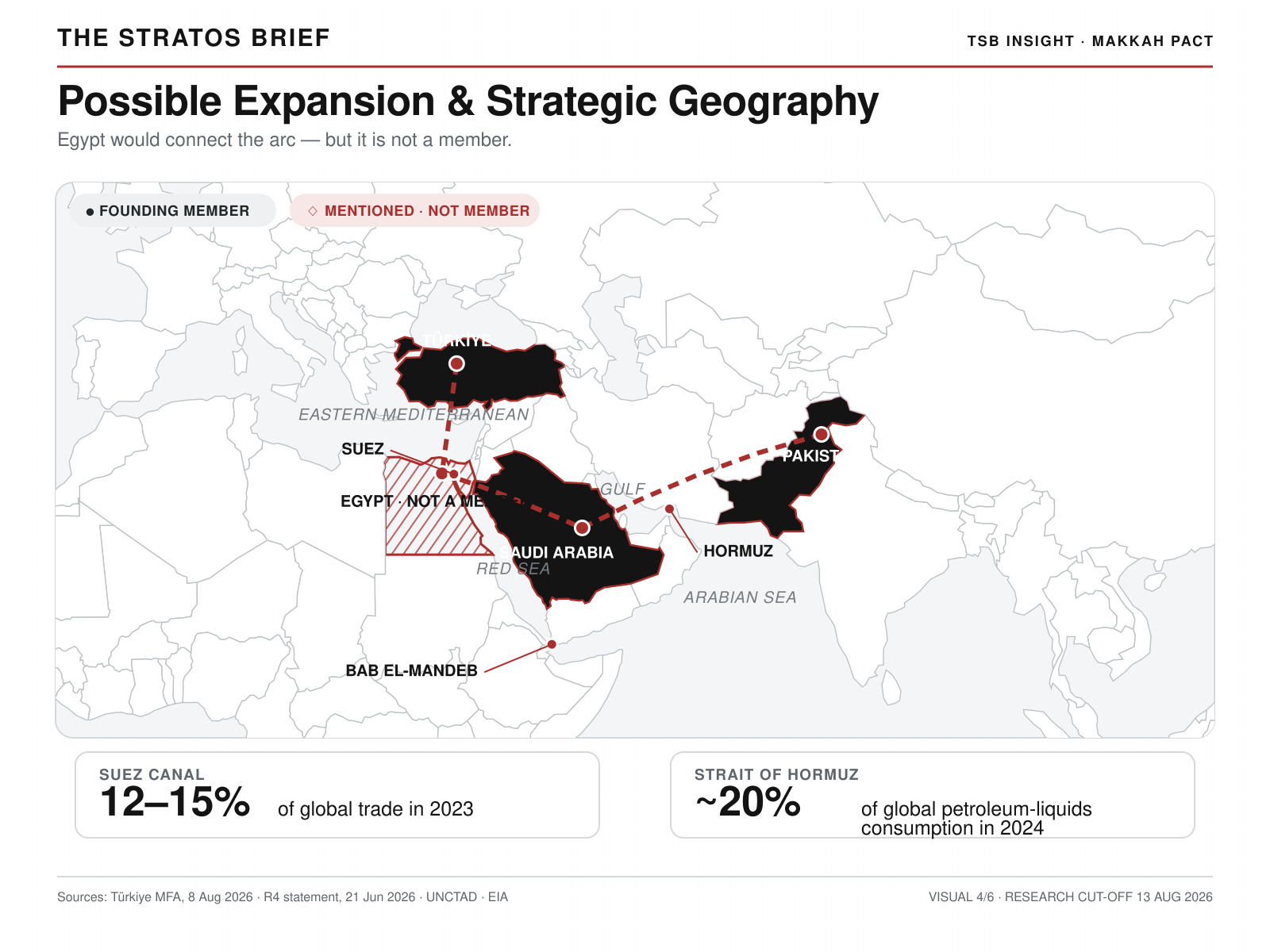
Türkiye, Saudi Arabia and Pakistan form a strategic arc across the eastern Mediterranean, Red Sea, Gulf and Arabian Sea. Egypt would connect that arc, but it is not a member.
The founders intend the agreement to be open in principle. Fidan said the treaty contains an accession provision under which the three core members set standards and approve entrants, and he reported interest from unnamed states. Erdoğan favours wider participation. Pakistan has likewise said the framework is open to states prepared to uphold its defensive and peaceful principles. Those statements establish a pathway, not a queue of confirmed candidates.
Egypt is the only prospective member publicly discussed in detail by a founding-state official. It already participates with the three signatories in the R4 informal foreign-minister consultation format, and Fidan said he expected Egypt eventually to join once technical issues were addressed. Cairo had not announced an application or accession by 13 August, so it remains a country mentioned by an official, not a member or confirmed candidate. Commentary about other states is speculation unless their governments adopt a position.
Egyptian participation would change the strategic geography more than a larger membership count suggests. It would connect Türkiye and the Eastern Mediterranean to Egypt’s control of Suez, the Red Sea and Bab el-Mandeb approaches, Saudi Arabia’s Red Sea and Gulf coasts, and Pakistan’s access to the Arabian Sea. The arc would remain politically and geographically discontinuous, but it would touch maritime routes through which energy and trade move between Europe and Asia. UNCTAD estimated that Suez handled approximately 12–15 per cent of global trade in 2023, while the US Energy Information Administration assessed that Hormuz carried oil flows equivalent to about 20 per cent of global petroleum-liquids consumption in 2024. That geography could support maritime-domain awareness, convoy coordination, port access and search-and-rescue; it could also draw the alliance into every major regional chokepoint crisis.
Enlargement should therefore follow capability and decision rules rather than symbolism. Adding states before the founders define triggers, security standards, financing and dispute procedures would multiply vetoes and technology complications. A compact three-state core can test command relationships and industrial workshare with fewer political variables. If it produces repeatable outcomes, accession becomes an amplifier. If it does not, a wider membership could turn a potentially usable alliance into another large consultative forum.
The attention gap is about depth, not silence
It is worth asking why an agreement with this potential has not generated broader and more sustained international scrutiny, but mainstream media did not ignore it. Reuters, AP, the Financial Times, The Guardian, CNN and Al Jazeera covered the signing; Reuters followed the Article 5 comparison and implementation, while CNN revisited the pact on 9 August. It received genuine international attention during its first week.
What remained scarce was institutional analysis. The “NATO-style” frame communicated the collective-defence clause quickly, while the “Muslim NATO” question offered a familiar headline; neither explains export controls, force assignment, secure C4ISR or how a committee becomes a command. The pact also competed with an ongoing Iran war, Houthi attacks and disruption of the world’s most important energy routes. Editors had reason for caution because previous “Arab NATO” schemes failed, and analysts lacked the treaty text needed for confident conclusions. The result was not a news blackout but a gap between the scale of initial attention and the depth of examination.
Four pathways from pact to alliance
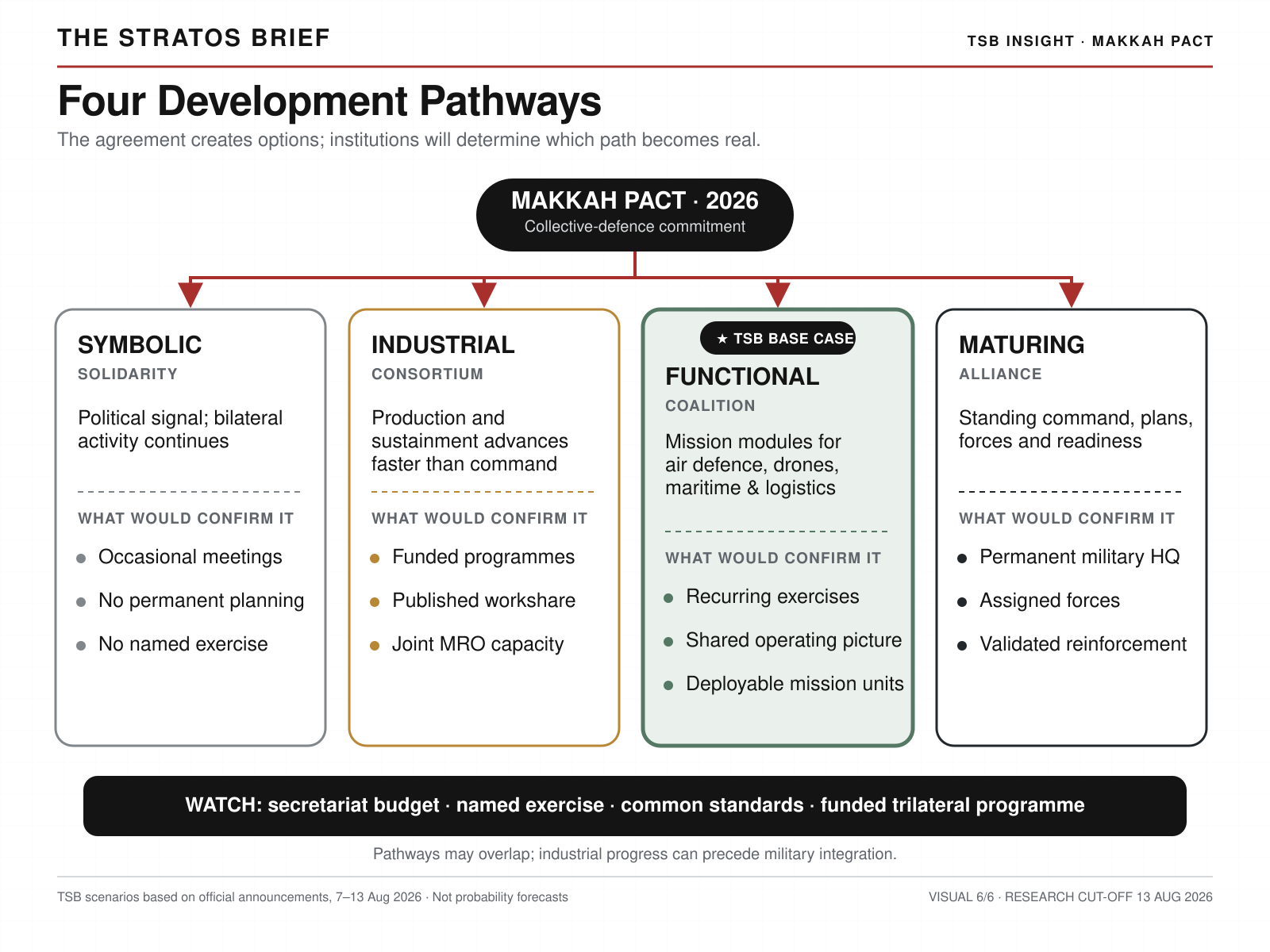
The same political commitment could remain symbolic, accelerate industrial cooperation, become a functional mission coalition or mature into a standing alliance. TSB’s base case is the functional coalition.
Over the next several years, the Makkah Pact could follow four broad paths. The first is symbolic solidarity: leaders reaffirm the attack-on-one clause, ministries meet occasionally and bilateral projects continue without a distinct trilateral planning system. The second is an industrial consortium, in which procurement, localisation and maintenance advance faster than collective defence; this could still produce significant commercial and military effects. The third is a functional coalition, focused on selected missions such as air and missile defence, maritime security, unmanned systems and logistics, with interoperable modules rather than a comprehensive integrated command. The fourth is a maturing collective-defence alliance, involving standing headquarters, approved contingency plans, assigned forces, readiness standards and regular reinforcement exercises.
The third pathway is the most plausible near-term destination. It fits the capabilities the members actually possess, avoids the political cost of naming a common enemy and can generate visible results in areas of shared threat. It would also suit a tiered technology architecture: national systems could contribute to specific missions through controlled interfaces without requiring unrestricted pooling. A full NATO analogue is possible only as a distant institutional choice, and even then the result would reflect regional political culture and mixed equipment origins rather than reproduce the transatlantic model.
The indicators are now concrete. Readers should watch for the first strategic committee meeting and the legal status of its decisions; the secretariat’s mandate, staffing and budget; publication or registration of treaty provisions; a named exercise programme; a joint threat assessment; liaison and command arrangements; assigned air-defence, maritime or rapid-response forces; common communications and identification standards; pre-positioned munitions; and the first funded trilateral industrial project with disclosed workshare. On enlargement, the relevant evidence is a formal application or government announcement, not an analyst’s map. On nuclear deterrence, it is doctrine, consultation and official command arrangements, not the mere fact of Pakistani membership.
TSB Assessment
The Makkah Joint Defence Agreement has crossed a threshold that earlier regional proposals often avoided: its founders have publicly accepted that an armed attack on one concerns all. That commitment can alter diplomatic calculations before a single integrated unit exists, especially because Pakistan has already supported Saudi defence bilaterally and Türkiye can offer mature industrial and organisational capabilities. Yet deterrence depends on an opponent believing that leaders will decide, forces will arrive and systems will work together under pressure. Those beliefs cannot be manufactured by treaty language alone.
The pact’s strategic significance lies in its attempt to build regional capacity across existing alignments rather than to replace them. Saudi capital, Turkish integration and Pakistani scale form a credible industrial and operational proposition, but the same mix brings US export controls, NATO security boundaries and Chinese-system compatibility into one room. Managed well, that diversity could produce a flexible security network able to support air defence, maritime protection and sustained production. Managed poorly, it will yield political ceremonies and disconnected procurement.
The “Muslim NATO” label is therefore best treated as a question about trajectory, not a description of present reality. The Makkah Pact already has more substance than a slogan, and far less maturity than an alliance whose institutions have been built and tested for more than seven decades. Its future will be decided in committee mandates, exercise orders, secure data links, maintenance depots and production contracts. Those are less dramatic than the signing in Makkah, but they are where collective defence becomes credible.
TSB Research Note
Research was completed on 13 August 2026 using official Saudi, Turkish, Pakistani, Indian, GCC, NATO, UN, US and industry documents; SIPRI and IISS-derived data; Reuters and AP reporting; and selected international and specialist analysis in English, Turkish and regional sources. The full text of the Makkah Joint Defence Agreement was not publicly available at the cut-off. Provisions described only by officials are attributed as such, Reuters-sourced deployment details remain labelled as media reporting, and all conclusions on nuclear deterrence, China and future operational behaviour are analytical assessments rather than confirmed treaty obligations.
Sources:
Core primary and official sources
Pakistan Ministry of Foreign Affairs — Makkah al-Mukarramah Summit for Joint Defence, 7 August 2026
Saudi Press Agency — Makkah Joint Defence Agreement announcement, 7 August 2026
Turkish Ministry of Foreign Affairs — Hakan Fidan interview transcript, 8 August 2026
Anadolu — Turkish Defence Ministry implementation briefing, 13 August 2026
Turkish Ministry of Foreign Affairs — R4 joint statement, 21 June 2026
Indian Ministry of External Affairs — bi-weekly media briefing, 11 August 2026
GCC Secretariat — Joint Defence Agreement and indivisible security statement
Islamic Military Counter Terrorism Coalition — mission and membership
US State Department — CAATSA sanctions following Türkiye’s S-400 acquisition
Defence data and industry sources
SIPRI — Arms-transfer trends in the Middle East and North Africa, 2020–24
Saudi General Authority for Military Industries — localisation reached 24.89 per cent
Turkish Presidency of Defence Industries — 2025 export results
Anadolu — Pakistan’s four-ship MILGEM programme and technology transfer
US Energy Information Administration — Strait of Hormuz flows
High-quality reporting and analysis
Reuters — reported Pakistani deployment to Saudi Arabia, 18 May 2026
Reuters — Pakistan military capability profile, 17 July 2026
Reuters — nuclear ambiguity after the 2025 Saudi–Pakistan pact
Associated Press — defensive purpose and possible enlargement
Brookings — background to the 2025 Saudi–Pakistan defence pact
Belfer Center — caution against assuming a Saudi nuclear umbrella