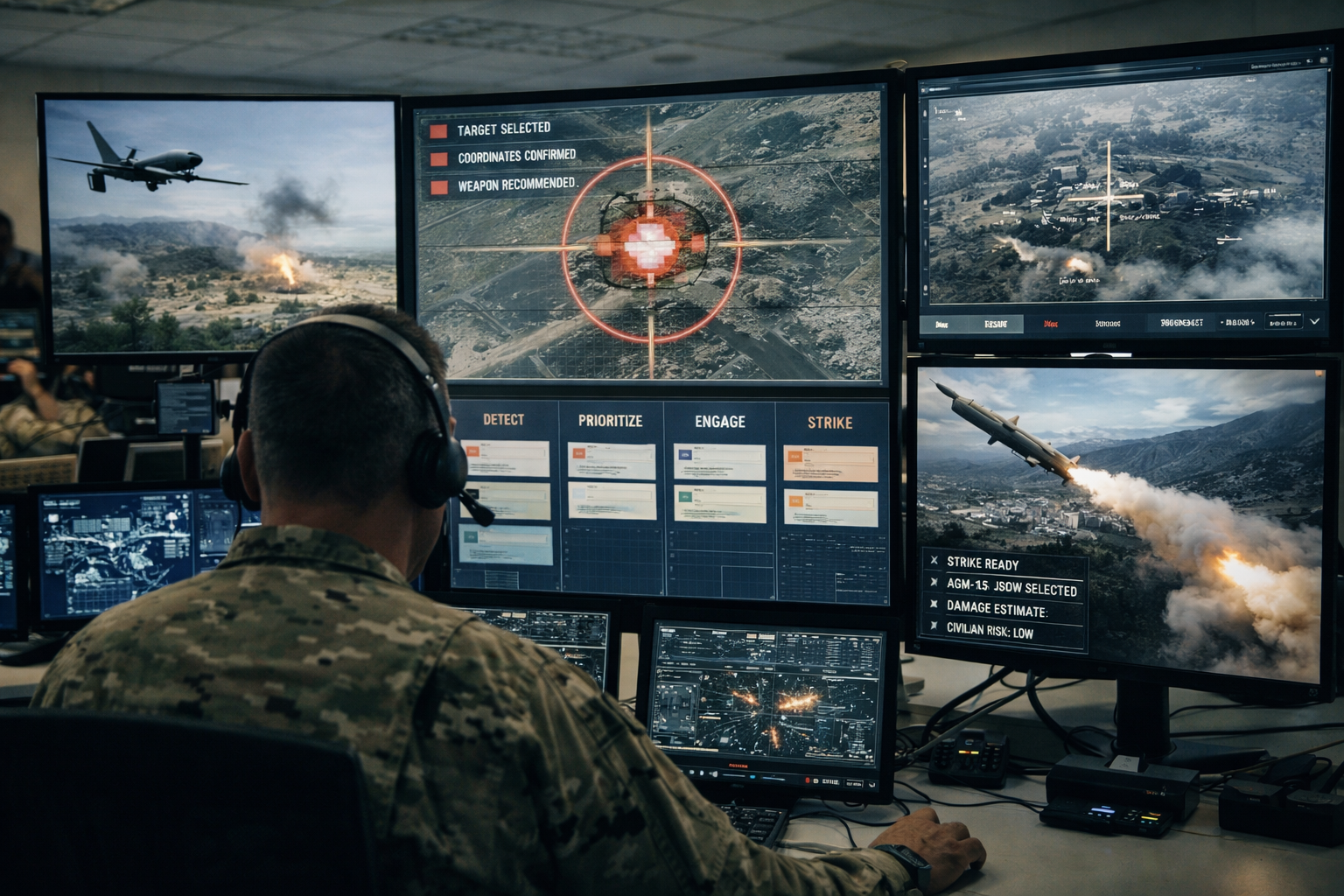
AI-Supported Battle Management: The Next Decisive Layer of Modern Warfare
Modern warfare is no longer constrained primarily by the availability of sensors or shooters. It is increasingly constrained by the speed at which militaries can turn fragmented data into coherent decisions, distribute those decisions across formations, and translate them into action before an adversary adapts. That is why AI-supported battle management is emerging as one of the most consequential capability areas in defence today.
What matters is not simply “AI in war,” but the rise of data-enabled command-and-control systems that compress the chain from detection to decision to engagement. NATO now describes Palantir’s Maven Smart System NATO as an AI-enabled warfighting system that enhances intelligence fusion, targeting, battlespace awareness, planning, and accelerated decision-making. The U.S. Marine Corps describes Maven in similarly operational terms: as a mission command and data-integration platform that enables a live synchronized view of the battlespace and faster sensor-to-shooter workflows.
This is a strategic shift, not a software upgrade. In February 2024, the Pentagon said CJADC2 had reached an initial capability, explicitly framing the department’s goal as decision advantage through software applications, data integration, and cross-domain operational concepts. In December 2024, the DoD’s AI Rapid Capabilities Cell was tasked with accelerating adoption of next-generation AI for warfighting use cases including command and control, decision support, operational planning, logistics, intelligence, and autonomy.
The clearest signal that this category is becoming central to Western force design is institutional adoption. On April 14, 2025, NATO announced the acquisition of Maven Smart System NATO for Allied Command Operations, calling it one of the fastest procurements in the Alliance’s history. In August 2025 and January 2026, NATO’s Joint Warfare Centre described Maven as the Alliance’s first AI-enabled warfighting command-and-control system and began integrating it into major exercises such as STEADFAST DUEL.
The U.S. side is moving in parallel. Reuters reported on March 20, 2026 that the Pentagon plans to make Palantir’s Maven a formal program of record, locking it into long-term military planning and funding. Earlier, the Marine Corps had already presented Maven as an enterprise capability for mission command, advanced target management, and digitally enabled sensor-to-shooter engagements. The U.S. Army is also beginning to institutionalize it in education and training for command-and-control operations.
The logic behind all of this is brutally simple: modern combat produces more data than human staffs can manually absorb. Drones, satellites, radars, EW systems, logistics feeds, and open-source reporting all generate partial pictures. AI-supported battle management systems promise to ingest that flow, fuse it into a common operational picture, surface anomalies or targets of interest, and help commanders prioritize actions. Reuters says Maven processes data from satellites, drones, and sensors to identify potential targets. NATO says MSS NATO spans applications from machine learning to LLMs and generative AI. Ukraine’s DELTA ecosystem likewise provides real-time battlefield awareness, operational planning support, and AI-enabled automatic detection of enemy equipment.
This means battle management is becoming a competitive layer of warfare in its own right. The advantage will increasingly go not only to the side with better platforms, but to the side with the faster, cleaner, more trusted digital decision architecture connecting them. Anduril’s positioning around Lattice reflects the same market logic: a command-and-control and mission-autonomy layer powering integrated awareness and autonomous systems “across land, sea and air — all at the tactical edge.”
Why this matters for defence leaders
1. The contest is shifting from platform-centric superiority to decision-cycle superiority.
For decades, procurement logic centred on acquiring better airframes, missiles, ships, or sensors. Those still matter. But the decisive variable is increasingly how rapidly and reliably a force can connect them. NATO’s framing of MSS NATO and the Pentagon’s CJADC2 language both point in the same direction: the goal is not more data, but faster sense-making and action across domains.
2. AI-supported battle management is becoming the operating system of multi-domain warfare.
This category sits above individual platforms and below strategic intent. It links ISR, C2, mission planning, and engagement workflows. The Marine Corps’ own language is revealing here: Maven is not described merely as an analytics tool, but as a mission-command application and data integration platform. That is a much larger role.
3. The most important industrial moat may become integration, not hardware.
The winners in this space will not necessarily be the firms building the most exquisite standalone weapons. They may be the firms that can integrate data sources, legacy systems, AI applications, and users into a resilient common architecture. NATO’s own description of MSS NATO emphasizes a common data-enabled warfighting capability and future adoption of additional models and simulation tools. That points toward ecosystem control, not single-product sales.
4. Ukraine is proving that digital battle management can become a national-scale combat advantage.
Ukraine’s DELTA has now been deployed across all levels of the Defence Forces, according to the Ministry of Defence. Kyiv says it supports targeting of more than 2,000 enemy assets daily, has added real-time AI detection of enemy equipment, and has increased target-data delivery speed by 45% over a recent three-month period while reducing duplicate auto-detected targets by 30%. Mission Control, launched in January 2026, extends the same logic specifically into unified drone-warfare management.
5. This is now a doctrine, training, and organizational problem as much as a software one.
The Army’s own recent commentary warns that decision superiority will not come from technology alone, but from commanders who understand how to question and use AI tools properly. NATO’s JWC has made a similar point, stressing integration into exercises and the need for human involvement in how outputs are interpreted and applied. In other words, battle management software only works if doctrine, training, trust, and workflow redesign keep pace.
The strategic upside
The appeal of AI-supported battle management is obvious.
It can reduce latency between sensing and acting. It can help staffs cope with data saturation. It can create a shared operational picture across units and headquarters. It can make operations more scalable by reducing reliance on manual fusion in every cell. And in coalitions, it offers a path toward faster interoperability if the underlying data layer is sufficiently open and standardized. NATO explicitly links its AI push to interoperability, while DoD’s Open DAGIR initiative is designed to create more interoperable data and application ecosystems for CJADC2.
Operationally, the strongest attraction is compression of time. Ukrainian officials and recent reporting describe digital battle-management tools as dramatically shrinking the gap between target detection and action. Even where exact performance metrics vary by mission and weapon type, the underlying effect is consistent: less time lost to manual reporting, deconfliction, and relay chains.
Strategically, these systems can also change deterrence. A force that can see, interpret, and coordinate faster becomes more credible, even before shots are fired. Faster command cycles improve survivability, responsiveness, and adaptability under pressure. That is why NATO’s adoption of MSS NATO matters beyond the software itself: it signals a broader shift in what credible military readiness now looks like.
The limits, risks, and controversies
The strongest criticism of AI-supported battle management is not that it exists, but that its success could normalize an increasingly automated pathway to lethal action.
The Pentagon’s formal policy still requires appropriate levels of human judgment over the use of force. DoD Directive 3000.09 says autonomous and semi-autonomous weapon systems must be designed to allow commanders and operators to exercise appropriate human judgment and to minimize the risks of unintended engagements. The department also ties AI deployment to its responsible AI framework, including traceability, reliability, governability, and testing.
NATO’s revised AI strategy similarly anchors adoption in responsible-use principles: lawfulness, responsibility and accountability, explainability and traceability, reliability, governability, and bias mitigation. It also explicitly warns about adversarial AI risks and the need for testing, evaluation, verification, and validation.
But those safeguards do not fully eliminate the core concern: as systems get better at surfacing targets, recommending actions, and presenting options through a single interface, the human role can become narrower and more procedural. The risk is not only full autonomy. It is also over-trust, automation bias, and accelerated decision-making under conditions where legal, contextual, or ethical review cannot scale at the same speed as machine-generated options. Reuters notes that Palantir insists humans remain in control of targeting decisions, but the broader public controversy persists precisely because the boundary between decision support and operational dependence is becoming harder to see from the outside.
A second risk is epistemic. These systems are only as good as their data hygiene, sensor fidelity, model performance, and interface design. Duplicate detections, stale tracks, spoofed data, adversarial inputs, and poor confidence signaling can all create false certainty. Ukraine’s own official DELTA updates highlight efforts to reduce duplicate automatically detected targets, which is a useful reminder that these problems are operational, not hypothetical.
A third risk is political-industrial. The more a military builds its battle management around a small number of proprietary vendors, the more dependency shifts upward from hardware to software architecture. Data sovereignty, hosting, accreditation, and interoperability all become strategic issues. Reuters reported on March 25, 2026 that the German army is actively weighing AI-enabled decision-support tools while also stressing data sovereignty and security concerns.
What this means for the defence industry
For primes, software firms, and subsystem suppliers, AI-supported battle management is likely to become a major growth corridor because it sits at the intersection of procurement, digital modernization, autonomy, ISR, and coalition interoperability. NATO’s Maven procurement, the Pentagon’s formalization of Maven, the Marine Corps’ enterprise adoption, and Ukraine’s rapid scaling of DELTA all point in the same direction: battle management is moving from experimental edge case to core capability.
This will likely reward five types of players.
First, integrators that can connect legacy and new systems into usable common operational pictures. Second, AI application providers that can solve narrow, trusted tasks such as classification, anomaly detection, route optimization, and staff support. Third, firms that can harden systems for secure military deployment and accreditation. Fourth, edge-computing and networking players that can keep battle management functioning under degraded conditions. Fifth, training and simulation providers that can help militaries adapt human workflows to machine-speed planning cycles.
For European industry especially, this is both opportunity and warning. The opportunity is to plug into a growing Alliance need for interoperable data, simulation, and decision-support tools. The warning is that if European defence firms do not build competitive battle-management layers, they risk being relegated to hardware suppliers inside someone else’s software-defined operational architecture. NATO’s own messaging around AI adoption and interoperability suggests that the value will increasingly sit in the connective tissue, not just the platforms being connected.
Conclusion
AI-supported battle management is becoming the new control layer of modern warfare.
Its strategic significance lies not in replacing commanders, but in restructuring the tempo and architecture of military decision-making. The side that can fuse data faster, trust its digital picture more, and move from observation to coordinated action with less friction will enjoy a decisive operational advantage. That is why NATO has moved, why the Pentagon is formalizing Maven, why Ukraine is scaling DELTA, and why even armies still early in adoption are now treating AI decision-support as urgent rather than optional.
The real question is no longer whether AI will enter battle management. It already has. The real question is which institutions will be able to harness it without surrendering human judgment, operational resilience, or strategic autonomy in the process.
Food for Thought for Defence Ministries, Armed Forces, and Industry Boards
How much of future combat advantage will come from better platforms — and how much from the software layer that fuses, interprets, and prioritizes what those platforms see?
If AI-supported battle management becomes the operating system of coalition warfare, who will own the architecture, the data standards, and the interfaces that others must plug into?
Can European and mid-sized defence firms build meaningful positions in this stack, or will they become dependent on a handful of U.S.-centric software ecosystems?
How should militaries train commanders and staffs so that AI accelerates decisions without encouraging automation bias or narrowing operational judgment?
And most importantly: where exactly should the human decision-maker sit in a future kill chain that is increasingly fast, digital, and machine-assisted?