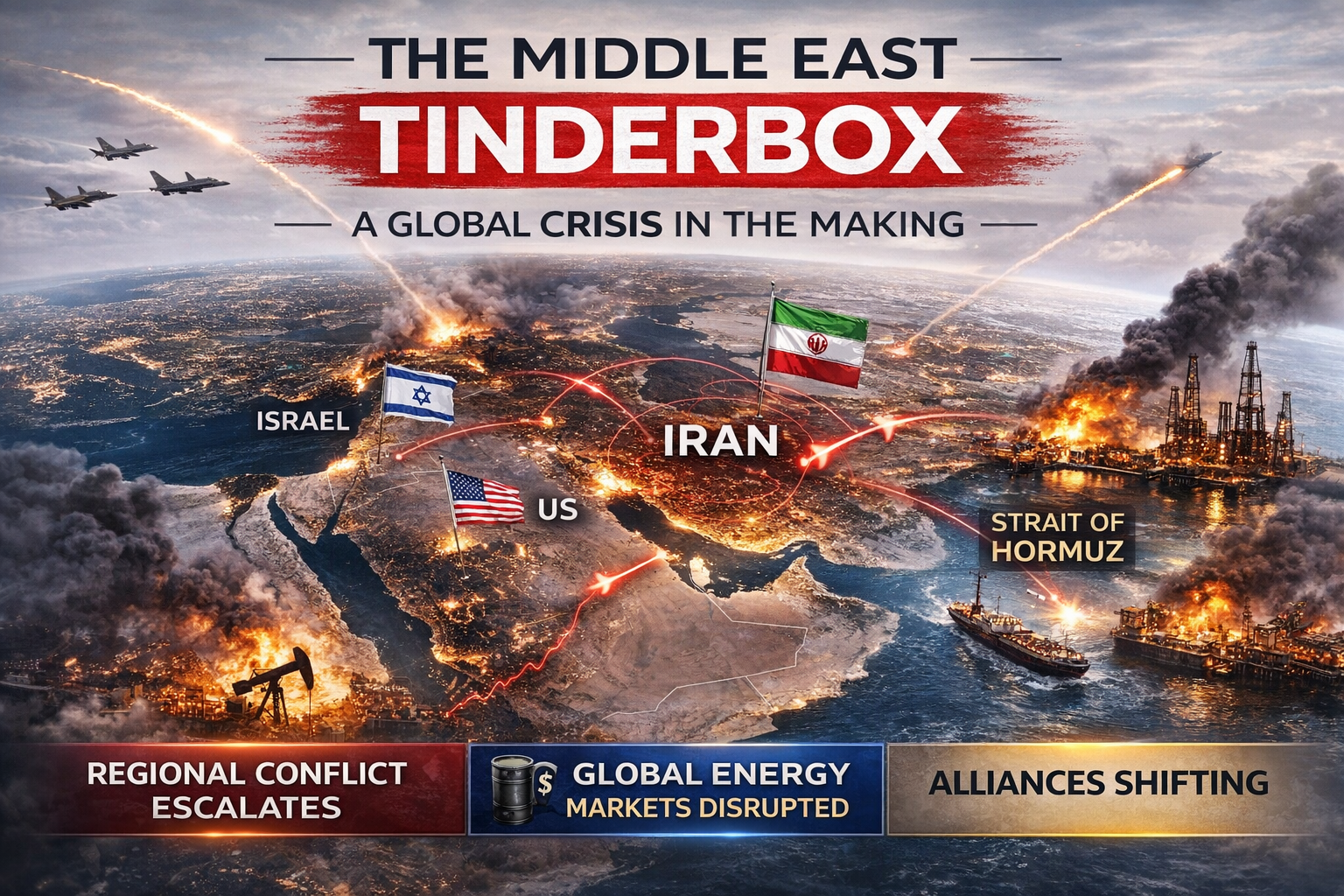
The Middle‑East Tinderbox: Iran, the US, Israel and the Return of Great‑Power War
Introduction
Since the sudden death of Iran’s Supreme Leader Ali Khamenei and the ensuing U.S.–Israel campaign against Tehran, the Middle‑East has slipped into its gravest crisis since the 1970s. Iranian missiles have slammed into Gulf cities, U.S. and Israeli aircraft have pounded Iranian territory, the Strait of Hormuz has been temporarily closed, and energy infrastructure across the region has been crippled. Tens of thousands of people have already been killed or wounded; global oil and gas prices have spiked; and capitals from Berlin and Paris to Beijing and Moscow are scrambling to respond. At stake is not only the balance of power in the Gulf, but also the stability of the global economy and the future shape of alliances.
This deep‑dive draws on contemporary reporting from Reuters, AP News and other well‑regarded outlets to examine the roots, causes and cascading effects of the current U.S./Israel–Iran conflict. It emulates the structured, comprehensive style of The Stratos Brief by dividing the analysis into thematic sections, combining historical context with data‑driven insights, and ending with concrete takeaways for policymakers and business leaders.
Historical Roots: Revolution, Sanctions and Proxy Wars
Understanding why the present war has escalated so quickly requires a look back. Since the 1979 Iranian Revolution severed diplomatic relations with Washington and Tehran’s seizure of the U.S. embassy, relations have been characterised by cycles of sanctions, covert operations and proxy battles. Iran developed a robust network of regional militias (Hezbollah in Lebanon, militias in Iraq and Syria, the Houthis in Yemen) to deter the U.S. and Israel. The U.S. responded with economic isolation, cyber operations (e.g., Stuxnet against nuclear centrifuges) and targeted killings such as General Qassem Soleimani in 2020. Despite periodic nuclear negotiations (2015’s Joint Comprehensive Plan of Action (JCPOA) and its collapse), the distrust remained profound.
A New Red Line: Iran’s Nuclear and Missile Programmes
By the mid‑2020s Iran had enriched uranium well beyond the JCPOA limit and was perfecting long‑range missiles. Israel, which views an Iranian bomb as an existential threat, repeatedly attacked Iranian nuclear sites. When Supreme Leader Ali Khamenei was killed during an Israeli strike, Washington and Tel Aviv concluded that the regime might lash out. U.S. President Donald Trumpauthorised pre‑emptive strikes to neutralise Iran’s nuclear infrastructure and its missile force; Israel joined in, believing a narrow window existed to degrade Iran’s arsenal. This decision lit the fuse for today’s conflict.
The War’s Outbreak: Airstrikes, Missiles and the Closure of Hormuz
On 1 March 2026, U.S. and Israeli jets began bombing Iranian air bases, missile launchers and suspected nuclear facilities. Iran responded immediately by launching hundreds of ballistic missiles and attack drones at U.S. bases in Iraq and Syria, at Israeli cities and at infrastructure across the Gulf. The barrages were unprecedented: analysts estimate that 165 ballistic and cruise missiles and 600 drones were launched against the United Arab Emirates (UAE) in the first 48 hours. Iranian salvos also targeted Doha, Dubai and Manama, striking airports, ports and oil facilities and damaging the Gulf’s reputation as a stable financial hub. In retaliation, the U.S. and Israel intensified strikes on Iranian oil facilities and the Pars gas field, prompting Iran to threaten to attack oil and gas targets across Saudi Arabia, the UAE and Qatar and warning foreign companies to evacuate.
Amid these exchanges, Iran temporarily closed the Strait of Hormuz, through which roughly 20% of the world’s oil and liquefied natural gas (LNG) flows. The closure sent prices soaring and forced shipping to detour around Africa. President Trump urged NATO allies and China to deploy minesweepers and help reopen the passage, reminding them that 90% of China’s oil imports transit the strait. Oman and Egypt attempted to broker a ceasefire, but both Tehran and Washington rejected negotiations until the other side halted strikes.
Human Toll and Casualties
The scale of human suffering is staggering. According to a Reuters compilation as of 18 March 2026:
· Iran: Approximately 3,114 people killed, including many civilians and at least 257 children, with thousands more wounded.
· Lebanon:968 deaths from Israeli strikes.
· Iraq:60 fatalities, mainly Iraqi troops and paramilitaries.
· Israel:14 civilians and 2 soldiers killed by Iranian missiles.
· United States:13 service members killed.
· Gulf States & Others: Casualties have been reported in the UAE, Kuwait, Syria, Oman, Saudi Arabia, Bahrain and even France as debris and misfires hit military bases and ships.
Beyond the numbers lie millions of civilians living under bombardment, enduring power cuts and shortages. Cities such as Tehran, Beirut and Dubai have seen nightly sirens. Humanitarian corridors remain limited.
Gulf States: Neutrality Shattered and a Coalition Emerges
Before the war the Gulf Cooperation Council (GCC) – Saudi Arabia, the UAE, Qatar, Bahrain, Kuwait and Oman – tried to maintain a delicate balance: host U.S. forces while hedging with economic ties to Iran. The Iranian barrages obliterated that neutrality. Analysts note that Tehran’s strikes on ports and oil terminals were meant to pressure the GCC to compel Washington to end the war, but they backfired. Gulf leaders now face stark choices: openly align with the U.S. war effort by allowing their territory to be used for operations or risk repeated attacks on their own soil.
In an emergency meeting after Khamenei’s death, the GCC invoked Article 51 of the United Nations Charter, signalling readiness for collective self‑defence. They set “red lines” and activated joint air‑defence and reconnaissance systems. Gulf officials have warned Iran that further attacks will be met with more severe responses. The United Arab Emirates, which bore the brunt of Iran’s assault (63% of strikes targeted its airports, ports and oil infrastructure), withdrew its ambassador from Tehran, closed its embassy, and pressed the issue at the U.N. Security Council. The message from GCC capitals is clear: Iran’s aggression has united them and reinforced the logic of a broader anti‑Iran coalition.
Europe: Reluctance, Energy Shock and Strategic Reassessment
The war has tested Europe’s transatlantic relationship. President Trump admonished NATO and European allies for not contributing naval forces to reopen the Strait of Hormuz and warned that a failure to act would lead to a “very bad” future. In response, European leaders – particularly Germany and France – refused to join the U.S.–Israel operations, arguing they had not been consulted and doubting the war’s strategic rationale. Polls show that majorities of Europeans oppose the war; leaders fear being drawn into an open‑ended conflict and emphasise diplomacy and humanitarian relief. The EU’s foreign policy chief urged calm and restraint, highlighting that Europe’s priorities are de‑escalation and humanitarian assistance.
Yet Europe is deeply affected by the conflict. Iran’s closure of the Strait of Hormuz generated a third energy shock in the 2020s. LNG prices jumped and the cost of Europe’s energy imports rose by around €6 billion since the war began. Governments are therefore accelerating energy diversification:
· Expanding nuclear power: Countries like France propose new reactors, seeing nuclear as a hedge against volatile fossil fuel supplies.
· Accelerating renewables: Germany, Japan, Taiwan and China are boosting solar, wind and hydrogen investments.
· Growing strategic stockpiles and diversification: The EU aims to build larger crude and LNG reserves and sign long‑term contracts with non‑Middle‑Eastern suppliers.
· Electric‑vehicle (EV) push: Some countries view the conflict as a catalyst to transition fleets to EVs, though adoption rates vary.
European capitals also worry that Trump’s unilateral approach signals a broader decoupling of U.S. and European security interests. The European refusal to join the war underscores their desire for strategic autonomy. At the same time, energy shock and inflation are sowing domestic unrest, forcing governments to recalibrate economic policies.
Russia and China: Supportive Rhetoric, Calculated Distance
One might expect Russia and China – both adversaries of the U.S. and occasional allies of Iran – to leap to Tehran’s defence. Instead they have taken a cautious path. Moscow has publicly criticised U.S. and Israeli actions as illegal military aggression and called for negotiations to end the war. Analysts note that Russia benefits from high oil prices and sees an overstretched United States as an opportunity. However, the Kremlin is preoccupied with its own campaign in Ukraine and has limited capacity to intervene directly. Its support has been mainly diplomatic and through arms shipments.
Beijing faces a dilemma: it is Iran’s leading oil customer, but 90% of those imports pass through the perilous Strait of Hormuz. China has thus urged both sides to exercise restraint and offered to mediate. Analysts argue that China prefers to preserve stable energy flows and trade relations with the Gulf rather than join Iran militarily. Like Russia, China may benefit from a distracted United States and high oil prices. Both powers maintain flexibility: by staying on the sidelines they keep channels open to a future Iranian regime while avoiding direct confrontation with Washington.
The Regional Battlefield: Lebanon, Iraq and Syria
While the main confrontation pits Washington and Tel Aviv against Tehran, the war’s geography is regional. Israeli jets have pounded Hezbollah positions in Lebanon, flattening buildings in Beirut’s southern suburbs and killing senior Iranian officials. Iran has retaliated by launching missiles at Israeli territory and U.S. bases in Iraq and Syria, killing American troops and Iraqi militiamen. The U.S. has responded with further strikes on Iranian Revolutionary Guard Corps (IRGC) facilities in Syria. At least 60 Iraqis have died, and Baghdad fears being dragged into a broader conflict.
Hezbollah’s role is pivotal. If it escalates rocket fire into northern Israel, the conflict could mirror the 2006 Lebanon war on a larger scale. Lebanese infrastructure is already fragile after years of economic crisis; the war is exacerbating electricity and fuel shortages. In Iraq, pro‑Iranian militias have attempted to cut supply lines to U.S. bases, prompting Washington to deploy additional Patriot and THAAD air‑defence batteries.
Energy Infrastructure as a Target: Ras Laffan, Pars and Beyond
Iran and Israel have deliberately targeted each other’s economic lifelines. On 18 March, Israeli strikes (with U.S. consent) hit Iran’s Pars gas field, provoking Iranian threats against oil and gas targets in Saudi Arabia, the UAE and Qatar. In a dramatic expansion of the war, Iran attacked Qatar’s Ras Laffan industrial city – one of the world’s largest LNG hubs – causing extensive damage and forcing temporary evacuation. Qatar condemned the strike as a threat to its national security. Because Ras Laffan processes roughly a fifth of global LNG, its disruption sent gas prices soaring and underscored how vulnerable the world’s energy system is to regional conflict.
Iran has also hinted that it could attack Saudi and Emirati oil export terminals and pipelines if the U.S. and Israel persist. Such moves would risk a full interruption of global oil supply and could trigger a direct U.S. response. Analysts warn that if the Gulf cannot withstand prolonged conflict, other states may intervene to protect global energy flows.
Domestic Political Dynamics: U.S. Elections and Iranian Factions
Domestic politics shape each belligerent’s calculus. In the United States, the war has become a central issue in the 2026 presidential election. President Trump portrays the campaign as a necessary step to stop Iran from obtaining nuclear weapons and asserts that allies who benefit from Gulf shipping must share the burden. His critics accuse him of recklessness and warn that the war will overstretch U.S. forces and inflame anti‑American sentiment across the region. Democratic leaders call for an immediate ceasefire and humanitarian aid.
In Iran, Khamenei’s death has triggered a power struggle within the theocratic system. Some IRGC commanders favour escalating missile attacks to rally nationalist support and deter foreign intervention. Others worry that continued strikes will justify regime‑change operations by Washington and Jerusalem. The Iranian public, suffering under sanctions and now war, is divided. Protests erupted in cities like Isfahan and Shiraz after government security forces-imposed rationing and curfews; however, external aggression has also spurred a rally‑around‑the‑flag effect.
Potential Scenarios: Paths Forward
1. Escalation into Full‑Scale Regional War: If Iran continues attacking Gulf energy facilities and Israel intensifies strikes on Lebanese and Syrian targets, the GCC – backed by the U.S. – could enter the war militarily. NATO could be drawn in if Iran hits bases hosting European forces. Russia and China might increase arms supplies to Iran but remain reluctant to fight directly. Oil prices could exceed $150 per barrel, triggering a global recession.
2. Limited Containment and Prolonged Skirmishing: Both sides might settle into a pattern of periodic strikes without attempting regime change. Iran would keep the Strait of Hormuz open intermittently to avoid total economic collapse while continuing to pressure U.S. bases. Israel and the U.S. would focus on degrading Iran’s nuclear and missile capabilities. Casualties would continue, but a wider coalition might not form. Energy markets would remain volatile but manageable.
3. Negotiated Ceasefire and Diplomatic Off‑Ramp: As domestic costs mount, both Tehran and Washington could seek a face‑saving exit. Mediation by Oman, Qatar, Russia or China might produce a temporary ceasefire, possibly in exchange for Iran halting enrichment above JCPOA levels and the U.S. easing some sanctions. Israel would demand strict monitoring and dismantlement of missile factories. Such a deal would be fragile and might only delay the next round of confrontation.
4. Regime Collapse in Iran: Prolonged war and economic isolation could trigger internal unrest leading to a power struggle or collapse. This scenario would likely produce a humanitarian crisis and uncertain control over Iran’s nuclear and missile assets. External powers would scramble to secure facilities, risking a scramble reminiscent of post‑Saddam Iraq.
What to Watch
For decision‑makers and investors, several indicators will signal which scenario is emerging:
· Strait of Hormuz traffic: sustained closure or repeated mining of the strait would suggest escalation.
· Gulf coalition posture: watch whether GCC members allow U.S. strike aircraft to launch from their bases or deploy their own forces into Iran, indicating deeper alignment.
· Europe’s energy strategy: announcements of new nuclear plants, LNG deals or strategic reserves indicate how Europe is hedging against prolonged disruption.
· China and Russia’s engagement: arms transfers, joint naval drills or diplomatic initiatives could either stabilise or inflame the conflict.
· Domestic politics: protests in Iran and U.S. election rhetoric will influence leaders’ willingness to compromise.
· Attacks on energy infrastructure: further strikes on Ras Laffan, Saudi export terminals or pipeline networks would show Iran is willing to risk global condemnation.
Conclusion: Strategic Implications and Recommendations
The current U.S./Israel–Iran war is a profound geostrategic shock. It has shattered the illusion that great‑power rivalries had receded; the Gulf is once again the world’s most dangerous flashpoint. For policymakers, several lessons stand out:
· Deterrence and pre‑emption carry enormous risks. The decision to pre‑empt Iran’s nuclear and missile capabilities may degrade those programs, but it has triggered a regional war with global consequences. Future decisions to strike should weigh not only military targets but also economic and humanitarian spill‑over.
· Energy security is national security. Europe’s scramble for alternative energy sources and Asia’s vulnerability to Hormuz underscore how energy infrastructure is both an Achilles’ heel and a weapon. Investments in renewables, nuclear and resilient supply chains are not just climate policy – they are strategic insurance.
· Alliances are fluid. The Gulf states’ pivot from hedging to alignment shows how coercive actions can cement coalitions. Europe’s refusal to join the U.S. campaign reflects divergent threat perceptions. Russia and China’s cautious approach highlights their preference to exploit rather than resolve crises.
· Humanitarian considerations must be central. The thousands of deaths and the suffering of civilians demand far more robust humanitarian corridors and ceasefire efforts. Even in strategic competition, international law and human rights cannot be ignored.
Ultimately, the war’s trajectory remains uncertain. What is clear is that the Middle‑East has re‑entered a period of high‑stakes geopolitical competition. Leaders around the world must therefore prepare for sustained volatility, invest in resilience, and pursue diplomacy even as they reinforce deterrence. The lessons of this crisis will shape energy policy, alliance structures and military planning for years to come.