Beyond GPS: Why Quantum Navigation Is Becoming an Aerospace Imperative
As jamming and spoofing turn satellite navigation from a convenience into a vulnerability, quantum navigation is emerging as one of the most important technologies in the future of resilient flight.
For decades, modern aviation has relied on a quiet assumption: that satellite navigation would always be there.
It would always be available. Always be accurate. Always be trustworthy.
That assumption is breaking down.
In an era of electronic warfare, signal interference, and increasingly contested operating environments, GPS is no longer just a tool of convenience. It is a growing point of vulnerability. Civil aviation is feeling it. Militaries are planning around it. Aerospace companies are searching for answers.
One of the most serious answers now emerging is quantum navigation.
That phrase still sounds exotic, even slightly futuristic, but the reality is more concrete than the name suggests. Quantum navigation is no longer just a laboratory curiosity or a favorite topic of conference panels. It is becoming part of a real industrial effort to build aircraft, drones, ships, and autonomous systems that can continue to know where they are even when satellite signals fail, degrade, or lie.
Airbus’s recent spotlight on the subject is therefore notable not because it announces the death of GPS, but because it reflects a broader shift already underway across the aerospace and defense world: navigation is being rethought as a resilience problem, not just an accuracy problem.
And that changes everything.
The end of blind faith in GPS
Satellite navigation transformed the modern world so completely that most users stopped thinking about it. Positioning became invisible infrastructure, something as assumed as electricity or mobile coverage.
But GPS was never invulnerable. It was merely treated that way.
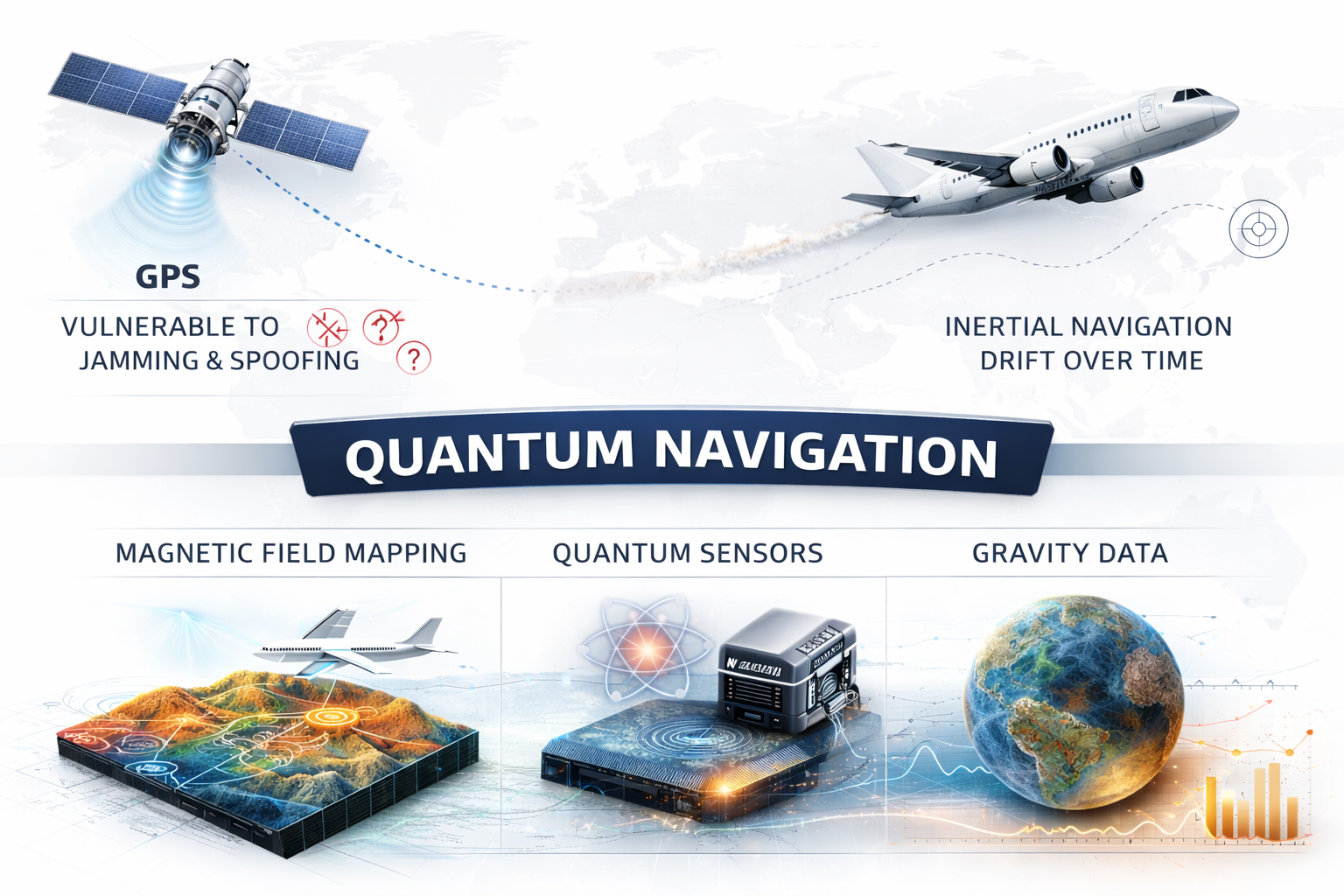
The weakness is obvious once stated plainly. GPS depends on signals coming from space. Those signals are faint by the time they reach Earth. They can be jammed. They can be spoofed. They can be denied. In peace, that may be an inconvenience. In a crisis, it can become a hazard or a strategic liability.
This is why alternative navigation is no longer a niche pursuit. It is not being driven by scientific curiosity alone. It is being driven by the realization that the systems underpinning modern aviation and defense cannot afford to rest on a single fragile pillar.
That is the strategic context in which quantum navigation matters.
What quantum navigation actually is
The first thing to understand is that quantum navigation is not one single technology. It is an umbrella term for several different approaches that use quantum sensing to improve positioning, navigation, and timing when satellite signals are unavailable or untrustworthy.
The version drawing the most immediate interest in aviation is magnetic anomaly-based navigation, often shortened to MagNav.
The principle is deceptively simple. The Earth’s magnetic field is not perfectly uniform. Different areas of the planet produce slightly different magnetic signatures because of variations in geology and mineral composition beneath the surface. These tiny irregularities form a kind of natural geophysical fingerprint.
A sufficiently sensitive sensor can detect that fingerprint. A sufficiently capable system can compare the live reading to a stored map and estimate where the aircraft is.
That is the core idea.
It sounds elegant because it is elegant. Instead of relying on a human-made signal that can be jammed or spoofed, the aircraft is effectively reading the planet itself.
This is what makes the concept so attractive. The world becomes part of the navigation system.
Why Airbus is paying attention
Airbus’s focus on magnetic navigation is not random. It reflects the part of the quantum navigation field that currently looks the most practical in the near term.
The appeal is easy to see.
Unlike a purely inertial system, magnetic map-matching does not just calculate where the aircraft ought to be based on previous motion. It can also compare that estimate against something external and real. That helps contain drift over time. And unlike GPS, it does not depend on a signal being broadcast from outside the operating environment.
In other words, it offers a different kind of truth source.
That does not mean it is ready to replace every other navigation method. It does mean it could become a powerful additional layer in a more resilient stack. That is the key point. The near-term future is not quantum navigation replacing everything else. It is quantum navigation reinforcing everything else.
This is also why serious players are talking less about revolution and more about redundancy, backup, assurance, and resilience. The language has matured because the use case has matured.
The field is broader than magnetics
Magnetic navigation is only one part of the picture.
Another major path is quantum inertial sensing. Traditional inertial navigation systems estimate position by measuring acceleration and rotation, but they drift over time. Quantum-enhanced inertial sensors aim to reduce that drift dramatically, making them far more useful when GPS is lost for extended periods.
Then there is quantum timing, particularly atomic clocks. Precise navigation depends not only on knowing where you are, but on knowing time with extraordinary accuracy. A better onboard clock can preserve timing integrity when external timing sources are degraded.
Gravity-based navigation is another related approach. Just as the magnetic field varies across the Earth, so too does gravity in subtle ways. Those variations can also serve as a map.
Taken together, these technologies suggest something important: the future of resilient navigation is unlikely to be a single miracle device. It is far more likely to be a layered architecture in which different sensing methods complement one another.
That is what makes the field strategically interesting. It is not a gadget story. It is a systems story.
Who is racing to make it real
This is no longer just the domain of universities and government labs.
Airbus is clearly exploring how magnetic anomaly navigation could fit into future aerospace architectures. Boeing has publicly demonstrated flight tests involving quantum inertial sensing. Startups and specialist firms are pushing aggressively into the market. Governments are funding national efforts to accelerate deployment. Naval applications are advancing alongside airborne ones. Drone and autonomy developers are watching closely.
Several companies have already moved beyond theory and into trials, validation campaigns, and early commercialization efforts. Some are focused on magnetic map-matching. Others are pursuing inertial breakthroughs. Still others are combining multiple approaches into hybrid resilient-navigation products.
What unites them is not a shared technical method, but a shared recognition that the demand signal is real.
Aviation wants backup. Defense wants independence. Autonomy wants robustness. Quantum navigation increasingly promises all three.
Why it matters far beyond military aviation
At first glance, the topic seems tailor-made for defense. And in many ways, it is.
A military aircraft operating in a contested environment has an obvious need for navigation that cannot be easily disrupted. The same is true for drones, missiles, ships, submarines, and autonomous systems moving through signal-hostile spaces.
But this is not only a military story.
Commercial aviation has its own reasons to care. Airliners do not need to be in a war zone to face satellite-navigation degradation. Interference can affect civilian operations too. As dependence on precision navigation continues to deepen, so does the need for trustworthy fallback layers.
Then there is the wider autonomy market. The more society asks unmanned systems, advanced aircraft, and autonomous vehicles to do, the less acceptable it becomes for them to fail gracefully only when GPS is available. Real resilience means operating through denial, not merely during normal conditions.
This is where quantum navigation starts to move from defense niche to broader strategic infrastructure.
The advantages are real
The strongest advantage is obvious: resilience.
Quantum-enabled navigation methods based on geophysical signatures do not rely on external radio-frequency signals in the same way satellite navigation does. That makes them inherently more resistant to jamming and spoofing.
The second advantage is passivity. These systems can navigate without needing to emit signals of their own, which is valuable in both civilian and military contexts.
The third is that they can help reduce the drift problem that limits conventional backups over time. That matters enormously for long-duration missions and for any platform that cannot count on frequent external correction.
The fourth is strategic independence. Countries and operators that develop alternatives to satellite reliance gain options, and in aerospace, optionality is power.
Put simply, quantum navigation is attractive not because it is new, but because it addresses a problem that is becoming impossible to ignore.
But so are the obstacles
For all the excitement, the technology still faces real barriers.
The first is mapping. A magnetic or gravity-based navigation system is only as useful as the quality of the reference data behind it. Building, refining, and validating those maps at the required resolution is not trivial.
The second is onboard interference. Aircraft are full of systems that create noise. Making ultra-sensitive quantum sensors work reliably on a moving airborne platform is a serious engineering challenge.
The third is miniaturization and ruggedization. Some quantum devices are becoming more compact and practical. Others still struggle with size, complexity, environmental sensitivity, or integration demands that make broad deployment difficult.
The fourth is certification. A successful trial is not the same thing as fleetwide operational use. Aerospace is rightly conservative when safety-critical systems are involved. The journey from promising demonstration to standard equipment can be long.
And then there is hype.
Quantum technology is one of those fields where the language can sometimes run ahead of the engineering. It is wise to separate what has been tested from what has merely been promised, and what has been commercialized from what has been certified at scale.
The field is real. The opportunity is real. But so is the need for discipline.
When does it become mainstream?
That depends on what “mainstream” means.
For defense and special-mission applications, the path may be relatively near. The demand is urgent, the environments are contested, and the value of resilient navigation is easy to justify.
For commercial aviation, the path is likely slower. The technology must not only work, but work reliably, integrate cleanly, satisfy regulators, and prove economically worthwhile. That is a tougher threshold.
So the most likely future is not a dramatic overnight transition. It is a staged adoption curve.
First, defense and high-end autonomy.
Then specialized aviation applications.
Then, if performance and certification continue to mature, broader civil integration.
That may not make for the most sensational headline. But it is how real aerospace transitions usually happen.
The deeper shift behind the technology
The most important thing about quantum navigation may not be the sensors themselves.
It may be what their rise tells us about the strategic environment.
For years, positioning and timing were treated as background conditions. Now they are becoming contested capabilities again. Navigation is re-emerging as something that must be actively protected, diversified, and designed for failure.
That mindset shift is profound.
It means the future will belong not simply to the platforms with the best range, payload, or speed, but increasingly to the platforms that can remain aware, trusted, and functional when the invisible infrastructure around them starts to fail.
That is the world quantum navigation is being built for.
The bottom line
Quantum navigation is not a science-fiction replacement for GPS.
It is something more useful than that.
It is the foundation of a new resilient-navigation ecosystem built for an era in which trust in satellite signals can no longer be taken for granted. Magnetic map-matching, quantum inertial sensing, advanced clocks, gravity-based navigation, and sophisticated sensor fusion are all part of that emerging picture.
Some of it is still early. Some of it is already being tested in the real world. None of it should be dismissed.
Because the real lesson here is not that GPS is finished.
It is that the age of effortless dependence on GPS is.
And once that becomes clear, quantum navigation starts to look less like an exotic frontier and more like an aerospace necessity.