Satellites That Repair Satellites: Why In-Orbit Servicing Has Finally Become Real
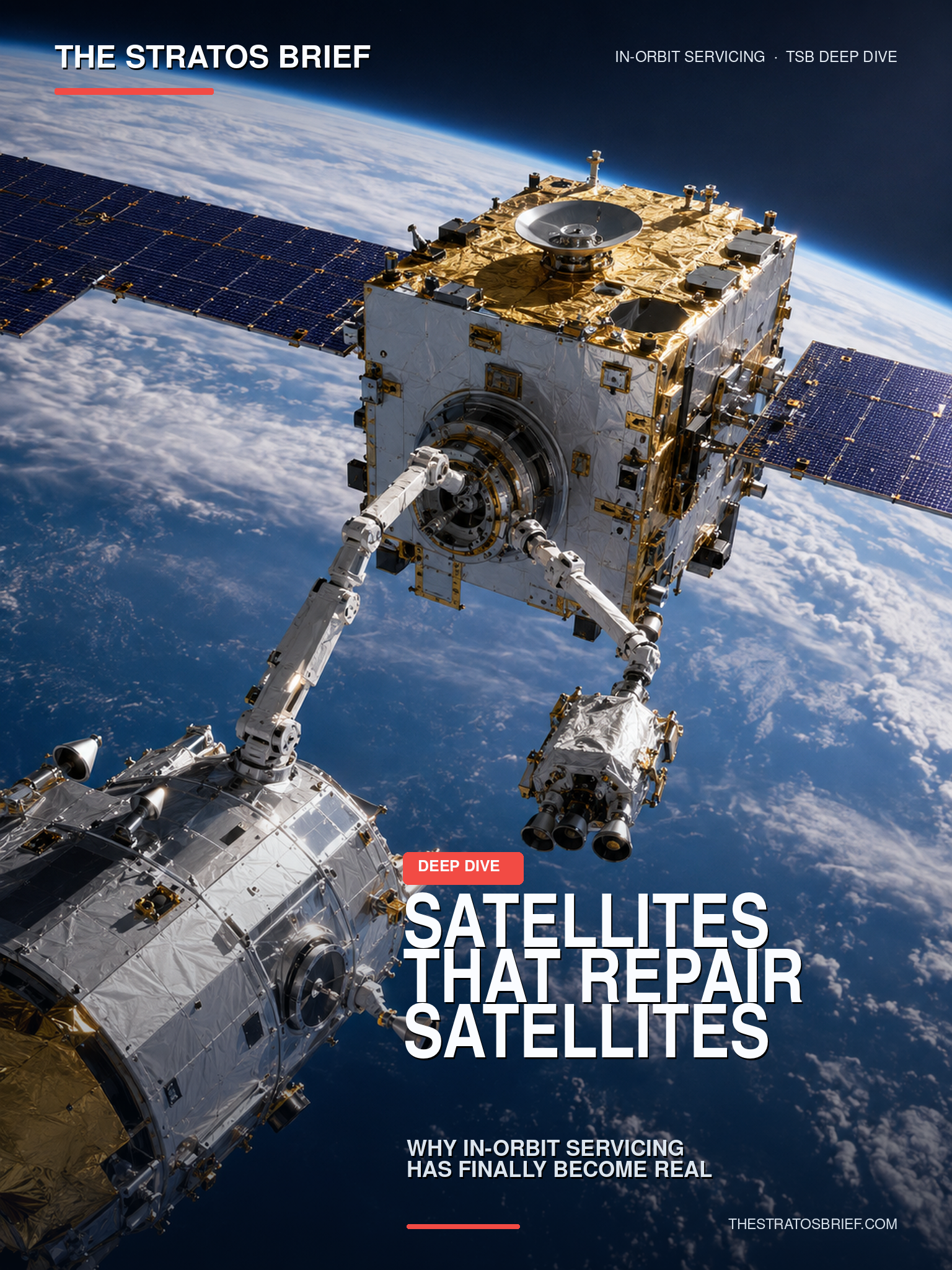
Deep Dive | The Stratos Brief | 6 August 2026 | 30-minute read
A robotic spacecraft launched in July is carrying two arms towards geosynchronous orbit. It has not repaired anything yet. But together with proven life-extension missions, Chinese refuelling experiments, Japanese debris inspections and European service programmes, it marks the beginning of a profound change: satellites are slowly becoming maintainable infrastructure rather than disposable machines.
In brief
• Active satelites life extension is real
• Robotic repair is next
• US and China are advancing fast
• Europe prioritises sustainability
• Every servicer is dual-use
On 21 July 2026, a Falcon 9 lifted off from Cape Canaveral carrying a spacecraft with an unusual destination and an even more unusual job.
Northrop Grumman’s Mission Robotic Vehicle, or MRV, is designed to inspect, relocate, upgrade and eventually repair other satellites. Its payload includes two three-metre robotic arms, more than 20 cameras and a set of interchangeable tools. It also carried three compact propulsion modules that it is intended to install on ageing spacecraft like orbital “jet packs”.
The mission is a genuine milestone. It is also easy to misunderstand.
MRV is only beginning a roughly year-long journey to geosynchronous Earth orbit, 36,000 kilometres above the planet. As of 6 August 2026, it has not serviced a client. The world’s most mature commercial satellite service does not replace failed computers or unfold jammed solar arrays. It attaches a second spacecraft to an otherwise healthy communications satellite and takes over its propulsion.
That distinction is the key to understanding the entire field.
Satellites that help other satellites are no longer science fiction. Two commercial vehicles have already extended missions in orbit. Astronauts and space-station robots have carried out real repairs. Autonomous spacecraft have demonstrated rendezvous, docking, inspection, capture, power transfer and some forms of propellant transfer. The United States, China, Europe, Japan and India are now assembling these capabilities into more complete systems.
But a general-purpose robotic repair service — the orbital equivalent of a mechanic who can diagnose an unknown failure, open a satellite and replace the damaged part — does not yet exist.
The near-term revolution is therefore broader than “repair”. It is the emergence of in-orbit servicing: inspection, life extension, refuelling, relocation, upgrading, repair and responsible disposal after launch.
If it succeeds, a satellite will no longer be defined entirely by what it carried on launch day or by the fuel inside its tanks. That would change the economics of commercial fleets, the resilience of military architectures and the responsibilities of governments that license and supervise activity in a shared orbital environment.
What does “repairing a satellite” actually mean?
The phrase covers several very different services, with sharply different levels of technical maturity.
Inspection is the first layer. A servicer approaches a satellite and photographs it from angles unavailable to ground telescopes. This can identify impact damage, failed insulation, an undeployed antenna or the cause of an anomaly. Inspection creates information, but does not restore the satellite.
Relocation and disposal use a servicer’s propulsion to move a client to another orbital position, raise its orbit, lower it for re-entry or take a dead geostationary satellite to a graveyard orbit. The same rendezvous and capture technology underpins both servicing and active debris removal.
Mission extension attaches an external propulsion vehicle to a satellite that still has a functioning payload but is running out of fuel. The servicer then performs station-keeping and attitude control. It is the only free-flying commercial servicing model with multiple completed client dockings.
Refuelling transfers propellant into the client’s own tank. It promises more operational flexibility than an attached propulsion vehicle, but requires compatible fluids, reliable seals, safe pressure management and a suitable port — or a robot capable of opening a spacecraft that was never designed to be refuelled.
Augmentation and upgrading add new capability without necessarily opening the original satellite. A servicer might install a propulsion pod, additional sensor, processor, communications package or defensive payload.
Repair and component replacement are the hardest layer. They can require removing thermal blankets, cutting retaining wires, undoing fasteners, extracting a failed orbital-replaceable unit, installing a new one and verifying that the satellite still works. The challenge rises dramatically when the target was not built with accessible modules or robotic interfaces.
Three further labels matter.
A prepared, cooperative client has a docking plate or refuelling port and actively supports the rendezvous. An unprepared but cooperative client can communicate and stabilise itself, but was not designed for servicing. An uncooperative target may be dead, tumbling and unable to provide its own position or condition. Each step down that ladder increases cost, autonomy and risk.
This is why a magnetic capture of a purpose-built demonstration target, docking with a stable communications satellite, and grappling a tumbling rocket body are not equivalent achievements — even though all may be described as “satellite servicing”.
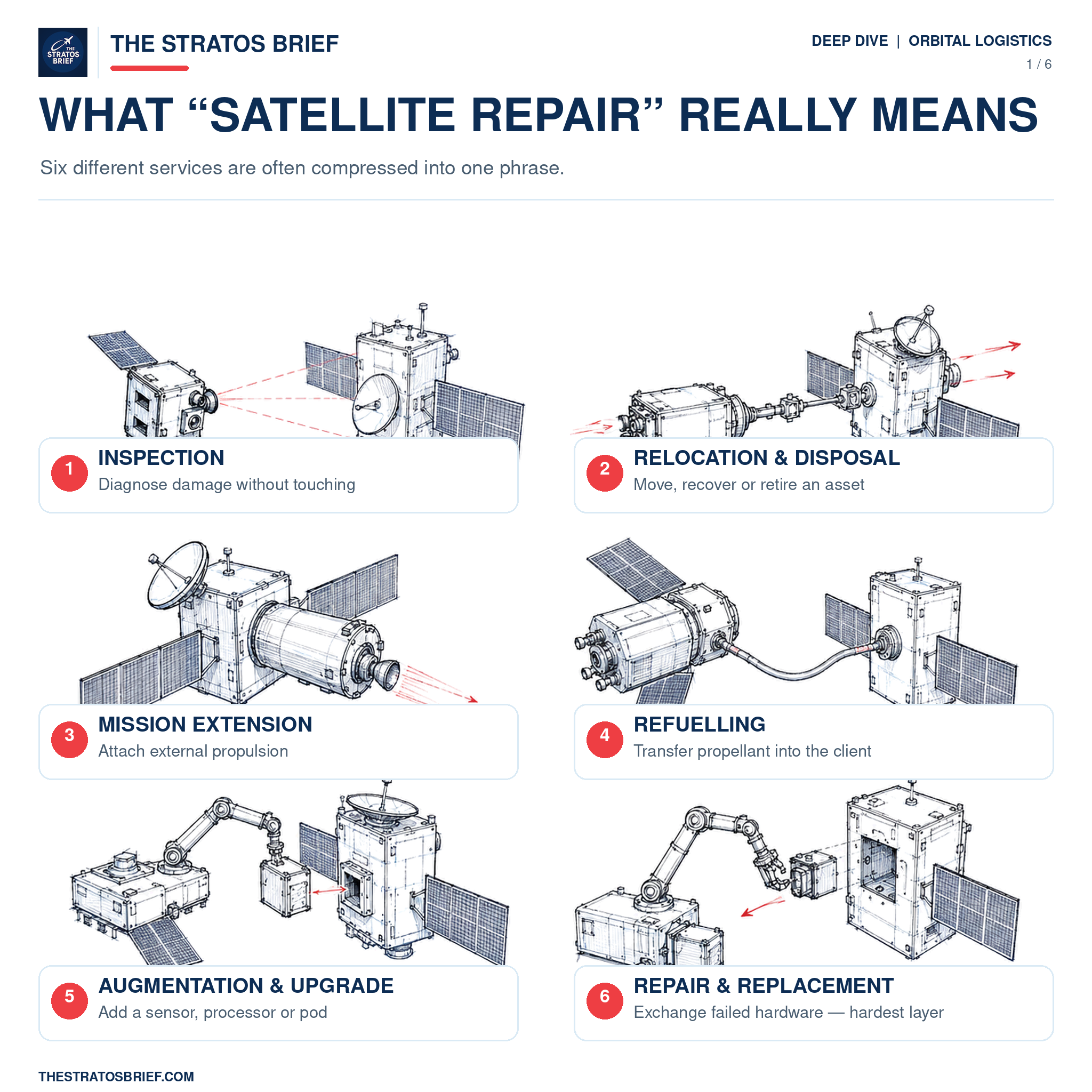
Satellite servicing is not a single capability. It spans inspection, relocation, life extension, refuelling, upgrading, repair and responsible end-of-life disposal.
The capability ladder in 2026
Human repair is the most mature form of orbital servicing. Five Hubble servicing missions and extensive maintenance aboard the International Space Station proved that astronauts can repair and upgrade complex spacecraft. The model is nevertheless expensive, restricted to accessible orbits and dependent on crews and highly specialised vehicles.
Robotic work on prepared hardware is also proven. The Dextre robot has carried out repairs and component changes on the ISS, while robotic refuelling experiments have demonstrated the manipulation of satellite plumbing. What remains immature is the use of free-flying robots to perform varied client missions without the controlled worksite provided by a space station.
Commercial life extension is already operational. Mission Extension Vehicles have completed three dockings and one undocking in geostationary orbit, with two service missions continuing. The next challenge is to expand the customer base and introduce smaller, less expensive vehicles capable of delivering the service repeatedly.
Autonomous rendezvous and capture have been demonstrated by the United States, Japan, China and India using both prepared and unprepared targets. The technology must still prove that it can operate robustly around unknown, tumbling or damaged spacecraft under a wide range of orbital conditions.
Propellant transfer has been demonstrated in controlled missions, while Chinese spacecraft have reportedly conducted related activity in orbit. Routine commercial delivery has not yet arrived. The industry still needs common interfaces, dependable multi-fuel logistics and repeated transfers to operational clients.
Robotic upgrading and repair are approaching their first operational test. Extensive work has been completed on the ground, and MRV has launched with a flight-ready robotic payload. It must still perform successful work on an actual client and demonstrate that orbital repairs or upgrades can become repeatable services rather than unique engineering projects.
Debris-removal missions have demonstrated inspection, close approach and the capture of prepared targets. No provider has yet completed the commercial removal of a large, unprepared orbital object from beginning to end.
The ladder matters more than any single launch. It shows why the technology has become real without implying that every promised service has arrived.
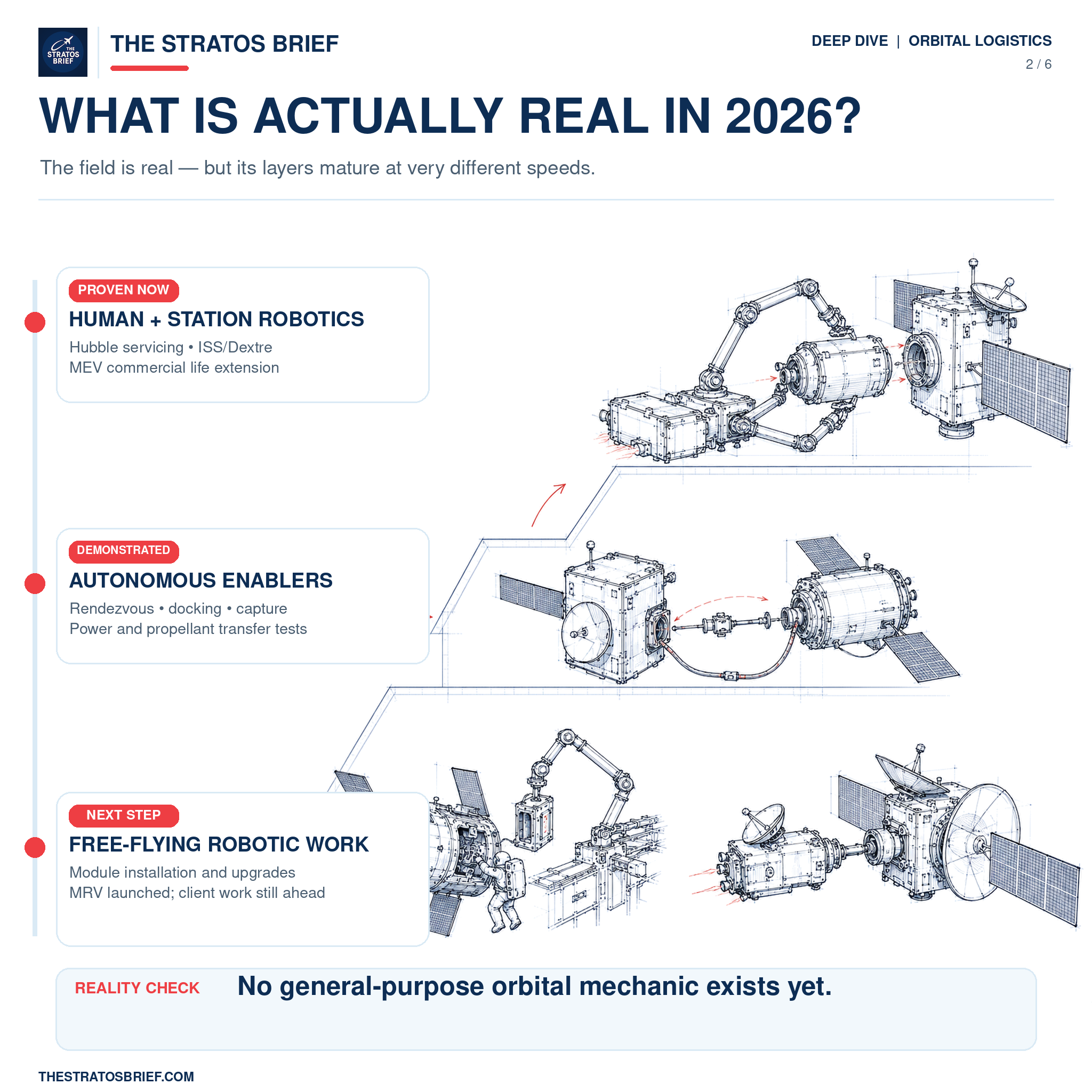
The field is progressing in layers. Commercial mission extension is operational, while general-purpose robotic repair and end-to-end removal of large unprepared objects remain emerging capabilities.
The idea is older than the current market
Spacecraft servicing began with people.
NASA designed the Hubble Space Telescope to be visited, repaired and upgraded in orbit. Five Space Shuttle missions between 1993 and 2009 corrected its flawed optics, replaced batteries and gyroscopes, installed new scientific instruments and even repaired failed electronics. Hubble proved that servicing could turn a compromised telescope into a continually renewed scientific platform. It also demonstrated the drawbacks: astronauts, a Shuttle launch, multiple spacewalks and years of mission-specific preparation were required.
Robots then began to inherit the task.
Japan’s ETS-VII mission in the late 1990s demonstrated autonomous rendezvous and docking alongside robotic manipulation. In 2007, the US Defense Advanced Research Projects Agency’s Orbital Express mission autonomously transferred fuel and exchanged components between two purpose-built spacecraft. On the International Space Station, the Canadian-built Dextre robot has replaced cameras and batteries and worked with NASA’s Robotic Refuelling Mission to cut wires, remove caps, manipulate valves and transfer fluid on hardware designed to imitate an unprepared satellite.
These were decisive demonstrations, but they did not create a service market. The targets travelled with the servicers, the work took place on the ISS, or the mission ended after proving its technology.
The commercial break came in February 2020.
Northrop Grumman’s Mission Extension Vehicle-1 docked with Intelsat 901 in geostationary orbit. MEV-1 did not transfer fuel. It gripped structural features around the satellite’s liquid-apogee engine and used its own propulsion to control the combined stack. After completing a five-year service period, it undocked in April 2025 and attached to another client the following month. MEV-2 has remained docked to Intelsat 10-02 since April 2021.
Three dockings and one undocking do not constitute a mature global industry. They do, however, establish something that earlier demonstrations did not: a reusable commercial vehicle has delivered a contracted service to revenue-generating satellites in orbit.
That is the foundation on which the current race is being built.
The United States: the operational leader, with an important failure
The United States has the deepest combination of servicing heritage, private capital, military demand and flight-proven commercial operations.
MRV is the clearest next step. Its robotic payload grew out of DARPA’s Robotic Servicing of Geosynchronous Satellites programme and was integrated with a commercial SpaceLogistics vehicle derived from the MEV design. The public-private structure is significant: the government paid to mature high-risk robotic capability, while a private operator owns the vehicle and is expected to sell services to both government and commercial clients.
MRV’s first advertised task is relatively controlled. It will use its arms to install Mission Extension Pods on existing geostationary satellites. These client-owned propulsion modules are much smaller than a full MEV and can provide at least six years of additional station-keeping. Optus has contracted for one to extend the life of its D3 communications satellite into the 2030s.
Once the platform is proven, the same arms and tools could support close inspection, relocation, anomaly resolution and hardware augmentation. DARPA calls MRV the first privately owned operational robotic servicing mission in GEO. That description refers to the mission and business model, not to completed repairs: the vehicle still has to reach GEO, commission its systems, rendezvous and work successfully on a client.
Around it, a wider US logistics market is forming.
Astroscale US lists its 300-kilogram Provisioner refueller as ready to launch in 2026 for multiple hydrazine transfers above GEO in support of the US Space Force. Orbit Fab has flight-qualified its RAFTI refuelling interface and plans 2026 demonstrations using compatible ports and capture hardware. Starfish Space has completed autonomous proximity operations, holds commercial and national-security servicing contracts, and is developing Otter vehicles for life extension and disposal. The Space Force is funding technologies ranging from propellant depots and transfer vehicles to inspection, orbital warehousing and repair.
Most of these systems are not operational services yet. Their importance lies in the emerging architecture: client interfaces, fuel suppliers, depots, tugs, robotic mechanics, government anchor customers and commercial operators are beginning to be developed together.
The US record also provides the field’s strongest warning against easy optimism.
NASA cancelled its OSAM-1 mission in 2024 after persistent technical, cost and schedule problems. The mission was intended to autonomously grasp, refuel and relocate Landsat 7 — a satellite never designed for servicing — and to demonstrate robotic assembly. NASA’s independent review found that the project faced substantial further cost and delay, while the industry was moving towards satellites equipped with servicing interfaces rather than expensive one-off work on legacy hardware.
OSAM-1 did not show that satellite repair is impossible. It showed that unprepared servicing can become economically irrational even when it is technically feasible. Designing the client for future access may matter as much as designing a clever robot.
Europe: less flight heritage, more emphasis on a serviceable ecosystem
Europe has no commercial equivalent of MEV in operation. Its strength lies instead in a coordinated portfolio that links life extension, robotic repair, debris removal, modular design and regulation.
ESA’s Resilient In-orbit Servicing for Europe mission, RISE, is being developed with Italy’s D-Orbit and is now planned for 2029. It will rendezvous with an unprepared but cooperative commercial satellite in geostationary graveyard orbit, dock to the launch-adaptor ring and take over attitude and orbital control. After the ESA demonstration, D-Orbit intends to continue operating the vehicle commercially.
This is deliberately structured as market creation, not simply a technology experiment. ESA is absorbing part of the first-mission risk, while the industrial partner co-funds, owns and operates the recurring service.
ClearSpace-1 tackles the more difficult problem of an uncooperative target. The ESA mission, led by Germany’s OHB with Swiss company ClearSpace, is planned to capture the 95-kilogram PROBA-1 satellite with four robotic arms and bring it down for atmospheric re-entry in 2029. Debris removal is not repair, but it requires the same core skills: finding an object that cannot help, estimating its motion, approaching without collision, capturing it and controlling the combined mass.
The EU-funded EROSS programme goes further towards true maintenance. Its architecture includes autonomous rendezvous, robotic capture, refuelling, tool changing and the exchange of orbital-replaceable units. In December 2025, the consortium completed a full ground demonstration at the German Aerospace Center, including approach, capture, tool changing and stacked component installation. That is meaningful systems integration, but it remains a ground test rather than an orbital repair.
The European Commission is also funding orbital warehousing and a universal interface concept called SPACE USB. ESA is developing standard capture features for future spacecraft. The United Kingdom has run a regulatory sandbox for rendezvous and proximity operations and tendered a £75.6 million mission to remove two defunct British satellites; the contract award had been delayed to summer 2026 at the time of writing.
Europe’s strategic proposition is therefore different from the American one. The US has moved first through commercial life extension and military logistics. Europe is trying to make the next generation of satellites easier to service and dispose of, while building a sovereign commercial capability around common rules.
Its risk is schedule. RISE, ClearSpace-1 and an orbital EROSS demonstration still have to convert sophisticated programmes and ground campaigns into safe flight operations. Standards without service capacity would leave European operators dependent on foreign providers. Service vehicles without common interfaces would leave each mission expensive and bespoke.
Europe needs both.
China: public civil objectives, rapid progress and unavoidable ambiguity
China’s programme is both highly consequential and less transparent.
In January 2025, China launched Shijian-25. The Shanghai Academy of Spaceflight Technology publicly described its purpose as verifying satellite fuel replenishment and life-extension technologies. During 2025, commercial tracking showed Shijian-25 conducting close operations with Shijian-21 in geostationary orbit. US Space Command has since assessed that the spacecraft probably docked and may have transferred fuel.
That final step has not been publicly documented by China in the detail that a commercial customer or independent technical review would require. A balanced assessment therefore has to preserve two statements at once: China explicitly launched a refuelling experiment, and the claim that an actual transfer occurred currently rests on external observation and US military assessment.
Shijian-21 had already shown another part of the capability. In 2022 it moved a defunct BeiDou navigation satellite from geostationary orbit to a higher graveyard orbit. That was a useful act of debris mitigation. It was also a demonstration that a Chinese spacecraft could approach, attach to and relocate another satellite at strategic altitude.
China’s commercial sector is now becoming visible as well. In March 2026, the Yuxing-3 06 satellite from startup Sustain Space used a flexible, trunk-like robotic arm to complete autonomous, ground-controlled and vision-guided refuelling simulations in orbit. Chinese state media reported that the arm docked with test ports. This was an orbital manipulation and interface demonstration, not evidence of a routine fuel delivery service to a separate client.
The pattern is nevertheless clear. China is developing inspection, rendezvous, capture, relocation, robotic manipulation and refuelling as parts of a broader in-space logistics capability. Its Tiangong station and crewed programme also provide extensive national experience in docking, cargo transfer, station maintenance and refuelling — although servicing a prepared station is not the same as repairing an independent satellite.
Western military concern is not evidence that every Chinese servicer is a weapon. Nor can China’s stated civil purpose remove the dual-use character of the technology. A vehicle that can grip and move a failed satellite can also interfere with an active one. A tanker that supports peaceful infrastructure can also replenish a military inspector or counterspace platform.
The strategic issue is not Chinese participation in servicing. A more maintainable and sustainable space environment benefits all operators. The problem is the combination of physical access, limited transparency and weak international mechanisms for communicating intent during close approaches.
Greater disclosure of mission plans, client consent, safety zones, abort procedures and completed outcomes would reduce uncertainty without requiring China — or any other state — to reveal sensitive engineering data.
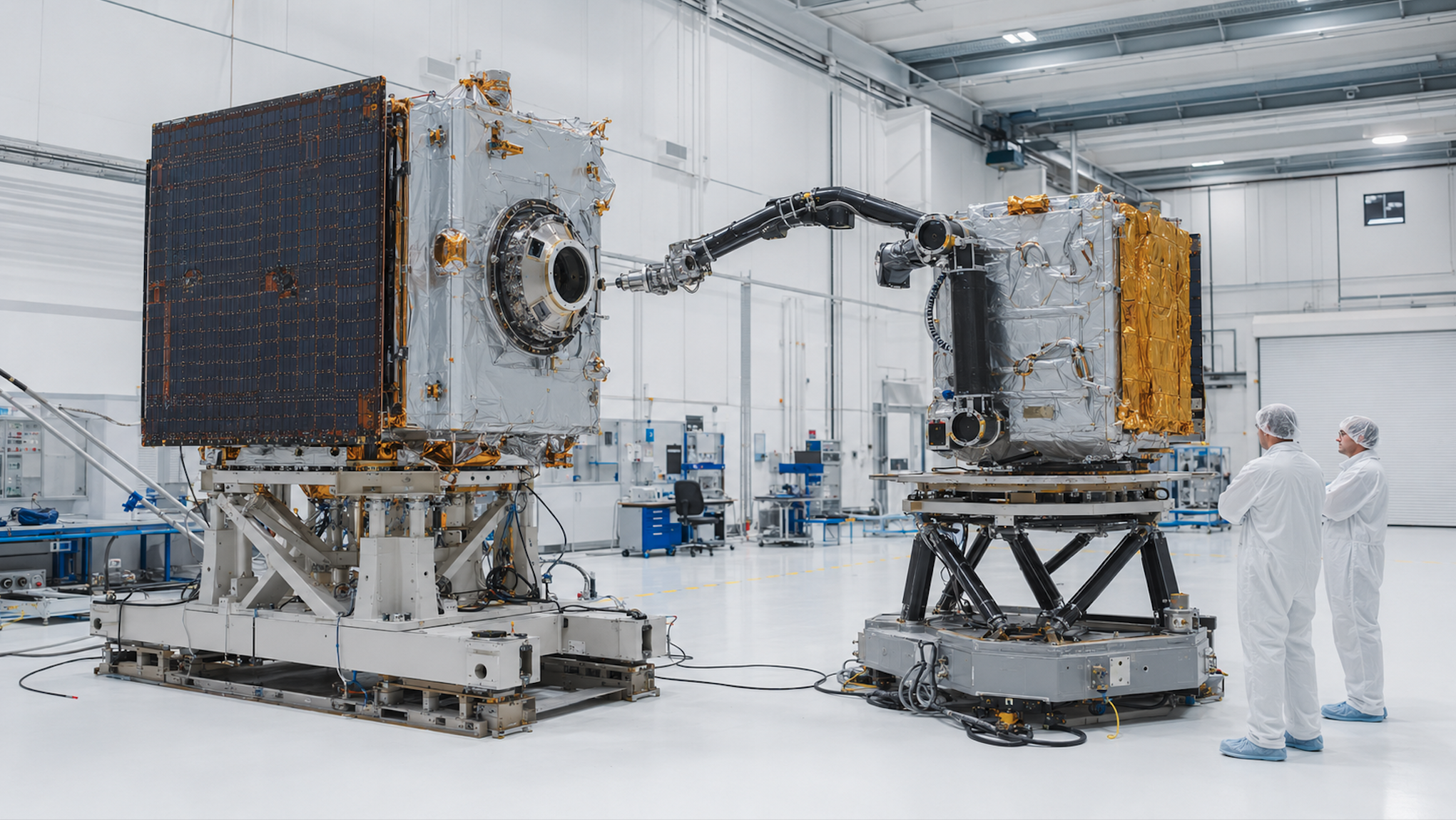
Every orbital intervention begins on Earth. Full-scale test rigs allow engineers to rehearse docking geometry, contact forces and failure recovery before a servicing spacecraft approaches a valuable satellite. Conceptual AI generated illustration.
Russia: deep rendezvous heritage, little public evidence of a repair service
Russia has more experience with orbital rendezvous, docking and crewed-station logistics than most countries. The Soviet Cosmos 186 and Cosmos 188 spacecraft completed the first automatic docking in orbit in 1967. Later Soyuz and Progress operations, together with the Salyut and Mir legacy, demonstrated long-standing competence in approach, docking, fluid transfer and space operations.
That heritage should not be confused with a current free-flying satellite servicing programme.
Russia has launched manoeuvrable “inspector” spacecraft capable of approaching and observing other objects. US military assessments describe several Russian deployments since 2017 as probable orbital anti-satellite prototypes and point to repeated close approaches. Publicly available evidence does not establish that these systems have refuelled, repaired or commercially extended the life of a separate satellite.
Russian academic work continues to examine servicing architectures, refuelling, modular replacement, debris removal and the economics of orbital service networks. This shows that the technical concept is understood and studied. It is not evidence of an operational programme.
The most accurate open-source conclusion in August 2026 is therefore narrow: Russia retains relevant rendezvous and human-spaceflight expertise, and it operates proximity-capable military spacecraft, but it has not publicly demonstrated a dedicated robotic satellite repair or commercial life-extension service comparable to MEV, MRV or the announced Chinese refuelling missions.
Secrecy cuts both ways. The absence of public evidence is not proof that classified development does not exist. It does mean that analysts should not convert every inspector satellite into a fictional repair programme — or assume that experience with space-station docking automatically solves autonomous work on an unprepared target.
Japan: the leader in inspecting the uncooperative
Japan combines early robotic heritage with some of the strongest recent flight evidence.
Its ETS-VII mission demonstrated autonomous rendezvous, docking and robotic operations in the late 1990s. Astroscale’s ELSA-d mission, launched in 2021, later demonstrated repeated magnetic capture and complex rendezvous with a companion target built for the experiment. The target’s docking plate made capture easier, but the mission validated sensors, navigation and operational procedures relevant to debris removal.
ADRAS-J moved to a harder class of target. Under the Japan Aerospace Exploration Agency’s Commercial Removal of Debris Demonstration programme, the spacecraft approached and inspected an actual H-IIA upper stage that carried no docking aids and could not cooperate. It completed multiple close approaches, fly-arounds and observations, reaching approximately 15 metres before ending mission operations in March 2026.
ADRAS-J did not capture the rocket body. Its value was learning how a large, ageing and potentially tumbling object really behaves at close range. Models can estimate shape and motion; a future capture vehicle needs verified geometry, surface condition and rotation.
ADRAS-J2, planned for Japan’s 2027 fiscal year, is intended to return to the same target, capture it and remove it. If successful, it will turn Japan’s inspection advantage into an end-to-end debris-removal capability.
Japan’s position also illustrates how global this industry already is. Astroscale was founded in Japan, operates missions with JAXA, develops UK debris-removal capability, builds a US military refueller and uses expertise from its Israeli operation. National capability increasingly resides in allied industrial networks rather than inside a single flag.
India: the enabling technologies are arriving
India crossed an important threshold in 2025 with its Space Docking Experiment, SpaDeX.
Two approximately 220-kilogram spacecraft demonstrated docking, undocking, a second fully autonomous docking from 15 metres and bidirectional electrical-power transfer. ISRO says this made India the fourth nation to demonstrate docking in space and explicitly identifies in-orbit servicing as a future application. The same launch also carried a small robotic-arm experiment on the POEM-4 orbital platform.
These achievements give India several essential building blocks: relative navigation, autonomous control, docking, composite-spacecraft operation, power transfer and orbital robotics. They do not yet amount to a servicer. SpaDeX used two purpose-built cooperative spacecraft, did not approach a legacy satellite and did not transfer propellant or replace a component.
The next strategic decision is whether India develops those technologies mainly for its planned space station and exploration programme, or also turns them into a commercial or military servicing architecture. Indian startups are exploring refuelling interfaces, propulsion and life extension, while the country’s growing launch sector could support lower-cost demonstrations.
India also has a useful international route. The Australian Space MAITRI mission is intended to launch a 450-kilogram Australian Orbital Servicing Vehicle on an Indian rocket, focusing on transport, debris management and sustainable operations. It is an example of how a country can acquire servicing experience through partnership rather than duplicating every element domestically.
The other important players
Several countries matter because they supply a critical part of the system, even if they do not operate a national repair vehicle.
Canada has one of the world’s strongest operational heritages in space robotics. Canadarm2 and Dextre routinely maintain the ISS. Dextre has replaced external equipment and demonstrated delicate operations on simulated satellite plumbing. Canadian robotics will remain important to both civil exploration and commercial servicing.
The United Kingdom is a major base for Astroscale and ClearSpace activity and is developing licensing practice for rendezvous, proximity operations and debris removal. Its contribution may be as important in regulation, insurance and mission approval as in hardware.
Switzerland is home to ClearSpace and contributes robotics and capture technology through European programmes. Italy’s D-Orbit is the operator and prime contractor for RISE. France and Germany supply major EROSS, ESA and robotic systems. Treating “Europe” as a single industrial actor can hide these national specialisations.
Australia has placed a first Orbital Servicing Vehicle in orbit and is funding the larger Space MAITRI demonstrator with India, although it has not yet delivered an orbital repair service. Israel contributes rendezvous and docking expertise through Astroscale Israel. New Zealand, working with the United Kingdom, has helped develop a regulatory blueprint for missions involving operators, clients and launch states across jurisdictions.
South Korea is at an earlier stage. Its national plans fund enabling technology for on-orbit services and active debris removal, while the twin SNUGLITE-III CubeSats announced separation, rendezvous and docking plans after reaching orbit in late 2025. This is a developing technology base, not yet a client-servicing capability.
This distributed map is a feature, not a footnote. A commercial service may have a Japanese parent, US government customer, Israeli guidance technology, British licence, European component and launch from another country. Political leaders who define capability only by prime-contractor nationality will miss both dependencies and opportunities.
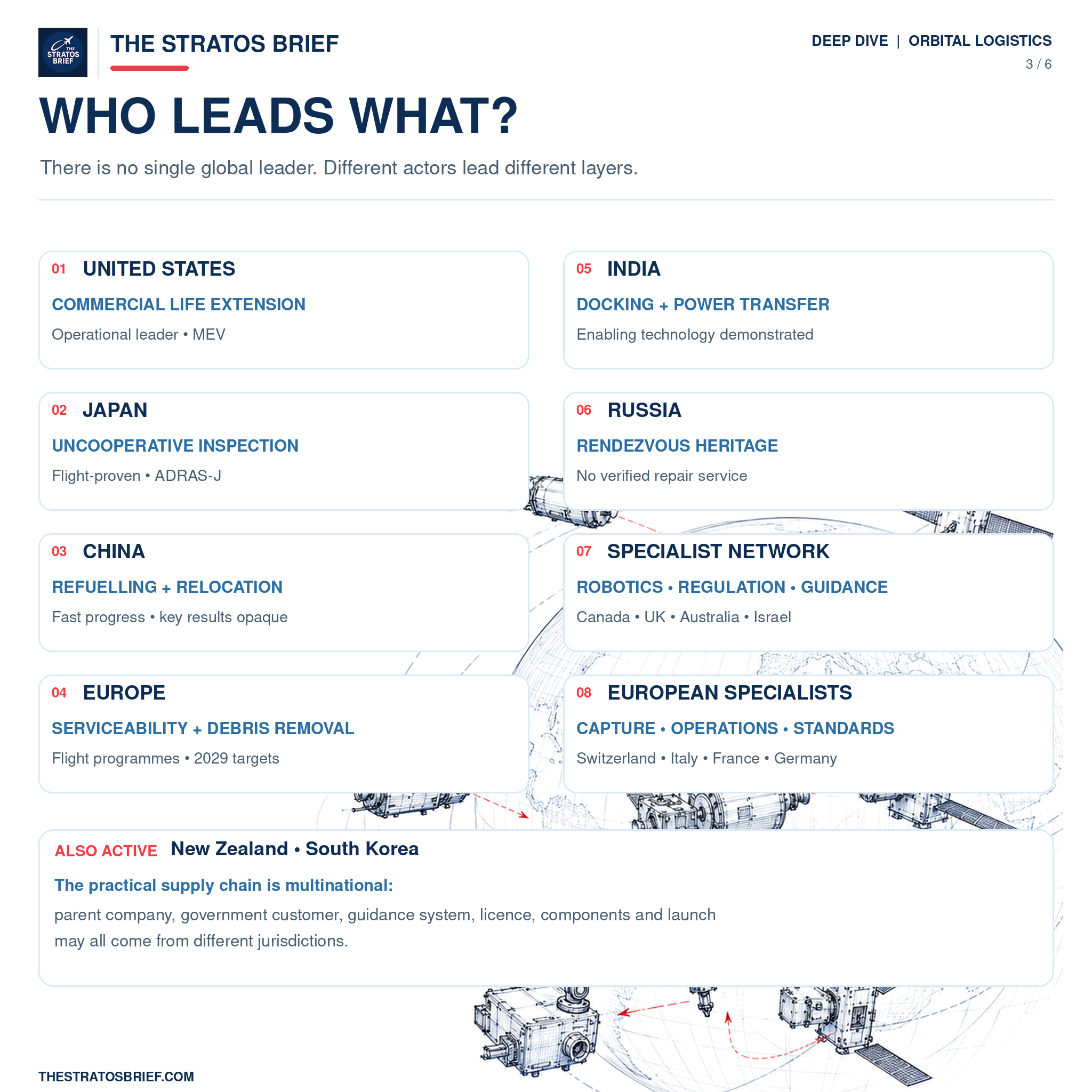
Leadership is distributed. The United States leads commercial life extension, Japan has produced the strongest inspection evidence around an uncooperative target, Europe is developing a standards-led service ecosystem, and China is advancing across several strategically sensitive capabilities.
Why has servicing become credible now?
No single invention made the transition possible. Several curves have converged.
Launch is more available. A servicer can ride alongside other payloads, use electric propulsion to raise its orbit and amortise its launch across multiple clients. MRV’s year-long transfer to GEO illustrates the trade-off: efficient electric propulsion saves propellant, but reaches the operational orbit slowly.
Autonomy has improved. A servicer must fuse cameras, lidar and navigation data while estimating the motion of an object it may never have seen up close. Communications delay is manageable around Earth, but ground controllers cannot safely command every millisecond of final approach or contact.
Robotics are more dexterous. Force-torque sensing, compliant control, machine vision and interchangeable tools allow arms to interact with delicate hardware without pushing both free-flying spacecraft apart.
The customer base is larger. ESA’s latest environment report recorded more than 300 launches and 4,000 new payloads in 2025 alone. It estimates 1.2 million debris objects between one and ten centimetres and 54,000 objects larger than ten centimetres, including active spacecraft. More assets create more failures, more congestion, more disposal obligations and more potential clients.
Governments now see logistics as a strategic capability. The US Space Force is openly planning for depots, tankers, reusable transfer vehicles, spares and orbital repair. Europe frames servicing as sovereign infrastructure and a circular economy. China presents refuelling as a life-extension technology while integrating related capabilities into a powerful state space sector. Japan treats debris removal as both public safety and industrial development.
Satellite design is beginning to change. Docking plates, refuelling valves, standard launch-adaptor rings, fiducial markers and replaceable modules can turn a heroic one-off intervention into a repeatable service.
The last change may be the most important. The future market will not be built only by better mechanics. It will be built by better clients.
Why geostationary orbit is the first real market
The strongest near-term business case is not universal.
Large geostationary communications satellites are expensive, generate revenue continuously and can operate for years after their original station-keeping fuel is depleted. They occupy valuable orbital positions and replacement can take years to procure, build, insure and launch. Attaching a propulsion vehicle can preserve service, defer capital spending or bridge a fleet until a replacement architecture is ready.
The economics are different in low Earth orbit.
For a mass-produced, short-lived constellation satellite, launching a replacement may be cheaper than dispatching a bespoke mechanic. Orbital planes are separated, relative inclinations are costly to change, and a servicer can consume substantial fuel travelling between clients. Servicing becomes more attractive when a LEO asset is unusually valuable, difficult to replace, stranded in the wrong orbit, needed for a critical mission or legally required to be removed.
This creates a practical decision rule:
Service a satellite when the remaining value recovered exceeds the full cost and risk of reaching, touching and supporting it — not merely the cost of the robot.
The calculation includes lost-revenue avoidance, replacement lead time, launch availability, insurance, client condition, residual mission life and the servicer’s next destination. It also includes the risk that an intervention damages a functioning payload.
Servicing will therefore begin as a portfolio of specialised markets, not as a universal mechanic for every satellite.
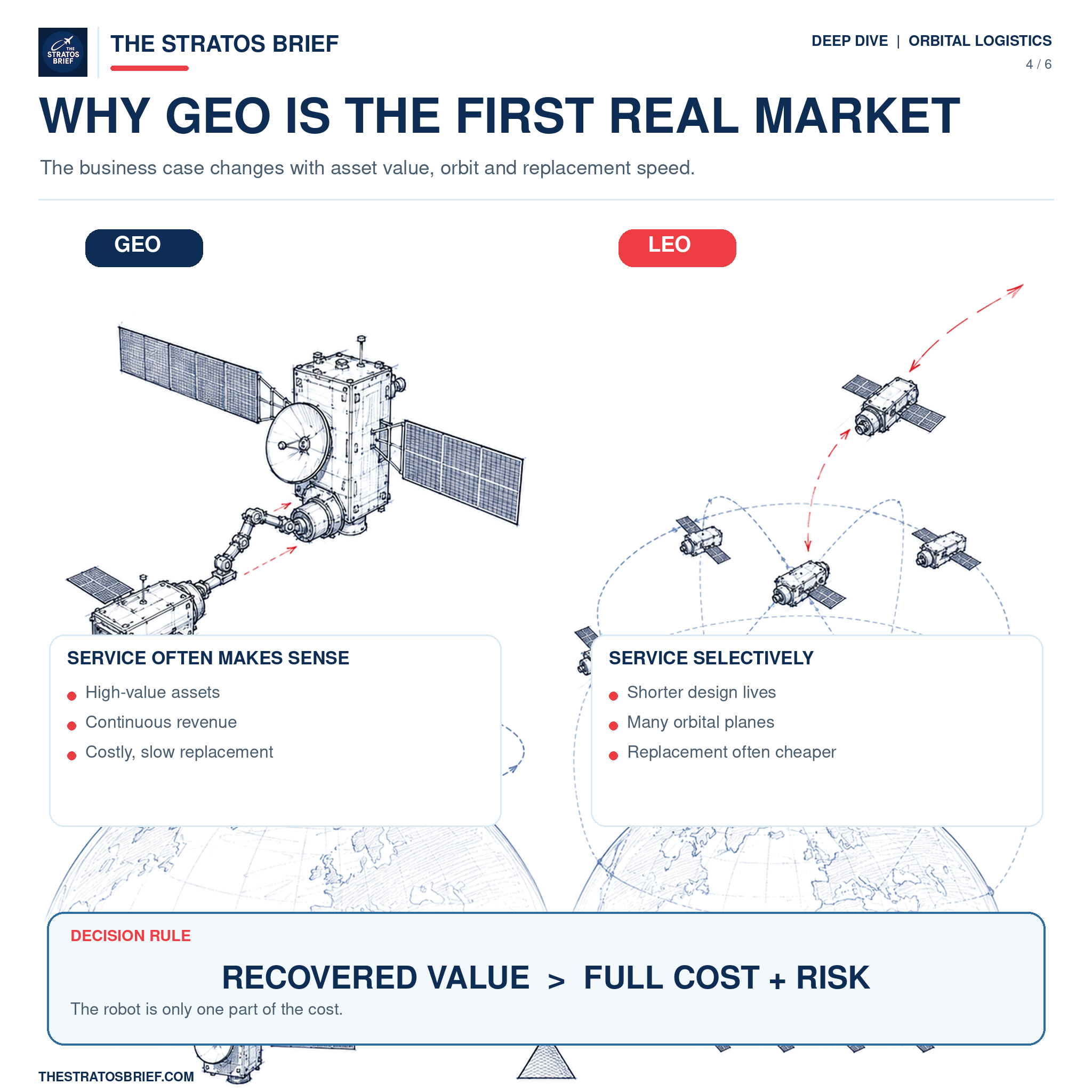
GEO provides the clearest early market for servicing because individual satellites are valuable, long-lived and expensive to replace. In LEO, repair must compete against the falling cost of launching a replacement.
What commercial leaders gain
For satellite operators, the immediate positive is optionality.
A fuel-limited satellite no longer has to face a binary choice between replacement and retirement. An operator can extend it for a fixed period, relocate it, inspect an anomaly before declaring a loss or add capability after launch. This can protect revenue and allow fleet transitions to follow market demand rather than the original fuel budget.
Servicing can also change spacecraft procurement. If refuelling and propulsion support are credible, a satellite may launch with less lifetime fuel and more revenue-generating payload. If processors or sensors can be replaced, the platform and payload no longer need identical design lives. Operators could buy an infrastructure layer and upgrade it incrementally.
For manufacturers, that creates a new product category: serviceable buses, standard interfaces, orbital-replaceable units and upgrade packages. For insurers, high-resolution inspection could replace uncertainty with evidence after an anomaly. For launch providers and logistics firms, it creates recurring traffic after deployment rather than a single transaction before operations begin.
The environmental benefit is also commercially relevant. Extending useful life extracts more service from hardware already launched. Reliable end-of-life removal can protect orbital access and help operators meet stricter debris rules. Neither benefit is automatic: keeping obsolete or unreliable hardware alive indefinitely can increase risk, and a failed servicing vehicle can itself become debris. The positive outcome depends on mission selection and responsible disposal.
Awareness gives executives an advantage before the service market matures. Spacecraft being specified today may still be operating in the 2040s. A low-cost docking feature, visual marker, accessible valve or modular interface included now can preserve future choices. Retrofitting serviceability after launch is precisely the expensive problem that defeated OSAM-1’s business logic.
What military leaders gain — and what they must protect against
Military satellites have traditionally carried all the fuel, computing power and hardware they were expected to need for their entire lives. Every manoeuvre consumes a finite reserve. That encourages operators to conserve fuel even when changing position would improve survivability or mission effect.
Refuelling changes that psychology of scarcity.
A logistics network could enable satellites to manoeuvre more often, evade threats or debris, change coverage, recover from launch underperformance and remain useful after an adversary expected their fuel to be exhausted. An external propulsion module can restore station-keeping. Inspection can distinguish a technical failure from impact or interference. Robotic upgrades could add new processors, sensors, communications packages or countermeasures faster than replacing an entire strategic satellite.
For forces dependent on a small number of exquisite GEO assets, the resilience value is substantial. Repair or augmentation can preserve missile warning, secure communications and intelligence functions whose replacements are neither quick nor cheap.
Servicing does not replace proliferation or responsive launch. A distributed LEO constellation may be more resilient when failed units are rapidly replenished from Earth. A repair vehicle may take weeks or months to reach the wrong orbital plane. The strongest military architecture will combine multiple approaches: proliferated systems where replacement is economical, protected high-value assets, launch reserves, manoeuvre fuel, servicing and allied commercial support.
The logistics network introduces new vulnerabilities too. Depots, tankers and servicers become high-value targets. A compromised servicing command link could grant physical access to a client. Docking creates cyber, software, supply-chain and contamination pathways between two spacecraft. Commercial providers may operate under different threat assumptions from military customers.
Military leaders therefore need doctrine, exercises and rules for more than buying hardware. They need authenticated consent, protected command links, inspection of servicing software, contingency procedures for failed dockings, clear authority to manoeuvre clients, and plans for operating when a commercial provider is unavailable or politically constrained.
Most importantly, they must understand the same technology in an adversary’s hands without treating every proximity operation as an attack.
The dual-use problem cannot be engineered away
The mechanisms of help and harm are nearly identical.
A camera that inspects damage can collect intelligence. A robot arm that installs a propulsion pod can tear off an antenna. A tug that removes debris can move an active satellite. A refueller can extend the life of communications infrastructure or sustain a manoeuvring counterspace system.
This does not make servicing uniquely dangerous. Aircraft tankers, repair ships and cyber-administration tools are also dual-use. It does mean that intent cannot be inferred from hardware alone.
Behaviour provides better signals:
• Did the client owner consent?
• Was the mission and approximate approach plan disclosed?
• Are the spacecraft exchanging navigation and safety data?
• Are there credible hold points, collision-avoidance manoeuvres and abort modes?
• Is the operator licensed and subject to continuing state supervision?
• Does the vehicle remain within the announced mission profile?
• Is there a reliable channel for urgent contact?
The strategic benefit of shared norms is not abstract diplomacy. It is crisis stability. A technically normal servicing approach can look similar to the opening phase of an attack. Notification, transparency and predictable procedures give military decision-makers more time to distinguish the two.
They also make malign behaviour easier to identify. Norms do not constrain only responsible operators; they create a baseline against which deviations become visible.
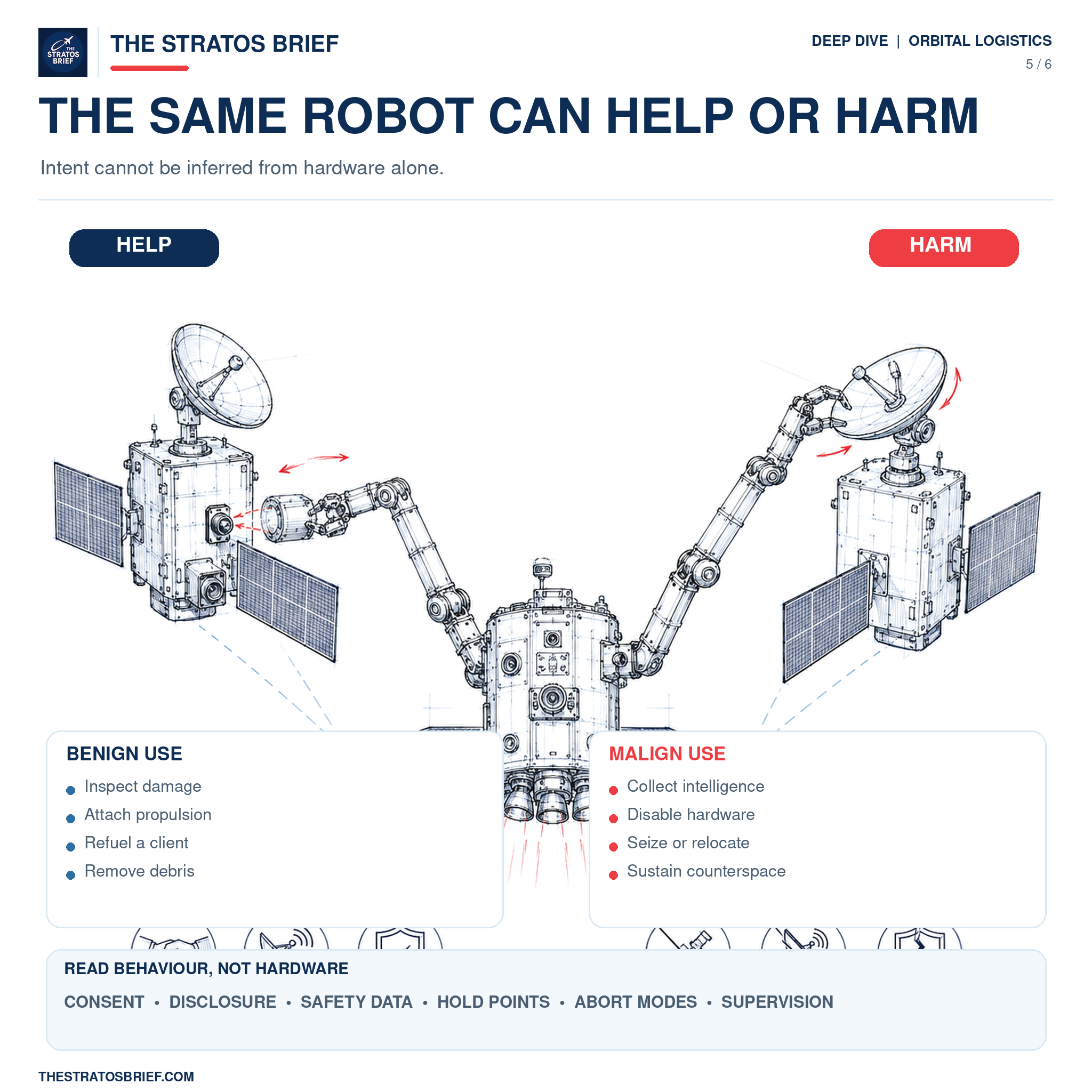
The same rendezvous, capture and manipulation tools can support or threaten a satellite. Consent, transparency and operational behaviour — not the hardware alone — are the decisive signals.
The law says there is no abandoned satellite free-for-all
Existing space law applies, but it was not written with commercial orbital mechanics in mind.
Under Article VI of the Outer Space Treaty, states remain internationally responsible for national space activity, including private activity, and must authorise and continually supervise it. Article VIII says the state of registry retains jurisdiction and control over its space object, while ownership is not lost simply because the object is dead or drifting in space.
There is therefore no general maritime-style right of salvage. A company cannot identify an apparently abandoned satellite and remove, repair or recycle it without the relevant owner’s and state’s agreement.
Article IX requires due regard for other states’ interests and consultation where an activity may cause potentially harmful interference. The Liability Convention makes launching states absolutely liable for certain damage on Earth and applies fault-based liability to damage between space objects in orbit. A servicing accident can involve the client’s owner, servicer operator, launch provider, state of registry and multiple launching states.
Contracts can allocate commercial risk between companies, but they cannot erase states’ treaty responsibilities.
Industry and standards bodies are filling some gaps. CONFERS has developed recommended design and operational practices, and ISO 24330:2022 establishes programme-level principles for rendezvous, proximity operations and on-orbit servicing. The United Nations has adopted 21 voluntary guidelines for the long-term sustainability of space activities.
What remains incomplete is a widely accepted operating regime for close approaches: timely notification, consent verification, safety data exchange, standard contact information, cyber assurance, evidence after an accident and rules for cross-border servicing chains.
Governments do not need to wait for a new global treaty to make progress. They can align national licences, require responsible RPO plans, recognise common technical standards and make transparency a condition of public contracts. The United Kingdom’s regulatory sandbox and joint work with New Zealand offer one practical model.
What political leaders gain from understanding the technology
The first benefit is better investment.
Governments can decide which capabilities are truly sovereign requirements and which can be bought from allied or commercial providers. A country may not need its own general-purpose servicer, but it may need domestic robotics, refuelling interfaces, licensing expertise, tracking data or assured access to an allied vehicle.
The second benefit is industrial timing.
Interfaces selected now can become standards used for decades. Countries that fund compatible docking plates, refuelling ports and modular components can shape supply chains and make their satellites easier to support. Those that wait may have to buy foreign adapters — or launch spacecraft that no existing servicer can touch economically.
The third is more credible security policy.
Leaders who understand the capability ladder are less likely to confuse a benign inspection with a completed refuelling system, or to dismiss a “debris-removal” vehicle that also has obvious military utility. Calibrated knowledge reduces both complacency and overreaction.
The fourth is sustainability with enforcement.
Debris removal and life extension can protect scarce orbital regions, but only if licensing prevents servicers from becoming new hazards. Public procurement can require disposal plans, passivation, cyber protection, transparent proximity procedures and standard interfaces. Governments can reward responsible design before a crisis makes it mandatory.
Finally, servicing creates a new form of alliance resilience. Partners could share depots, inspection data, refuelling standards and robotic services just as they share launch ranges, communications capacity and space-domain awareness. Interoperability will be valuable in normal operations and critical when a launch failure, collision or conflict disrupts national capacity.
For political leaders, the central question is not whether to support a futuristic repair robot. It is whether their country will be a customer, supplier, regulator, standard-setter, security provider — or dependent bystander — in an emerging orbital logistics system.
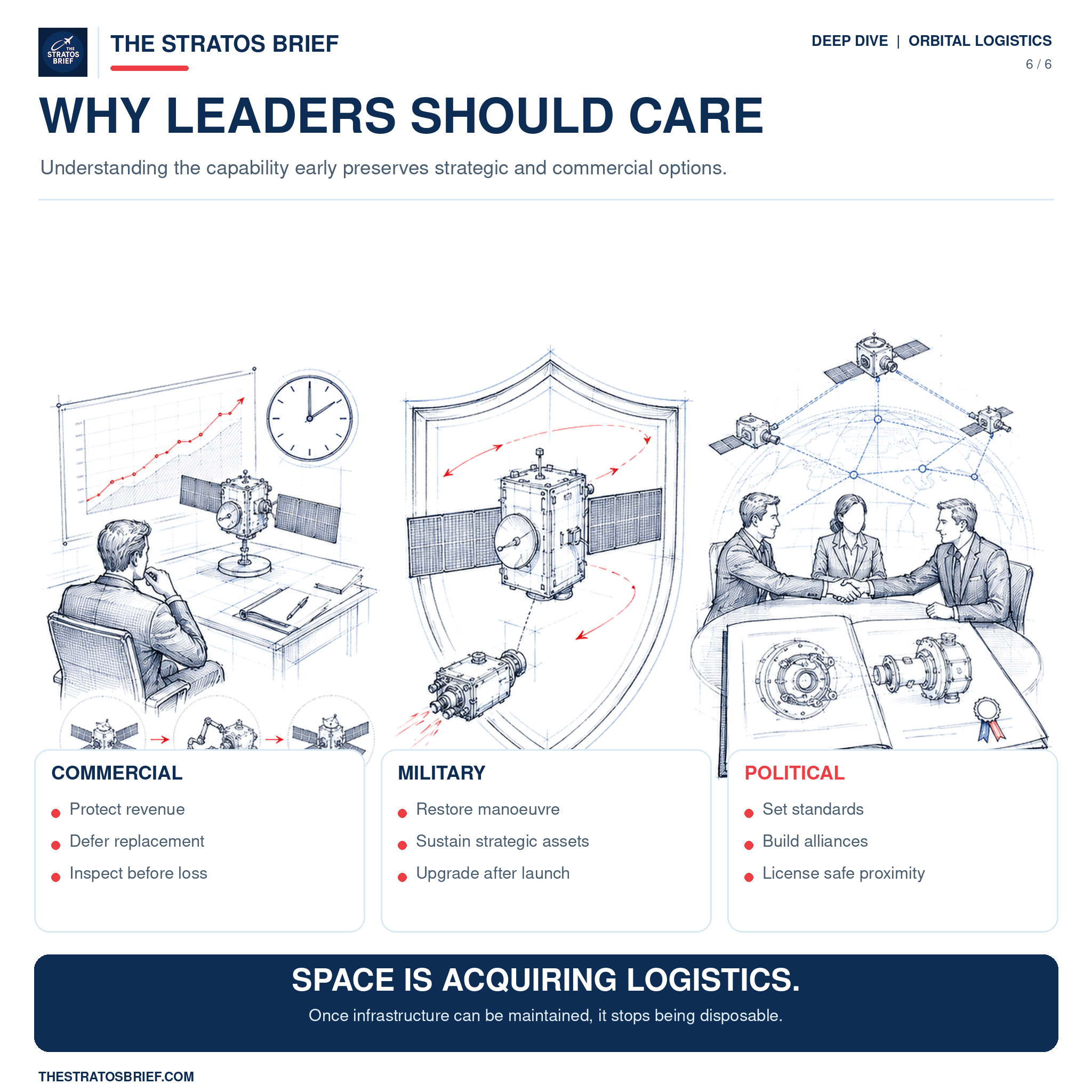
Understanding satellite servicing helps leaders identify investment priorities, protect strategic assets, shape standards and build more resilient commercial and allied space architectures.
What could still stop the market?
The greatest obstacle may not be robotic dexterity. It may be demand.
A servicer needs enough compatible, valuable clients in reachable orbits to repay development, launch and operations. Customers must trust a new provider to approach assets worth hundreds of millions of dollars. Insurers and manufacturers must agree on warranties, liability and access to proprietary spacecraft data. Governments must license missions that may involve several jurisdictions.
Standardisation presents a classic coordination problem. Operators hesitate to add mass and cost for interfaces before services exist. Service providers hesitate to invest before enough compatible clients are on orbit. Government anchor missions can break the deadlock, but they can also distort the market or sustain architectures that never become commercial.
Technology remains unforgiving. Lighting changes rapidly during rendezvous. Reflective insulation can confuse sensors. A dead satellite may tumble unpredictably. Plumes can contaminate optics. Contact forces can destabilise both vehicles. Old diagrams may not match hardware after years of thermal cycling and micrometeoroid impacts. Fuel types and pressures differ. Cryogenic propellants add boil-off and thermal-management problems far beyond room-temperature hydrazine transfer.
Then there is obsolescence. Extending propulsion does not repair degraded solar cells, radiation-damaged electronics or an outdated payload. A successful life-extension mission can keep the wrong capability in orbit if operators evaluate only remaining fuel.
The field will survive these constraints, but its shape may be narrower than the most ambitious forecasts. Life extension in GEO, inspection, military logistics, high-value science support and mandated debris removal have credible customers. Universal repair of cheap satellites does not.
The bottom line
Satellites that repair satellites have become real in the same sense that the first aircraft refuelling, container shipping or cloud-computing services became real: the essential operations have been demonstrated, early customers exist and an ecosystem is forming — but the mature infrastructure implied by the phrase has not arrived.
The United States leads in commercial flight heritage and is now sending a robotic servicing platform to GEO. China has combined a publicly declared refuelling programme with observed proximity and relocation capabilities, although key results remain opaque. Europe is building a standards-led, sustainability-focused service architecture. Japan has set the benchmark for inspecting a large uncooperative target. India has demonstrated the docking and power-transfer foundations. Canada, Australia, Israel, the United Kingdom, Switzerland and other specialised partners supply important pieces of the system. Russia retains deep rendezvous experience and proximity-capable spacecraft, but no comparable public repair service has been verified.
The decisive change is not that every broken satellite can now be saved.
It is that fuel exhaustion, a launch-day design and even some hardware failures are beginning to look like operational problems rather than automatic mission endings.
For commercial leaders, that creates asset flexibility and new business models. For military leaders, it creates endurance, manoeuvre and upgrade options — alongside new targets and escalation risks. For political leaders, it creates an early opportunity to shape standards, alliances and responsible behaviour before physical access to other nations’ satellites becomes routine.
The future orbital economy will not be built only from satellites. It will include the vehicles that inspect them, move them, fuel them, upgrade them and eventually dispose of them.
Space is acquiring logistics.
And once an infrastructure can be maintained, it stops being disposable.
Primary and official source dossier
Global status, law and standards
United States and Canada
DARPA — Robotic Servicing of Geosynchronous Satellites lifts off
US Space Systems Command — Servicing, Mobility and Logistics
US Space Systems Command — 2026 In-Domain Orbital Logistics Challenge
Europe and the United Kingdom
China and Russia
US Space Command — January 2026 assessment of SJ-21 and SJ-25
RUDN Journal — concept of on-orbit servicing for next-generation systems