The Silent Layer of Air Defence: Why Passive Infra-Red Sensors Are Becoming Harder to Ignore
Date published: 28 April 2026
Event date: April 2026 / ongoing development
Event location / region: Global / contested airspace / Middle East reference case
A recent rumour around the reported loss of a US F-15E over Iran has brought a little-known part of air defence into public debate: passive infra-red and electro-optical detection systems. The rumour itself should be treated carefully. Reuters reported that a US F-15E was shot down over Iran and that Iran claimed a “new air defence system” had been used, but open sources do not confirm whether the aircraft was detected or engaged by a passive infra-red system, a radar-guided system, a hybrid network, or another mechanism.
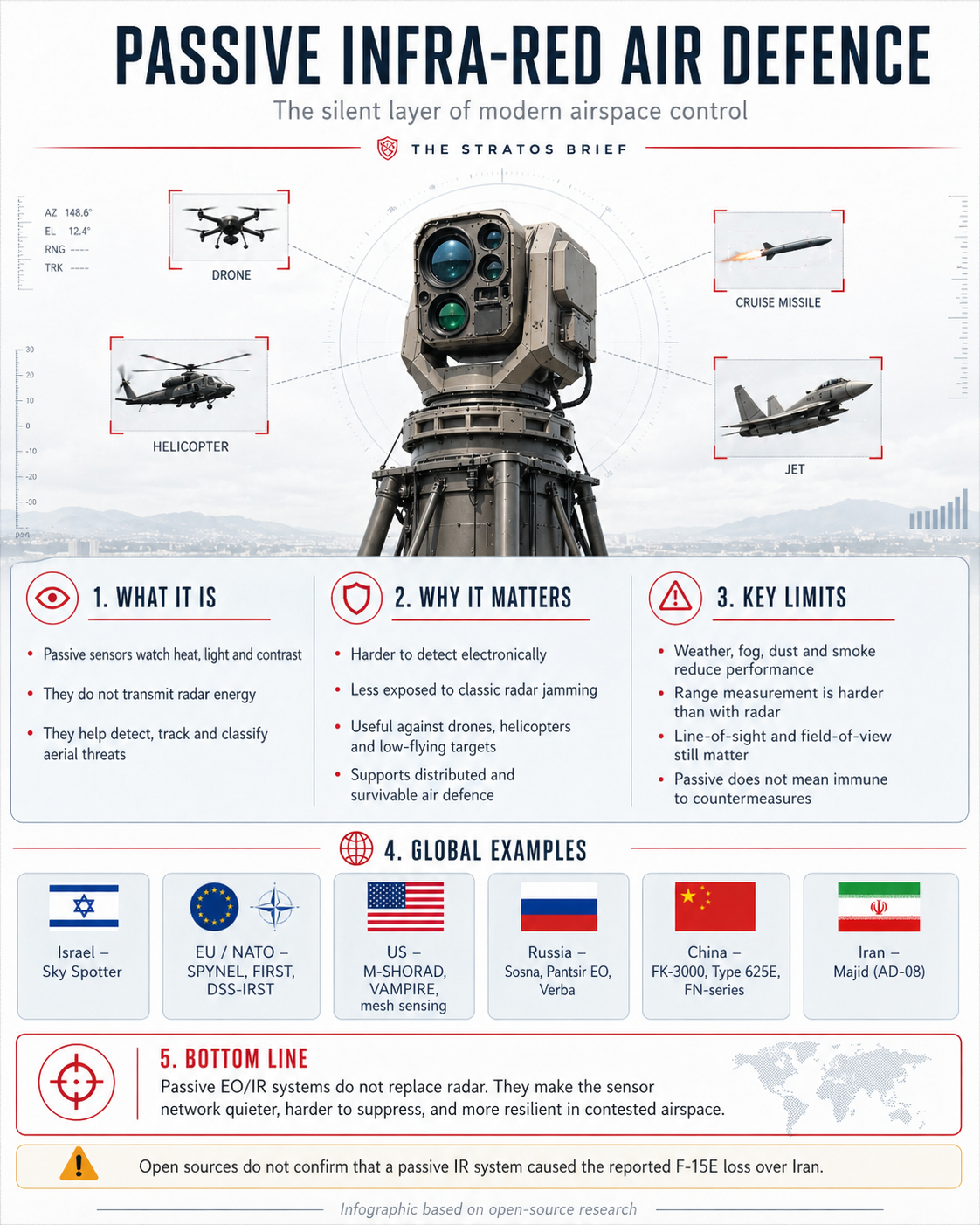
But the wider topic is real. Passive infra-red and electro-optical air-defence sensors are becoming a more important part of modern airspace control. They are not a replacement for radar. They are a silent layer that can make an air-defence network harder to detect, harder to jam, and harder to suppress.
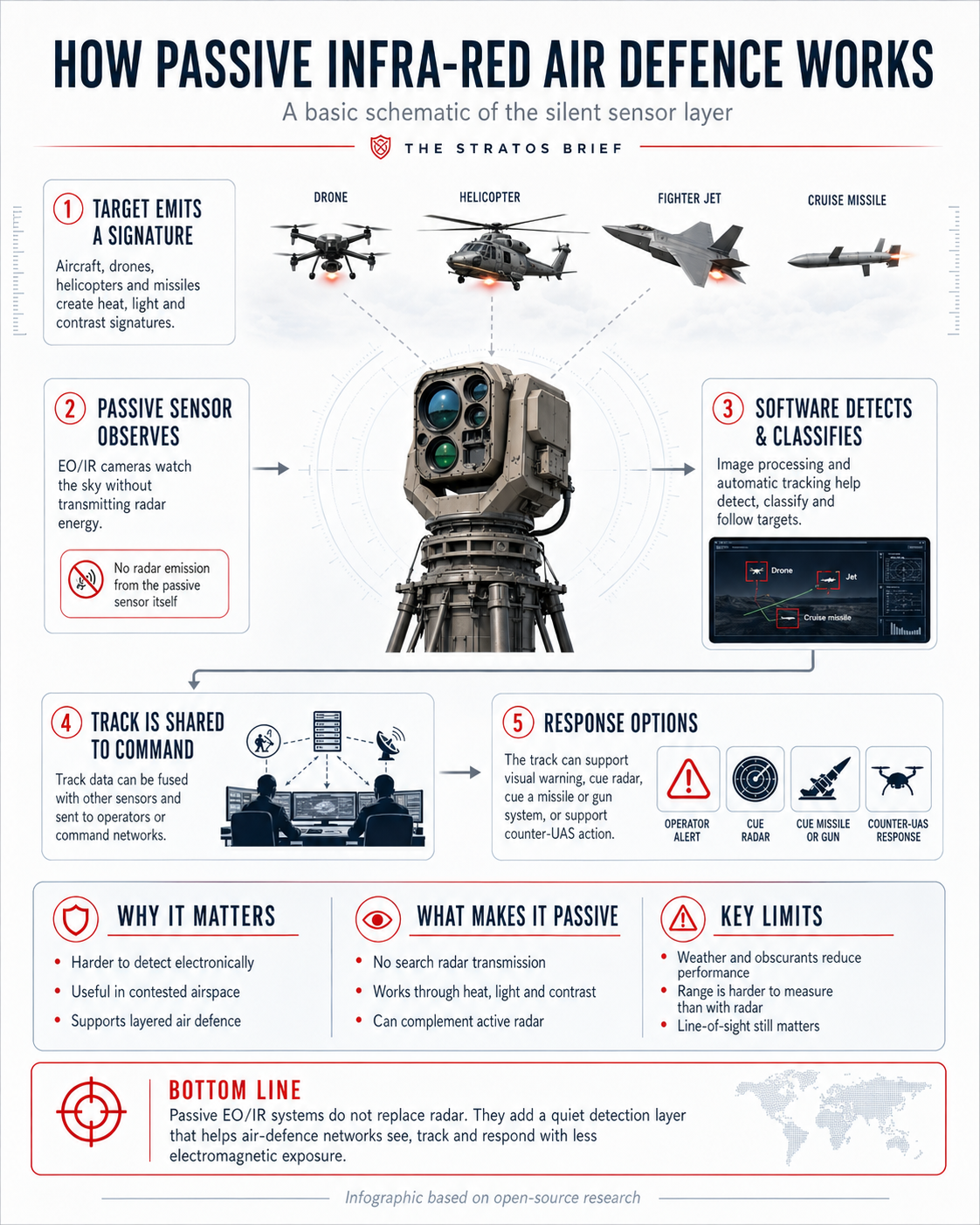
The central idea is simple: instead of transmitting radar energy and waiting for a return, passive systems observe energy that is already there. Aircraft engines, exhaust plumes, missile launches, drones, helicopters, cruise missiles and even aerodynamically heated airframes can create signatures that modern sensors may detect. The most relevant technologies include thermal cameras, mid-wave infra-red, long-wave infra-red, short-wave infra-red, visible-light sensors, automatic target tracking, image processing and AI-assisted classification.
In modern air defence, the most important sensor may not always be the one with the longest radar range. It may be the one the attacker does not know is watching.
What “passive” really means
The term passive can be misleading. It does not mean that the whole weapon system is invisible, nor that it is immune to countermeasures. It means that the sensor does not need to emit the signal used to detect the target.
A radar transmits. A passive electro-optical or infra-red sensor observes. That difference matters. A radar can be detected by electronic-support systems, geolocated, jammed, deceived, or attacked by anti-radiation weapons. A passive EO/IR sensor does not create the same radar-like electronic signature.
However, many real-world systems are hybrid. A short-range air-defence vehicle may combine radar, optical cameras, thermal imagers, laser rangefinders, radio communications and missile launchers. A launcher may use a passive sensor for tracking but receive target cueing from a radar elsewhere. A missile may use a passive imaging infra-red seeker in the terminal phase, even if the wider battery is part of a radar-based command network.
So the accurate point is not that passive systems are invisible. The accurate point is that the passive sensing layer can observe, track and sometimes support engagement without broadcasting its own radar signal.
The Stratos Brief Infographics
Why this matters now
Passive sensing is gaining importance for three reasons.
First, modern air-defence systems face a wider target set than before. Drones, cruise missiles, helicopters, glide bombs, loitering munitions and low-flying aircraft all stress traditional surveillance networks. Some of these targets are small, slow, low and cheap. Others are fast and low-observable.
Second, radars have become priority targets. Suppression and destruction of enemy air defences are built around finding, jamming and attacking the defender’s sensors. The more an air-defence network depends on a few large emitting radars, the more brittle it becomes.
Third, passive sensors are becoming smarter. Older optical systems depended heavily on human operators. Modern systems can automatically detect, track, classify and prioritise targets. Rafael’s Sky Spotter, for example, is marketed as a passive early-warning and air-surveillance system using MWIR, SWIR and day sensors, with image processing and AI to detect and manage multiple targets over tens of kilometres.
This is why the subject deserves attention beyond purely military audiences. Passive EO/IR is not just a sensor niche. It is part of a broader shift towards distributed, resilient and layered air defence.
The systems: not only a Western technology
It would be wrong to present passive infra-red air defence as a Western or Israeli speciality. The same logic is visible in Israel, Europe, NATO, the United States, Russia, China and Iran. The implementations differ, but the direction is similar: combine active radar with passive EO/IR, and use silent sensors to improve survivability, identification and short-range response.
Israel: Sky Spotter and the passive early-warning layer
Israel is one of the clearest public examples because Rafael openly markets Sky Spotter as a passive early-warning and air-surveillance system. It is designed to detect, track, classify and investigate aerial threats without operating as a conventional emitting radar. Rafael states that the system uses MWIR, SWIR and day sensors, and that AI-supported image processing allows simultaneous management of multiple targets.
This is strategically relevant because Israel already has a dense radar and missile-defence ecosystem. Sky Spotter’s role is not to replace systems such as Iron Dome or David’s Sling. Its role is to add a silent detection and classification layer that can complement radar, especially against drones, cruise missiles and low-signature targets.
Europe and NATO: from VSHORAD to passive surveillance initiatives
Europe has several strong examples.
France’s HGH Infrared Systems markets SPYNEL as a passive electro-optical infra-red search-and-track system for automatic detection, tracking and classification of aircraft, helicopters and drones. HGH specifically describes it as useful for ground-based air defence and VSHORAD, while remaining undetectable by the enemy.
Germany’s Rheinmetall offers FIRST, or Fast InfraRed Search and Track, a compact 360-degree infra-red scanning sensor for surveillance, detection and tracking. Rheinmetall’s Skyranger 30 documentation describes a system that monitors surrounding airspace with both active 3D AESA radar and passive infra-red sensors, showing the hybrid model now common in short-range air defence.
Italy’s Leonardo offers DSS-IRST for naval use. Leonardo describes it as a passive early-warning sensor with real 360-degree coverage, automatic detection and tracking of multiple targets, and relevance against sea-skimming missiles, surface threats and aerial targets. Its brochure also describes roles in silent navigation and EMCON missions, where a ship seeks to reduce its electromagnetic emissions.
European missile systems also matter. MBDA’s Mistral 3 is a very-short-range air-defence missile using an imaging infra-red seeker and advanced image processing, while Saab’s RBS 70 NG uses laser beam-riding guidance with thermal imaging, auto-tracking and day/night capability. These are not the same as wide-area passive surveillance systems, but they show how passive or difficult-to-jam sensing and guidance technologies are embedded in European VSHORAD.
NATO has also moved the topic into alliance-level work. In February 2025, NATO launched a multinational passive air-surveillance initiative aimed at lower-level air threats, including threats flying below 500 feet / 150 metres. NATO later listed the passive air-surveillance initiative as being established, with participation from multiple allies.
That matters because low-level threats are exactly where radar coverage, terrain masking, clutter and reaction time can become difficult.
United States: hybrid SHORAD, counter-UAS and mesh sensing
The United States does not publicly present one dominant ground-based passive infra-red air-defence system in the same way Rafael presents Sky Spotter, but the same principles are visible across US programmes.
The US Army’s M-SHORAD Increment 1 integrates sensor and shooter capabilities on a Stryker vehicle to defend manoeuvre units against Group 3 unmanned aircraft, fixed-wing aircraft and rotary-wing aircraft. Leonardo DRS describes the M-SHORAD mission equipment package as enabling units to detect, identify, track and defeat low-altitude threats.
L3Harris’ VAMPIRE is another example in the counter-UAS and low-flying-threat space. It combines electro-optical / infra-red sensing with a low-cost precision rocket solution and is designed for installation on different vehicles, vessels or fixed positions. L3Harris announced high-volume production of VAMPIRE counter-unmanned systems in March 2026, citing demand from the United States and allies against persistent drone threats.
At the conceptual level, CSIS has argued for “mesh sensing” in air and missile defence: distributed networks combining passive sensors with active radar to improve coverage, conserve radar resources and make the sensor architecture more resilient. Breaking Defense summarised the central logic directly: passive sensors such as EO, IR, acoustic and specialised RF sensors do not need to emit energy to find targets, making them harder for adversaries to find, track and target.
For the United States, then, the trend is less about one famous passive air-defence product and more about a wider architecture: distributed sensors, counter-drone systems, EO/IR targeting, networked SHORAD and passive sensing as a complement to radar.
Russia: Sosna, Pantsir and multispectral MANPADS
Russia has long invested in short-range air defence and has several relevant systems.
The Sosna short-range air-defence system is particularly important for this discussion because it is designed around passive optical / thermal detection and laser beam-riding missile guidance. European Defence Review described Sosna as not using radar on the launcher, making it passive and immune to anti-radar missiles, while target cueing can be provided by a command post located away from the launcher.
Pantsir is different because it is usually thought of as a radar-guided gun-missile system. But its fire-control system also includes an electro-optical channel with a long-wave thermal imager, infra-red direction finder, digital processing and automatic target tracking. Army Recognition describes Pantsir-S1 as capable of passive operation using its long-wave infra-red channel and automatic tracking.
Russia’s Verba MANPADS also belongs in the discussion. It is a man-portable air-defence system with a multispectral optical seeker using ultraviolet, near-infrared and mid-infrared channels. That improves discrimination between real targets and decoys compared with older single-band heat-seeking missiles.
The Russian case shows that passive infra-red air defence is not only about fixed sensors. It is also about missile seekers, optical fire-control channels and short-range systems designed to survive in a dense electronic-warfare environment.
China: hybrid SHORAD, EO/IR fire-control and passive missile seekers
China’s publicly visible systems also show the hybrid trend.
The FK-3000 counter-drone and short-range air-defence system combines radar with electro-optical and infra-red video cameras for target detection and tracking. The system is designed to counter drones, drone swarms and low-flying threats, with a large interceptor magazine in some configurations.
The Type 625E short-range air-defence system similarly combines search radar, tracking radar and an optoelectronic tracking system. Army Recognition describes the optoelectronic system as part of the detection and tracking chain against low-flying aircraft, drones, helicopters and cruise missiles.
China also has passive infra-red missile seekers in its MANPADS family. The FN-6 is described as a third-generation passive infra-red man-portable air-defence system, while the newer FN-16 uses an IR and UV dual-colour quasi-imaging seeker with anti-decoy capability.
China’s approach therefore appears similar to the wider global pattern: radar remains central, but EO/IR tracking and passive missile seekers are increasingly important inside layered short-range and counter-UAS systems.
Iran: Majid and the problem of open-source certainty
Iran is the most politically sensitive case because of recent claims and rumours.
The AD-08 Majid is a short-range, low-altitude Iranian air-defence system publicly associated with electro-optical target acquisition and passive imaging infra-red missile guidance. Open defence reporting describes Majid as having electro-optical acquisition, a detection range around 15 km, and missile engagement out to roughly 8 km with altitude coverage up to about 6 km.
Iranian state media also reported that Iran tested the Majid missile system in 2025 during air-defence exercises, with visual monitoring networks used for low-altitude drone attacks inside an integrated command-and-control network.
This makes Majid relevant to any discussion of passive EO/IR air defence. But relevance is not proof. There is no reliable open-source confirmation that Majid, or any other specific passive infra-red system, was responsible for the reported F-15E shootdown over Iran. The careful conclusion is this: Iran has systems in this general category, and such systems could complicate air operations at low altitude or short range, but the specific kill chain in the F-15E incident remains unconfirmed.
Why passive EO/IR complicates air operations
Passive EO/IR systems matter because they attack one of the attacker’s assumptions: that the defender must emit in order to see.
Against a radar-based network, an attacker can build tactics around detection of emissions. Electronic-support aircraft, radar-warning receivers, anti-radiation missiles, jamming, decoys and cyber-electromagnetic effects all aim to disrupt the defender’s active sensors. Passive sensors make that problem harder. They may still be located by other means, but they do not advertise themselves in the same way.
They also help with identification. Radar can generate a track, but an EO/IR system can sometimes help classify the object. That matters in crowded airspace, near civilian routes, around critical infrastructure, and in politically sensitive engagements where misidentification can have strategic consequences.
They are also relevant against low radar cross-section targets. Stealth shaping and radar-absorbent materials are built mainly around radar-frequency management. They do not eliminate heat. A fast aircraft still has engines, exhaust, skin heating and contrast against the background. A 2022 paper on IRST systems noted that infra-red search-and-track systems offer passive operation, resistance to jamming and long detection ranges under favourable conditions, while also pointing out the key limitation: unlike radar, they do not directly measure range.
This is why passive sensing is often best understood as a cueing and survivability layer. It may not give the whole fire-control solution alone, but it can tell the network where to look, when to activate radar, where to slew a launcher, or what target requires visual confirmation.
Why passive does not mean invincible
For objectivity, this point is essential. Passive EO/IR systems have serious limits.
Weather matters. Fog, rain, cloud, dust, smoke, haze and battlefield obscurants can reduce performance. Infra-red transmission depends on atmospheric conditions, target aspect, altitude, temperature contrast and background clutter.
Range is also complicated. A radar can measure distance directly. A single passive EO/IR sensor normally gives angle and image information, but not always precise range. Range can be estimated through triangulation, target motion analysis, laser rangefinding, comparison with known target size, or fusion with radar. But each method has limitations.
Field of view is another trade-off. Wide-area search requires broad coverage. Identification requires resolution. Tracking requires stability. A modern system therefore needs scanning, staring, automatic detection, target handover and data fusion.
Countermeasures still exist. Aircraft can use flares, signature reduction, tactics, route planning, altitude, weather, obscurants and directed infra-red countermeasures. Leonardo explains that traditional flares try to seduce heat-seeking missiles by presenting a brighter and hotter signature, while newer MANPADS seekers have become better at differentiating flares from sustained heat sources such as engines.
Modern aircraft also carry advanced self-protection systems. BAE Systems describes the F-15’s EPAWSS system as a digital electronic-warfare and survivability suite designed to improve situational awareness and protection in highly contested environments. This does not make an aircraft immune, especially against every possible infra-red or optically cued threat, but it does underline why specific shootdown claims should be treated carefully unless the engagement chain is known.
The real strategic lesson
The lesson is not that passive infra-red systems will make radars obsolete. They will not.
Radar remains essential for long-range surveillance, all-weather coverage, fire-control quality tracking and integration into national air-defence systems. Passive EO/IR is more limited by weather, range estimation and line of sight. It is not a miracle technology.
The real lesson is that air defence is becoming more sensor-diverse. The most resilient networks will not rely on one category of sensor. They will combine active radar, passive EO/IR, passive RF detection, acoustic sensing, visual observation, electronic intelligence, airborne sensors, space-based warning, command-and-control fusion and distributed shooters.
That is where passive infra-red becomes strategically important. It increases uncertainty for the attacker. It allows some surveillance without radar emissions. It helps preserve radar assets by letting them emit less often. It gives short-range systems better identification and tracking options. It creates ambush possibilities at low altitude. And it supports counter-UAS defence, where the cost and scale of the threat are forcing militaries to rethink how they detect and engage targets.
For political and business decision-makers, the key point is simple: air defence is not only about the missile. It is about the sensor chain that makes the missile useful.
Passive EO/IR sensors are part of that chain. They are less visible than launchers, less politically dramatic than fighter aircraft, and less familiar than radar. But in a contested electromagnetic environment, the silent layer may become one of the most valuable parts of the whole system.
Closing thought
The F-15E incident over Iran has created speculation, but open sources do not yet prove that a passive infra-red system was responsible. What the episode does highlight is a broader and more important trend.
Modern air defence is no longer only about who can shoot the farthest. It is increasingly about who can see, classify and cue weapons while remaining difficult to find.
In that environment, passive infra-red sensors are not a side topic. They are becoming part of the centre of gravity of modern air defence.