On 14 April 2026 at 1:30 pm CET, Airbus SE held its Annual General Meeting (AGM) at the Hotel Okura in the Netherlands' capital Amsterdam.

More than a formal shareholder meeting.

Airbus’s 2026 Annual General Meeting looked, on the surface, like what annual meetings usually look like: accounts approved, directors renewed, dividend endorsed and governance mandates extended. But the underlying documents point to something much more important. Airbus is no longer speaking like a company defending a post-crisis recovery. It is speaking like a company trying to industrialise growth, convert defence momentum into durable scale, and position itself as one of the very few European firms able to turn geopolitical instability into long-cycle industrial relevance.

The financial message: confidence, but not complacency.

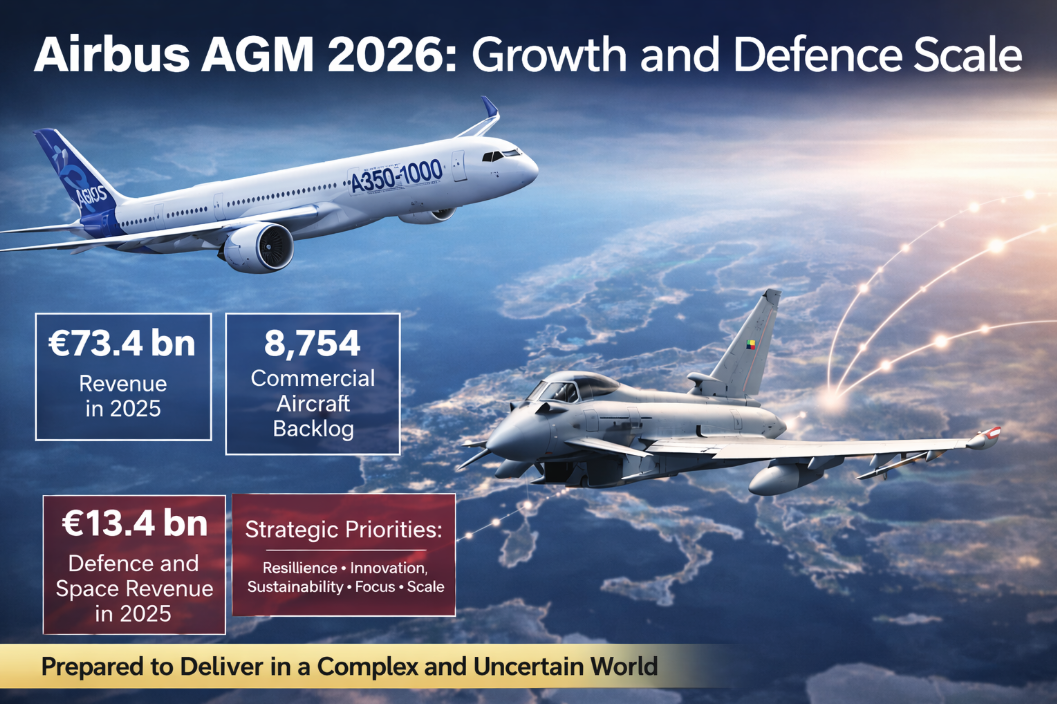
The financial backdrop was strong. Airbus reported 2025 revenues of €73.4 billion, EBIT Adjusted of €7.1 billion, net income of €5.2 billion, free cash flow of €4.8 billion, and 793 commercial aircraft deliveries. The AGM also approved a gross dividend of €3.20 per share, with shares trading ex-dividend from 21 April 2026, record date on 22 April 2026, and payment on 23 April 2026. Airbus also confirmed that it had widened its dividend policy payout range from 30–40% to 30–50%, with the proposed 2025 dividend corresponding to a 48% payout ratio.

That matters because Airbus was not merely telling shareholders that 2025 had gone well. It was showing that management believes the company now has enough confidence in future earnings and cash generation to raise shareholder returns while still funding the next stage of industrial and technological expansion. That is a more consequential signal than the dividend itself.

The real issue is not demand. It is execution.

Demand is clearly not Airbus’s immediate problem. At the end of 2025, Airbus had a commercial aircraft backlog of 8,754 units. Airbus Helicopters delivered 392 helicopters in 2025, while Airbus Defence and Space generated €13.4 billion in revenues. The company’s own strategic framing is built around five priorities: resilience, innovation, sustainability, focus and scale. That is not marketing language. It is a diagnosis of the environment Airbus believes it is operating in: strong demand, persistent supply chain pressure, geopolitical volatility and a growing premium on companies that can deliver at volume without losing control of margins, schedules or future investment.

This is why the AGM should be read primarily as an industrial signal. Airbus is emphasising resilience not as a generic corporate virtue, but as a production doctrine: de-risk the supply chain, broaden the profit base, and gain tighter control over critical industrial assets. The acquisition of selected Spirit AeroSystems businesses, the opening of additional A320 final assembly capacity in both China and the United States, and the continuing effort to strengthen lifecycle and services activities all fit that pattern. Airbus is effectively saying that the central bottleneck is no longer market appetite. It is the ability to convert backlog into output, and output into cash, without margin erosion.

Why the board changes matter.

The governance changes approved at the AGM reinforce that industrial reading. Shareholders renewed Mark Dunkerley, Stephan Gemkow and Antony Wood for three-year terms, and approved Henriette Hallberg Thygesen for a three-year term and Oliver Zipse for a one-year term, replacing Prof Dr Feiyu Xu and Victor Chu respectively. Airbus’s own explanatory material makes clear why those additions matter: Thygesen brings senior experience from Terma and Maersk, while Zipse brings deep large-scale manufacturing and industrial transformation experience from BMW.

This is not a cosmetic refresh. It is a board increasingly shaped around defence, supply chain complexity, manufacturing depth, digital transformation and industrial execution. Airbus appears to be aligning governance with the exact areas that will determine whether its next phase succeeds or stalls.

The defence signal is even stronger.

The deeper strategic message of the AGM lies in defence and European industrial policy. Airbus’s 2025 Board Report explicitly ties its outlook to a harsher geopolitical environment, to NATO’s long-term defence spending commitments, and to the European Commission’s proposed €800 billion “Readiness 2030” plan. Airbus is not presenting itself merely as a passive beneficiary of rising defence budgets. It is presenting itself as a platform for European strategic consolidation across air power, defence aerospace and space.

That reading is reinforced by the company’s emphasis on programmes and capability areas such as FCAS, Eurodrone, A330 MRTT / MRTT+, Eurofighter, tactical and maritime UAS, crewed-uncrewed teaming in helicopters, and the memorandum with Leonardo and Thales aimed at combining selected space activities into a new company expected to become operational in 2027, subject to approvals. Airbus is not simply trying to sell more systems. It is trying to embed itself more deeply in the architecture of European sovereignty.

What this means for business leaders.

For business leaders, Airbus offers a clear lesson. In post-2020 aerospace and defence, the winners may not be the firms with the boldest concepts, but the firms that can keep supply chains functioning, maintain schedule discipline, ramp production under pressure, and still invest in the next generation of products. For suppliers, reliability is becoming a strategic differentiator, not an administrative requirement. For competitors, Airbus is signalling that it intends to defend today’s franchise while funding tomorrow’s at the same time. For investors, the central question is not whether Airbus has demand. It is whether it can industrialise that demand faster than complexity destroys returns.

What this means for political leaders.

For political leaders, the message is sharper. Airbus’s own documents make clear that Europe’s problem is no longer simply whether it has engineering talent or flagship defence programmes. The real problem is fragmentation, insufficient scale and limited industrial cohesion. Airbus is openly arguing for a more integrated European defence and space base, including stronger cross-border industrial structures and coordinated procurement logic. In practical terms, policymakers who speak about “strategic autonomy” will increasingly have to decide whether they are willing to support the consolidation, capital intensity and long-term programme discipline that autonomy actually requires. Airbus has placed that question squarely on the table.

What this means for military leaders.

For military leaders, the takeaway is equally practical. Airbus’s product and strategy documents point toward a future force model built around connected, multi-domain and increasingly crewed-uncrewed operations. But the same documents also underline a harder truth: capability is meaningless without availability. If Europe is serious about readiness, then it needs more than brochures and declarations. It needs dependable production, sustainment depth, upgrade paths, support contracts, parts availability and industrial endurance. Airbus is building its argument from the factory outward, and commanders as well as procurement officials should take that seriously. In the coming decade, force credibility will depend not only on platform performance, but on industrial stamina.

The vote itself: strong backing for management.

The voting results show how much room Airbus has been given to proceed. All fifteen resolutions passed, with about 74.8% of voting rights represented. The dividend resolution passed with 99.98% of votes cast in favour. The appointment of Oliver Zipse passed with 99.99% support, and Henriette Hallberg Thygesen also received very strong backing at 99.72%. The advisory vote on remuneration still passed comfortably, though with lower support at 96.50%, making it one of the few items where shareholders signalled at least some measurable reserve.

That does not mean Airbus is risk-free. It means shareholders are, for now, willing to back management’s wider argument: that Airbus has earned permission to push harder on output, defence relevance and shareholder returns at the same time.

The real conclusion:

Airbus AGM 2026 was not really about approval. It was about permission.

Permission from shareholders to keep converting a strong order book, a more favourable defence environment and a more fractured geopolitical landscape into something much harder to build than optimism: durable industrial power. Airbus is not behaving like a company waiting for the world to stabilise. It is behaving like a company that has concluded instability may be the new normal, and that the winners in that world will be those with scale, discipline and enough industrial depth to keep moving anyway.

Sources
Airbus SE, 2026 AGM Convening Notice.
Airbus SE, 2026 AGM Information Notice.
Airbus SE, Extract of the Minutes of the Annual General Meeting held on 14 April 2026.
Airbus SE, CEO Presentation – 2026 Annual General Meeting.
Airbus SE, 2025 Report of the Board of Directors.
Airbus SE, 2025 Financial Statements.
Airbus SE, 2026 AGM Declaration of Dividends.
Airbus SE, Voting Results – AGM 2026.Airbus Annual General Meeting 2026: The Real Message Was About Scale, Not Ceremony.
Previous
Previous
Rassvet and Russia’s Sovereign Space Internet
Next
Next