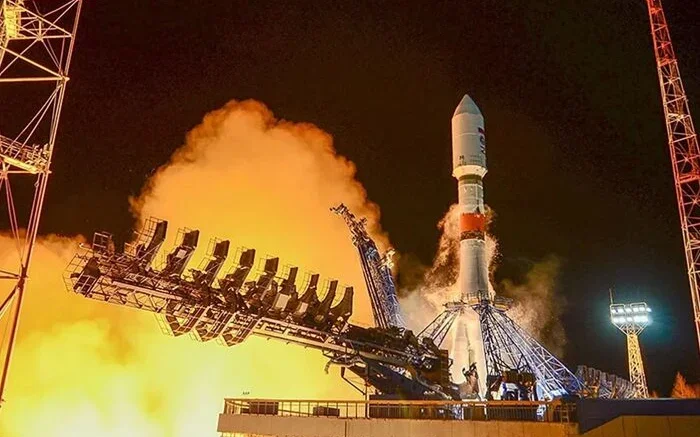
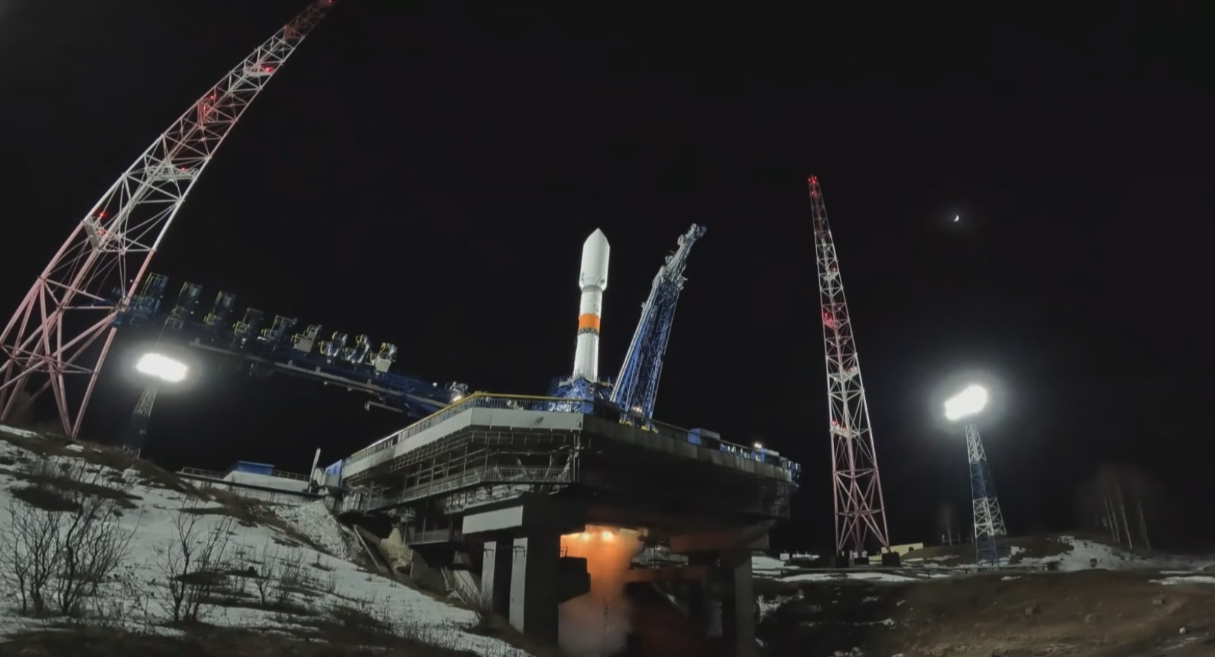
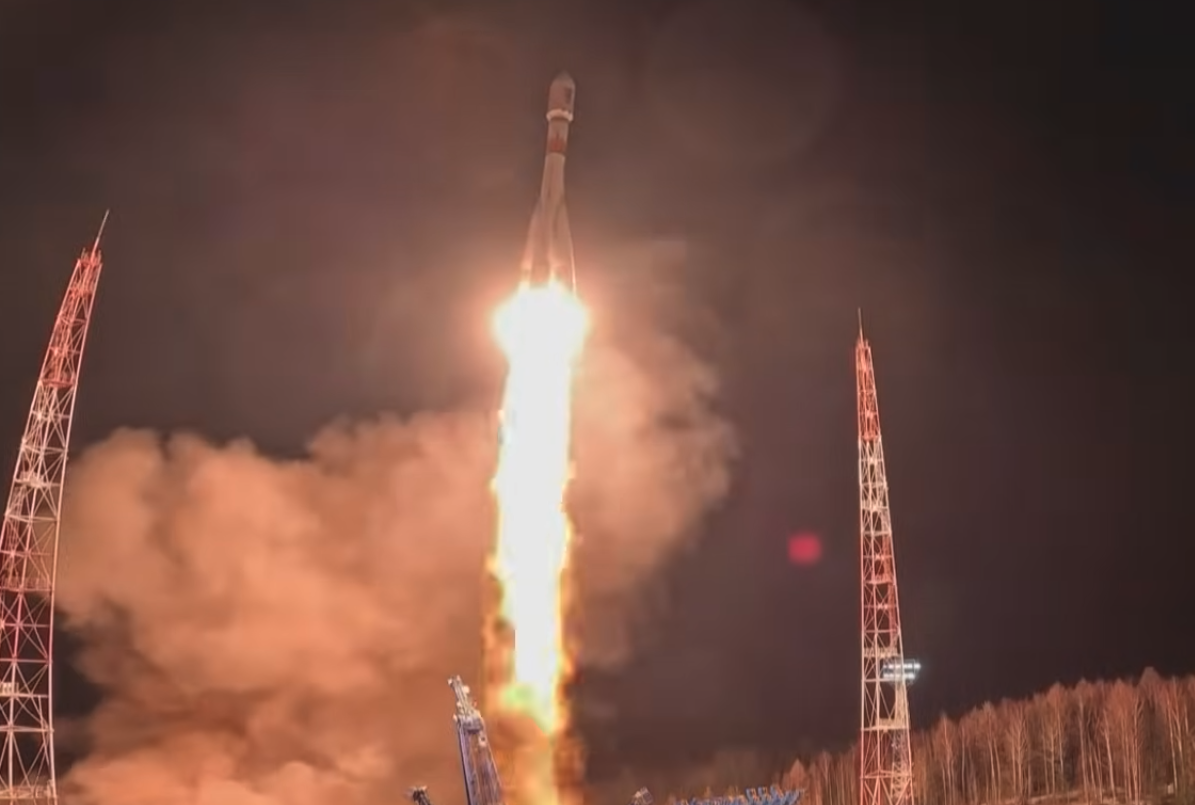
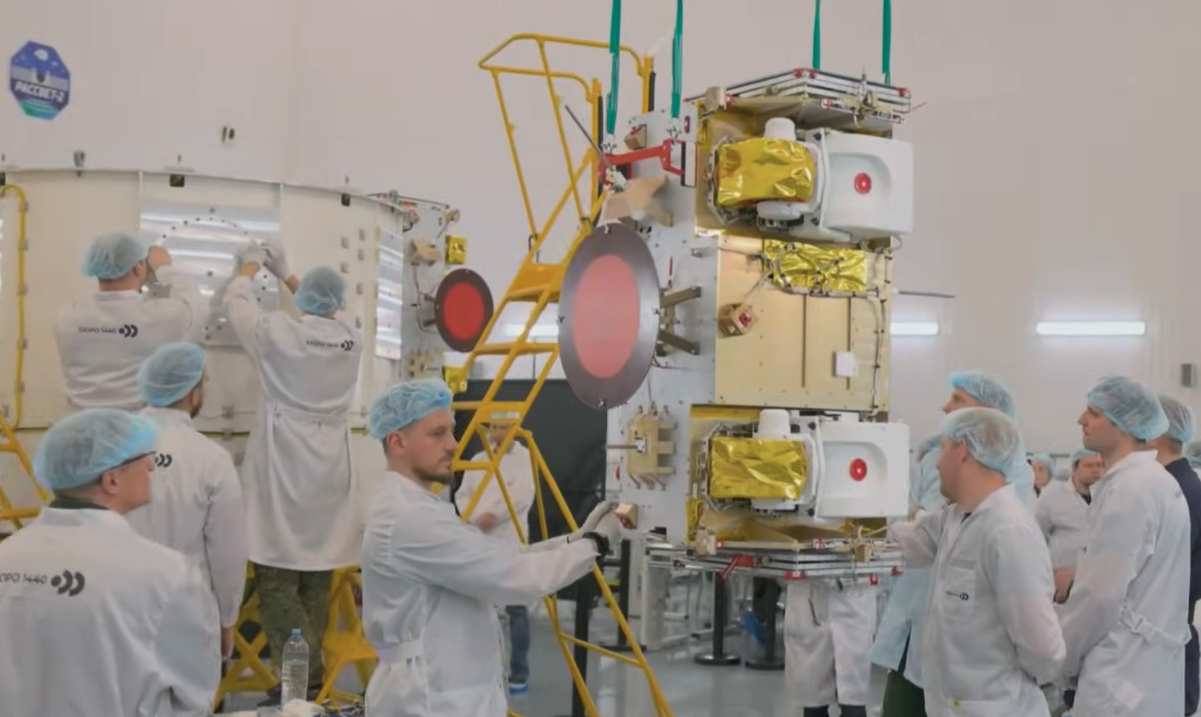
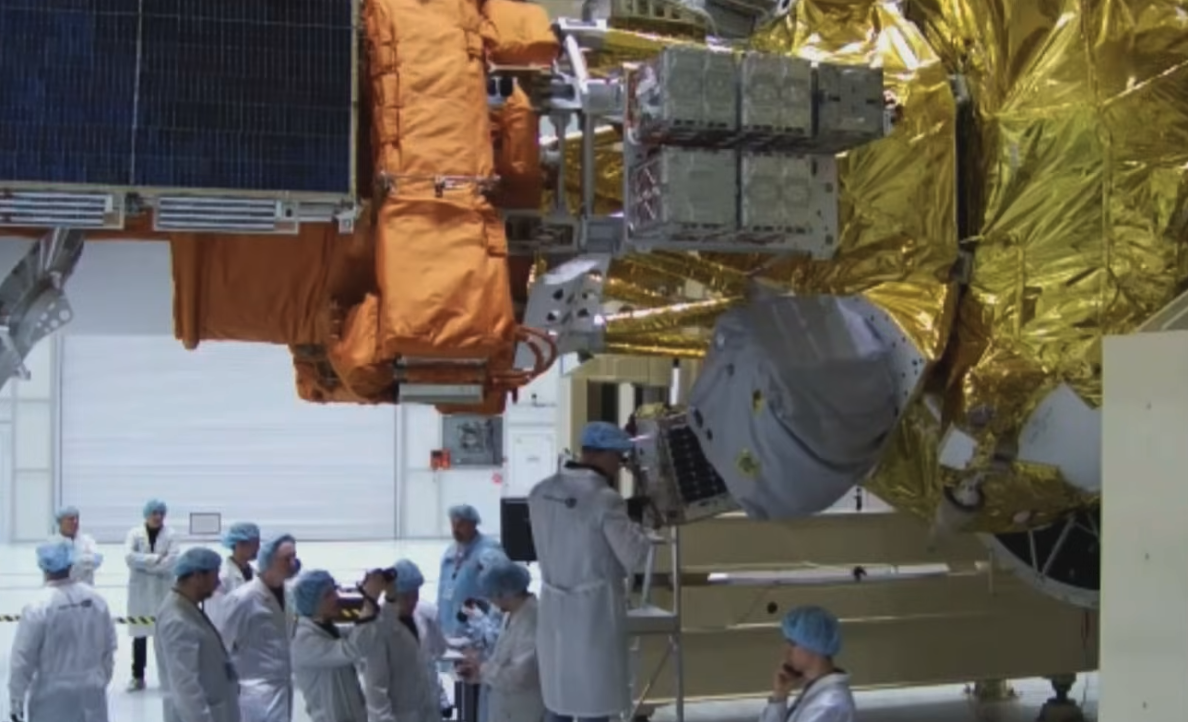
On 23 March 2026, a Soyuz-2.1b lifted off from the Plesetsk Cosmodrome carrying the first 16 operational satellites of Bureau 1440’s Rassvet constellation. With that launch, Russia’s long-discussed answer to Starlink moved from prototype work into early deployment. That makes this the right moment to look at Rassvet for what it is: not yet a Russian Starlink in scale, but already a serious attempt to build a sovereign low-orbit communications layer with clear civilian, strategic and military relevance.

What Rassvet actually is

Rassvet is being developed by Bureau 1440, a Russian aerospace company founded in 2020 inside X Holding. The company’s public architecture describes a low-Earth-orbit network built around satellites at roughly 800 km altitude, user terminals for fixed and mobile platforms, gateway stations, and laser inter-satellite links. Bureau 1440 says the system is designed to deliver up to 1 Gbit/s with latency under 70 ms, and that its satellites act as 5G NTN base stations in orbit. The company also explicitly markets the network for cars, ships, aircraft and trains, which is a useful clue: Rassvet is being framed from the outset not just as rural broadband, but as a mobility and infrastructure network.

The technical path to that March 2026 launch was not built overnight. Bureau 1440’s own timeline shows two experimental missions before the first operational batch: Rassvet-1 in June 2023 and Rassvet-2 in May 2024. It also says the company achieved its first 5G NTN user-terminal session in June 2024 and tested laser inter-satellite links at 10 Gbit/s in May 2024. In other words, the project has already moved through several of the key enabling technologies that matter for a modern low-orbit broadband network: orbital communications, user terminals, laser links and manufacturing preparation.

That matters because Rassvet is not being presented as a traditional geostationary satcom replacement. It is being built as a low-latency, mobile-capable, software-defined communications layer that can serve public networks, transport systems, remote sites and, potentially, government users who want more control than foreign systems can offer. That is a much more consequential ambition than simply “internet for villages.”

What is Russia trying to build?

The official ambition is large by Russian standards, even if still modest by Starlink standards. Roscosmos chief Dmitry Bakanov said in January 2026 that serial production of a Russian Starlink-like terminal would begin that year and that more than 300 satellites would be deployed by 2027. Russian business reporting tied to the national Data Economy project says the Rassvet program is backed by roughly 102.8 billion rubles (1,37 billion USD) of federal funding plus 329 billion rubles (4,38 billion USD) of company funding through 2030. Separate reporting based on the State Commission on Radio Frequencies’ protocol indicates a broader plan toward 383 satellites by 2030, with operation beginning in 2027. The Russian government’s 2035 telecom strategy also explicitly calls for a low-orbit constellation able to provide broadband internet and even mobile-phone emergency messaging in areas with weak or no terrestrial coverage.

But the March 2026 launch also exposed the project’s most important weakness: deployment pace. The first batch had originally been expected in late 2025 and slipped into 2026, with reporting pointing to incomplete assembly of the required spacecraft. Bureau 1440’s own statement after the March launch acknowledged that the next phase will require dozens of launches and a sharp increase in the number of spacecraft on orbit. In plain terms, Russia has now proven it can begin the rollout; it has not yet proven that it can sustain the industrial rhythm needed to build a resilient constellation at scale.

That distinction is central. A single successful batch launch is a milestone. A credible low-orbit internet system requires something harder: repeatable satellite production, repeatable launch cadence, ground infrastructure, terminals, software integration and ongoing replenishment. March 2026 answered the first question. It did not answer the second.

Rassvet is only part of the story

One analytical mistake would be to treat Rassvet as the entire Russian answer to Western space internet. In reality, Moscow appears to be moving toward a layered connectivity architecture.

Alongside Rassvet, Russia is also advancing Skif, a separate broadband constellation under the Sfera framework. TASS reported that the first pair of operational Skif satellites was planned as the start of deployment, while a Roscosmos-based April 2026 release said additional contracts had been signed for more spacecraft and that the first stage of the Skif system would include six satellites, with twelve as the full system. Skif is designed for broadband access over Russia and neighboring regions from a much higher orbit than Rassvet.

Russia is also pushing Express-RV, a highly elliptical system aimed at Arctic coverage. Roscosmos has said the first Express-RV launch is scheduled for late 2026, and Bakanov explicitly linked the system to stable communications for unmanned aerial vehicles in the Arctic. That is a very important point. It suggests that Russia is not just trying to replicate Starlink one-for-one; it is trying to combine multiple orbital layers to solve different national problems, especially sovereignty, Arctic coverage and UAV control.

The better analytical frame, then, is this: Rassvet is the spearhead of Russia’s low-orbit communications push, but not the whole architecture. The broader objective looks closer to a sovereign, state-aligned connectivity stack than to a pure commercial clone of SpaceX.

Civilian impact: more than remote internet

On the civilian side, Bureau 1440’s own market positioning is unusually revealing. The company is targeting aviation, shipping, railways, land mobility, regional government, emergency services, healthcare, mining and remote industrial operations. It also says the system can back up terrestrial base stations when wired channels fail and support passenger connectivity in flight, at sea and along rail routes. This is not just a consumer internet proposition. It is a platform for resilience, mobility and remote operations in a country where geography is a structural problem.

If even part of that vision is realized, the civilian implications are significant. It would improve communications redundancy in remote industrial sites, expand options for aviation and maritime connectivity, strengthen digital services in isolated regions, and give Russian transport and public-sector operators a domestically controlled alternative for critical links. The Arctic and the Northern Sea Route matter especially here, because they combine sparse terrestrial infrastructure with rising economic and strategic importance.

The caveat is equally important: none of this becomes strategically transformative at 16 satellites. Civilian impact at scale depends on whether Russia can move from demonstration to routine service delivery, and whether terminals and bandwidth become affordable enough for widespread use. Open sources show meaningful progress, but not yet a mature mass-market network.

Military impact: what changes, and what does not

The most sober military reading is this: Rassvet does not yet give Russia a Starlink-class battlefield capability, but it could materially improve Russian military resilience if deployment continues. That is because the value of low-orbit communications in war is no longer theoretical. Starlink’s role in Ukraine made that unmistakable, and Reuters reported in February 2026 that unauthorized Starlink terminals used by Russian forces were deactivated, disrupting Russian battlefield communications. That episode highlighted Moscow’s vulnerability when it relies on foreign or illicitly obtained systems for combat connectivity.

Russian official statements leave little doubt that Moscow sees low-orbit networks as relevant to military and dual-use tasks. Putin ordered additional financing for low-Earth-orbit communication and navigation groups needed for UAV control and monitoring. Bakanov has said the Rassvet project will be Russia’s answer to Starlink and that it should improve GLONASS accuracy for UAV control to 2.5 meters, with later discussion pointing to the possibility of still better combined performance. Separately, Express-RV has been publicly tied to stable UAV communications in the Arctic.

What does that mean in practice? If Russia can scale Rassvet and connect it effectively with navigation, UAV and relay systems, the likely benefits are better beyond-line-of-sight communications, more resilient drone control, greater redundancy against terrestrial disruption, and more sovereign control over mission-critical data flows. That does not automatically produce a “Russian Starshield.” Open sources still show early deployment, not a mature, battle-proven warfighting layer. But they do show the foundations of a more robust military communications ecosystem than Russia had before.

Advantages and disadvantages versus other systems

Compared with Starlink, Rassvet’s main advantage is not scale. It is sovereign control. Russia can shape access, regulation, integration with public networks, and military-government interfaces without depending on a foreign commercial actor. For a state that increasingly treats communications as strategic infrastructure, that is an advantage in itself. Rassvet is also being built around 5G NTN and laser inter-satellite links from the start of operational deployment.

Its disadvantages versus Starlink are straightforward. Starlink already serves more than 6 million users, reports typical land latency of 25–60 ms, and continues to add capacity at a global industrial cadence. By contrast, Rassvet publicly claims up to 1 Gbit/s and under 70 ms latency, but is only at the beginning of deployment and has already shown schedule slippage. In other words, Rassvet may end up strategically useful long before it is commercially comparable to Starlink.

Compared with OneWeb, Rassvet may eventually look closer in role than it does to Starlink. Eutelsat’s OneWeb constellation already has 600+ satellites at 1,200 km and is oriented toward high-speed, low-latency connectivity for fixed and mobile use cases worldwide. Rassvet is smaller, lower and not yet operational at scale, but the eventual market logic may be more similar: a system serving enterprise, mobility, state and remote-area demand rather than simply chasing mass consumer dominance.

Compared with Project Kuiper, the gap is mostly industrial and financial scale. Amazon’s FCC-approved first-generation constellation is 3,236 satellites, far beyond Rassvet’s currently disclosed end-state. Russia’s program is more constrained, but also more narrowly national in purpose. That may prove to be a weakness in global commercial competition and a strength in domestic strategic focus.

Bottom line

The most accurate conclusion today is not that Russia has built its own Starlink. It has not. The accurate conclusion is that Russia has moved beyond presentations and prototypes and has begun deploying a sovereign low-orbit communications system that could become strategically meaningful even if it never matches Starlink in scale. The March 2026 launch matters because it marks the transition from concept to infrastructure. The remaining question is industrial: can Russia repeat this often enough, cheaply enough and reliably enough to turn Rassvet from an impressive first batch into a functioning national system.

Why this matters for business, military and political leaders

For business leaders

Rassvet is a potential new layer of connectivity for aviation, shipping, rail, remote industry, mining, public services and infrastructure backup, which means it could reshape the economics of operating in hard-to-connect regions of Russia and adjacent markets.
It signals that Russia is trying to build not only satellites, but a nationally controlled digital backbone for transport, logistics and industrial data flows. That matters for market access, partnerships, risk and sanctions-era operating assumptions.

For military leaders

Even a smaller sovereign LEO network could improve beyond-line-of-sight communications, UAV control, navigation support and resilience against terrestrial disruption, especially when combined with systems like Express-RV and GLONASS upgrades.
The project also reflects a lesson learned from the war in Ukraine: dependence on foreign-controlled or illicitly accessed connectivity is a strategic vulnerability.

For political leaders

Rassvet is ultimately a technological sovereignty project. It is about who controls critical communications, who can deny access, and how much strategic autonomy a state retains in crisis or conflict.
It also matters for Arctic policy, regional development and national resilience, because communications infrastructure is no longer just an economic utility; it is part of state capacity.
Sources
TASS — “Russia puts 16 Rassvet constellation satellites into low orbit,” 24 March 2026.
Next Spaceflight — “16 x Rassvet-3 | Soyuz 2.1b,” launch record for 23 March 2026.
Bureau 1440 — official company site and technical overview of the Rassvet system.
TASS — “Three satellites of Rassvet-2 mission successfully orbited — Bureau 1440,” 21 May 2024.
TASS — “Russian analog of Starlink to begin serial production in 2026 — Roscosmos CEO,” 17 January 2026.
TASS — “Russia to start deploying low-orbit satellite cluster in December, says Roscosmos chief,” 23 October 2025.
The Moscow Times — “Russia Delays Launch of First Batch of Starlink Rival Satellites,” 23 January 2026.
TASS — “Russia to set up low-orbit satellite constellation for internet access by 2030,” 4 December 2023.
TASS — “Russia may begin exporting communication services to other countries by 2035,” 15 August 2023.
TASS — “Putin requests allocation of extra funds for development of satellites for drone control,” 21 March 2025.
TASS — “Satellites for drones control in the Arctic to be launched in 2026,” 9 June 2026.
Roscosmos / AK&M — “The Roscosmos enterprise will produce four more Skif communications satellites for the Sphere project,” 6 April 2026.
TASS — “Roscosmos faces grandiose task to start serial production of satellites — CEO,” 27 October 2023.
Reuters — “Ukraine says Starlink terminals used by Russia deactivated in blow to Moscow,” 5 February 2026.
Starlink — official network update and service specifications.
Eutelsat OneWeb — official overview of the OneWeb LEO constellation.