Week in the World of Business Jets: Strong Backlogs Meet a Harder Operating Environment

Embraer Praetor 600E. Photo by Embraer.
Date published: 6 May 2026
Event window: 29 April–6 May 2026
Event location / region: Global business aviation market
Event type: Weekly business aviation brief / OEM results, aircraft deliveries, certification and operating-cost pressure
The business jet market entered May with a familiar but increasingly important contrast. On the demand side, the leading manufacturers continue to report strong order books, resilient services revenue and active fleet customers. On the operating side, however, the sector is being tested by higher fuel costs, supply-chain pressure and geopolitical disruption.
The past week did not suggest a sudden weakening of business aviation. If anything, the signals from Bombardier, Gulfstream, Textron Aviation and Embraer point to a market that remains fundamentally healthy. But it also showed that the strongest companies in this cycle will not simply be those with attractive aircraft. They will be those with production discipline, aftermarket depth, fuel resilience and the ability to serve large fleet operators at scale.
Bombardier and Gulfstream point to resilient high-end demand
Bombardier’s first-quarter results were the clearest signal that large-cabin and super-midsize demand remains solid. The Canadian manufacturer reported revenue of $1.6 billion, generated $360 million in free cash flow, and raised its full-year 2026 free-cash-flow guidance to more than $1 billion. Reuters also reported that Bombardier delivered 24 aircraft in the quarter and maintained its plan to deliver more than 157 jets in 2026. The company’s large-cabin Global jet usage rose by 8% year-on-year in the quarter, underlining that existing aircraft utilisation remains a demand driver for both new aircraft and services.
The most strategically important part of Bombardier’s result may not be the delivery number itself, but the composition of its performance. Services revenue reached $617 million, up sharply from the previous year, while the company continued to benefit from new orders linked to the recently certified Global 8000. This is important because the aftermarket is becoming a stabilising pillar for business jet manufacturers. Even when production is constrained by suppliers, active aircraft fleets still create demand for maintenance, upgrades, parts and modifications.
Gulfstream showed a similar pattern at the upper end of the market. General Dynamics’ Aerospace segment, which includes Gulfstream and Jet Aviation, reported first-quarter revenue growth of 8.4% to $3.3 billion. Gulfstream delivered 38 aircraft in the quarter, including 31 large-cabin jets and seven mid-cabin aircraft. Corporate Jet Investor reported that Gulfstream ended the quarter with a $22.26 billion backlog and a 1.2x book-to-bill ratio, indicating that orders continued to outpace deliveries.
The caveat is that the market is not isolated from geopolitics. Reuters reported that General Dynamics’ aerospace revenue was supported by stronger Gulfstream output and services demand, but also noted management comments that some transactions slowed near the end of the quarter because of the conflict in the Middle East. For Gulfstream, this matters not only because of customer sentiment, but also because the G280 and future G300 involve Israeli industrial participation, adding another potential exposure point if regional disruption persists.

Gulfstream G650. Photo by Pexels.
NetJets brings the Citation Ascend into fleet service
The most important fleet-development story of the week came from Textron Aviation, which delivered the first three Cessna Citation Ascend midsize business jets to NetJets. NetJets is the fleet launch customer and, according to Textron, the first private fleet operator to take delivery and begin operations with the aircraft.
This is more than a standard delivery announcement. NetJets is not a small symbolic customer; it is one of the most influential fleet operators in private aviation. When an aircraft enters NetJets service, it is exposed to a demanding operating environment: high utilisation, diverse missions, intensive maintenance planning and a customer base that expects reliability as much as cabin comfort.
The Citation Ascend therefore enters the market with a practical validation channel. The aircraft offers a flat-floor cabin, seating for eight passengers, Garmin G5000 avionics with autothrottles, Pratt & Whitney Canada PW545D engines and a four-passenger range of 1,940 nautical miles. Textron also emphasised its global support infrastructure, including company-owned service centres, authorised service facilities, mobile service units and AOG support.
For the wider market, the Ascend highlights the continuing importance of the midsize segment. The ultra-long-range jets dominate the financial headlines, but midsize aircraft remain central to fractional, corporate and owner-operator networks. They are often the aircraft that make private aviation scalable rather than purely symbolic.

NetJets Cessna Citation Ascend. Photo by Cessna.

NetJets Cessna Citation Ascend Cabin. Photo by Cessna.
Embraer strengthens the Praetor family with 600E certification
Embraer’s most important business jet update was the triple certification of the Praetor 600E by Brazil’s ANAC, the FAA and EASA. The aircraft was unveiled earlier in 2026 alongside the Praetor 500E as the first evolution of the Praetor family, and the certification confirms that the 600E is ready for global operations across the main regulatory markets.
The Praetor 600E is not a clean-sheet aircraft, but it is a strategically relevant update. Its value lies in how Embraer is sharpening the aircraft’s cabin, digital and passenger-experience proposition while preserving the range and performance profile that already made the Praetor 600 competitive in the super-midsize category.
Embraer lists an intercontinental range of 4,018 nautical miles with four passengers and NBAA IFR reserves, enabling missions such as London–New York and São Paulo–Miami. The update introduces a redesigned cabin, a new cabin management system and the optional 42-inch 4K OLED Smart Window, which can support external camera views, entertainment and productivity functions.
The timing also matters. Embraer says the Praetor 500E is expected to receive triple certification by the end of 2026, with deliveries for new orders of both aircraft planned to begin in 2029. This gives Embraer a clear upgrade pathway in the midsize and super-midsize markets at a time when buyers are increasingly comparing not only range and speed, but also cabin usability, connectivity and onboard work environment.






Fuel disruption becomes a business aviation issue, not only an airline problem
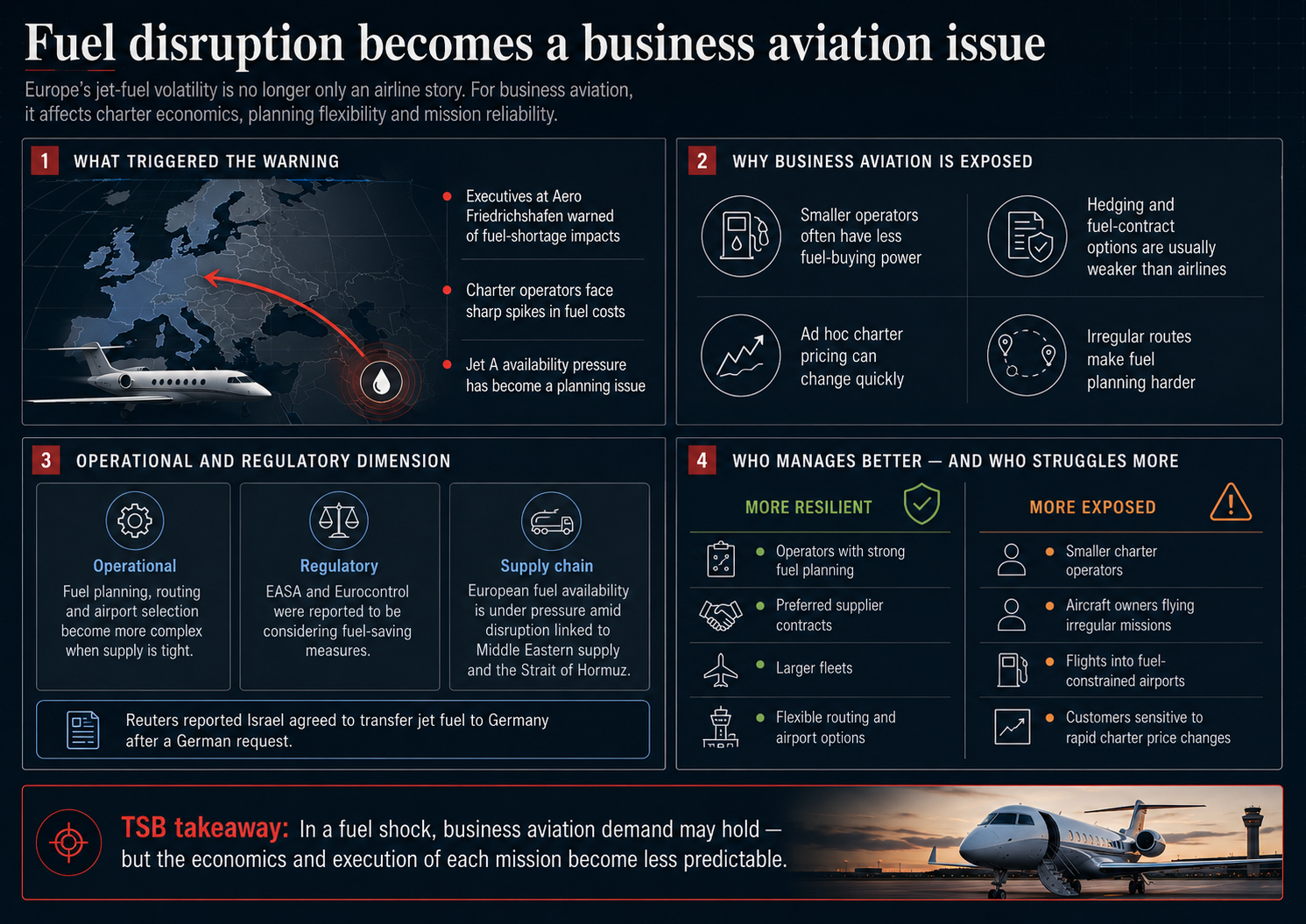
The operational warning of the week came from Europe’s fuel environment. AIN reported that business aviation executives at Aero Friedrichshafen were discussing the potential impact of fuel shortages, with charter operators facing sharp spikes in fuel costs.
This is significant because business aviation is structurally more exposed to fuel volatility than some observers assume. Charter operators may be able to pass on part of the cost, but not always quickly or cleanly. Smaller operators may lack the purchasing power, hedging structures or fuel-contract sophistication of major airlines. For ad hoc charter customers, volatile fuel pricing can quickly change the economics of a mission.
The situation also has a regulatory and operational dimension. AIN reported that EASA and Eurocontrol were considering measures to save aircraft fuel, while suppliers such as Air bp were working to maintain Jet A availability at European airports amid disruptions linked to Middle Eastern supply and the closure of the Strait of Hormuz. Reuters separately reported that Israel agreed to transfer jet fuel to Germany after Berlin requested assistance, while Germany’s economy ministry said it did not currently face a physical energy shortage but was monitoring aviation-industry impacts.
For business aviation, the immediate impact is likely to be uneven. Operators with strong fuel planning, preferred supplier contracts, larger fleets and flexible routing will manage the shock better. Smaller charter operators, aircraft owners using irregular routes, and missions into fuel-constrained airports may face higher costs and more complicated planning.
The week’s signal: demand is intact, but execution risk is rising
Taken together, the week’s five main developments point to a business jet market that remains strong but is becoming more selective.
Bombardier and Gulfstream show that large-cabin demand, aftermarket revenue and backlog strength remain robust. NetJets’ first Citation Ascend deliveries show that fleet operators are still renewing and expanding capacity. Embraer’s Praetor 600E certification shows that the super-midsize competition is moving toward cabin experience, connectivity and productivity, not only range. But the European fuel disruption is a reminder that the operating environment can change faster than the order book.
The key question for the rest of 2026 is therefore not simply whether wealthy individuals and corporations still want business jets. The stronger question is whether manufacturers and operators can convert that demand into reliable deliveries, predictable costs and stable utilisation in a more volatile geopolitical and energy environment.
For now, the answer appears cautiously positive. The demand is there. The fleets are flying. The backlogs are strong. But the easy part of the post-pandemic rebound is over. The next phase will reward discipline more than momentum.
List of sources
Reuters — Bombardier Q1 2026 results and business jet demand update.
Reuters — General Dynamics / Gulfstream Q1 2026 results.
Corporate Jet Investor — Gulfstream Q1 2026 aerospace revenue, deliveries and backlog.
Textron Aviation — NetJets delivery of first three Cessna Citation Ascend aircraft.
Embraer — Praetor 600E triple certification by ANAC, FAA and EASA.
AIN — Business aviation fuel crisis discussion and European fuel-supply pressure.
Reuters — Israel/Germany jet fuel transfer following Strait of Hormuz disruption.