Brazil’s C-390 Breaks Into the Gulf: Why the UAE Deal Matters Beyond 10 Aircraft
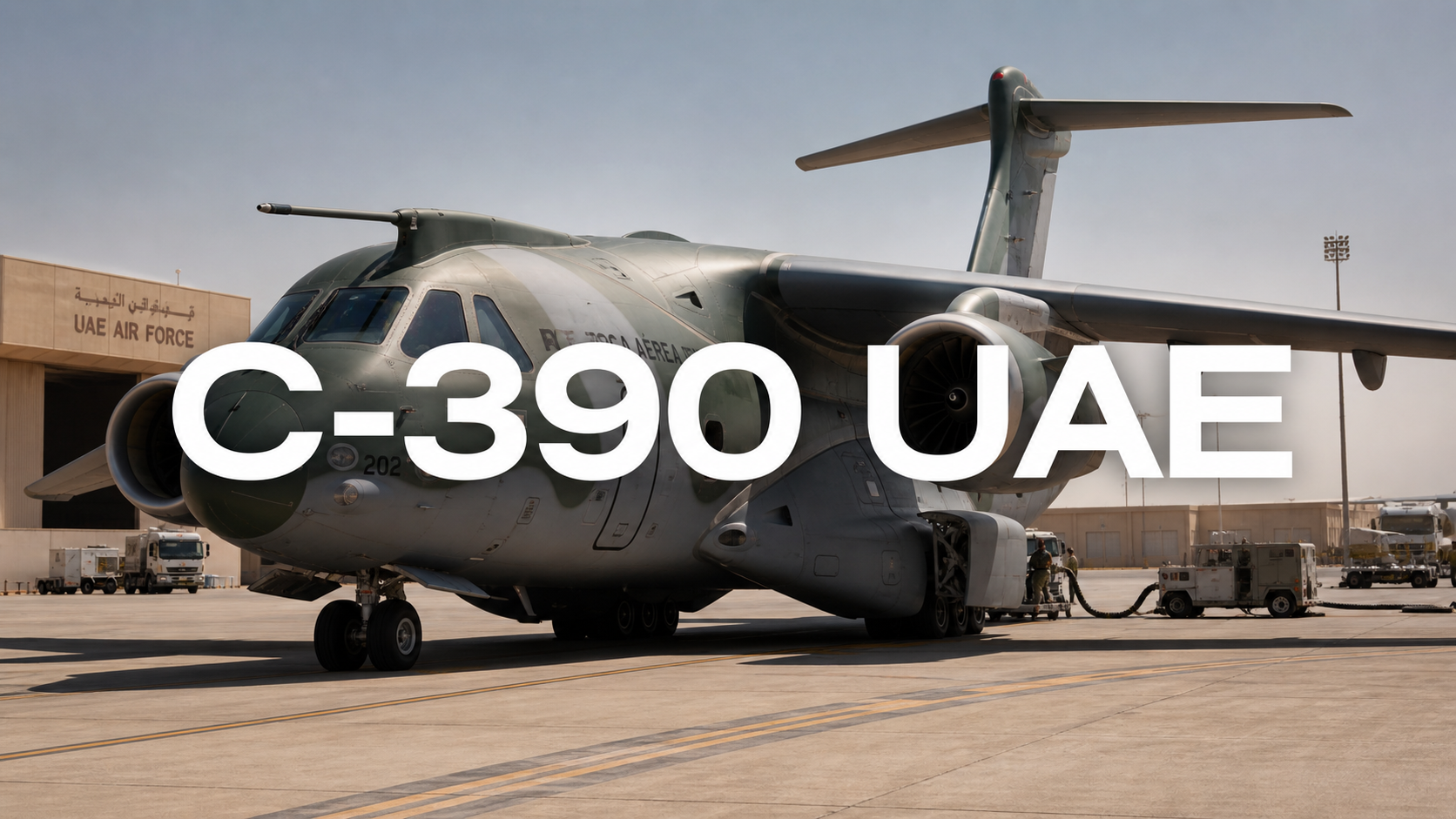
An AI visualization of the C-390 in the UAE environment
Date published: 6 May 2026
Event date: 4 May 2026
Event location / region: Abu Dhabi, United Arab Emirates / Middle East defence aviation market
Event type: Military airlift procurement / defence-industrial cooperation
Summary
The United Arab Emirates has awarded Embraer a contract for 10 C-390 Millennium military transport aircraft, with options for 10 additional aircraft, giving the Brazilian manufacturer its first C-390 customer in the Middle East. The agreement was signed through the UAE’s Tawazun Council for Defence Enablement for the UAE Air Force and Air Defense, and Embraer describes it as the largest international C-390 order from a single country so far.
For the UAE, the deal strengthens medium airlift, humanitarian-response and multi-mission mobility capacity. For Embraer, it is a strategic breakthrough. The C-390 is no longer only a Brazilian or European success story. It has now entered one of the world’s most demanding defence aviation markets, where procurement decisions are shaped by operational performance, industrial participation, lifecycle cost and geopolitical diversification.
The order also points to a wider shift in the military airlift market. Many air forces are looking at ageing transport fleets, rising sustainment costs and the need for aircraft that can operate across military, humanitarian and crisis-response missions. The C-390 is positioning itself directly inside that replacement cycle.
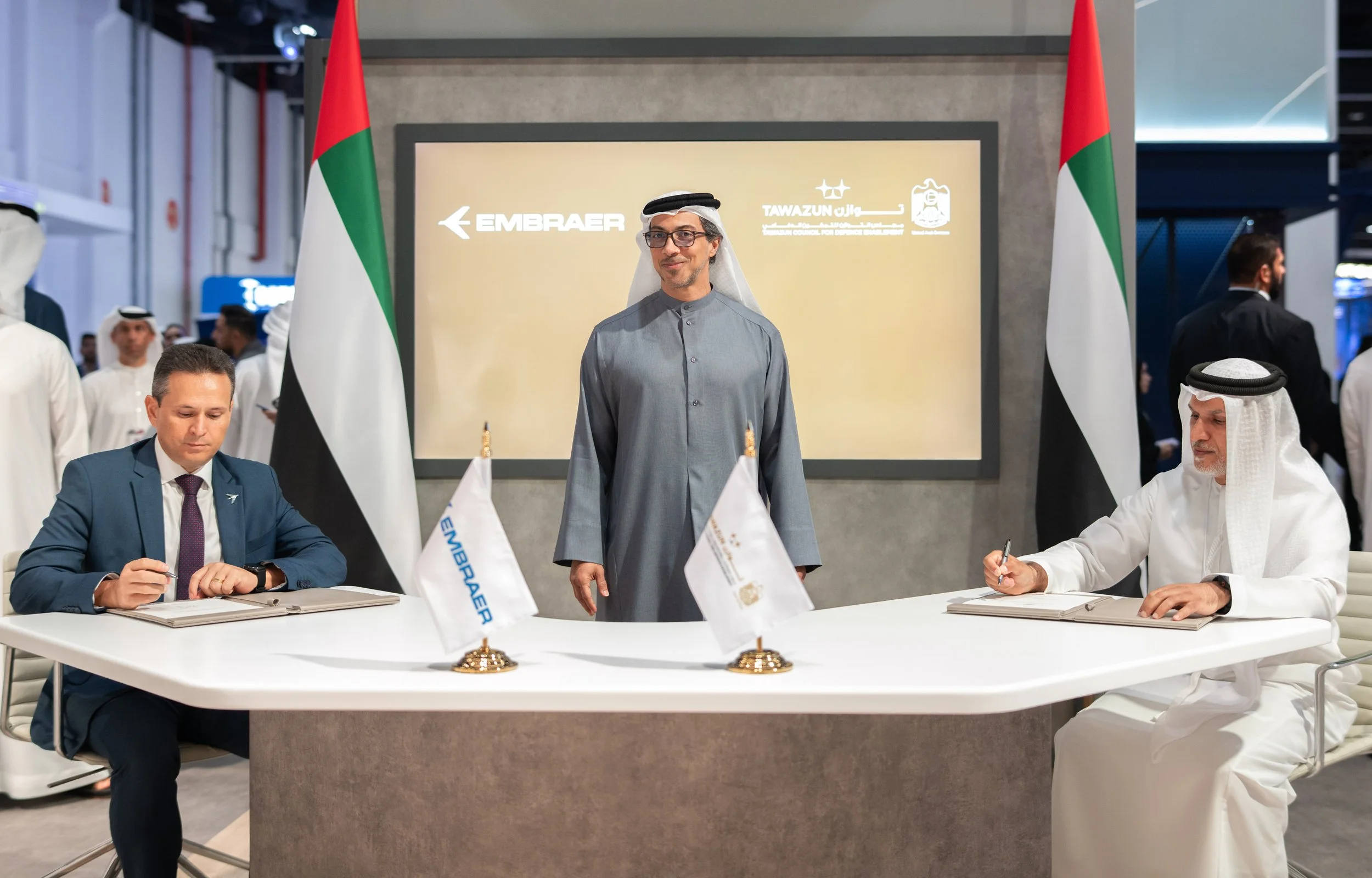
Tawazun Awards Contract to Brazil’s Embraer for Up to20 C-390 Millennium for the UAE. Photo by Embraer.
A Brazilian aircraft enters the Gulf
The UAE order is important because of where it happened. The Gulf has traditionally been a highly competitive market for US and European defence manufacturers. A major Brazilian military aircraft order in the UAE therefore carries significance beyond the number of aircraft involved.
The contract covers 10 firm aircraft and 10 options. It was awarded by Tawazun Council for Defence Enablement and signed during Make it in the Emirates 2026 in Abu Dhabi, in the presence of senior UAE and Embraer representatives. Embraer says the C-390 will support the UAE Air Force and Air Defense across military, humanitarian and interoperability missions.
This is the aircraft’s first selection in the Middle East. It also makes the UAE the 12th country to select the
C-390, according to Reuters.
That matters because the C-390 programme had already gained momentum in Europe, including Portugal, Hungary, the Netherlands, Austria, Sweden and the Czech Republic. But the UAE gives Embraer something different: a Gulf reference customer with a sophisticated air force, high operational expectations and existing experience with Western airlift platforms.
What the UAE is buying
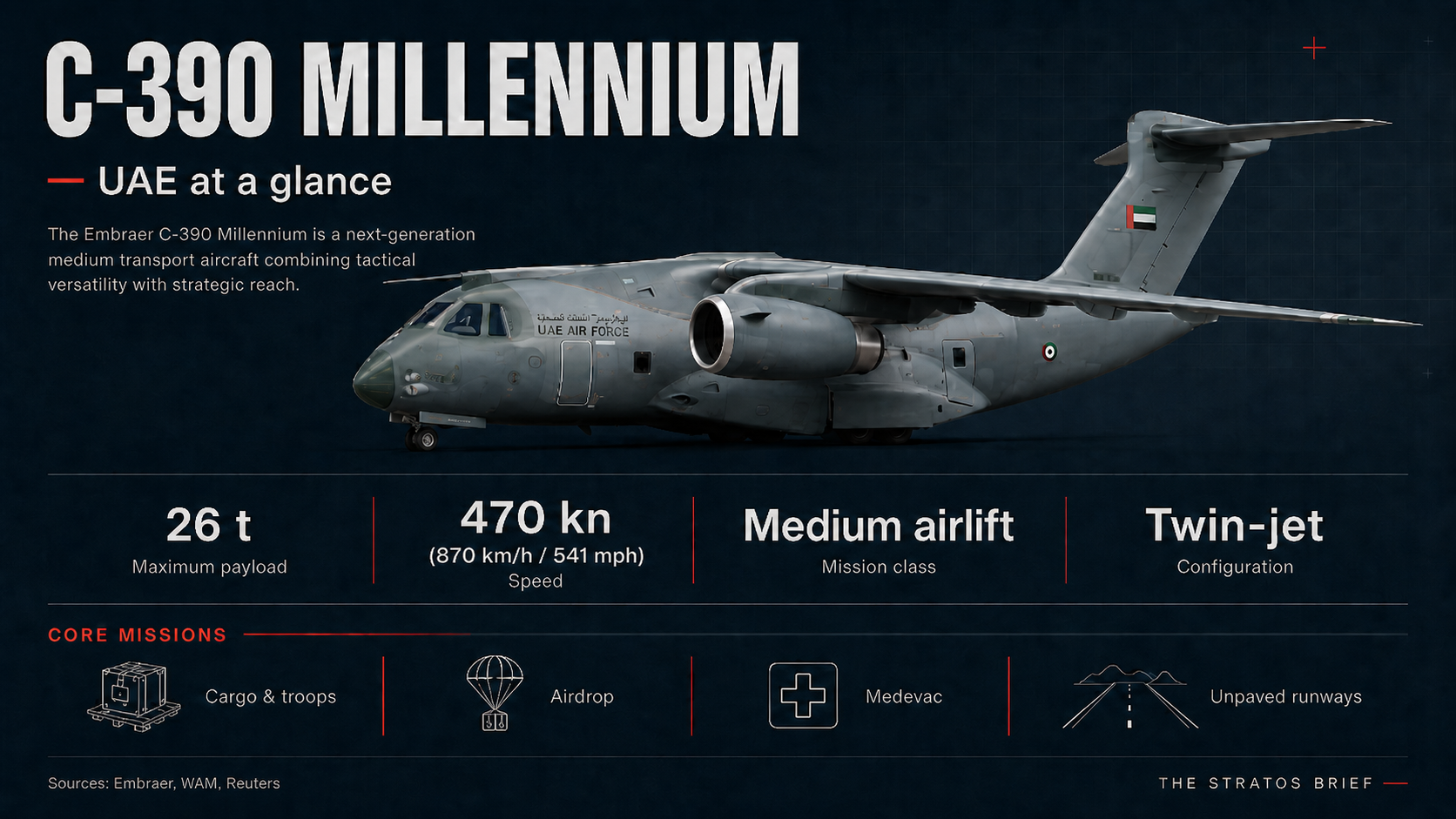
The C-390 Millennium is a twin-engine, jet-powered military transport aircraft designed for medium airlift missions. Its mission set includes cargo and troop transport, airdrop, medical evacuation, humanitarian assistance, search and rescue, firefighting and operations from temporary or unpaved runways. UAE state agency WAM described the aircraft as capable of carrying 26 tons and flying at 470 knots.
For the UAE, this gives the aircraft a role between lighter tactical aircraft and heavy strategic airlifters. The UAE already operates larger and smaller transport platforms, including C-17 and C-130 aircraft, according to Reuters.
This means the C-390 should not be read only as a simple one-for-one replacement for older transport aircraft. It is more likely to become part of a layered airlift structure: faster and more capable than smaller transports, but not intended to perform the same strategic heavy-lift role as the C-17.
Its value lies in operational flexibility. The aircraft can move cargo, personnel and equipment quickly; support disaster relief and evacuation missions; and operate from less developed airfields. For a country like the UAE, which uses military aviation for national defence, regional operations, coalition activity and humanitarian missions, that combination is attractive.
Why the UAE selection matters
Embraer says the UAE selected the C-390 after an extensive evaluation process, including a test campaign in UAE operational conditions. The company says the aircraft was selected to meet mission requirements while improving operational efficiency and lifecycle costs.
That point is central. The C-390 is not being marketed only around payload and speed. Embraer’s argument is increasingly built around the total package: performance, availability, lifecycle economics, mission flexibility and supportability.
For modern air forces, this matters as much as headline specifications. Transport aircraft are not prestige assets in the same way as fighters, but they are among the most operationally important aircraft in any fleet. They move troops, engines, vehicles, ammunition, medical supplies and humanitarian aid. They also reveal whether a military can actually project and sustain force.
The UAE’s decision therefore gives Embraer a strong validation point. It suggests that the C-390 can compete not only in European replacement tenders, but also in a Gulf environment where aircraft must operate in heat, dust, long distances and high-tempo operational conditions.
The industrial deal behind the aircraft
The C-390 agreement is also an industrial cooperation story. Embraer and Generation 5 Holding, a UAE-based defence and technology company, signed an exclusive strategic partnership agreement covering the C-390 programme in the UAE. WAM reported that the partnership includes maintenance, repair and overhaul, after-sales support, mission readiness, rapid response, long-term fleet sustainability, industrial and supply-chain integration, and training for technical, maintenance and operational personnel.
This is not a secondary detail. For the UAE, major defence acquisitions are often linked to domestic industrial development. The signing at Make it in the Emirates 2026 reinforces that context. The aircraft purchase is therefore also part of the UAE’s broader ambition to strengthen local defence and aerospace sustainment capacity.
For Embraer, local support is equally important. A Gulf C-390 fleet will need reliable regional sustainment, training and parts support. If the UAE becomes a credible support base for the aircraft, the deal could improve Embraer’s regional position beyond this single order.
That said, this should be described carefully. The public announcements confirm local MRO and support cooperation. They do not yet prove that the UAE will become a regional C-390 hub for future third-country fleets. That is a plausible strategic implication, not a confirmed fact.
Why this matters for Embraer
For Embraer, the UAE order is a major export milestone. It strengthens the C-390’s credibility in three ways.
First, it expands the aircraft’s customer geography. Before this deal, much of the aircraft’s international momentum had come from Europe. The UAE order shows that the C-390 can also appeal to Gulf operators.
Second, it demonstrates that the aircraft can win in a market with strong US and European defence ties. That does not mean the C-390 is replacing established platforms across the region, but it does show that countries are willing to consider a Brazilian alternative when the capability and industrial package are strong enough.
Third, the order may support wider Middle East sales efforts. Reuters reported that Embraer sees the UAE deal as a potential gateway to further regional defence deals, including possible government-to-government mechanisms similar to those used in Europe. Embraer’s defence chief also said the company is targeting additional C-390 and Super Tucano opportunities in the region.
The options matter here. A contract for 10 firm aircraft is already significant. A structure that allows for 10 more creates room for fleet expansion if the aircraft performs well and if the UAE decides to deepen the programme.
The global airlift replacement cycle
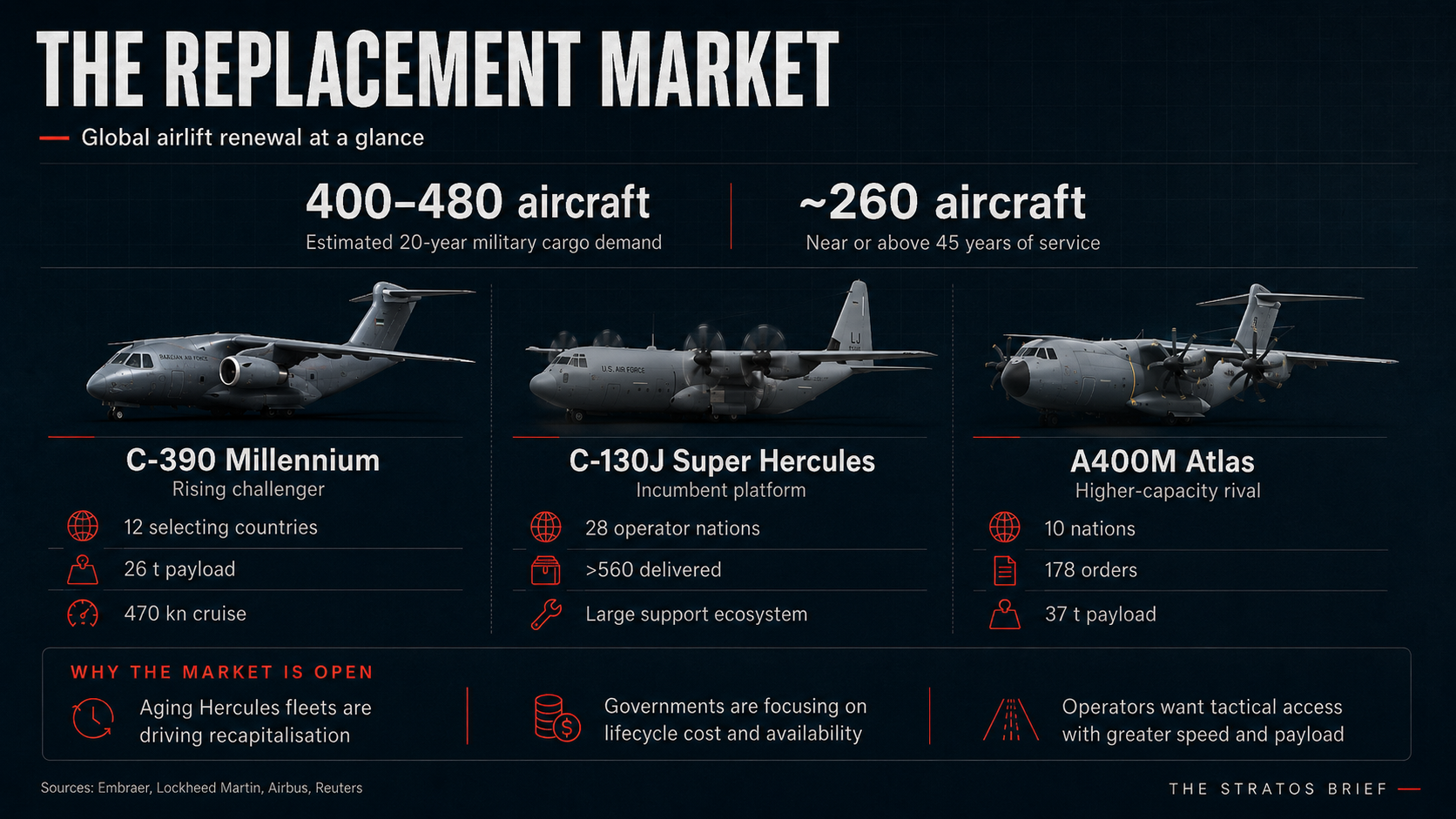
The C-390 is entering the market at a favourable moment. Many air forces still rely on ageing tactical transport fleets, especially variants of the C-130 Hercules. These aircraft have been extremely successful, but age, sustainment burden and mission demands are pushing operators to consider replacement or complement options.
Reuters reported that Embraer estimates global demand for 400 to 480 military cargo aircraft over the next 20 years, with around 260 aircraft worldwide nearing or exceeding 45 years of service.
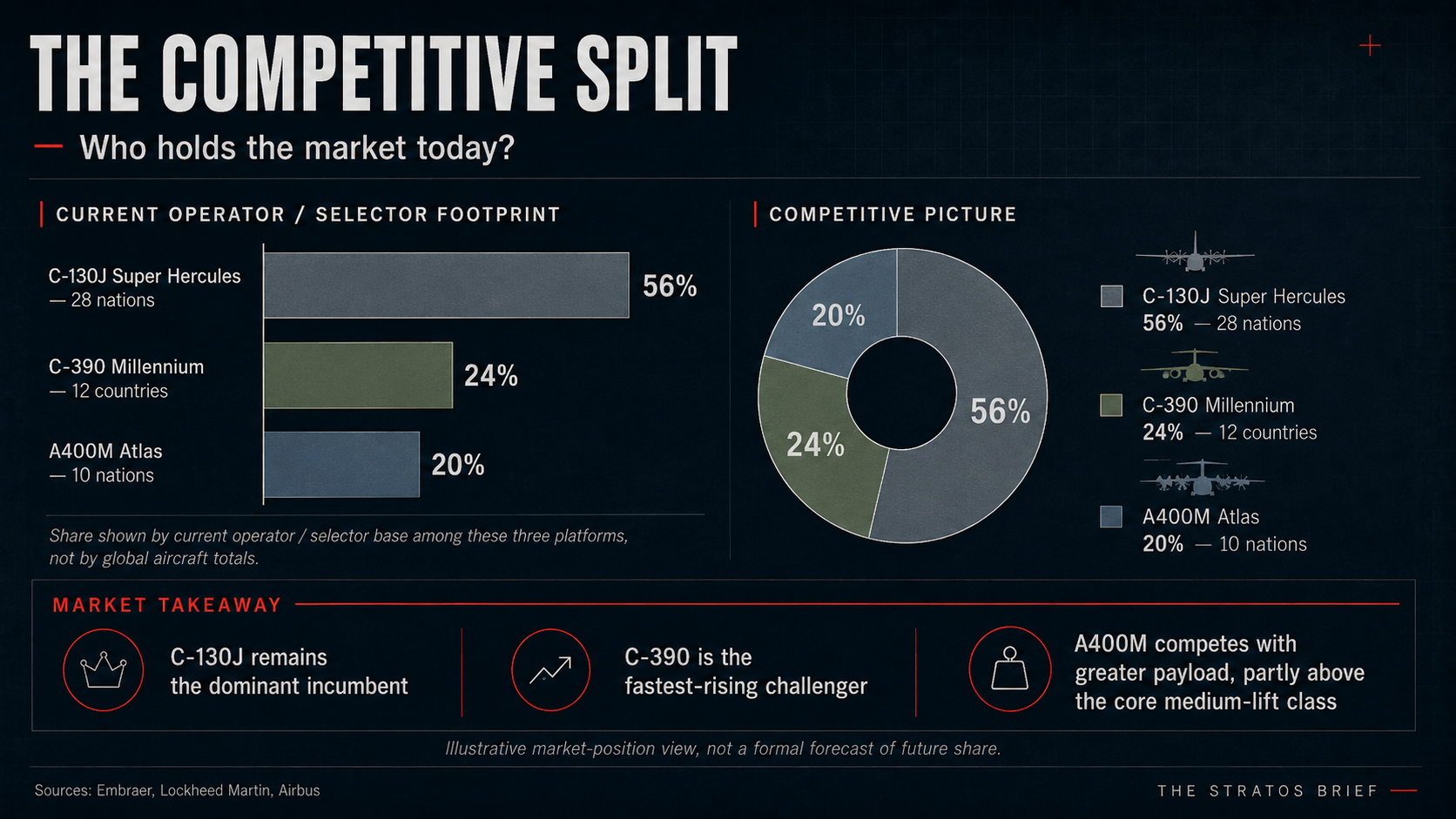
This does not mean Embraer will capture that market alone. Lockheed Martin’s C-130J remains a powerful competitor with a huge installed base, deep support ecosystem and strong political backing. Airbus also remains relevant in parts of the transport market with aircraft such as the C295 and A400M, depending on the mission category.
But the C-390 does not need to dominate the market to be strategically successful. It needs to win enough replacement and expansion campaigns to become a durable third pillar in the military airlift market. The UAE deal helps that effort.
The C-390’s competitive logic
The C-390’s argument is not simply that it is “better” than legacy aircraft. Its stronger argument is that it offers a different balance.
It is a jet-powered medium transport aircraft with high cruise speed, multi-mission flexibility and modern systems. It can support military and humanitarian roles, operate from austere locations and be configured for different mission requirements. For countries looking beyond pure tactical lift, that matters.
The aircraft also benefits from Embraer’s broader reputation as a serious commercial and military aircraft manufacturer. Embraer is not a niche start-up attempting to enter the defence aviation market. It is an established aircraft producer with decades of experience in regional jets, executive aircraft and military platforms.
The UAE order therefore strengthens a larger narrative: Brazil has produced a military aircraft that can compete globally, not just regionally.
A wider signal about defence-industrial diversification
The UAE’s selection also fits a wider trend in defence procurement: strategic diversification.
Many countries still buy heavily from the United States and Europe, but they are increasingly willing to consider capable alternatives when those alternatives bring operational value, industrial participation or political flexibility. The C-390 benefits from that environment.
For Abu Dhabi, buying a Brazilian aircraft does not replace its relationship with Western suppliers. Instead, it broadens the supplier base. That can reduce dependency, add industrial options and give the UAE more flexibility in future fleet planning.
For Brazil, the symbolism is even stronger. A South American aerospace company has won a major military aircraft order in the Gulf. That is not common. It suggests that the global defence-industrial map is becoming more plural, even in high-end aviation segments that were once dominated almost exclusively by the United States, Europe and Russia.
What remains unclear
Several important details have not yet been publicly confirmed.
The official contract value has not been disclosed. Reuters reported that Itaú BBA analysts estimated the 10 firm aircraft could be worth around USD 1 billion, but this is an analyst estimate, not an official contract figure.
The delivery schedule has also not been publicly detailed in the official announcements reviewed for this article. The exact configuration of the UAE aircraft, including self-protection systems, communications fit, tanker capability and mission equipment, has not been fully specified in public sources.
It is also not yet clear how the C-390s will map onto existing UAE airlift assets. The aircraft may replace some older capacity, complement existing C-130 operations, or create additional medium-lift flexibility. The safest conclusion is that the C-390 will modernise and expand the UAE’s medium airlift capability, rather than assuming a specific replacement plan that has not been officially stated.
Strategic assessment
The UAE’s C-390 order is more than a procurement announcement. It is a validation moment for Embraer and for Brazil’s defence aerospace sector.
For the UAE, the aircraft offers modern medium airlift, mission flexibility and a local sustainment pathway. For Embraer, it provides a Gulf reference customer, strengthens the aircraft’s export credibility and supports the company’s ambition to compete in the global military transport replacement cycle.
The deeper significance is that the C-390 is no longer only challenging the legacy transport market from the margins. It is now being selected by sophisticated operators with demanding mission profiles and serious industrial expectations.
That does not mean the C-390 will displace the C-130 family as the default global tactical transport aircraft. The C-130’s installed base, support network and political weight remain formidable. But the UAE deal shows that the C-390 has become a serious alternative in a market that is beginning to move.
For The Stratos Brief, the key insight is this: the UAE order shows that Brazil’s aerospace industry has produced a military aircraft capable of competing not only in South America or Europe, but in one of the most strategically important defence aviation markets in the world.
Sources
Embraer — contract announcement on UAE C-390 order.
Embraer — Generation 5 Holding strategic partnership announcement.
WAM — Generation 5 Holding and Embraer strategic partnership.
Reuters — Embraer eyes further Middle East defence deals after UAE C-390 order.
Aviation Week / Breaking Defense / Aerospace Global News / specialist defence reporting on the order and market context.