The Last MV‑22B Has Been Delivered. The Osprey’s Hardest Chapter Begins Now
Date published: 01 August 2026
Assessment date: 01 August 2026
Event location / region: U.S.A.
Event type: MV-22B Osprey Production Details
AT A GLANCE
Final MV‑22B — delivered
Assault support — transformed
Safety risks — unresolved
Fleet modernisation — accelerating
Navy production — continuing
NGAS successor — undefined
The US Marine Corps has accepted the 359th and final MV‑22B in its approved acquisition programme. That closes the aircraft’s fielding phase — not its operational story. The challenge now is to keep one of the world’s most capable, complex and closely scrutinised military aircraft safe, available and relevant through 2055.
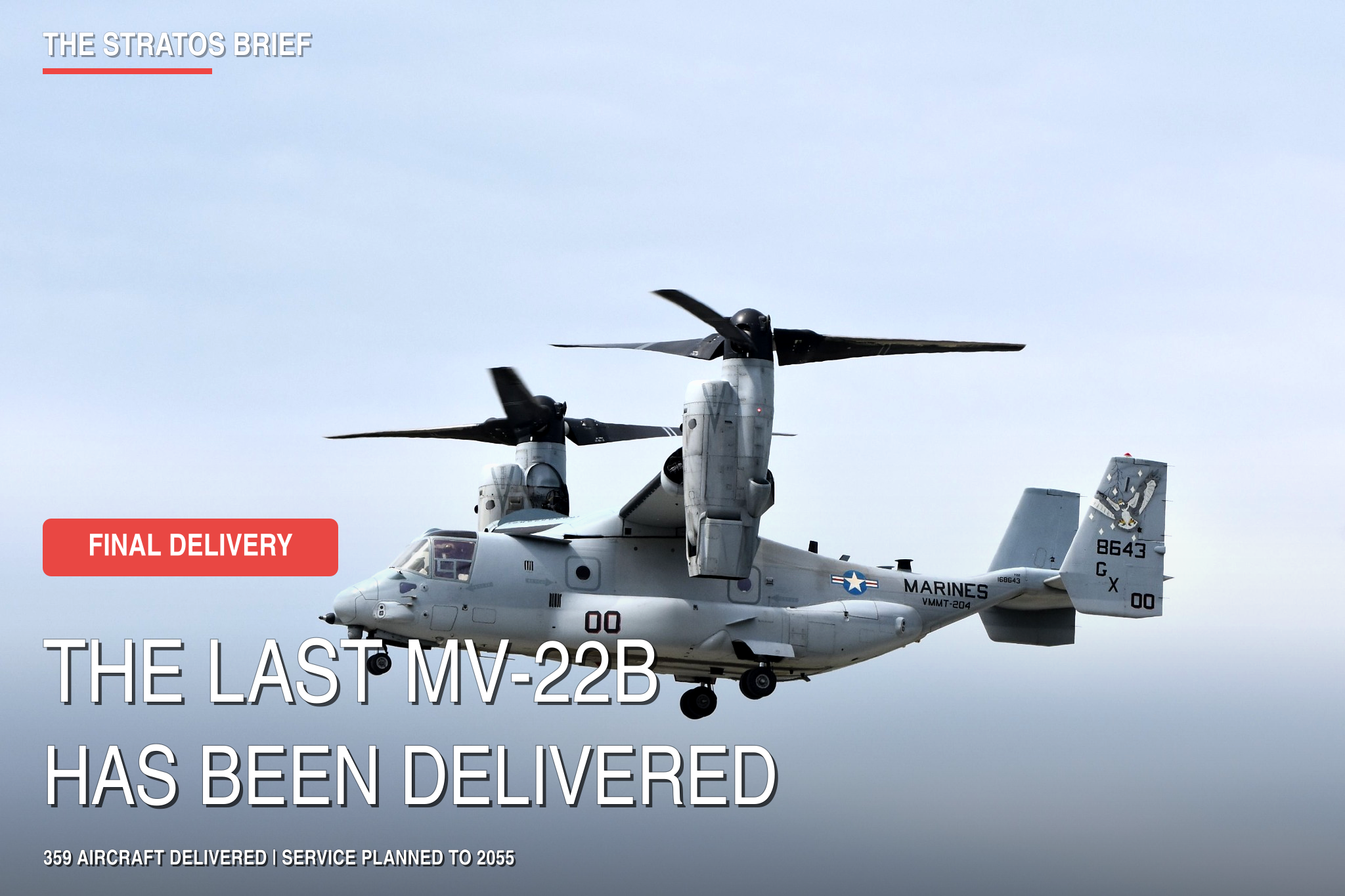
On 28 July 2026, the US Marine Corps accepted its 359th and final MV‑22B Osprey, completing the type’s Program of Record. After almost two decades of operational service, the Marine Corps is shifting its focus from acquiring aircraft to sustaining and modernising the fleet.
At first glance, this is a conventional end-of-production milestone. In reality, it marks a much more consequential transition.
The MV‑22B has already demonstrated that tiltrotor aviation can fundamentally change the speed, range and geography of expeditionary operations. What it has not yet demonstrated is whether such a complex capability can be kept safe, affordable and consistently available for another three decades.
That is the real story behind the final delivery.
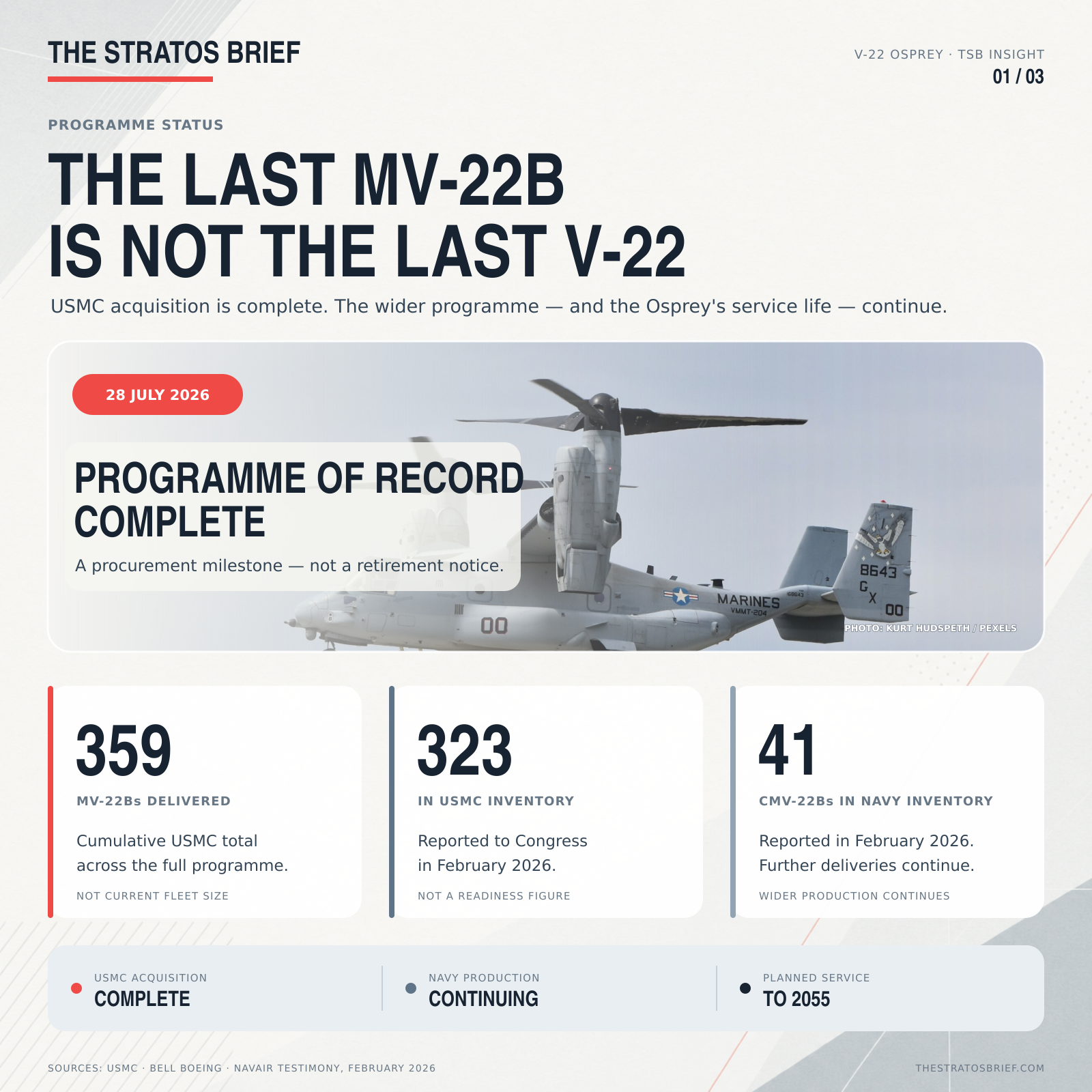
The final MV‑22B completes USMC acquisition — not the wider V‑22 programme.
What has ended — and what has not
The milestone completes the Marine Corps’ acquisition programme for new MV‑22Bs. It does not mean that 359 aircraft remain in service, that the entire V‑22 production line has closed, or that the Osprey is approaching retirement.
The number 359 represents cumulative deliveries. In February 2026, NAVAIR told Congress that the Marine Corps possessed 323 aircraft. Attrition, test aircraft, retirements and inventory accounting therefore separate the delivery total from the operational fleet.
There is also a small discrepancy in the public record. The 2025 Marine Aviation Plan listed a Program of Record of 360 MV‑22Bs, while the latest Marine Corps and Bell Boeing announcements identify aircraft 359 as the final delivery. The change has not been publicly explained, but the newest official figure supersedes the earlier planning number.
Most importantly, this is not the final V‑22. Bell Boeing continues to build the longer-range CMV‑22B for the US Navy. Congressional testimony listed 41 Navy aircraft in February 2026, with further deliveries still to come.
The correct interpretation is therefore precise: production of new Marine Corps MV‑22Bs has ended, while the wider V‑22 programme continues.
US Marine Corps final-delivery announcement · Bell Boeing programme milestone · NAVAIR testimony to Congress
The aircraft that rewrote Marine assault support
The Osprey was created to combine two traditionally separate capabilities: the vertical access of a helicopter and the speed and range of a turboprop aircraft.
For the Marine Corps, that combination was transformational.
The MV‑22B replaced the CH‑46E Sea Knight and allowed forces to move personnel, equipment and supplies between ships, forward operating locations and austere landing zones over distances that would have been difficult to cover with conventional helicopters. Its speed also reduced transit time and gave commanders more freedom in choosing where ships and supporting bases could operate.
Since reaching initial operational capability in 2007, the Marine MV‑22B fleet has accumulated more than 686,500 flight hours across 114 operational deployments. The Marine Corps says the aircraft now provides 75 per cent of its rotary-wing assault-support capacity.
That final qualification matters. The figure does not mean that the Osprey performs 75 per cent of every Marine Corps assault-support mission. It means that it supplies three quarters of the capacity provided by the Corps’ rotorcraft assault-support fleet.
Even with that distinction, the number illustrates how deeply the MV‑22B has become embedded in Marine operations. The aircraft supports amphibious manoeuvre, troop transport, contested logistics, casualty evacuation, embassy reinforcement and humanitarian relief. Marine expeditionary planning is now built around the speed and reach that the Osprey provides.
Replacing the aircraft is therefore not simply a matter of buying another medium-lift helicopter. A successor would have to preserve the operational geometry that the MV‑22B created.
The safety debate cannot be reduced to a slogan
The Osprey’s operational value has never eliminated concerns about its safety. Four fatal accidents since 2022 killed 20 service members and triggered partial or fleet-wide groundings, extensive technical reviews and renewed congressional scrutiny.
However, the accidents did not share one simple cause.
In Norway in March 2022, four service members were killed when an MV‑22B crashed during low-altitude manoeuvring. The investigation identified pilot error and found that the aircraft had been flown beyond its authorised bank-angle limit.
The June 2022 accident in California killed five service members after a dual hard-clutch engagement caused a catastrophic drivetrain failure. Investigators specifically excluded both crew and maintenance error.
Three service members were killed in Australia in August 2023. Pilot error was identified as the primary cause, while the investigation also documented deficiencies in mission planning, risk management and procedural discipline.
The deadliest of the four accidents occurred in Japan in November 2023, when a CV‑22B suffered a catastrophic proprotor gearbox failure that produced unrecoverable asymmetric lift. All eight crew members were killed. Investigators also concluded that crew decision-making prolonged the emergency sequence and removed an earlier opportunity to land.
A further CV‑22B mishap in New Mexico in November 2024 caused no fatalities, but investigators again found a catastrophic proprotor-gearbox gear failure, this time associated with a material inclusion and the design of the affected gear.
These findings rule out both of the simplistic narratives surrounding the aircraft.
It is inaccurate to claim that every Osprey accident was caused by a defective gearbox. It is equally inaccurate to portray the recent safety concerns as media exaggeration or pilot error alone. The record contains human, organisational and material failures — including two distinct drivetrain mechanisms capable of producing catastrophic consequences.
GAO safety review · Norway investigation · California investigation · Japan investigation · New Mexico investigation
What the accident statistics actually show
The Government Accountability Office found that serious Osprey accident rates for the Marine Corps and Air Force increased during fiscal years 2023 and 2024 compared with their averages over the preceding eight years. Depending on the service, the increase ranged from 36 to 88 per cent.
Those figures require context.
Fleet-wide groundings and lower aircraft availability reduced the number of flight hours, which makes every accident weigh more heavily in a rate calculated per 100,000 hours. The three US variants also perform different missions and have produced different safety records. The Navy, for example, recorded no Class A or B CMV‑22B accident between its initial operational use and the end of fiscal year 2024.
The data therefore do not support treating every V‑22 variant as an identical statistical population.
Nevertheless, the trend cannot be dismissed. The combination of serious accidents, reduced flying hours and long-standing technical risks points to a programme under genuine safety and readiness pressure.
The less visible problem is fleet readiness
The public discussion concentrates on crashes. For the Marine Corps, the larger day-to-day challenge may be maintenance, aircraft availability and the ability to generate enough flying hours to preserve crew proficiency.
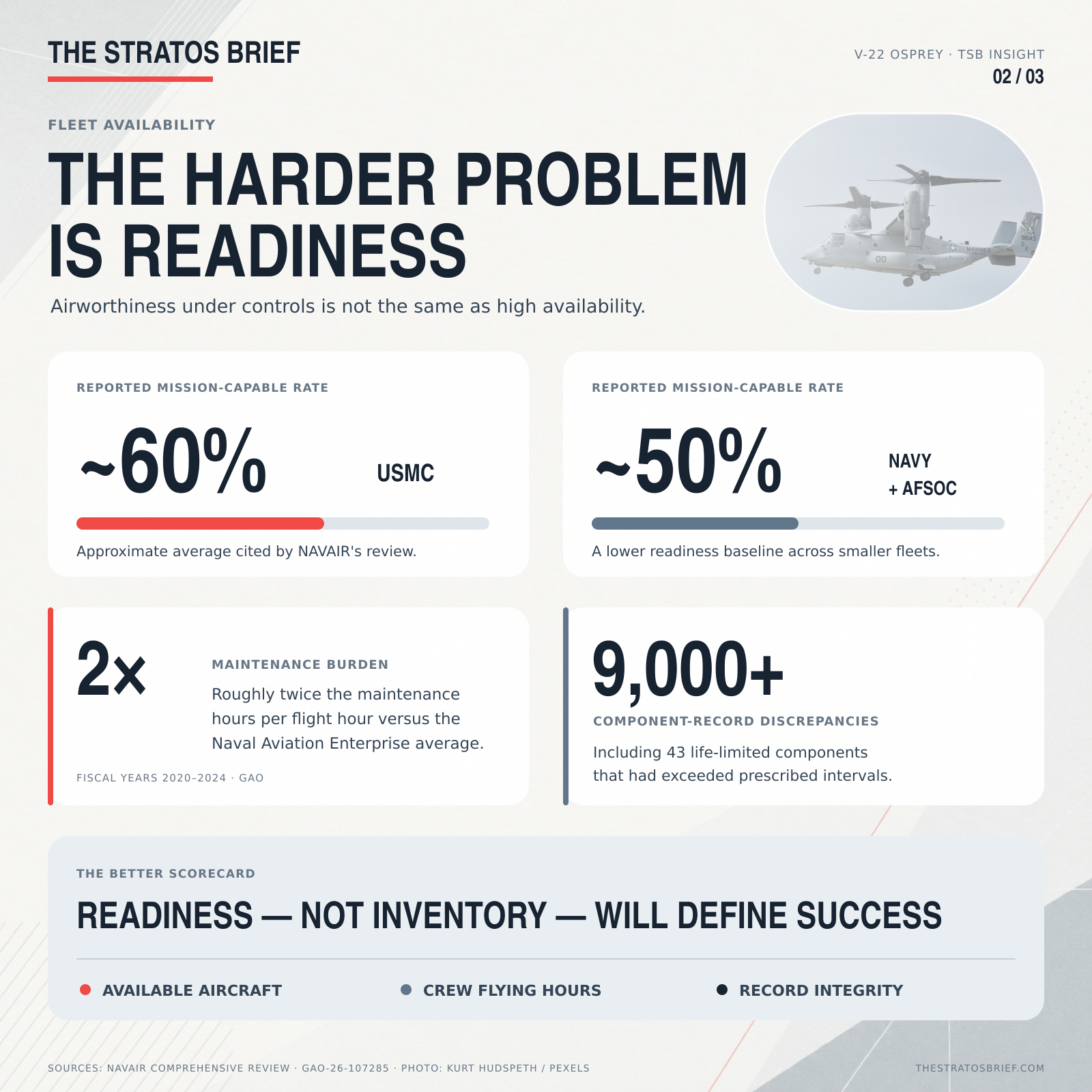
Aircraft availability, crew proficiency and component-record integrity will matter more than the nominal fleet size.
The GAO found that:
V‑22 maintenance hours per flight hour were consistently around twice the average of the wider Naval Aviation Enterprise between fiscal years 2020 and 2024;
programme stakeholders had not fully responded to 34 known system-related risks;
the median age of 28 unresolved serious and medium risks was approximately nine years;
an audit identified more than 9,000 discrepancies in records for serialised components, including 43 life-limited components that had exceeded their prescribed intervals;
Marine Corps pilot flying hours had declined by approximately 38 per cent during recent grounding periods;
maintenance staffing, qualification mismatches and limited training time created additional non-technical safety risks.
The NAVAIR Comprehensive Review nevertheless reaffirmed the V‑22’s airworthiness under established operating controls. It issued 32 recommendations covering safety, readiness, governance and information sharing. By February 2026, the programme reported that 24 had been closed, five were expected to be completed during the year and three remained under monitored implementation.
This distinction is important. Airworthiness under specified controls does not mean that every underlying risk has been engineered out. It means the aircraft can continue operating while restrictions, inspections, component limits, training measures and technical modifications manage the remaining exposure.
NAVAIR Comprehensive Review summary · Full GAO report
Modernisation is now a condition of continued service
The Marine Corps intends to operate the MV‑22B through 2055. That is a planning horizon, not a guaranteed retirement date. Reaching it will depend on sustained funding, improved reliability, continued access to components and successful management of structural and avionics obsolescence.
Several major initiatives are already under way.
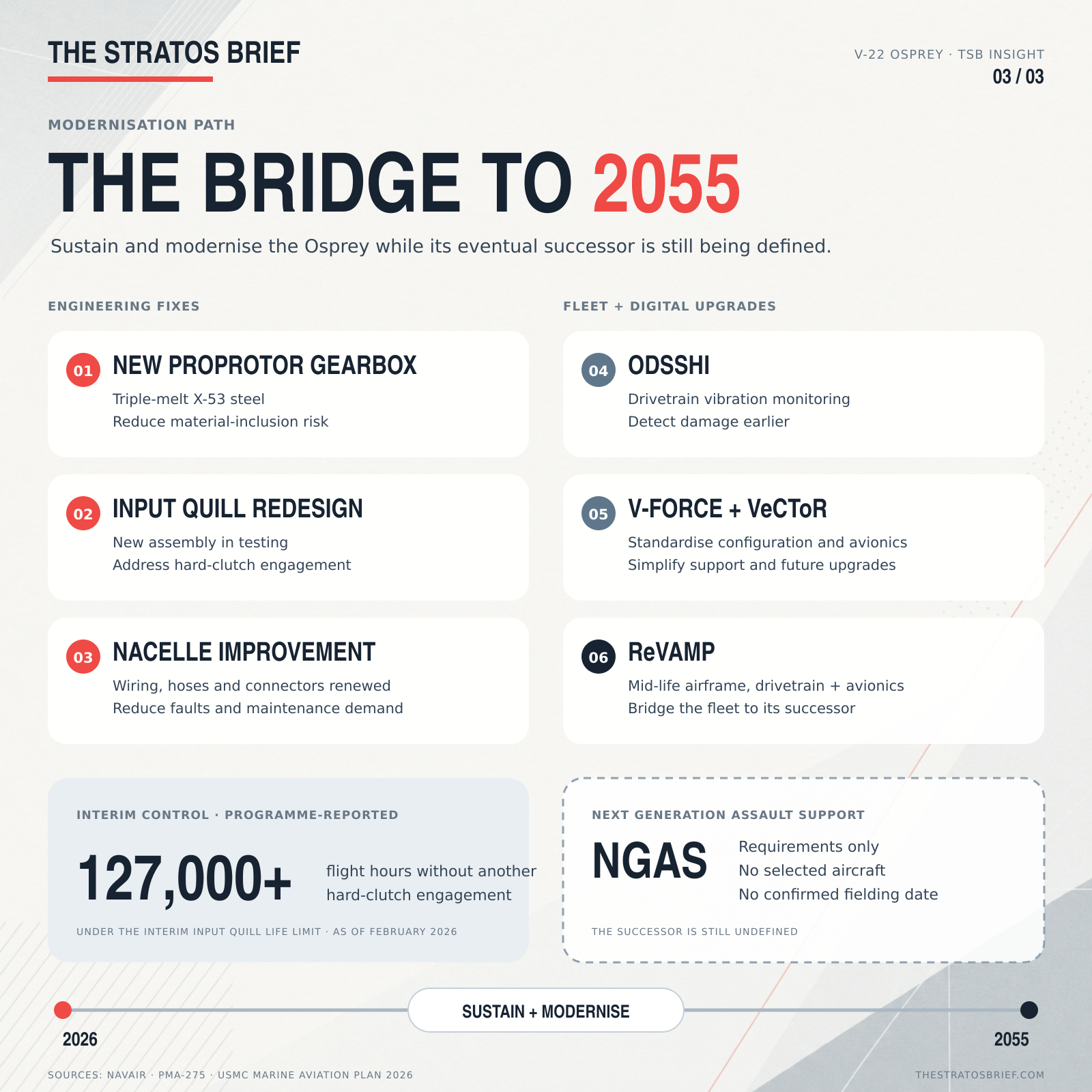
The MV‑22B must be sustained and modernised through 2055 while its eventual NGAS successor remains undefined.
The proprotor gearbox is one of the most urgent priorities. New gearboxes manufactured from X‑53 triple-melt steel began entering the fleet in January 2026. The new material is intended to reduce microscopic inclusions associated with premature gear failure.
To address hard-clutch engagement, a redesigned Input Quill Assembly is currently undergoing testing. Until it can be introduced, existing assemblies remain subject to mandatory preventive replacement limits. The longer-term objective is to remove, or at least significantly reduce, the mechanism behind catastrophic hard-clutch events.
The nacelles are also undergoing a broader reliability improvement effort. Wiring, harnesses, connectors, hoses and other maintenance-intensive components are being redesigned or replaced to reduce maintenance demand and improve aircraft availability.
At fleet level, V‑FORCE and related modifications are reducing the number of different aircraft configurations in service. A more standardised fleet should simplify training, logistics, software support and overall fleet management.
Finally, ReVAMP is intended to address the Osprey’s mid-life requirements across the drivetrain, airframe, avionics and open-system architecture. Its purpose is to keep the aircraft safe, supportable and operationally relevant until NGAS arrives.
NAVAIR reported that the interim Input Quill replacement limit had supported more than 127,000 flight hours without another hard-clutch engagement as of February 2026.
It also told Congress that nacelle improvements demonstrated on the CV‑22B had increased aircraft availability by more than 20 per cent, extended mean flight hours before failure by over 1,500 hours and reduced maintenance demand by more than two hours per flight hour. The Marine Corps and Navy are now working to introduce tailored versions of those improvements.
These are programme-reported results rather than an independent long-term assessment. Even so, they indicate that targeted engineering changes can produce substantial readiness gains.
The central question is whether those gains can be reproduced across a much larger and increasingly mature Marine fleet.
From production programme to sustainment economy
The final MV‑22B also changes the programme’s industrial centre of gravity.
Bell Boeing says the Osprey industrial team includes more than 500 US suppliers and supports approximately 27,000 employees across 44 states. Continued CMV‑22B production gives that network a remaining manufacturing workload, but its long-term business will increasingly come from sustainment rather than new aircraft.
The most valuable parts of the programme will now include:
depot maintenance and structural life management;
gearbox and nacelle modifications;
spare-parts production and repair;
avionics and flight-control modernisation;
predictive health monitoring;
configuration standardisation;
technical-data integrity;
simulator and aircrew training;
obsolescence management.
This creates a substantial long-term aftermarket, but it also introduces risk. As new-aircraft volumes decline, second- and third-tier suppliers may face weaker economics for retaining specialised tooling, personnel and production capacity. Components produced in small quantities can become slower and more expensive to obtain precisely when an ageing fleet needs them most.
For Bell Boeing and the US government, preserving the supply chain may therefore become as important as improving the aircraft itself.
The successor exists only as a requirement
The Marine Corps refers to its future replacement effort as Next Generation Assault Support, or NGAS.
NGAS is not yet a selected aircraft. There is no announced winning configuration, completed competition or confirmed fielding date. The programme remains focused on defining the capabilities the Marine Corps will need after the MV‑22B.
Those requirements are likely to be shaped by several lessons from the Osprey era:
greater combat radius;
higher survivability in contested airspace;
lower maintenance and logistics demand;
easier operation from distributed and austere sites;
stronger digital connectivity;
integration with uncrewed systems;
modular systems that can be upgraded faster.
The US Army’s MV‑75 Future Long Range Assault Aircraft may influence the technology and industrial landscape, but it should not automatically be described as the future Marine Corps Osprey replacement. NGAS will have to satisfy distinct naval, expeditionary and shipboard requirements.
This uncertainty makes the MV‑22B modernisation programme more important. The Marine Corps is not maintaining the aircraft while waiting for a replacement that is already approaching production. It is maintaining the aircraft while the replacement is still being defined.
The real strategic trade-off
The Marine Corps faces an uncomfortable but straightforward reality.
The MV‑22B is expensive and demanding to maintain. It has unresolved safety and readiness risks. Its crews need more flying hours, its component records require stronger control, and its mid-life modernisation arrived later than would have been ideal.
At the same time, no available aircraft can directly reproduce its combination of vertical access, range, speed, shipboard compatibility and payload.
Retiring it early would create a major operational gap. Continuing to operate it without substantial investment would allow availability and safety pressures to grow. The only realistic path is therefore an expensive bridge: modernise the Osprey while simultaneously defining and developing its eventual successor.
The success of that effort should not be measured by how many aircraft appear in the inventory. It should be measured by:
mission-capable aircraft available to commanders;
maintenance hours required per flight hour;
aircrew flying hours and qualification depth;
closure of long-standing safety risks;
integrity of life-limited component records;
reduction in fleet configurations;
cost per effective operational mission.
Those indicators will reveal whether the Corps is preserving a transformational capability or merely sustaining an increasingly difficult fleet on paper.
The Stratos Brief assessment
The final MV‑22B delivery deserves recognition. The aircraft changed Marine aviation, proved the operational value of tiltrotor technology and created a combination of speed, range and vertical access that conventional helicopters still struggle to match.
But the milestone should not be mistaken for the completion of the programme’s hardest work.
The Osprey now enters a period in which engineering discipline, maintenance capacity, supply-chain resilience, crew proficiency and transparent risk management will matter more than production totals. Its continued relevance is highly plausible. Its continued readiness is not automatic.
The planned 2055 service horizon is therefore less a forecast than a commitment. It assumes that the United States will continue funding the upgrades, people, components and oversight required to keep the aircraft viable.
The Osprey no longer has to prove that tiltrotor operations can transform Marine aviation. It now has to prove that a revolutionary capability can be sustained safely, affordably and at scale for another generation.
Why this matters for business, military and political leaders
For business leaders
The programme is moving from aircraft production towards a multi-decade sustainment market. Opportunities will concentrate in MRO, component reliability, diagnostics, avionics, training, supply-chain continuity and obsolescence management. Suppliers should also expect greater scrutiny of quality assurance, traceability and lifecycle performance.
For military leaders
Inventory totals are less important than aircraft availability and trained crews. The MV‑22B can continue providing a unique operational advantage only if technical modifications are matched by sufficient maintenance staffing, flying hours and cross-service sharing of safety information.
For political leaders
Operating the Osprey through 2055 will require consistent long-term funding and oversight. The choice is not between a perfect Osprey and an immediately available replacement. It is between investing in the existing capability or accepting a major gap in Marine expeditionary mobility while NGAS remains under development.