UPDATE: Rassvet and Russia’s Sovereign Space Internet (after 2nd launch)
Date published: 03 August 2026
Assessment date: 03 August 2026
Event location / region: Russia / Ukraine / Low Earth Orbit
Event type: Rassvet Satellite Constellation – Programme and Operational Update
AT A GLANCE
Expansion: second batch launched
Coverage: daily windows emerging
Combat use: still unverified
Orbit: working altitude unclear
Schedule: major acceleration needed
Competition: China much further, Starlink as an industry lead
What Russia’s emerging LEO network can — and cannot — do?
Russia now has 31 production-series Rassvet satellites in orbit and predictable periods of geometric visibility over Ukraine. That is strategically relevant. It is not yet evidence of a continuous, operational or combat-proven Russian equivalent to Starlink.
The exceptional reader interest in our April Insight, Rassvet and Russia’s Sovereign Space Internet — now The Stratos Brief’s most-read article — made one thing clear: the question is no longer whether Russia wants its own low-Earth-orbit communications network, but how quickly that ambition is becoming real.
This article is a response to that interest and a continuation of the original analysis. Since April, one satellite from the first production batch has been lost, a second group has been launched into a different orbital plane, the surviving spacecraft from the first group have formed a more useful chain, and President Vladimir Putin has publicly connected Bureau 1440 with Russia’s work on satellite-enabled drone control.
Those developments make Rassvet more serious than it was three months ago. They do not, however, justify describing it as a mature Russian Starlink. The public evidence supports a more measured conclusion: Rassvet has moved beyond a technology demonstration and can now create planned communications opportunities, but continuous service, significant capacity and confirmed battlefield use remain unproven.
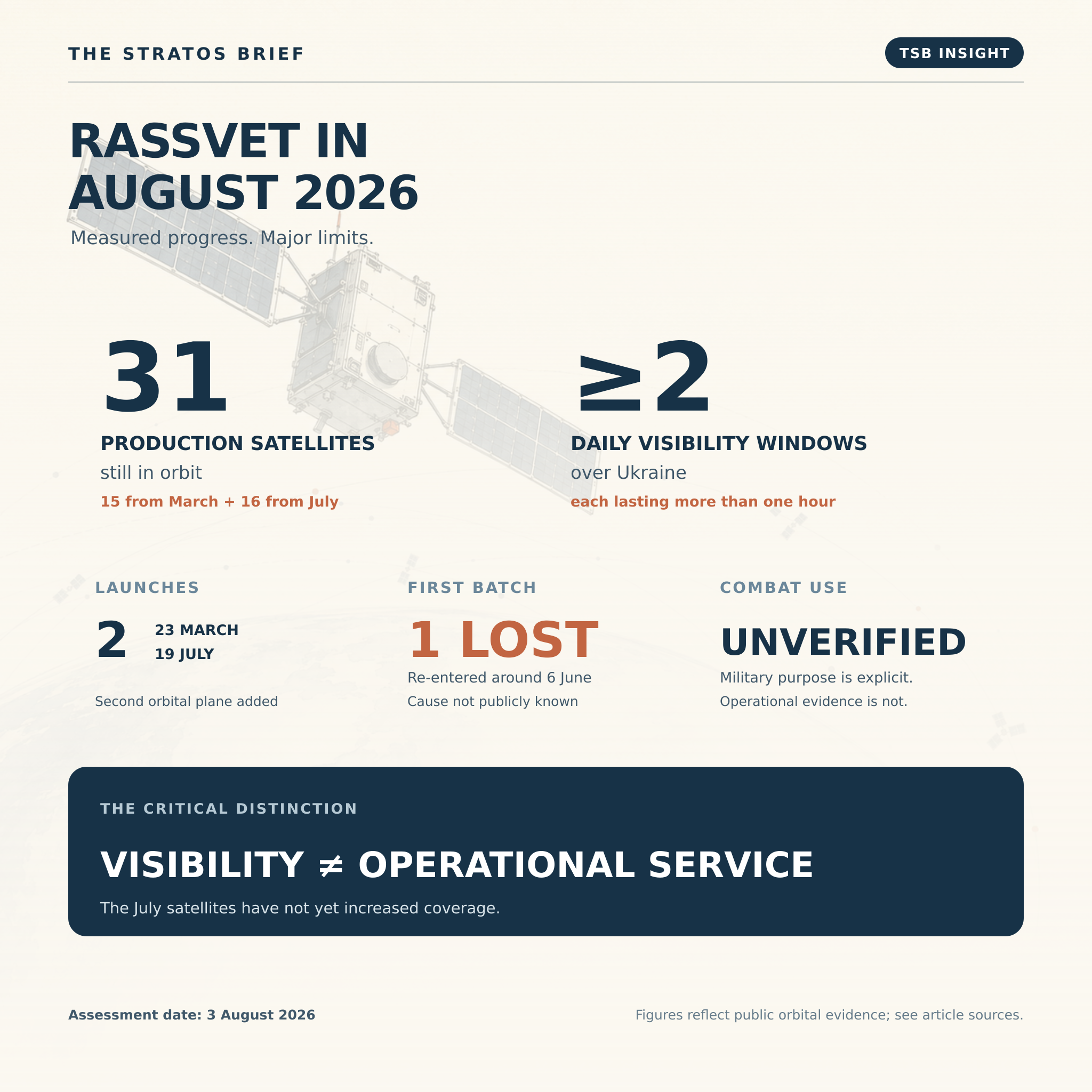
Rassvet has moved beyond the demonstration stage, with 31 serial satellites remaining in orbit as of 3 August 2026. The constellation nevertheless provides only intermittent visibility—not continuous operational broadband coverage.
From 16 launched to 31 still in orbit
The first production-series group of 16 Rassvet-3 satellites was launched from Plesetsk on 23 March 2026. One of them, catalogued as Object 4, never performed a publicly observable orbit-raising manoeuvre and re-entered the atmosphere around 6 June. No official cause has been published. A propulsion failure or loss of control would fit the observed behaviour, but both remain hypotheses rather than established facts, according to the orbital chronology maintained by RussianSpaceWeb [3].
Losing one spacecraft from a first production batch — 6.25 per cent of the group — is not by itself a programme-defining failure. Early constellations routinely expose manufacturing and operational problems. It does show, however, why the distinction between “launched”, “in orbit” and “operational” matters.
On 19 July, a Soyuz-2.1b launched a second group from Plesetsk at approximately 17:51 UTC. Bureau 1440 confirmed that the spacecraft separated successfully and established contact with its control centre, but did not publicly state the number in the group. Independent launch reconstruction and the subsequent catalogue of 17 objects — 16 spacecraft and the rocket stage — support a batch size of 16 with high confidence [1][2].

Bureau 1440’s Mission Control Center in Moscow. The company said the spacecraft from its second production launch established contact with the centre following orbital separation on 19 July 2026.
Original image: Bureau 1440; webpage overlays removed and obscured areas reconstructed by The Stratos Brief.
The second group entered an initial orbit of roughly 290 by 327 kilometres. Its orbital plane is oriented more than 100 degrees away from the plane used by the March group. That is important: adding a genuinely different plane can eventually provide contact opportunities at different times of day rather than merely lengthening one existing train of satellites [2].
The correct count is therefore 31 production-series Rassvet satellites in orbit, not 31 fully operational service satellites. Fifteen survive from the March launch and 16 were added in July. Bureau 1440’s six earlier experimental Rassvet-1 and Rassvet-2 spacecraft are a separate category.
The July launch has also not yet increased coverage over Ukraine. Its spacecraft are still near their low insertion orbit and must complete checks, orbit raising and phasing. The improvement observed in late July came from the continuing deployment of the March group, not from the immediate arrival of the second batch.
A communications window is not the same as a communications service
By the end of June, five satellites from the March group had formed a chain with roughly three to four minutes between successive spacecraft. RussianSpaceWeb assessed that configuration as capable of providing only a few minutes of daily geometric availability over a selected area — useful for testing a formation, but not for sustained service [3].
The formation became denser during July. Satellite-communications specialist Volodymyr Stepanets told the Ukrainian defence publication Militarnyi that, by 31 July, 12 of the original 16 spacecraft had joined the main chain, three were still climbing and one had been lost. Based on his analysis of their trajectories, the chain passed within view of Ukraine about four times per day, but only two or three passes rose sufficiently high above the horizon to offer a stable link. He assessed that at least two of those passes created windows lasting more than an hour, with a full-chain window of roughly one to one and a half hours [6].
That is a meaningful change from April. It is also a result that needs to be reported carefully.
First, the estimate comes from one underlying orbital analysis. Militarnyi was the original outlet; Kyiv Post and other English-language publications repeated the same assessment. They are not independent confirmations of one another.
Second, the calculation demonstrates line-of-sight geometry, not detected data traffic. A satellite being visible from Ukraine does not prove that its communications payload is active, that a compatible terminal is present, that capacity has been allocated, or that the connection can reach a gateway or use functioning inter-satellite links.
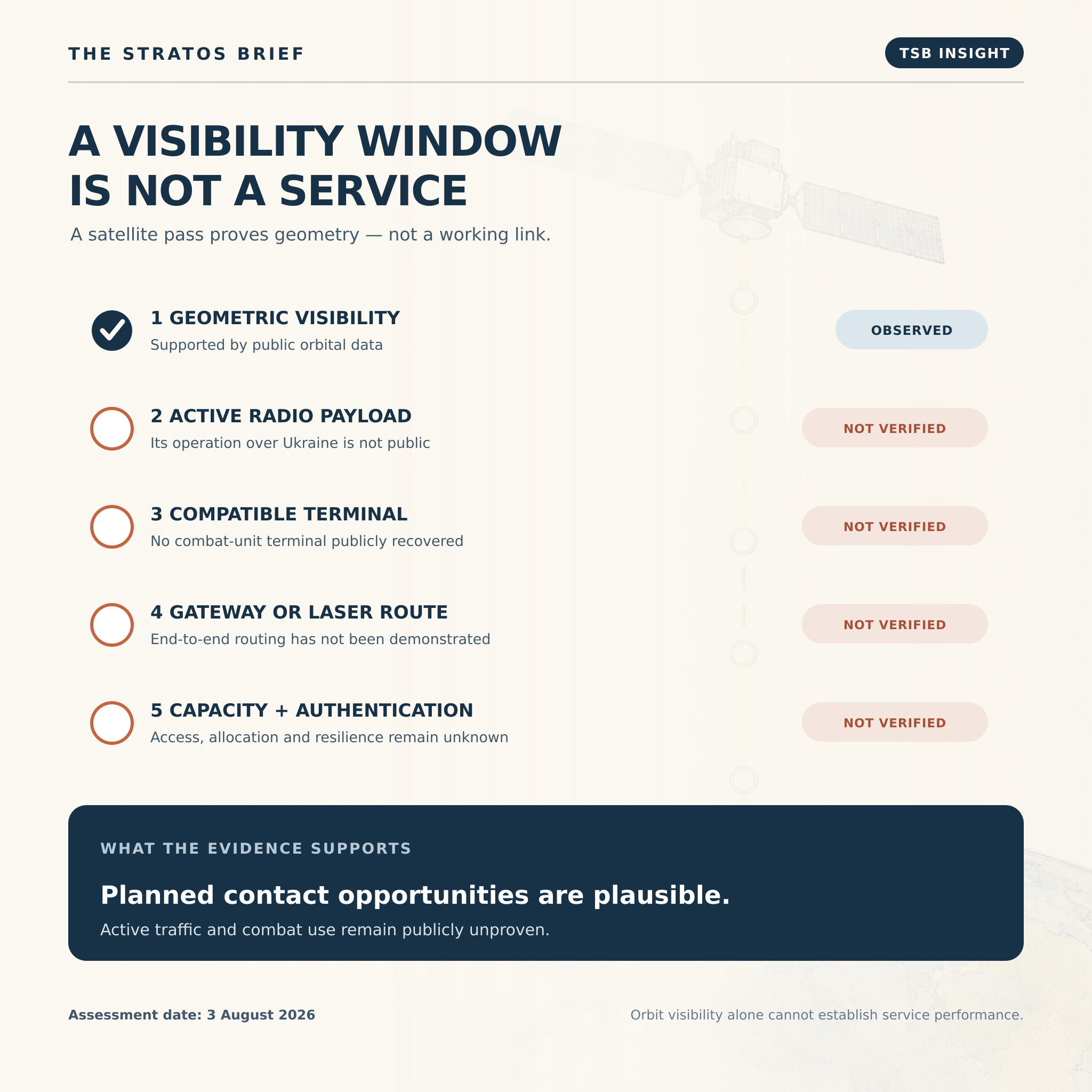
Orbital visibility alone does not establish a functioning communications service. Reliable connectivity also requires compatible terminals, sufficient satellite capacity, ground gateways or inter-satellite links, and continuous network operation.
Third, the arithmetic should not be stretched beyond what the source supports. Two or three suitable passes of one to one and a half hours could imply a theoretical range of roughly two to four and a half hours. The robust public claim, however, is only that there are at least two windows of more than an hour each. The upper end should not be treated as guaranteed availability.
The most accurate description is therefore not that Rassvet is already providing a normal internet service over Ukraine. It is that the March satellites have formed a geometry capable of supporting scheduled communications sessions for at least part of the day.
If the July group follows a similar deployment pattern, Stepanets estimates that it could add two more daily windows around October or November [6]. That is a plausible scenario, not a Bureau 1440 commitment. The windows could overlap, and usable service would still depend on radio performance, terminals, gateways, laser links, capacity management and resistance to interference.
The military purpose is now explicit. Combat use is not
In April, Rassvet’s military relevance could be inferred from the strategic value of sovereign LEO communications, Russian policy statements and the experience of Starlink in Ukraine. Since then, the political signalling has become more direct.
During a 12 June exchange concerning satellite-based control of heavy drones, Putin said that work had been under way since 2023, named Bureau 1440 and said Russia was expanding the constellation. He also claimed that the system was not inferior to Starlink and might surpass it in some respects [7].
The first part is significant because it publicly associates Bureau 1440 with a military communications requirement. The comparison with Starlink is a political assertion, not a technically supportable description of the current system. Rassvet has 31 production-series spacecraft in orbit, no public commercial service, no independently demonstrated coverage network and no published independent performance tests for the Rassvet-3 generation.
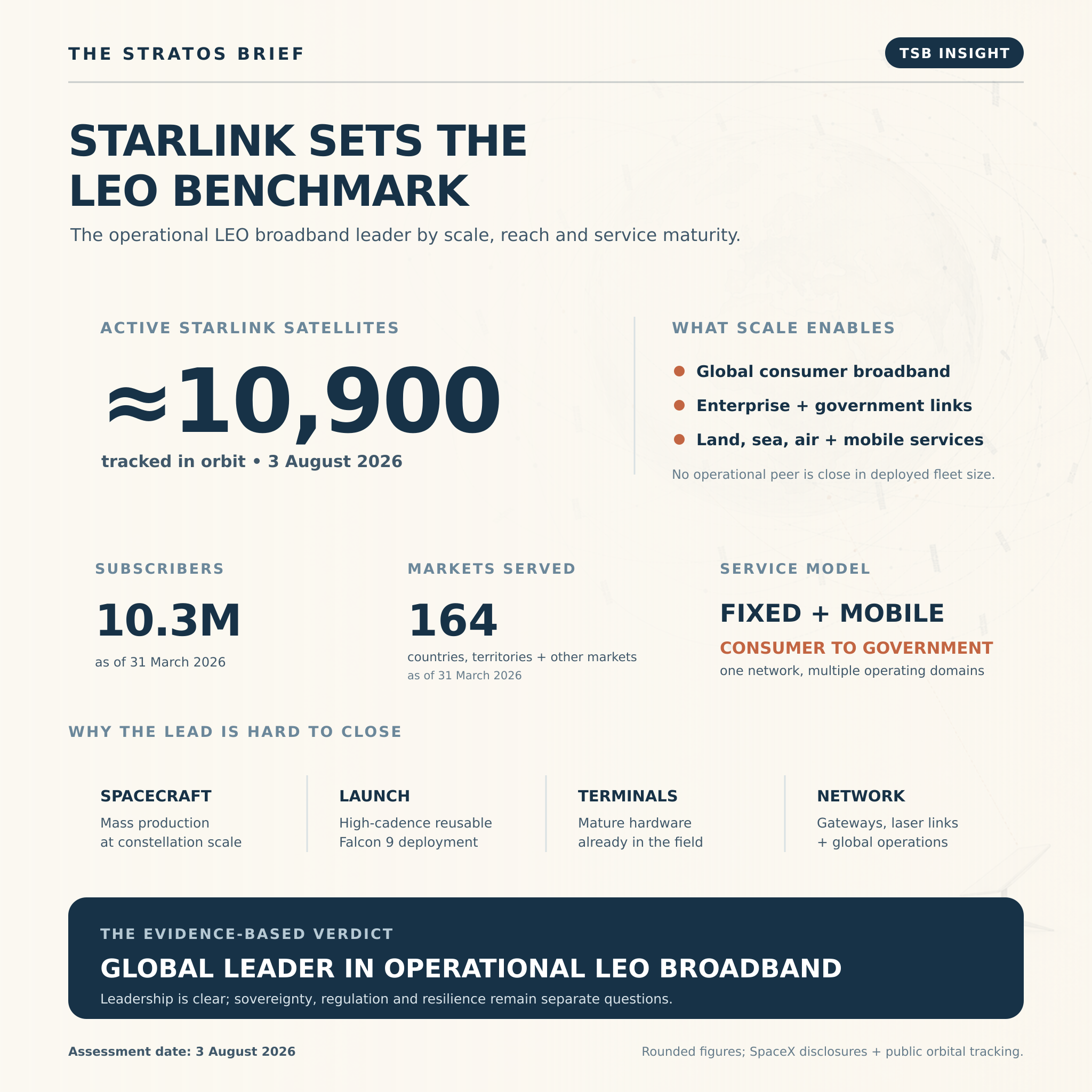
With approximately 10,900 active satellites as of 3 August 2026 and 10.3 million subscribers across 164 markets as of 31 March, Starlink remains the global benchmark for operational LEO broadband connectivity.
The strategic motivation is nevertheless clear. In February, Ukraine and SpaceX introduced an authorisation regime intended to disable unauthorised Starlink terminals used by Russian forces. Kyiv reported disruption to Russian communications and assault operations, although Reuters noted that the full scale of the effect was unclear [8]. A domestically controlled network would remove dependence on an American company’s authentication, geofencing and service-denial decisions.
Even intermittent access can have military value. Two predictable hour-long windows per day could potentially support:
periodic retasking of a long-range unmanned aircraft;
transmission of telemetry, status reports and selected imagery;
target updates during an otherwise autonomous mission;
beyond-line-of-sight links to naval drones or surface vessels;
scheduled backup communications for command posts, vehicles or specialised units; and
synchronisation of a mission’s most communications-intensive phase with a satellite pass.
Between those windows, the platform would need to remain autonomous, store data or use another communications channel. This would make Rassvet a planned supplementary layer, not an always-available substitute for Starlink.
Public reporting places the current Bureau 1440 user terminal at up to approximately 60 by 60 centimetres and below 15 kilograms, using an electronically steered phased-array antenna [6]. If accurate, that would make early integration most credible on command vehicles, fixed sites, ships and larger reconnaissance or strike UAVs. It would be much less suitable for ordinary small FPV drones. Integration on Geran-family aircraft, cruise missiles or glide bombs remains a scenario discussed by Ukrainian analysts, not a confirmed finding from recovered hardware.
As of 3 August, The Stratos Brief found no publicly verifiable evidence of:
a Rassvet terminal fielded by a Russian combat unit;
a terminal recovered from the wreckage of a UAV or missile;
measured Rassvet data traffic over Ukraine;
a combat mission directly attributable to the network; or
an independent speed, latency or capacity test of a production Rassvet-3 satellite.
The balanced conclusion is that Russia has now confirmed the intended military role and created potentially useful orbital geometry. It has not yet publicly demonstrated combat use.
The unresolved question: 800, 550 or 514 kilometres?
Bureau 1440 continues to advertise an 800-kilometre operating altitude, speeds of up to 1 Gbit/s per terminal, latency below 70 milliseconds, laser inter-satellite links and seamless global coverage once the constellation is complete [1].
The observable orbits do not yet match that architecture.
Most of the leading March satellites stopped climbing between roughly 510 and 550 kilometres. On 2 August, for example, Rassvet-3 16 was in an orbit of approximately 510 by 513 kilometres. Other spacecraft remained considerably lower, while a spacecraft from the July group was still close to its initial 300-kilometre deployment orbit [4].
Russian communications publication ComNews asked several industry specialists to interpret the pattern. Andrei Gritsenko of the Northern Crown Information Space Centre assessed approximately 514 kilometres as a possible new working altitude. Other experts cautioned that the spacecraft could instead be undergoing tests, phasing and communications checks before resuming their climb. Bureau 1440 did not answer ComNews’s question about whether the target altitude had changed [5].
A permanent move from 800 to roughly 514 kilometres would involve real trade-offs.
The shorter signal path could improve the radio link and reduce latency. A failed satellite would also re-enter sooner instead of remaining in orbit for decades. Against that, each spacecraft would cover a smaller area, handovers would become more frequent, atmospheric drag and station-keeping demand would rise, and the constellation could require more satellites than the original architecture assumed. A lasting change might also require revisions to orbit and frequency coordination filed through the International Telecommunication Union [5].
None of those consequences makes the lower orbit inherently wrong. Starlink itself operates much of its network around similar altitudes. The issue is whether Bureau 1440 deliberately redesigned its architecture, is temporarily testing at a lower level, or encountered limits in orbit raising. Only the operator — or the subsequent trajectory of the July group — can resolve that question.
The more difficult problem is deployment tempo
Russian programme documents have cited a target of 156 satellites in orbit in 2026, rising to 292 in 2027 and 318 in 2028. A separate government target calls for 383 spacecraft to be manufactured between 2025 and 2030, including 91 replacements needed to sustain a nominal 292-satellite constellation [9]. These figures describe different measures — annual in-orbit targets, nominal constellation size and total production including replacements — and should not be treated as interchangeable.
At the beginning of August, only 31 production-series spacecraft remained in orbit. Reaching 156 by year-end would require approximately 125 additional functioning satellites. If future batches remain at 16 spacecraft, that means at least eight more launches in about five months: roughly one every 19 days. The first and second production launches were separated by almost four months.
Russia could accelerate production and launch cadence, and two data points do not establish a permanent rate. Even so, the present gap is so large that the 156-satellite objective now appears highly unlikely without a step change in manufacturing and launch operations.
This does not mean the programme is fictitious or doomed. Two production launches, active orbit raising, formation building and a second orbital plane are tangible progress. It means the original schedule is running behind the pace required to fulfil its own published targets.
The possible lower operating altitude adds another uncertainty. If Bureau 1440 settles near 514 kilometres, the number of spacecraft needed for continuous wide-area coverage could be higher than estimates built around 800 kilometres.
Civil demand is becoming more concrete
Rassvet is not solely a military programme. Bureau 1440 presents it as infrastructure for transport, mining, remote industry, telecommunications backhaul, aviation, shipping, emergency services, healthcare and regional government [1]. Since April, two developments have given that commercial narrative more substance.
First, Bureau 1440 and Russian Railways developed a plan to equip 135 Sapsan and Lastochka trains with satellite terminals. Public reporting identifies routes including Moscow–St Petersburg, Moscow–Nizhny Novgorod, Moscow–Minsk and St Petersburg–Pskov. The implementation roadmap begins with tests of the subscriber terminal before the service enters operation [10].
Second, Bureau 1440 and Belarusian national satellite operator Belintersat signed a strategic partnership to test and integrate the Russian LEO service into Belarusian infrastructure and establish a national partner network [11]. It is the programme’s clearest publicly announced step beyond the Russian market.
Both are serious indicators of intended demand. Neither proves that a large-scale service is ready. There is still no public coverage map, confirmed user count, current retail price, independently measured service performance or evidence of mass-produced terminal availability.
Rassvet’s most credible early market is therefore business-to-business and business-to-government: rail operators, telecom providers, state agencies, remote industries and neighbouring governments. A mass consumer product is likely to come later, if the space and ground segments scale successfully.
The wider sovereign-connectivity race
Rassvet is part of a much broader trend. Governments increasingly view space-based communications not only as a commercial utility but as infrastructure whose owner can grant, restrict or prioritise access during a crisis. The relevant international projects, however, are not direct equivalents.
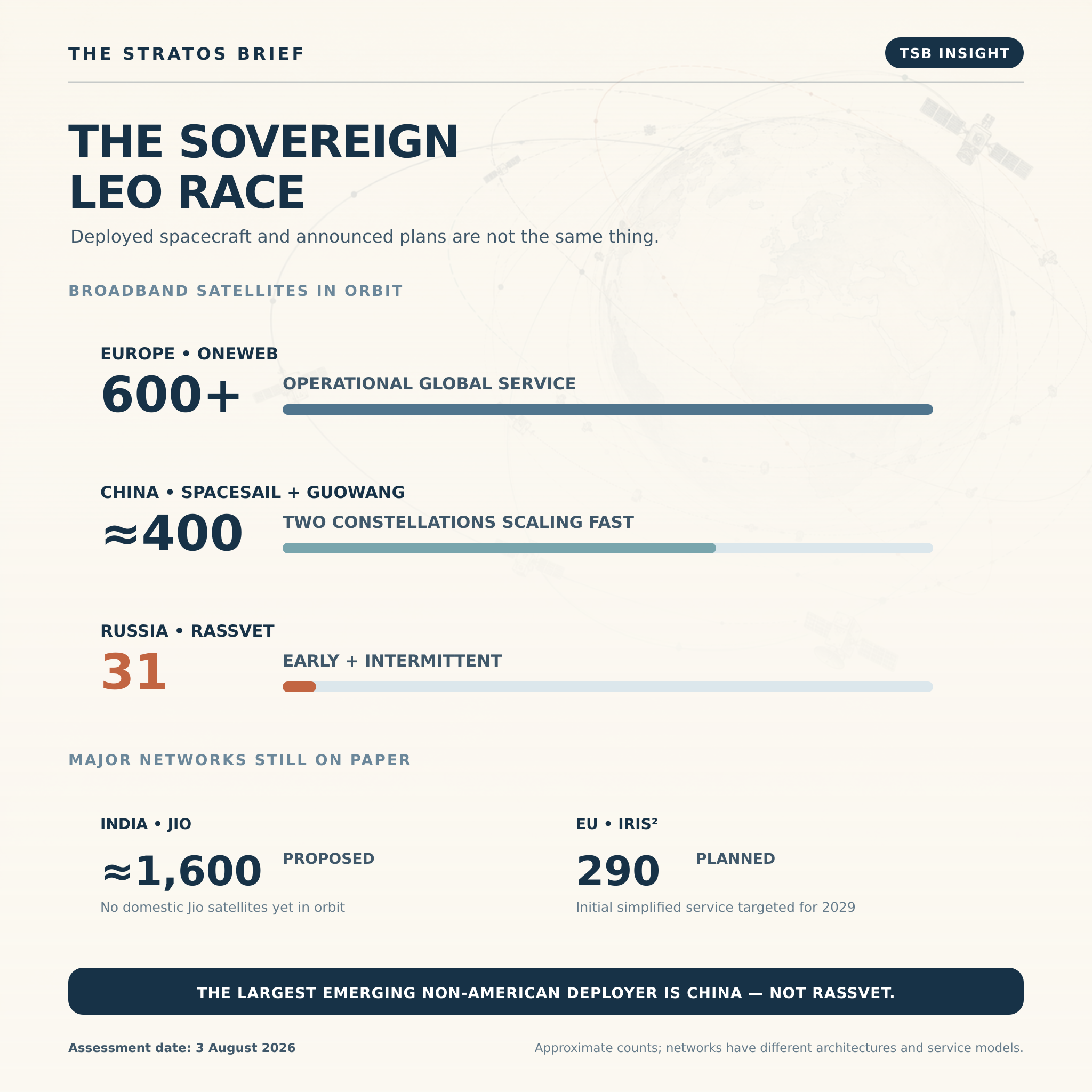
Russia, China, Europe and India are pursuing distinct approaches to sovereign satellite connectivity. Their systems differ substantially in scale, maturity, architecture and intended users, making direct comparisons inherently approximate.
China: already operating at a different scale
China is building two major broadband constellations in parallel. The more commercially oriented SpaceSail, also known as Qianfan, had 200 satellites by 5 June and launched another group of 18 on 4 July. It has also reported a direct-to-cell voice test using an unmodified smartphone. Public orbital tracking places the more state-centred Guowang constellation at roughly 190 spacecraft by mid-2026 [12].
The combined Chinese deployment is therefore already measured in hundreds, with a much faster recent launch tempo than Rassvet. China still trails Starlink in scale, service maturity, terminal availability and launch economics, but it is clearly ahead of Russia in serial deployment. The largest emerging non-American challenger is China, not Rassvet.
Europe: service now, a new institutional system later
Eutelsat OneWeb already operates a global network of more than 600 LEO satellites for government, enterprise, maritime, aviation and other mobility users. Eutelsat has arranged the procurement of 440 additional spacecraft to replace early units and maintain continuity [13].
EU GOVSATCOM became operational in early 2026 by pooling existing national and commercial capacity for authorised governmental users. It is not a newly launched constellation. The EU’s dedicated IRIS² architecture is planned as a 290-satellite multi-orbit system, with an initial simplified service targeted for 2029 and fuller capacity later [13].
Europe therefore has usable LEO and secure governmental capacity today, but its new EU-level sovereign constellation is still several years from deployment.
India: a larger plan, but only on paper for now
Reliance Jio has proposed a sovereign Indian constellation of approximately 1,600 satellites, with 20 to 22 ground stations and a mix of broadband, backhaul and direct-to-device services. India’s space regulator IN-SPACe judged the proposal technically sound in July, allowing work on international orbital filings to advance [14].
That is an important regulatory milestone, not a completed authorisation or an operational constellation. No satellite from this proposed domestic network is yet in orbit. Russia therefore leads India in deployed hardware, while Jio’s financial resources, terrestrial customer base and domestic market could support much faster scaling if the plan receives full approval and funding.
Japan: sovereignty through direct-to-device service
Japan is pursuing a different model. The government plans to provide up to 148 billion yen in support for a Rakuten-led satellite communications project, while Rakuten is working with the US company AST SpaceMobile. The partners have already demonstrated a video call between ordinary smartphones and a LEO satellite and aim to commercialise satellite-to-mobile broadband from 2026 [15].
This is not a Japanese broadband megaconstellation equivalent to Rassvet. It is a direct-to-device service in which a Japanese operator and public policy shape access, while critical spacecraft technology comes from an American partner.
Australia: specialised networks rather than a domestic Starlink
Australia has domestic LEO activity, but not a planned broadband megaconstellation on the scale of Rassvet. Fleet Space and Myriota operate specialised communications and low-power Internet-of-Things services. A consortium led by Optus is developing a single sovereign LEO research satellite, expected to launch in 2028, with radio, optical communications and potential defence applications [16].
Australia’s model is currently a combination of foreign commercial services, specialised domestic networks and sovereign technology demonstrators rather than a national Starlink-style system.
What Rassvet is — and is not — in August 2026
Rassvet is no longer merely a proposal or a small experimental mission. Russia has launched two production-series batches, retained 31 spacecraft in orbit, created a second orbital plane and manoeuvred most of the first group into a formation capable of providing regular geometric access. The Russian president has publicly connected Bureau 1440 to satellite-enabled drone control, while railway and Belarusian partnerships are beginning to define a civil market.
Rassvet is also not yet a Russian Starlink in any practical sense. It does not offer proven continuous coverage, its working altitude remains uncertain, its deployment schedule is slipping, one of its first 16 production spacecraft was lost, and no public evidence demonstrates operational combat use or independently verified Rassvet-3 performance.
The best assessment is therefore:
Rassvet has become a strategically relevant emerging communications layer, but it remains an early and intermittent one. Its threat and commercial potential are real; claims of parity with Starlink are not supported by the evidence now available.
Why this matters for business, military and political leaders
For business leaders
Rassvet is beginning to move from programme ambition to identifiable customers in transport, telecommunications and state-linked infrastructure. The relevant opportunity is currently institutional connectivity in Russia, Belarus and other politically aligned markets — not mass consumer broadband.
The key commercial indicators to watch are terminal production, published service pricing, railway trials, gateway deployment and the first independently measured performance data.
For military leaders
Regular but intermittent communications windows can still support selected beyond-line-of-sight tasks, especially for large autonomous platforms designed to store data and operate between passes. Monitoring should focus not only on satellite counts, but also on terminal recovery, radio emissions, gateways and actual integration with UAV and maritime systems.
At the same time, geometric visibility must not be misreported as confirmed battlefield connectivity. The system’s current value is plausible and increasingly relevant, but its combat performance remains unknown.
For political leaders
Rassvet demonstrates why communications sovereignty has become a strategic priority. Foreign control of authentication, coverage and access can become a wartime vulnerability, whether the dependent state is Russia, a European country or another user of commercial space infrastructure.
The broader comparison also matters: Russia is making measurable progress, Europe already has operational alternatives, and China is scaling two constellations at a substantially faster rate. The emerging contest is not simply Starlink versus Rassvet, but a wider fragmentation of orbital communications into commercial, national and alliance-controlled ecosystems.
What to watch next
Whether the July satellites climb towards 800 kilometres or join the 500–550-kilometre layer.
Whether a third production launch occurs before autumn and at what batch size.
Whether Bureau 1440 publishes operational tests, coverage maps or customer-service data.
Whether terminals appear in Russian military units or recovered unmanned systems.
Whether railway trials begin and the Belarus partnership moves into practical integration.
Whether the launch cadence moves meaningfully closer to the programme’s official targets.
Sources and what each one establishes
[1] Bureau 1440 — official technical overview and programme timeline. Operator source for the advertised 800-kilometre architecture, speeds of up to 1 Gbit/s, latency below 70 ms, laser links, target industries and confirmation that the second batch reached orbit. These are company claims unless independently verified.
[2] RussianSpaceWeb — “The second batch of ‘Russian Starlink’ satellites launches”. Independent reconstruction of the 19 July launch, probable 16-satellite payload, estimated launch time, subsequent US catalogue entries, insertion orbit and separation of the March and July orbital planes.
[3] RussianSpaceWeb — orbital chronology of the 23 March Rassvet launch. Tracks the first group’s manoeuvres, the loss of Object 4, recovery of another low spacecraft, formation of the first satellite chain and the 800-kilometre architecture described in known ITU filings.
[4] Orbital Radar — Rassvet-3 16 and N2YO — Rassvet-3 20. Public TLE-derived orbital records used to check the approximate altitude of a leading March satellite and the continuing low insertion orbit of a July spacecraft. TLE data establish trajectory, not communications activity.
[5] ComNews — “New altitude: Bureau 1440 may have lowered its target orbit”. Russian industry analysis of NORAD data and competing expert interpretations of the apparent 514-kilometre layer, including technical trade-offs and Bureau 1440’s lack of confirmation.
[6] Kyiv Post — “Russian ‘Rassvet’ Satellites Secure Two Daily Comms Windows Over Ukraine”. English-language account of Volodymyr Stepanets’s original analysis for Militarnyi, covering the late-July formation, estimated daily visibility windows, reported terminal dimensions and possible uses. It is one underlying Ukrainian expert assessment, not independently demonstrated service traffic.
[7] Reuters — Putin on Russia’s satellite-based drone-control work and Reuters Connect video transcript.Establishes the context in which Putin named Bureau 1440 and made the political claim that its system was not inferior to Starlink.
[8] Reuters — “Ukraine says Starlink terminals used by Russia deactivated in blow to Moscow”. Reports Kyiv’s account of the February authorisation measures, claimed disruption to Russian operations and the uncertainty over the full scale of the effect.
[9] Russian Ministry of Digital Development target reproduced by ConsultantPlus and Kommersant — federal project schedule. Sources for the 292-spacecraft nominal constellation, 383 manufactured spacecraft including 91 replacements, and the published annual deployment targets and planned launch programme.
[10] Forbes Russia — planned satellite internet for long-distance trains. Reports the plan for 135 Sapsan and Lastochka trains, named routes and the sequence of terminal testing followed by service introduction.
[11] Belarusian State Authority for Military Industry — Bureau 1440–Belintersat partnership. Official Belarusian account of the strategic partnership, planned integration with Belintersat infrastructure and creation of a domestic partner network.
[12] Xinhua — SpaceSail reaches 200 satellites and tests direct-to-cell, CGWIC — 18-satellite SpaceSail launch on 4 July and Orbital Radar — Guowang and Qianfan status. Chinese official reporting and public orbital tracking used to establish the approximate scale and launch tempo of China’s two parallel broadband systems.
[13] Eutelsat — OneWeb LEO constellation, Eutelsat — February 2026 results and procurement update, European Commission — EU GOVSATCOM and European Commission — IRIS². Official sources for OneWeb’s operational 600-plus-satellite network and procurement of 440 additional spacecraft, the start of GOVSATCOM operations and the planned 290-satellite IRIS² architecture.
[14] Business Standard — Reliance Jio’s proposed 1,600-satellite network. Reports IN-SPACe’s technical assessment, the planned constellation scale, ground segment and service model. The project remains a proposal rather than a deployed network.
[15] Reuters — Japanese support for the Rakuten satellite project and Rakuten — satellite-to-mobile video-call demonstration. Sources for planned Japanese public funding, the AST SpaceMobile partnership, the completed direct-to-device demonstration and intended commercialisation from 2026.
[16] Australian Department of Defence — sovereign LEO research project, Australian Space Agency — Optus-led satellite consortium and Myriota — July 2026 constellation expansion. Official and operator sources showing Australia’s focus on a research spacecraft and specialised IoT networks rather than a domestic broadband megaconstellation.
Source note
Information cut-off: 3 August 2026. Russian official and company statements are treated as statements by programme stakeholders; Ukrainian military assessments are identified as such; independent orbital observations are used for objectively observable trajectories but cannot demonstrate communications traffic or service quality.