THE ADVANTAGE IS NOT THE DRONE

Four Clocks That Decide Whether a Military Can Change Before Its Advantage Expires
Date published: 08 August 2026
Assessment date: 08 August 2026
Event location: Ukraine / Russia
Event type: Uncrewed Systems Development
THE ARTICLE IN 20 SECONDS
Drone advantage expires / Four clocks govern / Slowest clock constrains / Evidence prevents failure
A new drone appears over the front. For a time, it works partly because the opposing side is not ready for it. Then its wreckage is recovered. Frequencies are mapped. Flight patterns are studied. Operators change tactics, engineers modify countermeasures and factories prepare the next production run.
The original drone has not necessarily become worse. Its advantage has simply begun to expire.
The war between Russia and Ukraine provides the case study, but the principles examined here extend far beyond it. A successful system can still create a valuable operational window, but the window rarely remains open indefinitely. The opposing side does not need to reproduce the same aircraft. It can build a different machine for the same mission, change its tactics, introduce a countermeasure or compensate through scale.
The lasting advantage is therefore not the drone alone. It is the speed at which an institution can recognise that something has changed, understand why it matters, build a credible response and field it before the opportunity disappears.
That process runs on four clocks.
SIX MACHINES, THREE MISSIONS
Russia and Ukraine now operate uncrewed systems across many of the same mission categories. The following pairs are not technical twins, and placing them together does not imply direct copying, common lineage or chronological causation. They illustrate something more important: a capability can be matched through a different machine.
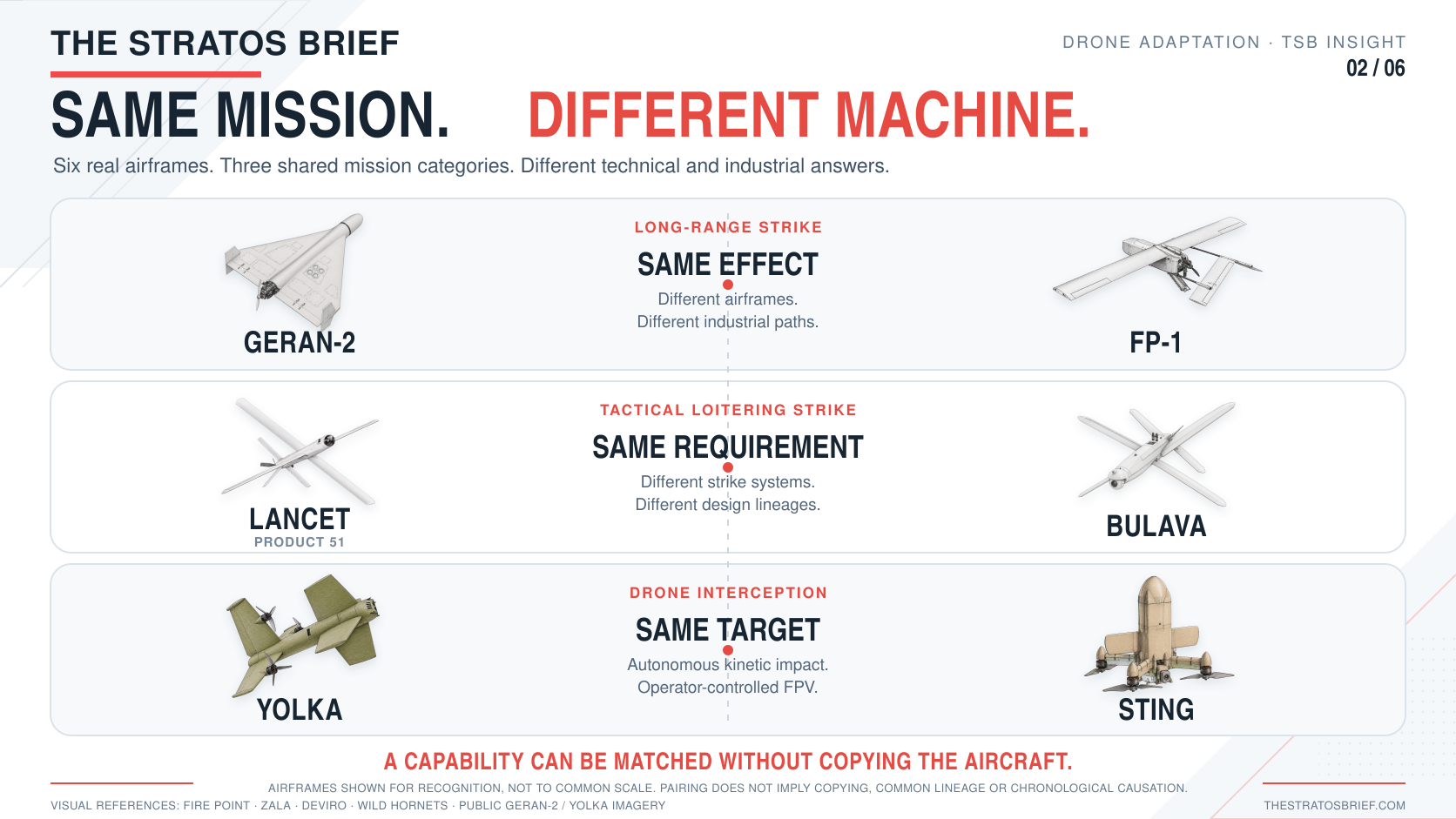
Different airframes can answer the same broad mission. The pairings show functional convergence, not direct copying, common lineage or a scale comparison.
LONG-RANGE STRIKE: GERAN-2 | FP-1
Geran-2 and FP-1 occupy the broad category of long-range one-way attack systems, but they arrived there through different airframes, industrial pathways and operating concepts. Russia has continued to modify the Geran family; in December 2025, the Kremlin said an improved Geran-2 with updated control and guidance had undergone combat testing. Fire Point currently presents FP-1 as a deep-strike system with a manufacturer-stated range of up to 2,600 kilometres, a payload of up to 60 kilograms and an 18-minute launch preparation time. The mission category is shared. The machines are not.
TACTICAL LOITERING STRIKE: LANCET | BULAVA
The same pattern appears closer to the front. ZALA said in May 2025 that its Product 51 and Product 52 Lancet munitions had received new communications channels and an intelligent guidance system. Ukraine’s DeViRo describes Bulava as an independently developed strike-and-reconnaissance system for moving and fixed targets, with day-and-night optics, resistance to electronic-warfare suppression and an ability to operate without GPS. Both address the need to find and strike tactical targets beyond the immediate reach of direct-fire weapons, but they package that function differently.
DRONE INTERCEPTION: YOLKA | STING
The interceptor category makes the contrast even clearer. Yolka’s developer describes a 1.3-kilogram Russian system that acquires its target autonomously and destroys it through kinetic impact, without an explosive warhead or a control link after lock-on. Wild Hornets describes Sting as a Ukrainian FPV interceptor controlled by radio, fitted with remote detonation and capable of a manufacturer-stated maximum speed of 280 kilometres per hour. One concept seeks to remove the pilot from the terminal engagement; the other builds on skills and components already present in the FPV ecosystem. The requirement is similar. The answer is not.
Public data are not equally complete for all six systems. Specifications and performance statements in this section are attributed to governments or manufacturers and are not presented as independently verified results.
FOUR NUMBERS BEHIND THE LOOP
These figures are not a scorecard. They measure different parts of the adaptation system and should not be compared as though they describe equivalent performance. Together, however, they show why the story is larger than airframes.
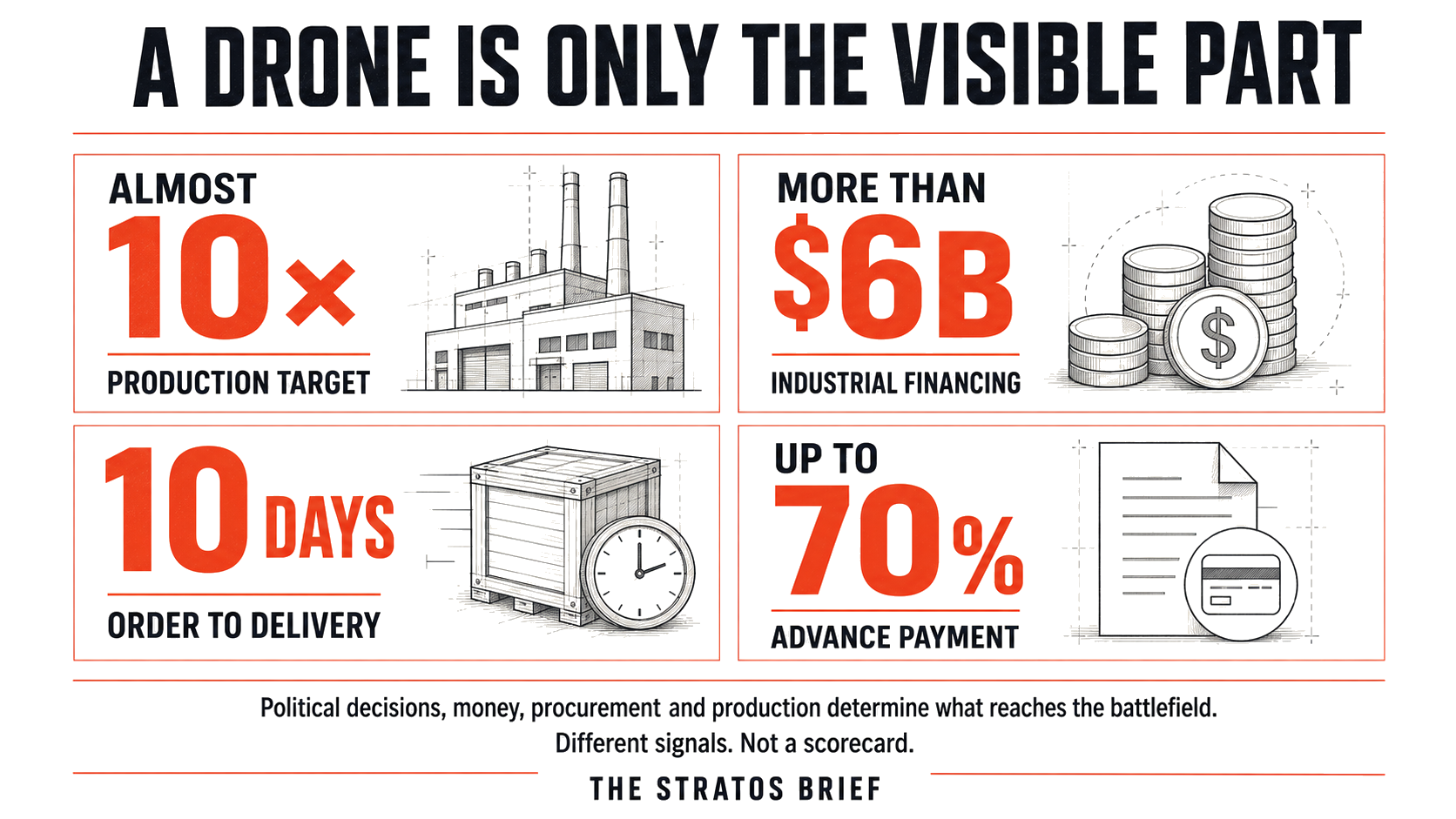
Four different signals reveal the system behind the airframe: production ambition, industrial financing, procurement speed and working capital. They measure different things and are not a scorecard.
ALMOST 10×
The increase in Russian UAV production that President Vladimir Putin said had been planned for 2024. It was a political and industrial target, not an independently verified output figure.
MORE THAN $6 BILLION
Foreign financing that Ukraine’s Ministry of Defence said was directed to the country’s defence industry in 2025.
10 DAYS
The average interval from order to delivery reported for equipment moving through Ukraine’s DOT-Chain Defence system.
UP TO 70%
The advance payment available through DOT-Chain Defence to qualifying manufacturers whose average delivery time does not exceed 30 calendar days.
FOUR CLOCKS DEFINE THE ADVANTAGE
The four clocks do not run in a neat sequence. They overlap, restart and sometimes contradict one another. A breakthrough on one clock can be wasted by delay on another. The slowest can constrain the entire system.
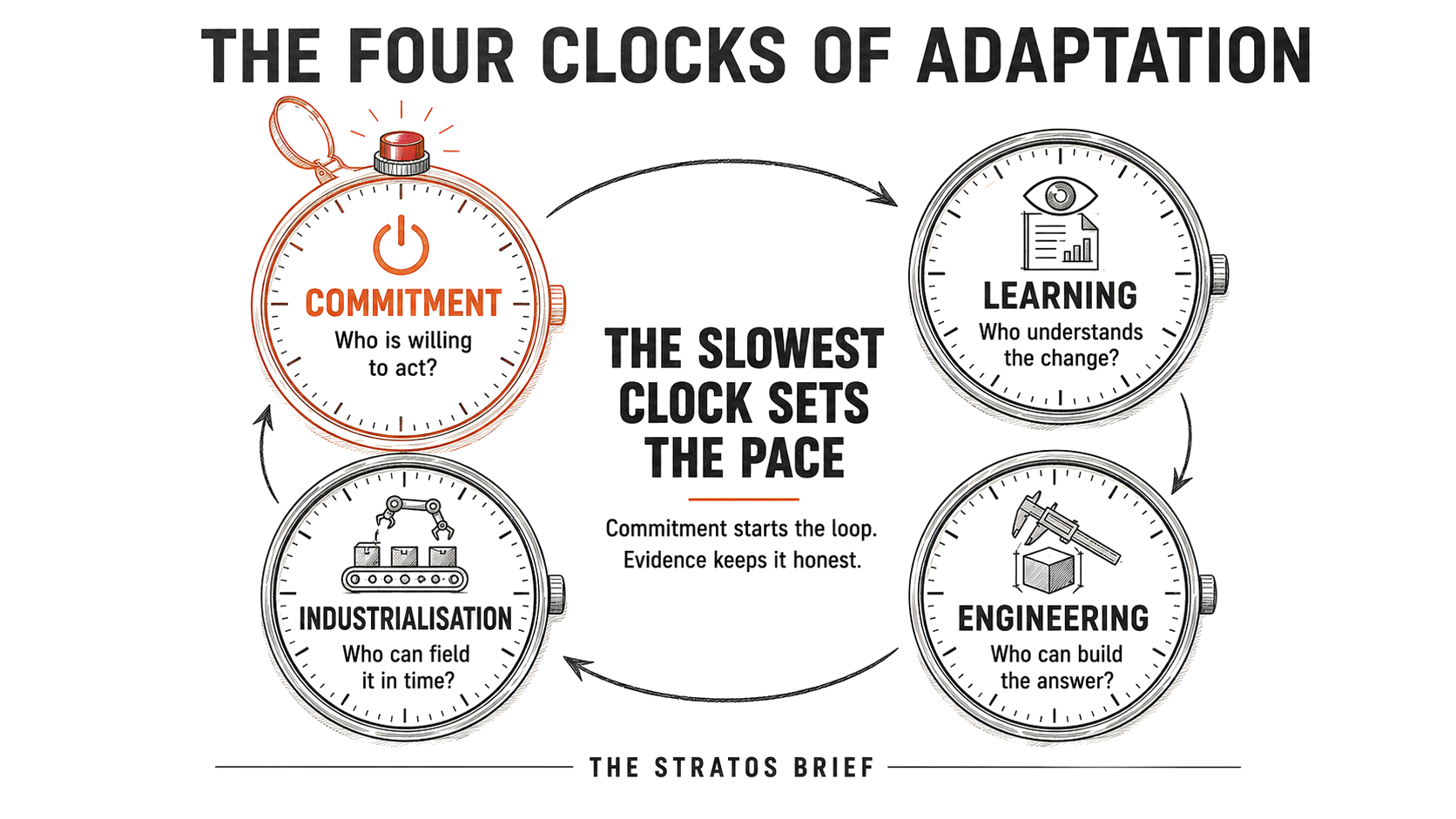
Military adaptation depends on four connected clocks. Strategic commitment starts the loop, but learning, engineering and industrialisation determine whether a validated response reaches the field in time.
1. WHO IS WILLING TO CHANGE?
The Strategic Commitment Clock
WHAT IT MEASURES
The time between the emergence of a challenge and a funded, institutionally supported decision to address it.
WHAT FAILURE LOOKS LIKE
Frontline personnel identify a problem and engineers propose an answer, but nobody with sufficient authority changes priorities, protects experimentation or releases sustained funding. The institution continues buying familiar equipment because it is easier to approve, not because evidence shows that it remains the best response.
CONCRETE SIGNAL
Russia’s publicly stated production target and Ukraine’s use of foreign financing, grants, lending and separately funded drone programmes are different expressions of strategic sponsorship. They show leadership attempting to turn a recognised need into institutional demand.
WHY IT MATTERS
Adaptation is not self-executing. A good idea without a sponsor may remain a workshop project. Strategic commitment starts the loop—but it can also fund the wrong answer, which is why the second clock matters.
2. WHO UNDERSTANDS WHAT CHANGED?
The Learning Clock
WHAT IT MEASURES
The time required to turn battlefield evidence into a reliable requirement.
WHAT FAILURE LOOKS LIKE
An institution reacts to a dramatic incident instead of a recurring pattern, mistakes correlation for cause or solves the most visible part of a problem rather than the part that determines operational effect.
CONCRETE SIGNAL
Ukraine’s Ministry of Defence says its After Action Review process now examines large-scale aerial attacks. TrophyLab collects drawings, technical data and analytical findings on captured Russian weapons, while registered researchers can request physical samples or fragments. ZALA, from the Russian industrial side, says combat experience has informed successive hardware and software changes to the Lancet family.
WHY IT MATTERS
Wreckage, operator reports and strike footage are not lessons by themselves. They become useful only when an organisation collects them, tests competing explanations and sends a credible requirement to people able to act.
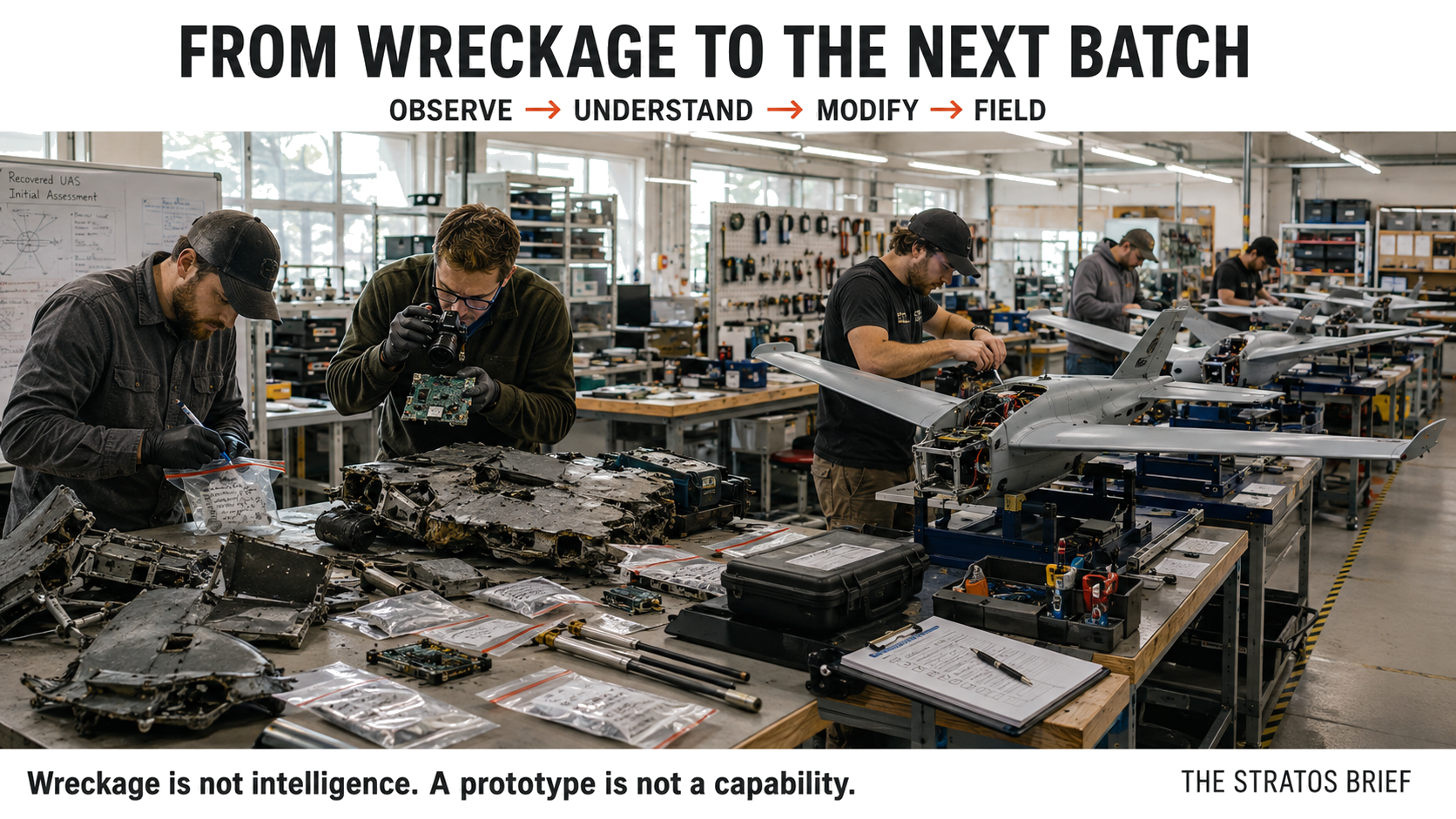
Illustrative visualisation of the path from recovered material to the next production batch. Wreckage becomes intelligence only through analysis; a prototype becomes capability only through fielding.
3. WHO CAN BUILD A WORKING ANSWER?
The Engineering Clock
WHAT IT MEASURES
The time required to convert a credible requirement into a solution that survives realistic testing.
WHAT FAILURE LOOKS LIKE
A prototype works once under controlled conditions but fails under electronic warfare, bad weather, operator stress or manufacturing variation. Alternatively, developers spend so long pursuing the ideal replacement that a useful modification never reaches the field.
CONCRETE SIGNAL
In January 2026, ZALA said a new single-use launcher for Product 51E had completed combat testing and entered mass production. The change did not replace the munition; it was intended to reduce launch preparation, crew exposure and the equipment that had to be recovered after firing.
WHY IT MATTERS
The quickest effective answer may be a new communications link, sensor, launcher, software model, warhead or tactic—not a new aircraft. Speed matters only when paired with validation. Otherwise, a rapid engineering cycle merely produces failure faster.
4. WHO CAN FIELD IT BEFORE IT EXPIRES?
The Industrial Clock
WHAT IT MEASURES
The time between a validated answer and sustained operational use in relevant numbers.
WHAT FAILURE LOOKS LIKE
A technically successful system remains a demonstration because contracting, working capital, components, quality control, training, repair or logistics cannot keep pace.
CONCRETE SIGNAL
DOT-Chain Defence is designed to let Ukrainian units select systems within an allocated budget while the procurement agencies handle financial, legal and logistical processes. The ministry reports a ten-day average from order to delivery. Its 2026 advance-payment mechanism directly addresses manufacturers constrained not by technology, but by the cash needed to increase output.
WHY IT MATTERS
A technically superior drone arriving after the requirement has changed may matter less than an adequate one available now. A prototype proves possibility. Industrialisation decides whether that possibility becomes military power.
SOMETIMES MORE OF THE OLD IS THE INNOVATION
Adaptation should not be confused with a permanent demand for novelty.
Sometimes the correct answer is a new platform. Sometimes it is revised software, a different frequency, a new launcher or a change in tactics. And sometimes evidence shows that an existing system still works—the real shortage is quantity, trained crews or ammunition.
Producing more of the old can therefore be rational. The failure occurs when an institution defaults to familiar means without seriously testing whether they can still create the required effect. Quantity is not the opposite of innovation when it follows a conscious assessment. It becomes a substitute for innovation when it replaces one.
THE SLOWEST CLOCK SETS THE PACE
Political commitment without disciplined learning can fund the wrong answer. Learning without engineering produces accurate reports but no new capability. Engineering without industrialisation creates demonstrations rather than operational mass. Industrial capacity without renewed evidence can efficiently manufacture a system whose relevance is already declining.
The objective is not to make every clock run at maximum speed. It is to keep all four connected through evidence, validation and correction.
CAN A MILITARY ACTUALLY ADAPT?
Four questions provide a quick test:
Is there an authority able and willing to fund and enforce change?
Do frontline observations reach people who can revise requirements?
Does the proposed answer survive realistic operational testing?
Can it be delivered, supported and used before the requirement changes again?
A military that cannot answer one of these questions has located its slowest clock.
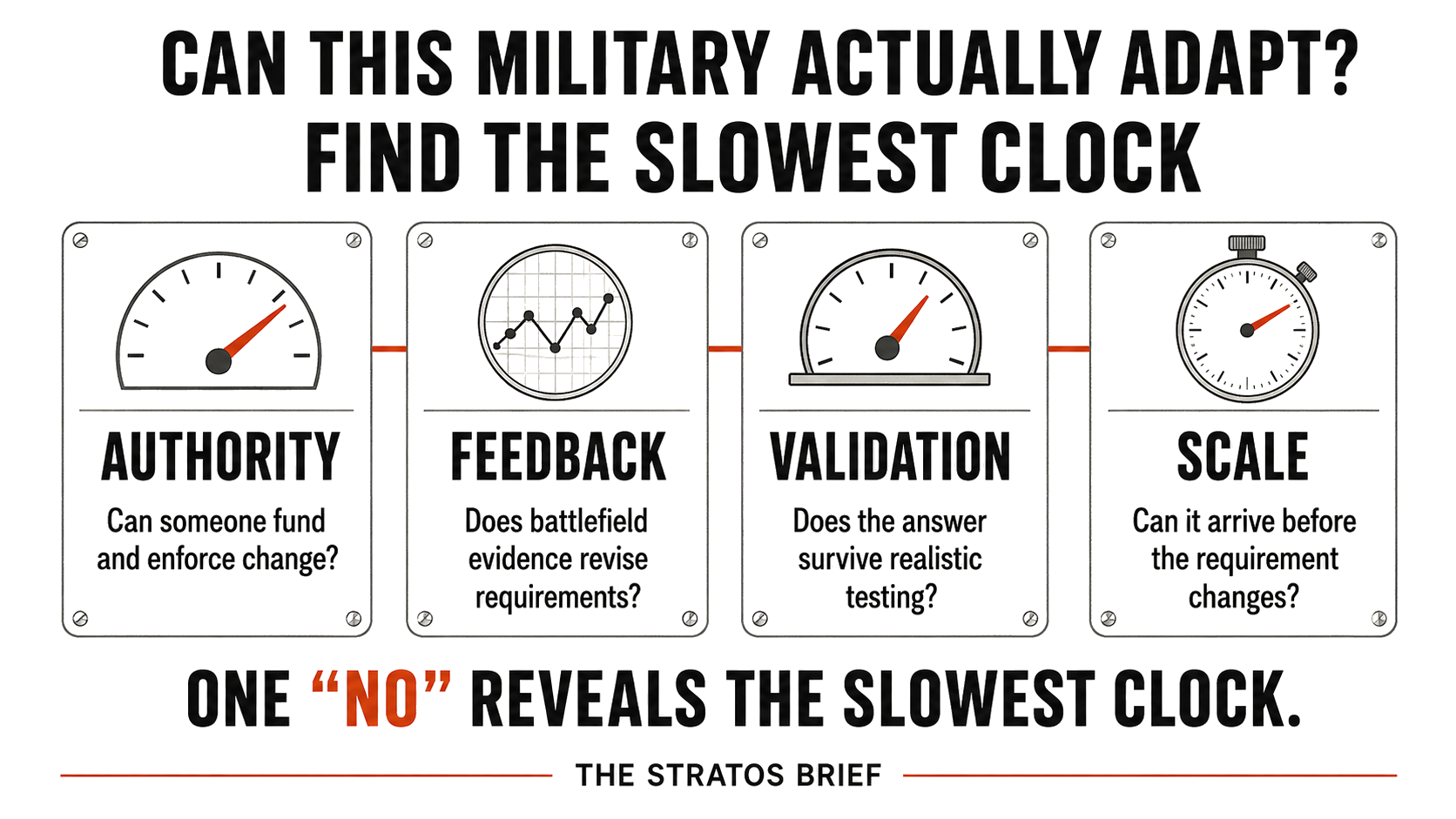
A military’s weakest answer across authority, feedback, validation and scale identifies the clock most likely to constrain adaptation.
THE ANSWER IS THE LOOP
Technological superiority has not disappeared. It has moved.
A superior drone can still matter. Better range, resilience, autonomy or production economics can create a significant operational window. But the evolving Russian and Ukrainian arsenals show why that window is perishable. Once a capability is repeatedly demonstrated, its value becomes visible—and so does the incentive to reproduce, bypass or counter it.
The more durable advantage lies in the loop connecting strategic attention, battlefield observation, engineering, testing, procurement, manufacturing, training and renewed operational use. It requires a sponsor powerful enough to start it, evidence strong enough to correct it and industry capable of fielding the right version before it becomes the wrong one.
The advantage is not the drone. It is the institution’s rate of validated change.
When every successful machine teaches the opposing side what problem to solve next, how fast do your four clocks run?
SOURCE NOTE
Public information on wartime drone development is incomplete and often originates from governments, armed forces or manufacturers. Statements on specifications, performance, production, funding and operational results are attributed accordingly and should not be treated as independent verification. The assessment pairs systems by broad mission only and does not attempt to determine which side initiated any individual development.